Korea Tones Down 20% Crypto Exchange Stake Ban as Regulators Seek Governance ‘Middle Ground’

bitcoinistPubblicato 2026-03-05Pubblicato ultima volta 2026-03-05

Introduzione

South Korean regulators and the ruling party have agreed to impose a 20% ownership cap on major shareholders of cryptocurrency exchanges, following months of debate. The policy includes a three-year grace period for large platforms like Upbit and Bithumb, and up to six years for smaller exchanges. The cap, part of the broader Digital Asset Basic Act, aims to limit founder control while allowing limited exceptions for new businesses. Opposition from industry groups and some lawmakers may still affect the bill's final passage.

South Korean authorities and the ruling party agree on a 20% ownership ceiling for “major shareholders” in crypto and virtual assets exchanges, with a three‐year implementation delay.

From A Strict Proposal To Compromise

After months of friction, the Financial Services Commission (FSC) and the Democratic Party’s digital asset task force have finally converged on a 20% cap for major shareholders, the Korea Herald reports.

South Korea’s 20% cap is the culmination of a long‐running push by FSC, the top financial regulator, to curb founder control at the country’s biggest crypto exchanges. Regulators initially floated a stricter 15–20% range for major shareholders at the leading platforms, a proposal that sparked outrage and fierce opposition from the industry. The backlash was led by the Digital Asset Exchange Alliance (DAXA), a self‐regulatory body representing South Korea’s five major exchanges, including, of course, Upbit and Bithumb.

The Deal Terms

The agreement on a 20% cap and a generous grace period looks like an attempt to find middle ground and defuse tensions. The FSC and the ruling party have endorsed a three‐year grace period to enforce the major shareholder stake restriction, giving Upbit and Bithumb, which together command roughly 90% of the domestic market, some breathing room to start trimming their stakes to meet the new threshold.

Smaller exchanges that do not meet the estimated 20% market‐share bar, such as Coinone, Korbit and GOPAX, will get an even longer runway. South Korean authorities have agreed to grant them an additional three‐year grace period, giving these platforms up to six years in total to prepare for full enforcement of the cap.

Exceptions

The FSC has also carved out narrow exceptions via enforcement decree, allowing stakes of up to 34% only for new businesses, not for existing exchanges. According to The Korea Herald, this threshold appears to mirror the Commercial Act’s 33.3% veto line for general shareholders’ meetings, effectively giving qualified new investors blocking power without restoring full control

The Final Details On The Digital Asset Basic Act

The ruling party’s policy committee is expected to hammer out the final details after a closed‐door meeting with the Financial Services Commission on the morning of the 5th, according to Hankyung. The ownership cap will be folded into a broader Digital Assets Basic Act, an umbrella bill that packages a wide range of crypto policy measures, from stablecoin rules to crypto exchange‐traded funds.

However, the bill’s passage is far from guaranteed. The Korea Herald notes that not only is the opposition party pushing back, but some lawmakers also object to strict limits on major shareholder stakes, casting doubt over whether the cap will clear the National Assembly in its current form.
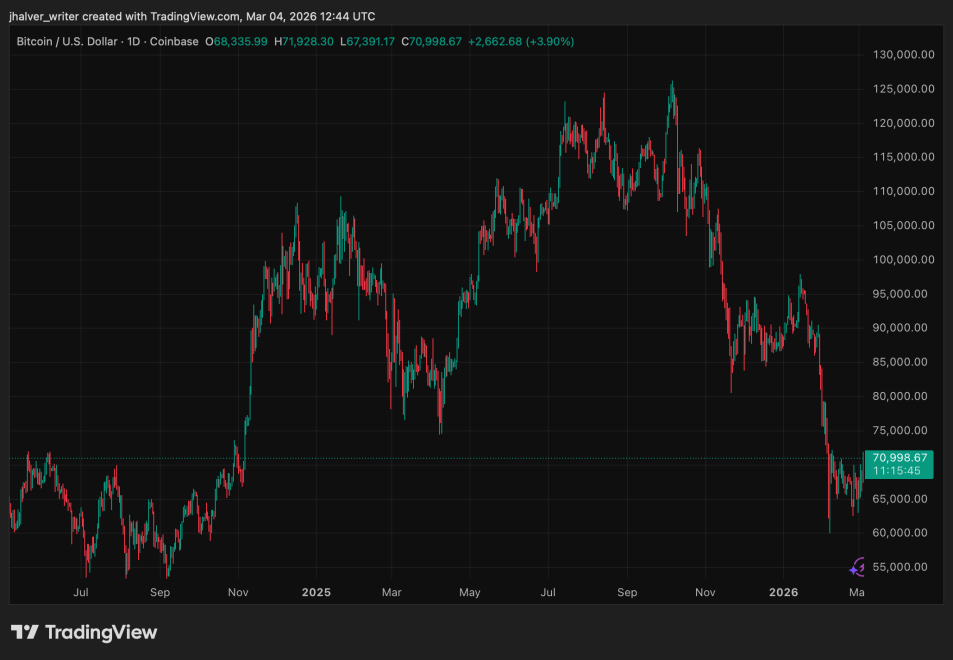
BTC's price trends to the downside on the daily chart. Source: BTCUSD on Tradingview

Cover image from ChatGPT, BTCUSD chart from Tradingview

Domande pertinenti

QWhat is the new ownership cap for major shareholders in South Korean crypto exchanges, and what was the implementation delay agreed upon?

AThe new ownership cap for major shareholders in South Korean crypto exchanges is 20%, with a three-year implementation grace period.

QWhich two major South Korean crypto exchanges, which dominate the market, were given a three-year grace period to comply with the new stake limit?

AUpbit and Bithumb, which together command roughly 90% of the domestic market, were given a three-year grace period.

QHow does the grace period for smaller exchanges like Coinone and Korbit differ from that of the major ones?

ASmaller exchanges that do not meet the 20% market-share bar will be granted an additional three-year grace period, giving them up to six years in total to comply.

QWhat is the exception to the ownership cap, and what specific power does it grant to qualified new investors?

AAn exception allows stakes of up to 34% for new businesses (not existing exchanges), which mirrors the Commercial Act's 33.3% veto line, giving qualified new investors blocking power in shareholders' meetings.

QInto what larger legislative package will the ownership cap be incorporated, and what is a major obstacle to its passage?

AThe ownership cap will be folded into the broader Digital Assets Basic Act. A major obstacle to its passage is opposition from some lawmakers and the opposition party who object to the strict limits on major shareholder stakes.

Letture associate

TechFlow Intelligence Agency: Anthropic Calls for Global Pause in AI Development While Preparing for Trillion-Dollar IPO; SpaceX IPO Roadshow Heats Up, But S&P 500 Rejects Fast-Track Inclusion

In today's TechFlow Intelligence Briefing, several major tech stories highlight a growing theme of trust and credibility gaps across AI, crypto, and finance. AI company Anthropic has publicly called for a global pause in AI development, citing risks from Claude's "recursive self-improvement." Ironically, this coincides with reports the company is preparing for a massive IPO targeting a near $1 trillion valuation. This perceived hypocrisy, coupled with widespread user complaints about Claude's declining performance, is sparking debate over whether the safety warning is genuine or a competitive tactic. Meanwhile, in a substantive security move, Anthropic open-sourced a framework for AI-powered vulnerability discovery. In the crypto market, Bitcoin's price drop below $61,000 triggered over $1.16 billion in liquidations, flipping the market into a state where more BTC is held at a loss than at a profit, a historical bearish signal. On the corporate front, SpaceX's highly anticipated IPO is generating immense Wall Street excitement, with Goldman Sachs projecting 100x revenue growth by 2030. However, the S&P 500 has refused to fast-track the company's inclusion post-IPO, potentially limiting immediate institutional demand. Separately, ByteDance's AI app Doubao lost over 6 million monthly active users after introducing a subscription model, highlighting the challenges of AI monetization. Other notable developments include Nvidia certifying HBM4 memory from Samsung, SK Hynix, and Micron; Cloudflare's acquisition of front-end tooling company VoidZero; and its CEO warning that bot traffic now exceeds human traffic online. The underlying narrative connects these events: a trust crisis. From AI firms' contradictory actions and crypto volatility to the clash between SpaceX's hyped narrative and institutional rules, a pattern is emerging where stated intentions and actual practices are increasingly misaligned.

marsbit7 min fa

TechFlow Intelligence Agency: Anthropic Calls for Global Pause in AI Development While Preparing for Trillion-Dollar IPO; SpaceX IPO Roadshow Heats Up, But S&P 500 Rejects Fast-Track Inclusion

marsbit7 min fa

Dalio Warns: AI Boom Shows Signs of a Bubble, Day of Reckoning Will Be the Time of Burst

Ray Dalio, founder of Bridgewater Associates, warns that the current artificial intelligence investment boom shows classic signs of a bubble, which he expects will eventually burst. In a Bloomberg Television interview, he noted that great technological revolutions often lead to capital inflows that create bubbles, making it difficult for investors and companies to calibrate their spending accurately—either overspending to capture market share or underspending and losing their competitive position. This caution comes amid significant rallies in AI-related assets, particularly chipmakers, driven by soaring demand for data centers and high-bandwidth chips, raising debates about overheating valuations. In contrast, Nvidia CEO Jensen Huang recently asserted that investors embracing the AI wave would see "crazy" returns and dismissed concerns over return on investment for data center spending as outdated. Dalio, however, focuses on the risks in the profit realization phase. He argues that bubbles tend to show signs of破裂 when markets transition from investment to the need for tangible returns, describing the burst as a process of converting paper wealth into cash. While acknowledging AI's intrinsic value, he expressed concern over the future profitability of some AI companies, suggesting the market is repeating a familiar pattern. The 76-year-old billionaire, who fully exited Bridgewater in 2025, has a net worth estimated at $21.5 billion according to the Bloomberg Billionaires Index.

marsbit42 min fa

Dalio Warns: AI Boom Shows Signs of a Bubble, Day of Reckoning Will Be the Time of Burst

marsbit42 min fa

Privacy Coin Crisis of Confidence! ZEC Plunges Over 56% in a Single Day

Zcash (ZEC), a leading privacy-focused cryptocurrency, experienced a severe crash on June 5th, plummeting over 56% in a single day and erasing nearly two months of gains. The flash crash was triggered by the disclosure of a critical zero-knowledge proof vulnerability within Zcash's Orchard privacy pool, which had existed since the pool's launch in May 2022. The flaw theoretically allowed an attacker to forge unlimited ZEC undetectably due to the pool's privacy features. The vulnerability was discovered on May 29th by independent security researcher Taylor Hornby during a proactive audit commissioned by Shielded Labs, utilizing AI-assisted analysis. The Zcash development team responded swiftly, implementing an emergency soft fork to disable Orchard transactions on June 2nd and executing a permanent hard fork fix (NU6.2) on June 3rd. Despite the technical fix, a major crisis of confidence emerged. The core issue is that Orchard's privacy design makes it cryptographically impossible to prove whether the vulnerability was exploited over the past four years, casting permanent doubt on the historical supply integrity of ZEC. While Shielded Labs argues exploitation was unlikely, the inability to provide definitive proof has severely damaged market trust. This sentiment was exacerbated when BitMEX co-founder Arthur Hayes, a prominent ZEC supporter, announced he was selling his entire position. He stated that privacy assets require "perfect security" rather than "probable safety." The combined effect of the disclosure and Hayes's exit ignited widespread panic selling, leading to massive liquidations and significant price decline. Analysts note the event highlights a fundamental tension within privacy coins: the conflict between verifiable supply and cryptographic privacy.

链捕手44 min fa

Privacy Coin Crisis of Confidence! ZEC Plunges Over 56% in a Single Day

链捕手44 min fa

Trading

Spot
Futures

Articoli Popolari

Come comprare BAN

Benvenuto in HTX.com! Abbiamo reso l'acquisto di Comedian (BAN) semplice e conveniente. Segui la nostra guida passo passo per intraprendere il tuo viaggio nel mondo delle criptovalute.Step 1: Crea il tuo Account HTXUsa la tua email o numero di telefono per registrarti il tuo account gratuito su HTX. Vivi un'esperienza facile e sblocca tutte le funzionalità,Crea il mio accountStep 2: Vai in Acquista crypto e seleziona il tuo metodo di pagamentoCarta di credito/debito: utilizza la tua Visa o Mastercard per acquistare immediatamente ComedianBAN.Bilancio: Usa i fondi dal bilancio del tuo account HTX per fare trading senza problemi.Terze parti: abbiamo aggiunto metodi di pagamento molto utilizzati come Google Pay e Apple Pay per maggiore comodità.P2P: Fai trading direttamente con altri utenti HTX.Over-the-Counter (OTC): Offriamo servizi su misura e tassi di cambio competitivi per i trader.Step 3: Conserva Comedian (BAN)Dopo aver acquistato Comedian (BAN), conserva nel tuo account HTX. In alternativa, puoi inviare tramite trasferimento blockchain o scambiare per altre criptovalute.Step 4: Scambia Comedian (BAN)Scambia facilmente Comedian (BAN) nel mercato spot di HTX. Accedi al tuo account, seleziona la tua coppia di trading, esegui le tue operazioni e monitora in tempo reale. Offriamo un'esperienza user-friendly sia per chi ha appena iniziato che per i trader più esperti.

500 Totale visualizzazioniPubblicato il 2024.12.11Aggiornato il 2026.06.02

Come comprare BAN

Discussioni

Benvenuto nella Community HTX. Qui puoi rimanere informato sugli ultimi sviluppi della piattaforma e accedere ad approfondimenti esperti sul mercato. Le opinioni degli utenti sul prezzo di BAN BAN sono presentate come di seguito.

活动图片