KITE under pressure: 1.8B supply meets falling demand and rising shorts

ambcryptoPubblicato 2026-03-27Pubblicato ultima volta 2026-03-27

Introduzione

KITE remains in a bearish phase with weakening fundamentals and negative market sentiment. The number of holders has declined from 105,420 to 104,780 since March 24, while market capitalization dropped by $57 million. Despite a high circulating supply of 1.8 billion tokens, demand is shrinking. The price fell 11% in 24 hours, with rising volume indicating strong bearish momentum. Perpetual traders are increasing short exposure, pushing the funding rate to a deeply negative -1.2420%, similar to levels preceding a previous sharp decline. Liquidity analysis suggests a potential drop toward $0.175, with further downside risk likely due to persistent selling pressure and dominant short positioning.

Kite [KITE] remains in a bearish phase as market sentiment continues to weaken. The recent decline reflects underlying structural shifts that could push prices lower in the near term.

Perpetual traders are capitalizing on this trend, increasing short exposure in ways that may exert additional downward pressure in upcoming trading sessions.

KITE fundamentals weaken as holder count drops

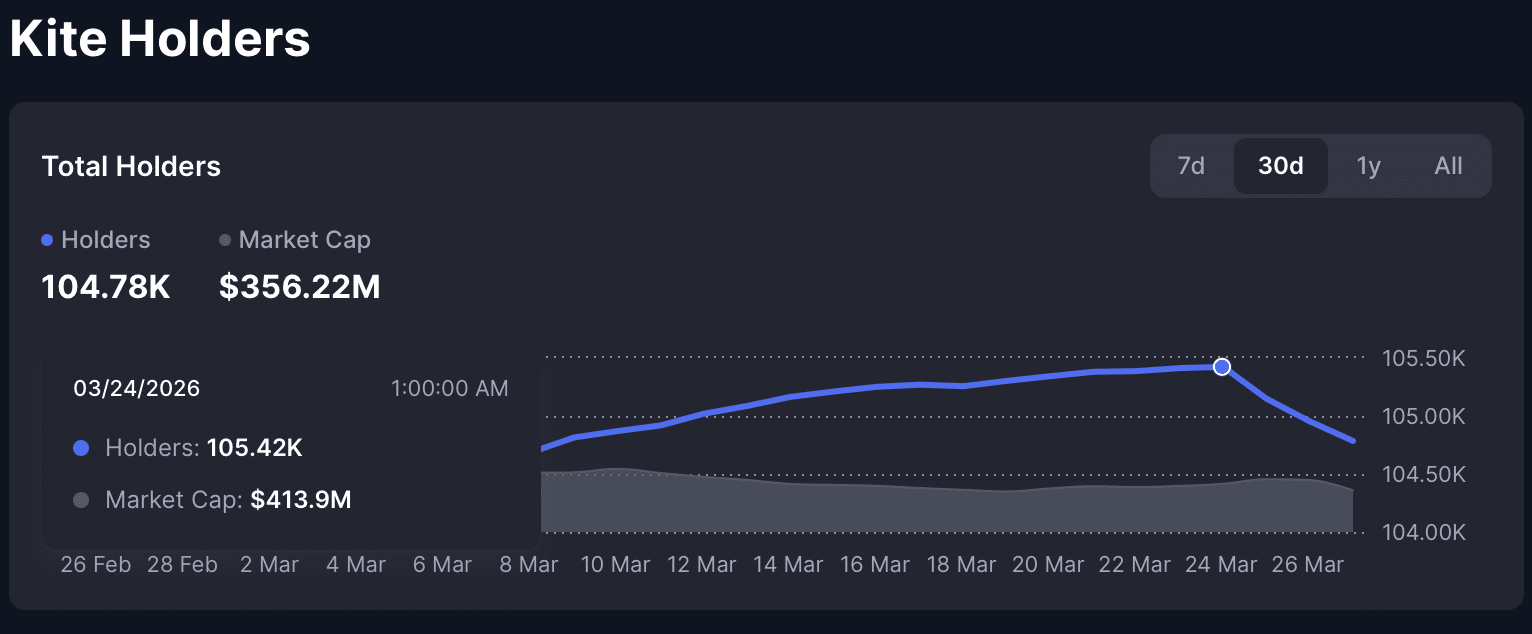
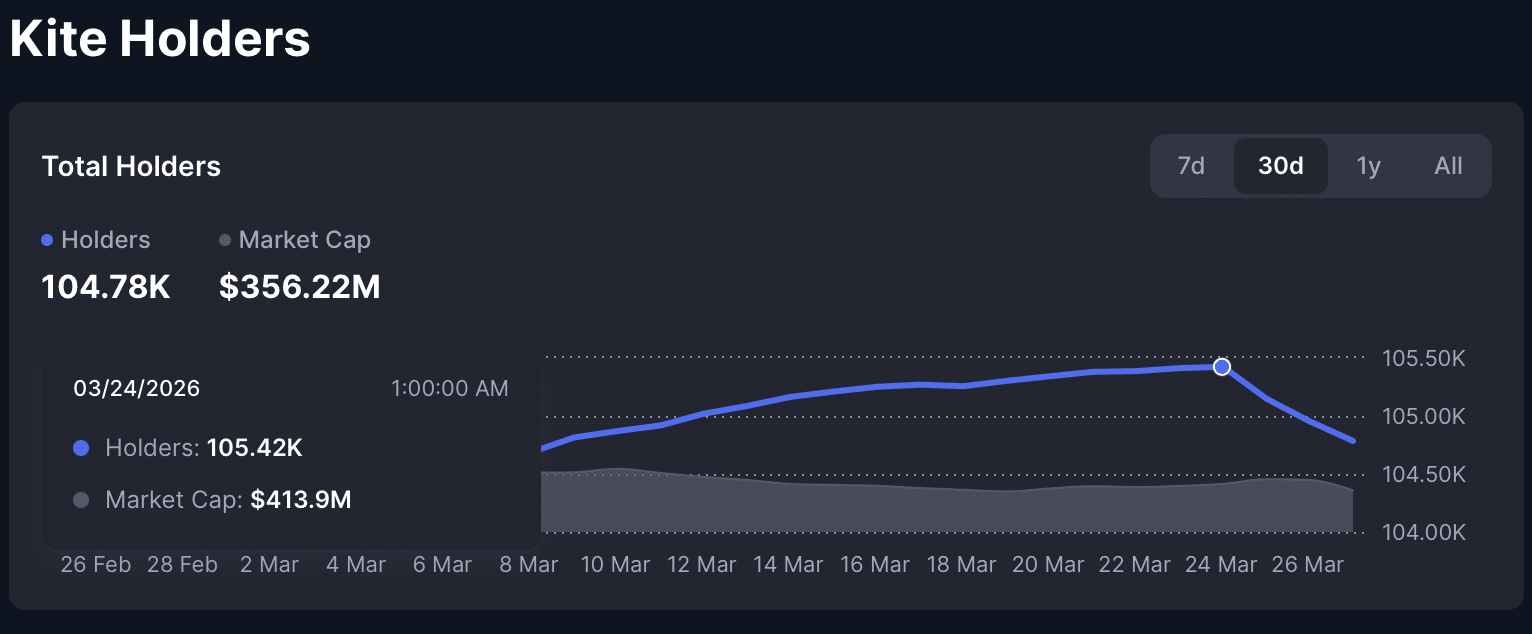
A key driver behind KITE’s recent decline lies in deteriorating fundamentals. The number of holders has dropped sharply after peaking at 105,420 on the 24th of March, when market capitalization reached $413.9 million.

At press time, the holder count has fallen to 104,780, while market capitalization has declined by $57 million, according to CoinMarketCap.
Source: CoinMarketCap

Despite the drop in participation, KITE’s circulating supply remains elevated at 1.8 billion tokens. This imbalance between supply and shrinking holder demand continues to weigh on sentiment.

At the same time, price action has weakened, with KITE posting a double-digit loss of 11% over the past 24 hours as of writing. Trading volume, however, has increased. Historically, rising volume alongside falling prices signals strong bearish momentum, suggesting the downtrend may extend.

Perpetual market signals growing short dominance

The perpetual futures market adds further downside risk.

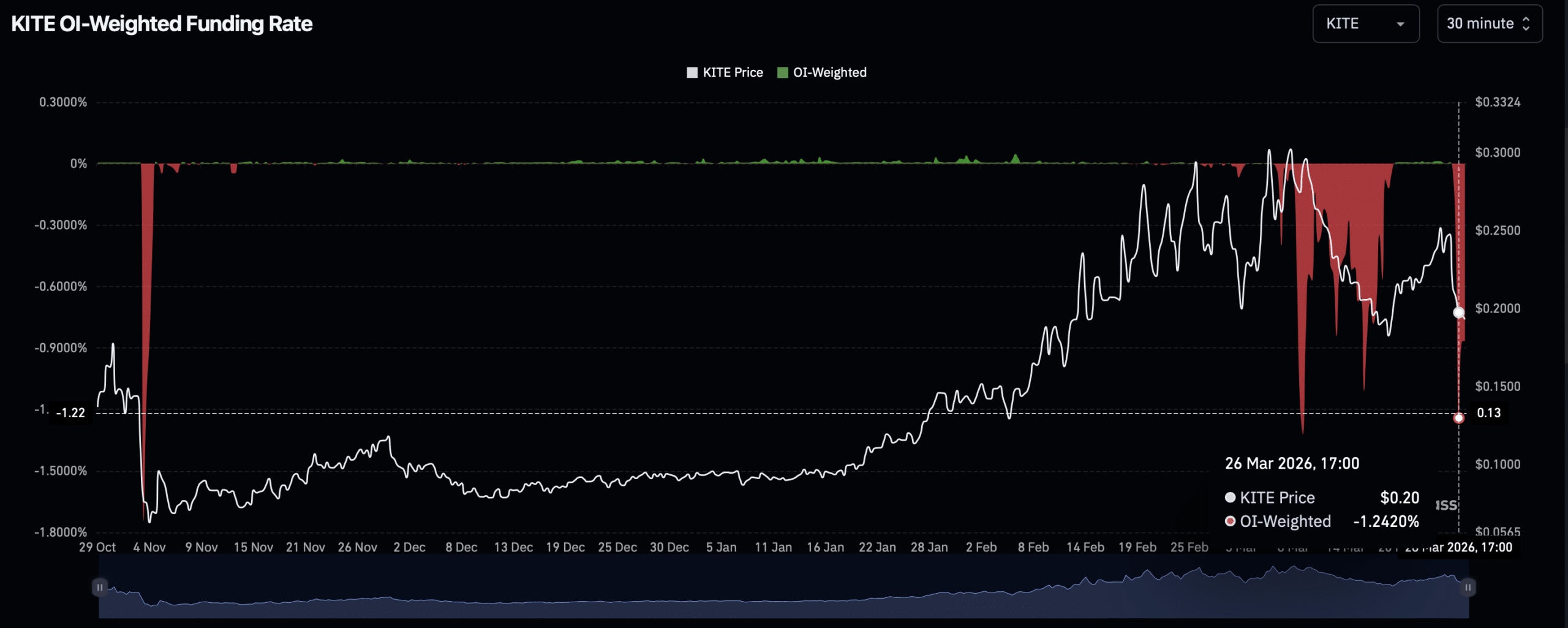
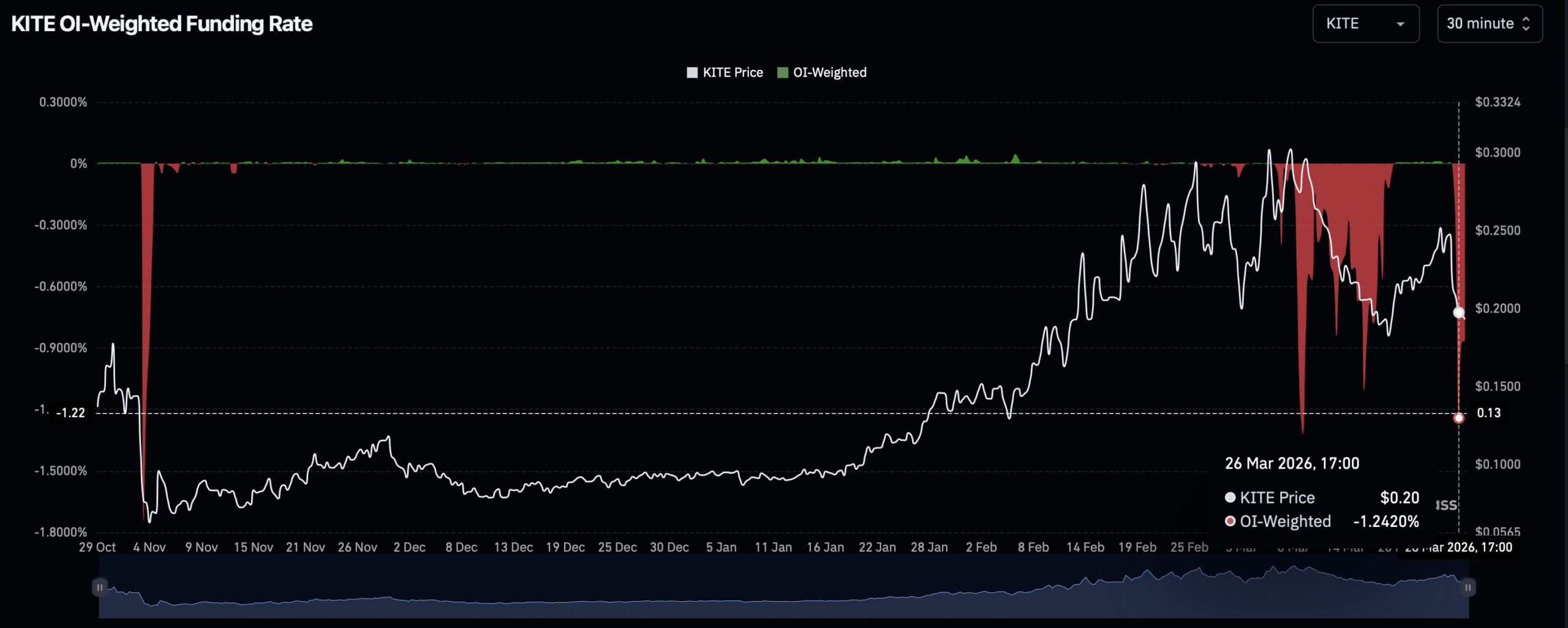
Short traders have increased their dominance across KITE contracts. Over the past 24 hours, the Open Interest Weighted Funding Rate, which measures whether longs or shorts control the market, has turned sharply negative, at press time, reinforcing bearish sentiment.

The Funding Rate dropped to -1.2420%, the steepest drop since the 9th of March. On the 19th of March, a similar decline occurred, resulting in a sharp price drop from $0.29 to $0.18, indicating potential downside pressure.
Source: CoinGlass

Notably, capital inflows into the perpetual market have risen even as short positioning intensifies. Open Interest has increased by nearly 1% to $50.54 million, suggesting that traders are adding liquidity primarily to build short exposure.

Liquidity points to further downside risk

Liquidity data indicates that KITE may still have room to decline.

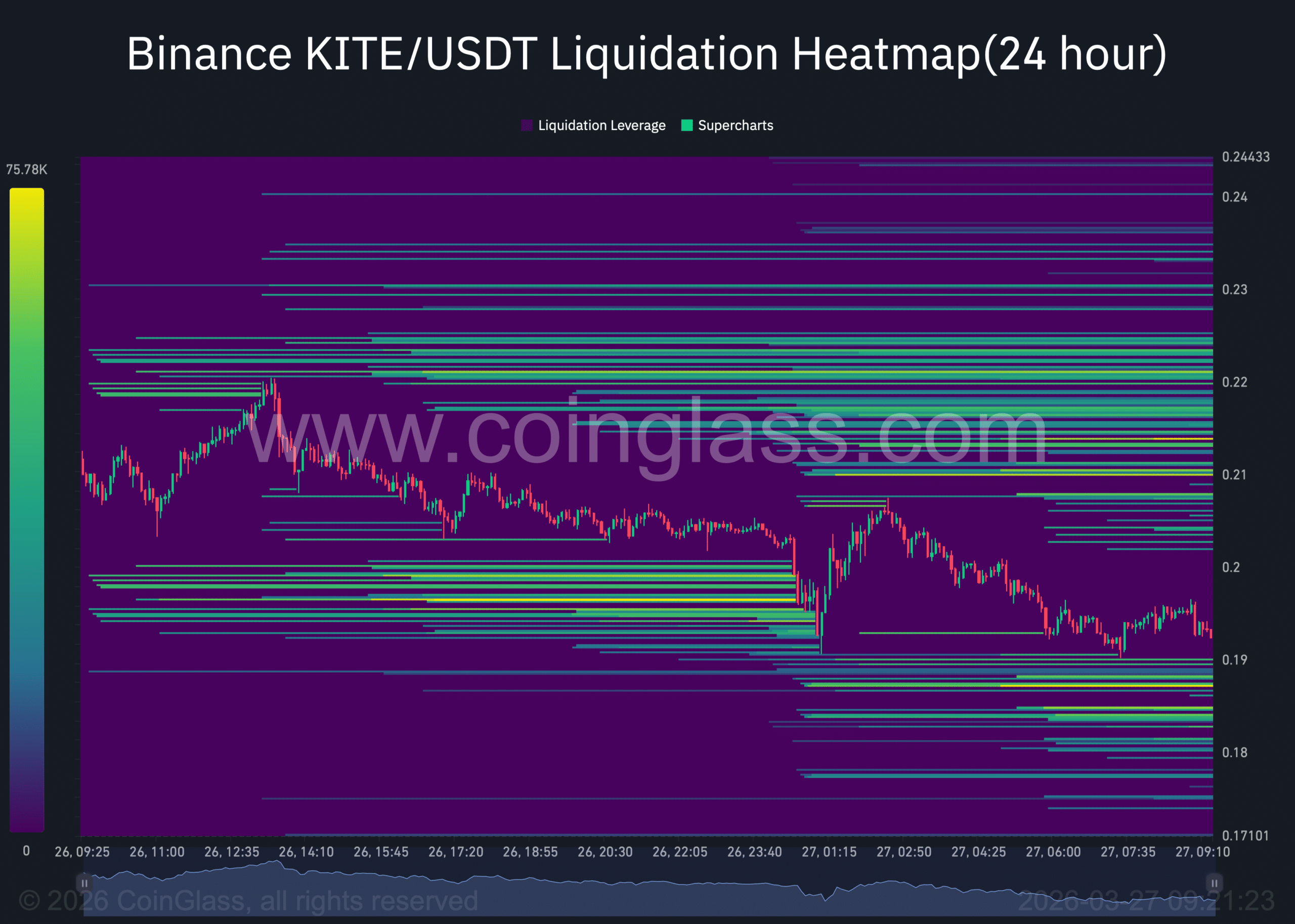
Current liquidity clusters indicate a potential move toward $0.175, where a concentration of unfilled orders exists. With minimal liquidity below this level, price may gravitate toward this zone in the short term.
Source: CoinGlass

If KITE stabilizes and rebounds from this region, it could target a recovery toward the $0.23–$0.24 range. However, given the prevailing bearish momentum and increasing short pressure, the probability of further downside remains higher for now.


Final Summary

  • KITE’s holder count continues to decline after reaching an all-time high on March 24, coinciding with a $57 million drop in market capitalization.
  • Perpetual traders are reinforcing the downtrend, with short contracts rising to levels last seen weeks ago.


Domande pertinenti

QWhat is the main reason behind KITE's recent price decline according to the article?

AThe main reason is deteriorating fundamentals, including a sharp drop in holder count and an imbalance between the elevated circulating supply of 1.8 billion tokens and shrinking holder demand.

QHow has the number of KITE holders changed since its peak on March 24th?

AThe holder count has dropped from a peak of 105,420 on March 24th to 104,780 at the time of writing.

QWhat does the negative Open Interest Weighted Funding Rate indicate for the perpetual futures market?

AA sharply negative funding rate of -1.2420% indicates that short traders are dominant and paying long traders, reinforcing bearish sentiment in the market.

QWhat price level does liquidity data suggest KITE gravitate towards in the short term?

ALiquidity data suggests a potential move toward $0.175, where a concentration of unfilled orders exists.

QWhat was the percentage loss in KITE's price over the 24 hours preceding the article?

AKITE posted a double-digit loss of 11% over the past 24 hours as of writing.

Letture associate

Former Bankless Member Lucas: Why I Still Bullish on Ethereum

Former Bankless member Lucas explains why he remains bullish on Ethereum despite widespread pessimism. He acknowledges ETH's poor price performance over the past five years compared to Bitcoin and traditional markets, but draws parallels to historical multi-year consolidations seen in tech giants like Amazon and NVIDIA before major breakouts. Fundamentally, Ethereum is stronger than ever: record-high daily transactions (2.27 million in May 2026), significantly lower average gas fees ($0.27), over 400 million total addresses, and more than 32% of ETH staked, securing the network. Lucas's core thesis remains unchanged: all valuable assets will eventually be tokenized, Ethereum will become the primary settlement layer for these assets, and ETH will capture the resulting value. This transition is already underway. Stablecoins, the first proven tokenized real-world asset (RWA), have a $300+ billion market cap, with 54% settled on Ethereum. The broader RWA sector has surpassed $30 billion, with over 53% deployed on Ethereum. He compares the current RWA adoption phase to early DeFi in 2019-20, suggesting immense growth potential. Key catalysts like the potential passage of the U.S. CLARITY Act in 2026 could accelerate institutional adoption. While other blockchains will share the market, Lucas argues that traditional finance prioritizes Ethereum's security, stability, and established ecosystem for trillion-dollar asset tokenization. He concludes that as global assets migrate on-chain, the market will reprice ETH accordingly.

foresightnews_api5 min fa

Former Bankless Member Lucas: Why I Still Bullish on Ethereum

foresightnews_api5 min fa

Trump's 'Bitcoin Retirement Plan' Hits Roadblock: Democrats Claim It Endangers American Workers' Pensions?

Democratic Senators Bernie Sanders (I-VT) and Elizabeth Warren (D-MA), along with Rep. Bobby Scott (D-VA), are urging the Labor Department to repeal a proposed rule that would open U.S. retirement savings accounts, like 401(k) plans, to investments in Bitcoin and other cryptocurrencies. In a letter to Acting Labor Secretary Keith Sonderling, they argue the rule would endanger workers' financial futures and contradicts long-standing legal precedents under the Employee Retirement Income Security Act (ERISA). The rule, stemming from a Trump executive order, would shift the legal standard for plan fiduciaries. Instead of requiring them to prove they conducted due diligence on volatile assets, it would presume prudence if they followed a specified process. The lawmakers warn this exposes the $14.2 trillion in 401(k) savings to highly volatile and less-regulated assets, citing FINRA warnings on crypto's risks and FBI data on massive crypto scam losses. The letter also alleges a conflict of interest, noting that President Trump's adult children manage the family's crypto business, which has raised billions. They claim the rule could allow the Trump family to profit at the expense of workers and retirees. Consumer advocates echo concerns that it could turn retirement savings into a lifeline for a risky industry. The Trump administration defends the rule as expanding worker choice, with officials stating it ends the department "picking winners and losers" and requires fiduciaries to follow a prudent process.

foresightnews_api8 min fa

Trump's 'Bitcoin Retirement Plan' Hits Roadblock: Democrats Claim It Endangers American Workers' Pensions?

foresightnews_api8 min fa

Rules Change Mid-Game, Polymarket’s Billion-Dollar Bitcoin Prediction Market Mired in Settlement Controversy

A nearly $150 million prediction market contract on Polymarket is in turmoil after the platform refused to settle in favor of traders who correctly predicted that MicroStrategy (now Strategy) would sell Bitcoin. The core dispute revolves around a sale of 32 BTC, which occurred between May 26-31 but was officially disclosed in an SEC 8-K filing on June 1. The original contract stated it would resolve to "Yes" if Strategy sold any Bitcoin before May 31, 11:59 PM ET, using public disclosures and on-chain data as proof. After the filing on June 1, traders who saw the disclosure rushed to buy "Yes" contracts, believing it was conclusive evidence. However, Polymarket's operators later added a rule that the disclosure itself must occur by the deadline, not just the transaction, invalidating the filing as proof. This retroactive rule change has sparked accusations of market manipulation, leaving traders like "willo2," who invested $527,000, facing total losses. The controversy highlights a deeper structural flaw in Polymarket's decentralized settlement system, which relies on UMA's optimistic oracle. Disputed resolutions are ultimately decided by a vote among UMA token holders, a mechanism critics say is vulnerable to manipulation by large holders ("whales") who can vote in their own financial interest rather than on objective facts. Data suggests a high concentration of voting power and significant overlap between voters and Polymarket traders. The dispute emerges as prediction markets like Polymarket and Kalshi are experiencing massive growth and seeking mainstream financial legitimacy, having recently secured regulatory approval from the U.S. CFTC. However, the incident underscores the unresolved tension between decentralized, token-vote-based settlement and the need for transparent, rules-based outcomes in high-stakes financial contracts.

foresightnews_api11 min fa

Rules Change Mid-Game, Polymarket’s Billion-Dollar Bitcoin Prediction Market Mired in Settlement Controversy

foresightnews_api11 min fa

Ethereum Foundation Researcher: Quantum Day Is Approaching, Plans to Complete Quantum-Resistant Migration by 2029

Ethereum Foundation researcher Justin Drake discusses the implications of a recent quantum computing breakthrough by Google’s quantum AI team, which demonstrated a 10x efficiency improvement in Shor’s algorithm against the secp256k1 elliptic curve used in Bitcoin and Ethereum. Notably, Google kept key algorithmic details confidential, using zero-knowledge proofs to verify the result without disclosure—a first in academia. Shortly after, the core optimization was independently reproduced, and an open-source competition (ecdsa.fail) emerged, further improving the algorithm by 8.4%. Meanwhile, startup Oratomic published research suggesting that neutral-atom quantum architectures could break secp256k1 with only 10,000 physical qubits, accelerating the timeline for "Q-Day"—the day quantum computers can break widely used cryptography. Drake estimates a 50% probability of Q-Day by 2032 and a 10% chance by 2030, contrasting with the U.S. government’s more conservative 2035 forecast. He warns against panic but stresses timely migration to post-quantum cryptography. Ethereum plans to complete its migration by 2029, covering consensus, data, and execution layers with hash-based systems. The Foundation is also developing leanVM, a formally verifiable zkVM, and has launched two $1 million initiatives to advance SNARK-friendly cryptography.

foresightnews_api12 min fa

Ethereum Foundation Researcher: Quantum Day Is Approaching, Plans to Complete Quantum-Resistant Migration by 2029

foresightnews_api12 min fa

Trading

Spot
Futures
活动图片