Kelp DAO Hack: Aave DAO Proposes To Contribute 25,000 ETH To Recovery Efforts

bitcoinistPubblicato 2026-04-25Pubblicato ultima volta 2026-04-25

Introduzione

Aave DAO has proposed contributing 25,000 ETH from its treasury to a coordinated recovery effort following a major exploit on Kelp DAO. The attack, which occurred on April 18, targeted Kelp's rsETH Ethereum LayerZero adapter, resulting in a loss of approximately 163,183 ETH. Through frozen assets, recovered funds, and expected liquidations, over half the deficit has been covered, but a gap of roughly 75,081 ETH remains. A coalition named "DeFi United," including pledges from EtherFi, Lido, Ethena, and a credit line from Mantle, is mobilizing to restore the system. Aave's anchored contribution is a key part of this effort to reintroduce liquidity and fully back the affected tokens.

Aave DAO has unveiled a proposal to deploy 25,000 ETH from its treasury to support a coordinated recovery effort following the recent Kelp DAO exploit. The move forms part of a broader “DeFi United” initiative aimed at restoring user funds and stabilizing affected lending markets.

On April 18, KelpDAO suffered a major attack targeted at its rsETH Ethereum LayerZero adapter, allowing a hacker to drain assets and break the backing relationship between locked ETH collateral and minted tokens across chains. The breach triggered a cascading liquidity and solvency challenge across DeFi platforms that integrated rsETH and its wrapped variant.

Over $160,000 ETH Gap Remains As Exploit Recovery Efforts Gain Traction

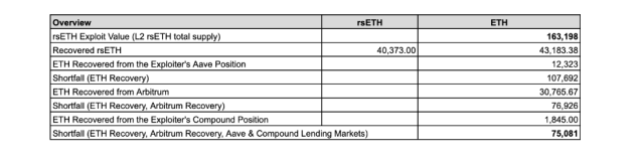
According to the Aave DAO governance proposal, the attacker stole 152,577 rsETH, which is approximately 163,183 ETH based on prevailing conversion rates. Since then, coordinated intervention by ecosystem participants has substantially reduced the gap. Kelp DAO managed to freeze 40,373 rsETH, equivalent to roughly 43,168 ETH. Additionally, the Arbitrum Security Council recovered 30,766 ETH that the attacker still held on its platform.
Source: Aave DAO

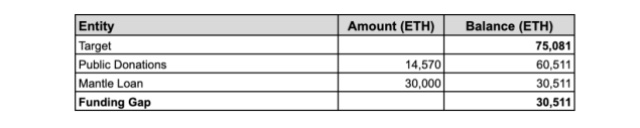
Notably, further recoveries are expected through liquidation processes on lending platforms. The attacker’s positions on Aave could yield up to 12,323 ETH, while an additional 1,845 ETH may be recovered from positions on Compound. In total, these efforts account for approximately 87,955 ETH, i.e, just over half of the original deficit. Despite this progress, a funding gap of roughly 75,081 ETH remains, resulting in a further coordinated capital injection to fully restore backing.

Aave DAO Steps In With 25,000 ETH Commitment As Coalition Mobilizes

To bridge the remaining deficit, the DeFi United coalition is combining donations, credit facilities, and treasury support. So far, ecosystem contributors including EtherFi, Lido, and Ethena have pledged 14,570 ETH, while Mantle has extended a credit facility of up to 30,000 ETH.
Source: Aave DAO

Aave DAO’s proposal to contribute 25,000 ETH represents a cornerstone of this recovery stack. Notably, the contribution is “anchored,” meaning it will not be reduced by future donations. Instead, any additional funds raised will be used to repay borrowed capital, thereby limiting Aave’s long-term exposure.

The plan requires approximately 120,015 ETH (excluding 43,168 ETH immediately frozen by Kelp DAO) to be reintroduced into the LayerZero lockbox to fully restore system integrity. However, a portion of expected recoveries remains illiquid, prompting the need for short-term loan financing from ecosystem partners.

Total crypto market cap valued at $2.57 trillion on the daily chart | Source: TOTAL chart on Tradingview.com

Domande pertinenti

QWhat is the total amount of ETH that was stolen in the Kelp DAO exploit, and what is the remaining funding gap after recovery efforts?

AThe attacker stole 152,577 rsETH, which is approximately 163,183 ETH. After recovery efforts, including frozen funds and liquidations, a funding gap of roughly 75,081 ETH remains.

QWhat is the role of the 'DeFi United' initiative mentioned in the proposal?

AThe 'DeFi United' initiative is a coordinated effort aimed at restoring user funds and stabilizing affected lending markets by combining donations, credit facilities, and treasury support from various ecosystem participants.

QHow much ETH has Aave DAO specifically proposed to contribute, and what is the nature of this contribution?

AAave DAO has proposed to contribute 25,000 ETH from its treasury. This contribution is 'anchored,' meaning it will not be reduced by future donations and any additional funds raised will be used to repay borrowed capital to limit Aave's long-term exposure.

QWhich other major ecosystem participants have pledged support, and what are their contributions?

AEcosystem contributors including EtherFi, Lido, and Ethena have collectively pledged 14,570 ETH. Additionally, Mantle has extended a credit facility of up to 30,000 ETH.

QWhat specific mechanism of the KelpDAO protocol was targeted in the attack on April 18?

AThe attack targeted KelpDAO's rsETH Ethereum LayerZero adapter, which allowed the hacker to drain assets and break the backing relationship between locked ETH collateral and minted tokens across chains.

Letture associate

SpaceX, OpenAI, Anthropic: The Three AI Giants Racing for IPO, Which One Is Worth Betting On?

SpaceX, OpenAI, and Anthropic are poised for historic IPOs within weeks, potentially raising a combined $180 billion—a sum exceeding the entire internet bubble's fundraising. The hosts of the Limitless Podcast argue this isn't just individual company financing but an unprecedented capital concentration for AI infrastructure, driven by an insatiable need for compute, data centers, power, and chips. SpaceX's IPO is notable for reportedly changing market index rules to allow faster inclusion, potentially funneling trillions in passive retirement funds into its stock, despite its unproven space-based data center business model. In contrast, Anthropic demonstrates explosive growth, with ARR reportedly hitting $45 billion and approaching profitability, fueled by strong enterprise adoption of products like Claude Code. Google's separate $80 billion raise highlights the immense capital pressure, even for giants. The discussion acknowledges bubble risks but leans optimistic. The hosts contend the massive spending is building essential physical infrastructure for the next technological era. A key bottleneck isn't capital but the real-world limits of chip manufacturing and construction speed. As long as demand for AI compute outstrips supply, this investment cycle represents a foundational build-out rather than a purely financial bubble. All three companies are seen as foundational bets on the future, with Anthropic often cited as the most immediately compelling due to its proven revenue trajectory.

marsbit2 h fa

SpaceX, OpenAI, Anthropic: The Three AI Giants Racing for IPO, Which One Is Worth Betting On?

marsbit2 h fa

From 'Old Guys' to 'New Favorites': How AI Is Revaluing Old Infrastructure from Dell to Nokia?

From "Vintage Tech" to "New AI Darlings": How AI Revalues Old Infrastructure One year ago, tech giants like Dell, Nokia, Cisco, and Western Data were seen as slow-growth, low-valuation stories, far from the AI spotlight dominated by players like Nvidia. Now, these legacy tech stocks are gaining market attention, sparking debate on whether this is genuine industry revaluation or a temporary narrative. As AI moves from model parameters to real-world data centers, the market is recognizing companies with proven delivery and infrastructure capabilities. This shift marks a change in the AI investment thesis: from pure model and GPU focus to the complex systems engineering required for deployment. Companies like Dell, HPE, and Corning are being revalued not for being "sexy" AI innovators, but for their decades of accumulated expertise in supply chains, enterprise delivery, and infrastructure—assets that have become critical in the AI buildout phase. The revaluation is unfolding across three key infrastructure lines: 1. **Servers & System Integration:** Dell and HPE are emerging as crucial system integrators or "general contractors" for AI data centers, translating GPU orders into complete, deployable server racks integrated with power, cooling, and networking. 2. **Networking & Connectivity:** AI's scale demands robust high-speed connections. Corning (fiber optics), Nokia (AI-RAN, 6G), and Cisco (data center switches) are gaining importance for enabling efficient data transfer within and between AI clusters. 3. **Storage:** Beyond high-speed memory (HBM/DRAM), the AI data explosion is driving demand for high-capacity hard drives (HDDs) from companies like Western Digital and Seagate to handle training data, logs, and cold storage cost-effectively. For this revaluation to be substantive and not just a narrative, three criteria are key: 1) Concrete AI-related order and revenue growth (e.g., Dell's AI server sales), 2) Upward revisions to company financial guidance, and 3) Sustainable improvements in profit quality, not just top-line revenue spikes. In essence, AI's transition to a real construction phase is re-pricing "old assets" against "new demand." The opportunity, however, is selective. Only those legacy firms that are demonstrably integrated into the capital expenditure chains of data center and enterprise AI deployment are likely to experience a true "logic re-rating" rather than just a temporary valuation bounce.

marsbit2 h fa

From 'Old Guys' to 'New Favorites': How AI Is Revaluing Old Infrastructure from Dell to Nokia?

marsbit2 h fa

The Merger of Codex and ChatGPT Marks the Beginning of a Major Reshuffle in Programming Tools

OpenAI is shifting its strategic focus from ChatGPT to Codex, merging them along with the browser tool Atlas into a unified desktop super-app. This move signals an internal belief that Codex, originally a programming tool, represents the next evolution of AI more than conversational models like ChatGPT. Over the past year, Codex's weekly active users have surged past 5 million. The key distinction is that while ChatGPT answers questions, Codex executes tasks. Enterprises increasingly value this ability to get work done over simply receiving advice. Consequently, Codex is attracting professionals beyond developers, including analysts, bankers, marketers, and product managers. OpenAI's reorganization and increased investment in Codex stem from recognizing that the future of AI competition lies in execution capabilities, not just conversation. The company is launching role-specific plugins (e.g., for data analysis, sales, design) to transform Codex into a broad knowledge work platform that automates and redefines white-collar workflows. Beyond being a tool, Codex reflects OpenAI's ambition to redefine software. New features like "Sites"—which generates interactive websites from documents—and collaborative "Annotations" aim to create a paradigm where the AI understands the goal and handles the tools and steps, functioning more like a digital colleague than traditional software. The ultimate goal is a unified experience where the user cares only about the completed task.

marsbit2 h fa

The Merger of Codex and ChatGPT Marks the Beginning of a Major Reshuffle in Programming Tools

marsbit2 h fa

Trading

Spot
Futures

Articoli Popolari

Come comprare DAO

Benvenuto in HTX.com! Abbiamo reso l'acquisto di DAO Maker (DAO) semplice e conveniente. Segui la nostra guida passo passo per intraprendere il tuo viaggio nel mondo delle criptovalute.Step 1: Crea il tuo Account HTXUsa la tua email o numero di telefono per registrarti il tuo account gratuito su HTX. Vivi un'esperienza facile e sblocca tutte le funzionalità,Crea il mio accountStep 2: Vai in Acquista crypto e seleziona il tuo metodo di pagamentoCarta di credito/debito: utilizza la tua Visa o Mastercard per acquistare immediatamente DAO MakerDAO.Bilancio: Usa i fondi dal bilancio del tuo account HTX per fare trading senza problemi.Terze parti: abbiamo aggiunto metodi di pagamento molto utilizzati come Google Pay e Apple Pay per maggiore comodità.P2P: Fai trading direttamente con altri utenti HTX.Over-the-Counter (OTC): Offriamo servizi su misura e tassi di cambio competitivi per i trader.Step 3: Conserva DAO Maker (DAO)Dopo aver acquistato DAO Maker (DAO), conserva nel tuo account HTX. In alternativa, puoi inviare tramite trasferimento blockchain o scambiare per altre criptovalute.Step 4: Scambia DAO Maker (DAO)Scambia facilmente DAO Maker (DAO) nel mercato spot di HTX. Accedi al tuo account, seleziona la tua coppia di trading, esegui le tue operazioni e monitora in tempo reale. Offriamo un'esperienza user-friendly sia per chi ha appena iniziato che per i trader più esperti.

157 Totale visualizzazioniPubblicato il 2024.12.11Aggiornato il 2026.06.02

Come comprare DAO

Discussioni

Benvenuto nella Community HTX. Qui puoi rimanere informato sugli ultimi sviluppi della piattaforma e accedere ad approfondimenti esperti sul mercato. Le opinioni degli utenti sul prezzo di DAO DAO sono presentate come di seguito.

活动图片













