Kalshi Trading Volume Continues to Break Records, What Is the Reasonable Pre-Market Stock Price?

Odaily星球日报Pubblicato 2026-02-11Pubblicato ultima volta 2026-02-11

Introduzione

Amidst a recent market downturn, the prediction market sector has shown remarkable resilience. Kalshi, the largest regulated prediction market platform in the US, reached a record single-month trading volume exceeding $9.5 billion in January, making it the sector leader. This surge has sparked renewed interest in pricing its pre-IPO shares. Significant price discrepancies exist across different pre-IPO trading platforms. On PreStocks, Kalshi shares are priced between $364 and $369. On Jarsy, the price is notably higher at around $504. In contrast, traditional private markets like Nasdaq Private Market and Hiive list shares at approximately $320 and $358, respectively. The analysis suggests a reasonable pre-IPO share price range for Kalshi is between $320 and $423. This is based on its last private funding round valuation of $11 billion and an estimated implied valuation of at least $15 billion, supported by its surging trading volume which now nearly equals the entire prediction market's size from October of the previous year. The article concludes that Jarsy's current price appears high, while PreStocks may present a potential arbitrage opportunity. Furthermore, with 2026 being a major year for global sporting events, Kalshi's annual revenue potential is seen as substantial, potentially exceeding estimates for competitor Polymarket, which could lead to further increases in its pre-IPO valuation.

Original|Odaily Planet Daily(@OdailyChina)

Author|Wenser(@wenser 2010)

During the market downturn, the prediction market has become the most eye-catching track in the crypto market. In early February, when the market plummeted, BTC and ETH once fell by more than 10%, but prediction market trading remained active, with weekly transactions reaching 26.39 million, a record high. At the same time, as the largest compliant prediction market platform in the United States, Kalshi also surged to the top of the track with over $9.5 billion in trading volume in January this year, setting a new historical high for monthly trading volume. Following this, the market has initiated a new round of pricing for Kalshi's pre-market stock price.

The question we are discussing today is—what should the reasonable price range be for the pre-market stock of Kalshi, which is expected to become the "first stock in the prediction market"?

Overview of Current Pricing on Tokenized Stock Trading Platforms: PreStocks, Jarsy

As of the time of writing, there is a significant price difference for Kalshi's pre-market stock on two major tokenized stock trading platforms:

On the PreStocks platform, Kalshi's pre-market stock pricing includes two prices—

One price is the token price under the implied market capitalization (market liquidity pricing level), with a per-share price of approximately $369;

The other price is the marked price under the capital market capitalization (existing financing pricing level), with a per-share price of approximately $364.
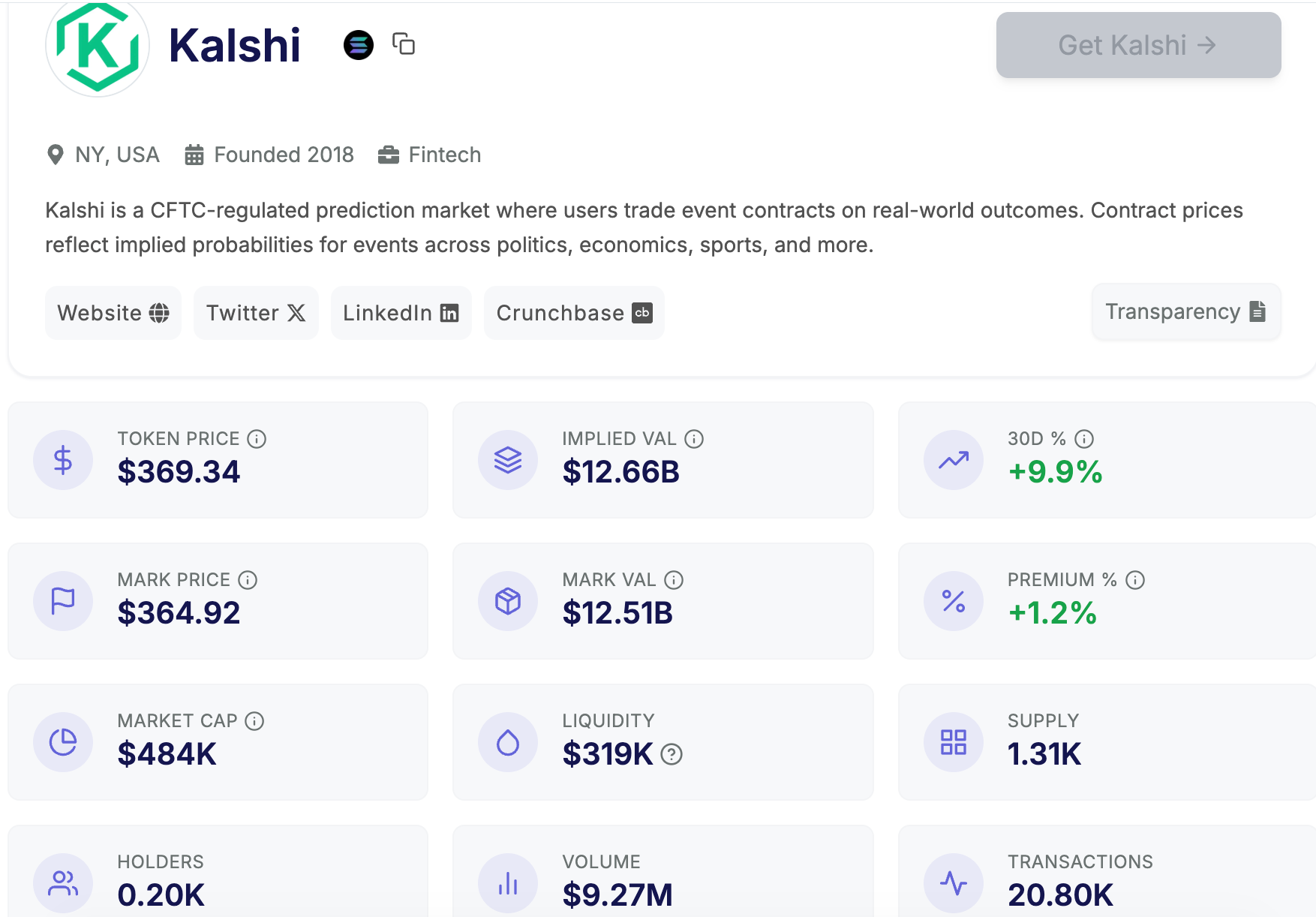
On the Jarsy platform, Kalshi's pre-market per-share price has risen to approximately $504.

It is worth mentioning that compared to the time when we previously wrote the article "Kalshi's Pre-Market Stock Price Soars, Is It Still Worth Buying Now?", the pre-market prices of Kalshi stock on both platforms have experienced varying degrees of increases and decreases. The price situation at that time was as follows:

  • On PreStocks, Kalshi's implied market capitalization was approximately $14 billion, with a per-share price of about $407;
  • On Jarsy, Kalshi's market valuation was $11 billion, with a per-share price of $450.

In other words, the price on the PreStocks platform fell from $407 to approximately $369; the price on the Jarsy platform rose from $450 to approximately $504.

For comparison, the pre-market pricing for Kalshi stock in traditional financial markets has also changed—

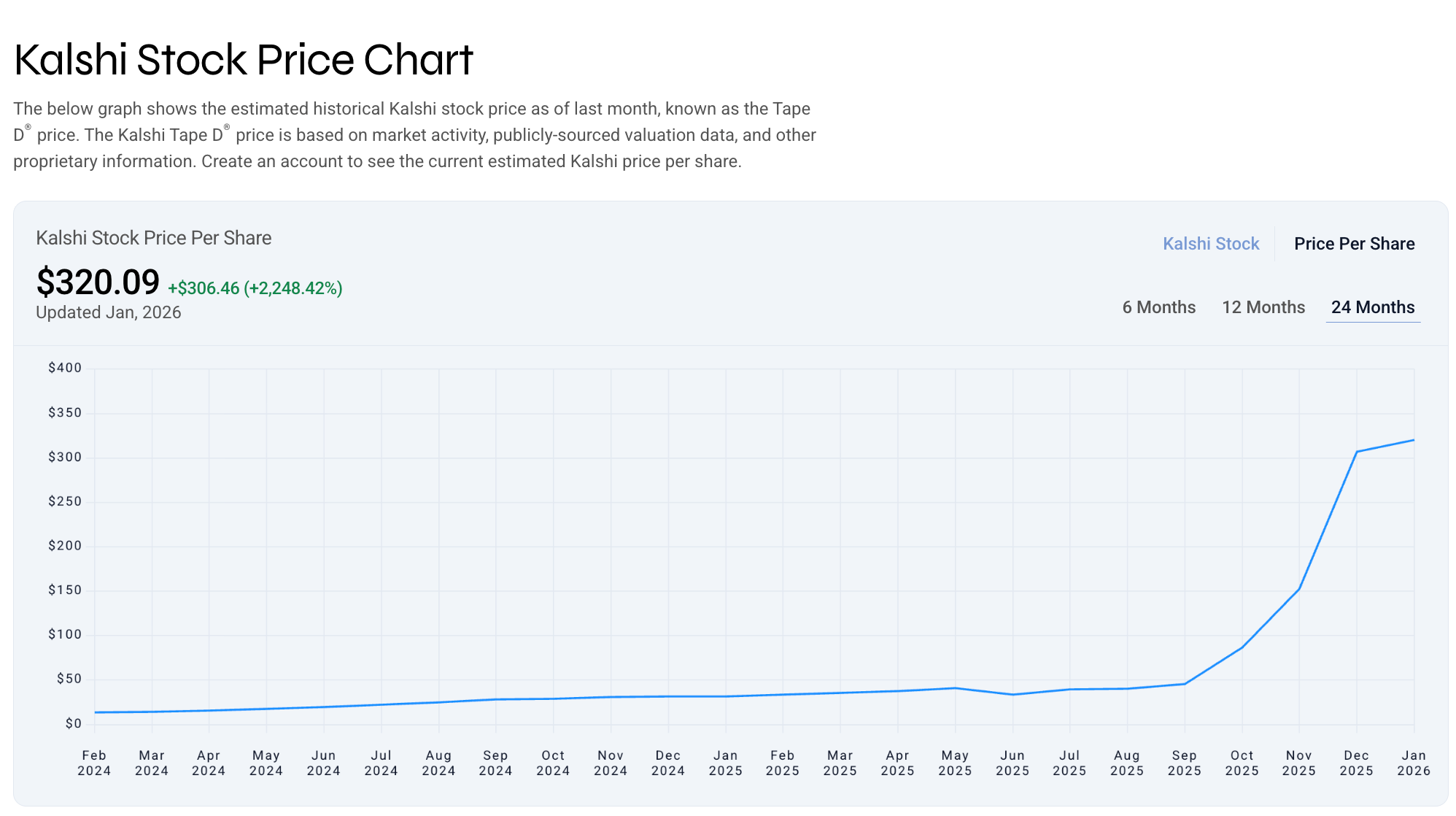
  • On Nasdaq Private Market, Kalshi's per-share price rose from approximately $307 to around $320;
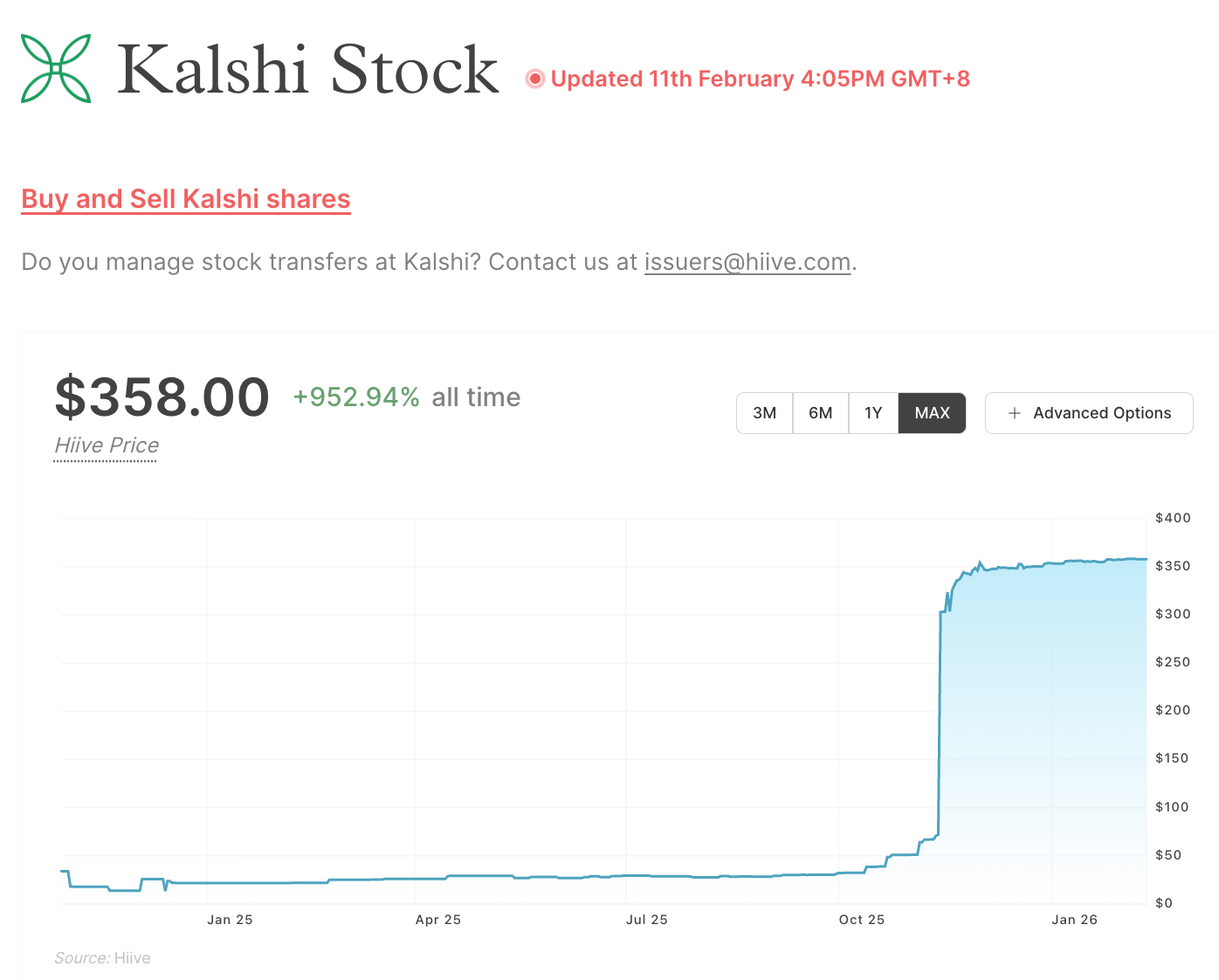
  • On Hiive, Kalshi's per-share price rose by $1 from approximately $357 to around $358.
Reasonable Pre-Market Pricing Range for Kalshi Stock: Approximately $320~$423

Last year, Kalshi completed a $1 billion Series E financing round with a valuation of $11 billion.

Based on the market capitalizations and corresponding stock prices mentioned above, the number of Kalshi shares is approximately between 30.72 million and 34.30 million.

Specifically, the number of shares is calculated as follows—
Based on a $11 billion valuation corresponding to the traditional financial market pre-market prices of $320 and $358, the number of Kalshi shares is approximately 30.72 million to 34.37 million;
Based on the implied market capitalization/token price and capital market capitalization/marked price on the PreStocks platform, the number of Kalshi shares is approximately 34.27 million to 34.30 million;
Based on the pre-market purchase price per share on the Jarsy platform, Kalshi's market capitalization tops out at $18.665 billion, with a per-share price of $604.84, and the number of shares is approximately 30.86 million.

Based on the above information, we can make the following deductions:

First, based on the $11 billion valuation, the reasonable pre-market pricing range for Kalshi stock is approximately $320-$358. In other words, the current pricing on crypto market tokenized stock trading platforms such as PreStocks and Jarsy is relatively high;

Second, Kalshi's trading volume in January reached $9.5 billion, close to the overall prediction market size of approximately $10 billion in October last year; in October last year, its market share was about 50% of the prediction market. From this perspective, Kalshi's current capital market valuation is at least above $15 billion.

Third, based on a $15 billion valuation and combined with data such as the range of the number of Kalshi shares, the pre-market pricing range for Kalshi stock is approximately $436~$488.

Therefore, if the number of Kalshi shares meets expectations, and under the premise of a $15 billion implied market capitalization, conservatively estimated, the reasonable pre-market pricing range for Kalshi stock might be $320~$378 (calculated based on the average of the lowest prices in the pricing range); optimistically estimated, the reasonable pre-market pricing range for Kalshi stock might be $358~$423 (calculated based on the average of the highest prices in the pricing range).

Based on the above data conclusions, the pre-market pricing for Kalshi stock on the Jarsy platform is relatively high, while the PreStocks platform offers some arbitrage opportunities.

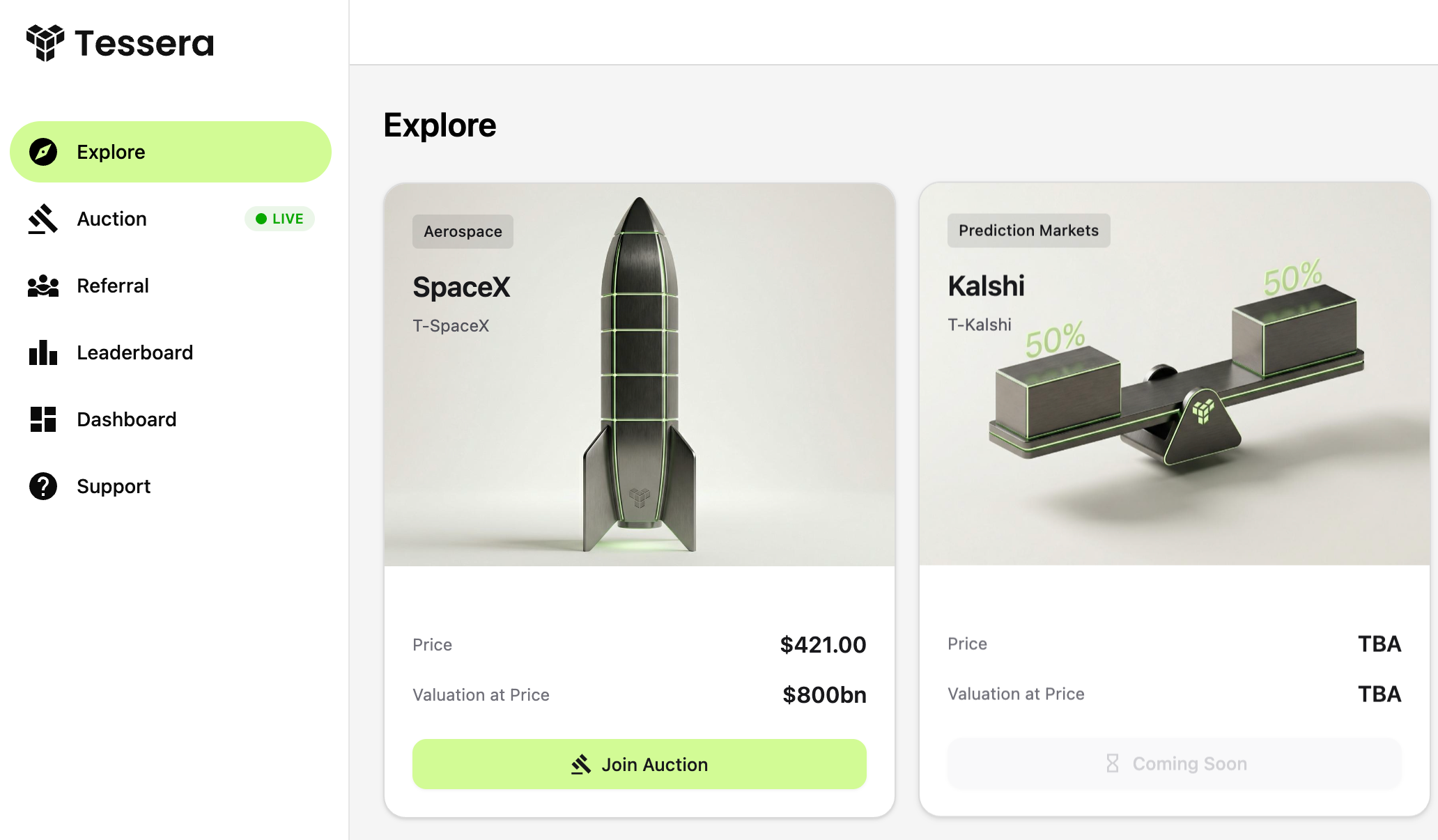
In addition, the latest tokenized stock trading platform, Tessera, plans to open equity public offerings in the future, which readers can also consider as an alternative reference (invitation code can be found here).
Combined with the relevant information mentioned in the previously published article by Odaily Planet Daily, "Data Calculation Shows Polymarket's Annual Revenue Exceeding 100 Million Is Not Difficult, Provided That...":

Based on a static calculation of the trading volume and fee ratio in the "15-minute cryptocurrency rise and fall" market on Polymarket, under the current trading volume level and structure, if Polymarket introduces a similar fee model in all markets, it is expected to bring annual revenue of $418 million to the platform.

As a prediction market platform with larger trading volume and higher fees, and taking advantage of the timing of the major sports year in 2026, Kalshi's annual revenue is expected to exceed this estimated revenue of Polymarket. From this perspective, the capital market may further raise the pre-market pricing of Kalshi stock in the future.


Domande pertinenti

QWhat is the current pre-market stock price range for Kalshi on PreStocks and Jarsy platforms?

AOn PreStocks, the pre-market stock price for Kalshi is around $369 (implied market cap) and $364 (capital market cap). On Jarsy, the pre-market price is around $504.

QWhat was the valuation of Kalshi after its Series E funding round last year?

AKalshi completed a $1 billion Series E funding round last year, valuing the company at $11 billion.

QWhat is the estimated reasonable pre-market stock price range for Kalshi based on a $11 billion valuation?

ABased on a $11 billion valuation, the reasonable pre-market stock price range for Kalshi is approximately $320 to $358.

QWhat is the optimistic estimated pre-market stock price range for Kalshi if its implied market cap reaches $15 billion?

AIf Kalshi's implied market cap reaches $15 billion, the optimistic estimated pre-market stock price range is approximately $358 to $423.

QHow does the article suggest Kalshi's future annual revenue might compare to Polymarket's estimated revenue?

AThe article suggests that Kalshi's annual revenue is expected to surpass Polymarket's estimated $418 million, especially with the advantage of the 2026 major sports events year, potentially leading to a higher pre-market stock valuation.

Letture associate

OpenAI Post-Training Engineer Weng Jiayi Proposes a New Paradigm Hypothesis for Agentic AI

OpenAI engineer Weng Jiayi's "Heuristic Learning" experiments propose a new paradigm for Agentic AI, suggesting that intelligent agents can improve not just by training neural networks, but also by autonomously writing and refining code based on environmental feedback. In the experiment, a coding agent (powered by Codex) was tasked with developing and maintaining a programmatic strategy for the Atari game Breakout. Starting from a basic prompt, the agent iteratively wrote code, ran the game, analyzed logs and video replays to identify failures, and then modified the code. Through this engineering loop of "code-run-debug-update," it evolved a pure Python heuristic strategy that achieved a perfect score of 864 in Breakout and performed competitively with deep reinforcement learning (RL) algorithms in MuJoCo control tasks like Ant and HalfCheetah. This approach, termed Heuristic Learning (HL), contrasts with Deep RL. In HL, experience is captured in readable, modifiable code, tests, logs, and configurations—a software system—rather than being encoded solely into opaque neural network weights. This offers potential advantages in explainability, auditability for safety-critical applications, easier integration of regression tests to combat catastrophic forgetting, and more efficient sample use in early learning stages, as demonstrated in broader tests on 57 Atari games. However, the blog acknowledges clear limitations. Programmatic strategies struggle with tasks requiring long-horizon planning or complex perception (e.g., Montezuma's Revenge), areas where neural networks excel. The future vision is a hybrid architecture: specialized neural networks for fast perception (System 1), HL systems for rules, safety, and local recovery (also System 1), and LLM agents providing high-level feedback and learning from the HL system's data (System 2). The core proposition is that in the era of capable coding agents, a significant portion of an AI's learned experience could be maintained as an auditable, evolving software system.

marsbit31 min fa

OpenAI Post-Training Engineer Weng Jiayi Proposes a New Paradigm Hypothesis for Agentic AI

marsbit31 min fa

Your Claude Will Dream Tonight, Don't Disturb It

This article explores the recent phenomenon of AI companies increasingly using anthropomorphic language—like "thinking," "memory," "hallucination," and now "dreaming"—to describe machine learning processes. Focusing on Anthropic's newly announced "Dreaming" feature for its Claude Agent platform, the piece explains that this function is essentially an automated, offline batch processing of an agent's operational logs. It analyzes past task sessions to identify patterns, optimize future actions, and consolidate learnings into a persistent memory system, akin to a form of reinforcement learning and self-correction. The article draws parallels to similar features in other AI agent systems like Hermes Agent and OpenClaw, which also implement mechanisms for reviewing historical data, extracting reusable "skills," and strengthening long-term memory. It notes a key difference from human dreaming: these AI "dreams" still consume computational resources and user tokens. Further context is provided by discussing the technical challenges of managing AI "memory" or context, highlighting the computational expense of large context windows and innovations like Subquadratic's new model claiming drastically longer contexts. The core critique argues that this strategic use of human-centric vocabulary does more than market products; it subtly reshapes user perception. By framing algorithms with terms associated with consciousness, companies blur the line between tool and autonomous entity. This linguistic shift can influence user expectations, tolerance for errors, and even perceptions of responsibility when systems fail, potentially diverting scrutiny from the companies and engineers behind the technology. The article concludes by speculating that terms like "daydreaming" for predictive task simulation might be next, continuing this trend of embedding the idea of an "inner life" into computational processes.

marsbit33 min fa

Your Claude Will Dream Tonight, Don't Disturb It

marsbit33 min fa

Trading

Spot
Futures
活动图片




