Kalshi Trading Volume Continues to Break Records, What Is the Reasonable Pre-Market Stock Price?

Odaily星球日报Pubblicato 2026-02-11Pubblicato ultima volta 2026-02-11

Introduzione

Amidst a recent market downturn, the prediction market sector has shown remarkable resilience. Kalshi, the largest regulated prediction market platform in the US, reached a record single-month trading volume exceeding $9.5 billion in January, making it the sector leader. This surge has sparked renewed interest in pricing its pre-IPO shares. Significant price discrepancies exist across different pre-IPO trading platforms. On PreStocks, Kalshi shares are priced between $364 and $369. On Jarsy, the price is notably higher at around $504. In contrast, traditional private markets like Nasdaq Private Market and Hiive list shares at approximately $320 and $358, respectively. The analysis suggests a reasonable pre-IPO share price range for Kalshi is between $320 and $423. This is based on its last private funding round valuation of $11 billion and an estimated implied valuation of at least $15 billion, supported by its surging trading volume which now nearly equals the entire prediction market's size from October of the previous year. The article concludes that Jarsy's current price appears high, while PreStocks may present a potential arbitrage opportunity. Furthermore, with 2026 being a major year for global sporting events, Kalshi's annual revenue potential is seen as substantial, potentially exceeding estimates for competitor Polymarket, which could lead to further increases in its pre-IPO valuation.

Original|Odaily Planet Daily(@OdailyChina)

Author|Wenser(@wenser 2010)

During the market downturn, the prediction market has become the most eye-catching track in the crypto market. In early February, when the market plummeted, BTC and ETH once fell by more than 10%, but prediction market trading remained active, with weekly transactions reaching 26.39 million, a record high. At the same time, as the largest compliant prediction market platform in the United States, Kalshi also surged to the top of the track with over $9.5 billion in trading volume in January this year, setting a new historical high for monthly trading volume. Following this, the market has initiated a new round of pricing for Kalshi's pre-market stock price.

The question we are discussing today is—what should the reasonable price range be for the pre-market stock of Kalshi, which is expected to become the "first stock in the prediction market"?

Overview of Current Pricing on Tokenized Stock Trading Platforms: PreStocks, Jarsy

As of the time of writing, there is a significant price difference for Kalshi's pre-market stock on two major tokenized stock trading platforms:

On the PreStocks platform, Kalshi's pre-market stock pricing includes two prices—

One price is the token price under the implied market capitalization (market liquidity pricing level), with a per-share price of approximately $369;

The other price is the marked price under the capital market capitalization (existing financing pricing level), with a per-share price of approximately $364.
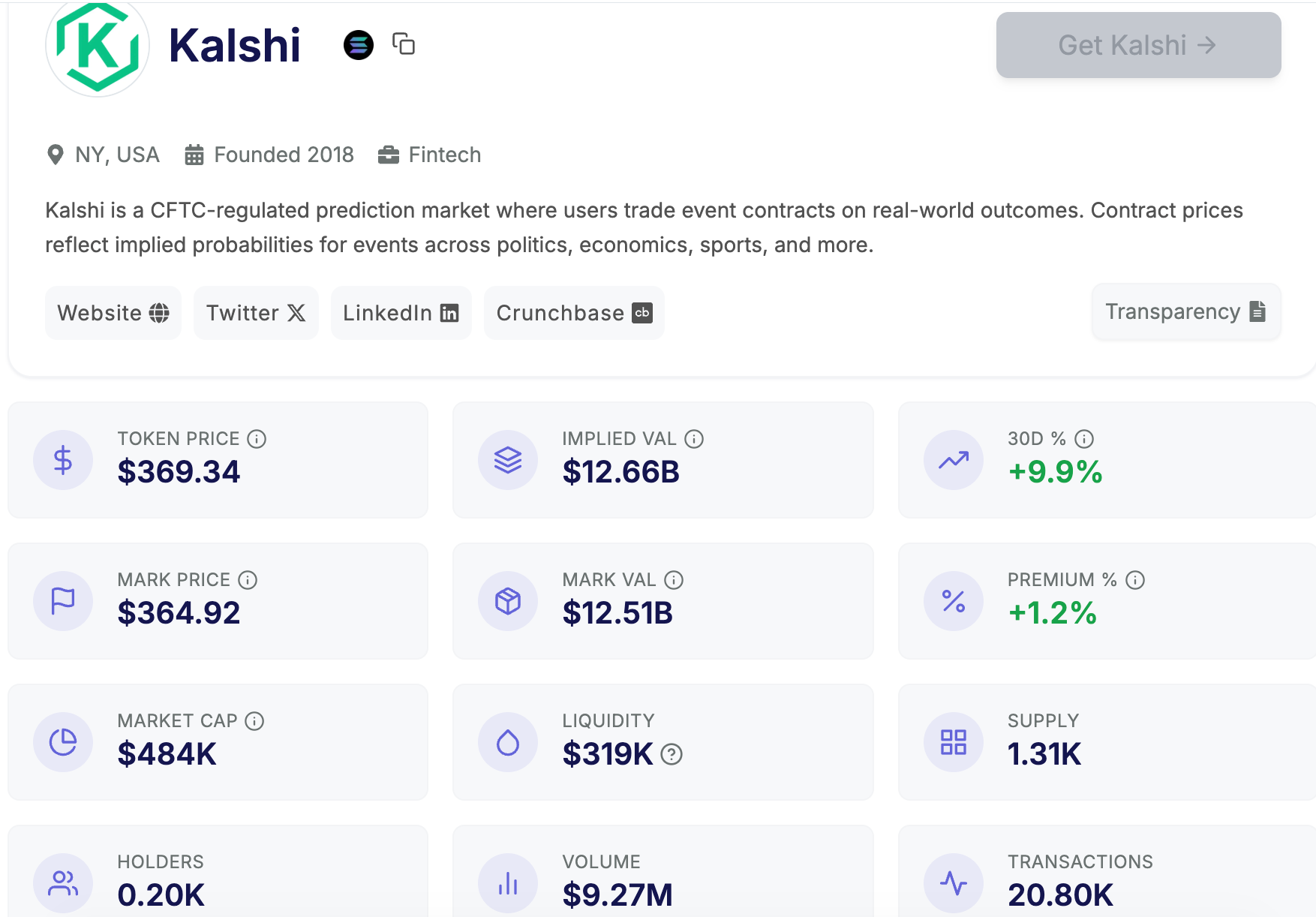
On the Jarsy platform, Kalshi's pre-market per-share price has risen to approximately $504.

It is worth mentioning that compared to the time when we previously wrote the article "Kalshi's Pre-Market Stock Price Soars, Is It Still Worth Buying Now?", the pre-market prices of Kalshi stock on both platforms have experienced varying degrees of increases and decreases. The price situation at that time was as follows:

  • On PreStocks, Kalshi's implied market capitalization was approximately $14 billion, with a per-share price of about $407;
  • On Jarsy, Kalshi's market valuation was $11 billion, with a per-share price of $450.

In other words, the price on the PreStocks platform fell from $407 to approximately $369; the price on the Jarsy platform rose from $450 to approximately $504.

For comparison, the pre-market pricing for Kalshi stock in traditional financial markets has also changed—

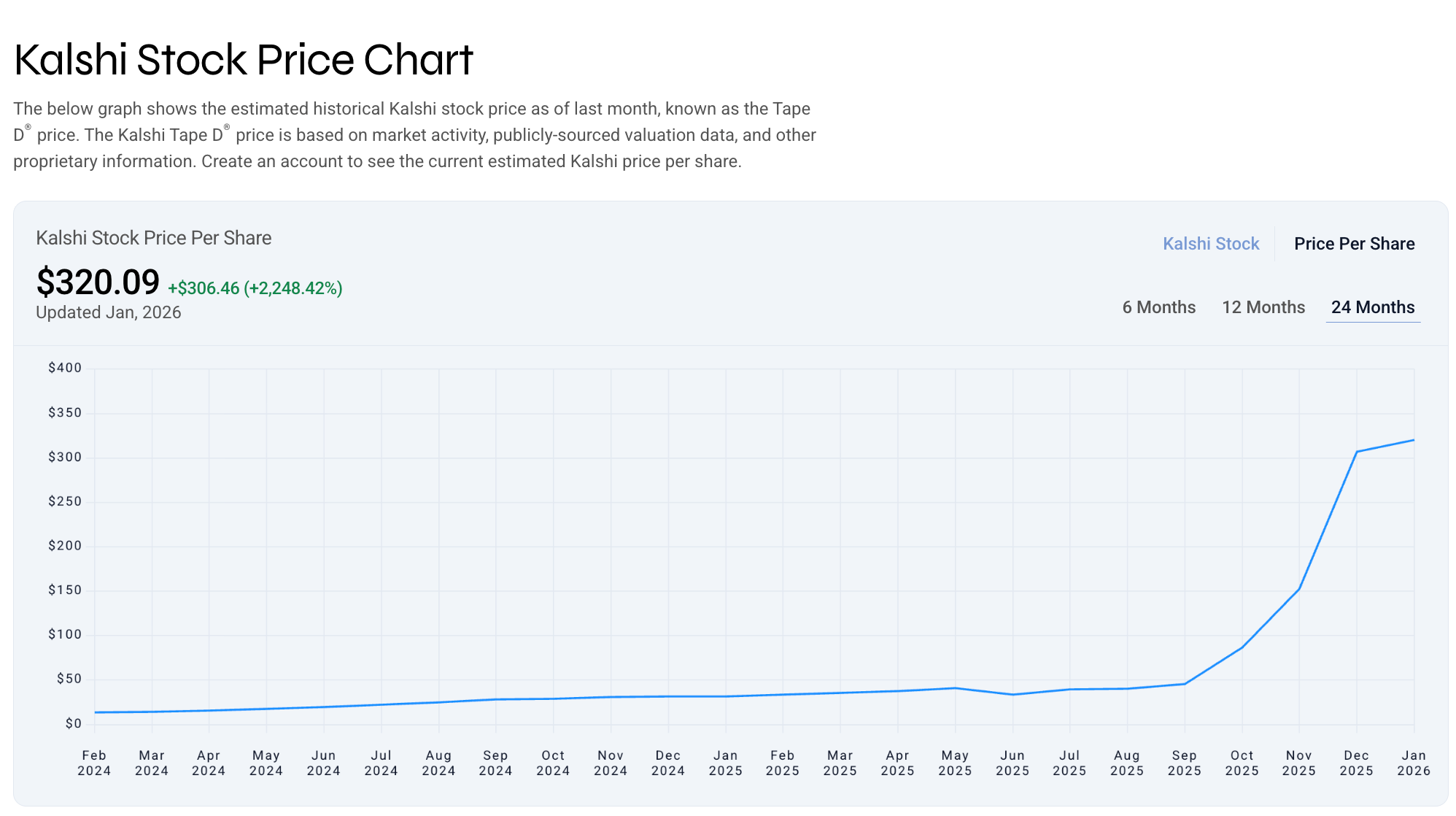
  • On Nasdaq Private Market, Kalshi's per-share price rose from approximately $307 to around $320;
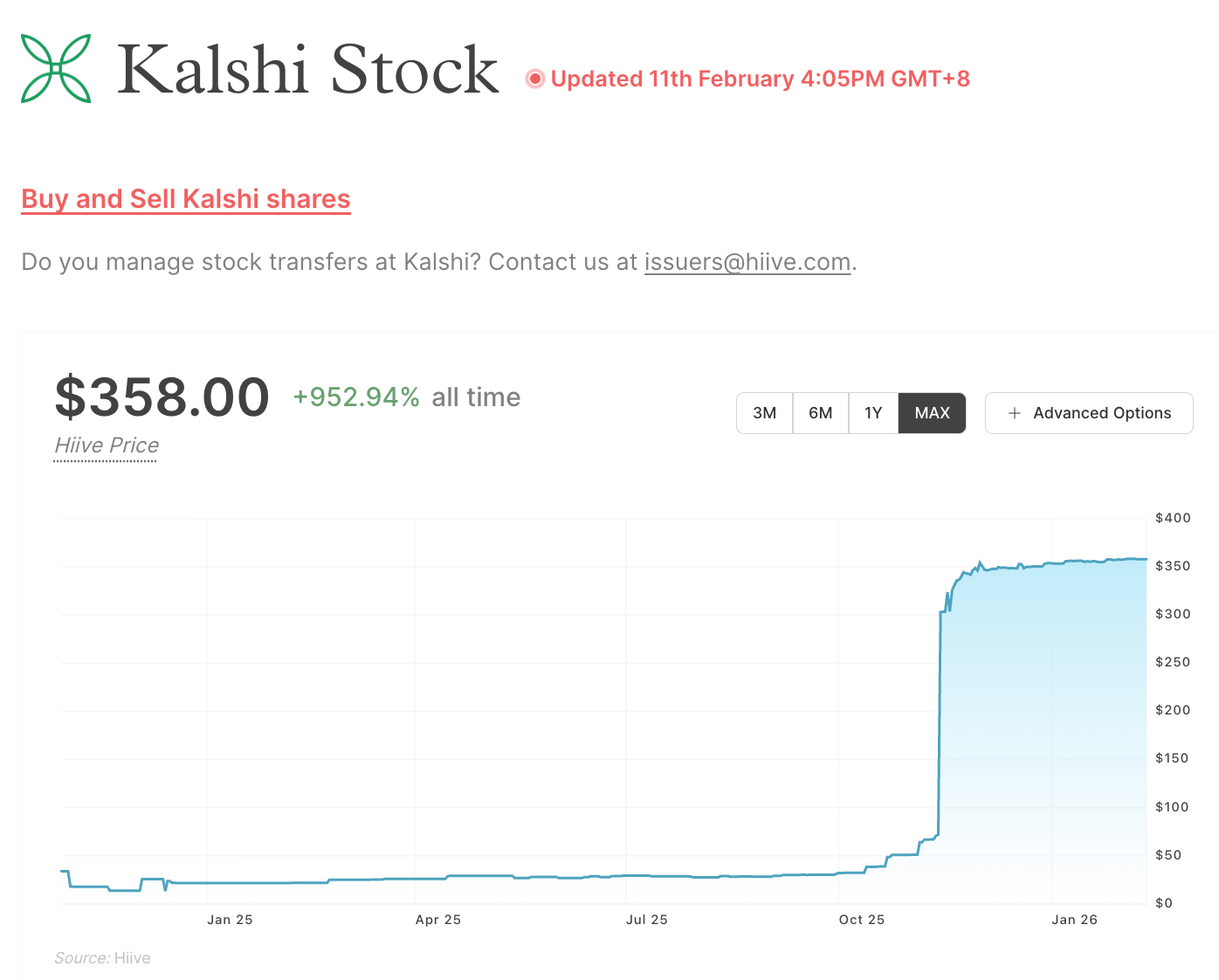
  • On Hiive, Kalshi's per-share price rose by $1 from approximately $357 to around $358.
Reasonable Pre-Market Pricing Range for Kalshi Stock: Approximately $320~$423

Last year, Kalshi completed a $1 billion Series E financing round with a valuation of $11 billion.

Based on the market capitalizations and corresponding stock prices mentioned above, the number of Kalshi shares is approximately between 30.72 million and 34.30 million.

Specifically, the number of shares is calculated as follows—
Based on a $11 billion valuation corresponding to the traditional financial market pre-market prices of $320 and $358, the number of Kalshi shares is approximately 30.72 million to 34.37 million;
Based on the implied market capitalization/token price and capital market capitalization/marked price on the PreStocks platform, the number of Kalshi shares is approximately 34.27 million to 34.30 million;
Based on the pre-market purchase price per share on the Jarsy platform, Kalshi's market capitalization tops out at $18.665 billion, with a per-share price of $604.84, and the number of shares is approximately 30.86 million.

Based on the above information, we can make the following deductions:

First, based on the $11 billion valuation, the reasonable pre-market pricing range for Kalshi stock is approximately $320-$358. In other words, the current pricing on crypto market tokenized stock trading platforms such as PreStocks and Jarsy is relatively high;

Second, Kalshi's trading volume in January reached $9.5 billion, close to the overall prediction market size of approximately $10 billion in October last year; in October last year, its market share was about 50% of the prediction market. From this perspective, Kalshi's current capital market valuation is at least above $15 billion.

Third, based on a $15 billion valuation and combined with data such as the range of the number of Kalshi shares, the pre-market pricing range for Kalshi stock is approximately $436~$488.

Therefore, if the number of Kalshi shares meets expectations, and under the premise of a $15 billion implied market capitalization, conservatively estimated, the reasonable pre-market pricing range for Kalshi stock might be $320~$378 (calculated based on the average of the lowest prices in the pricing range); optimistically estimated, the reasonable pre-market pricing range for Kalshi stock might be $358~$423 (calculated based on the average of the highest prices in the pricing range).

Based on the above data conclusions, the pre-market pricing for Kalshi stock on the Jarsy platform is relatively high, while the PreStocks platform offers some arbitrage opportunities.

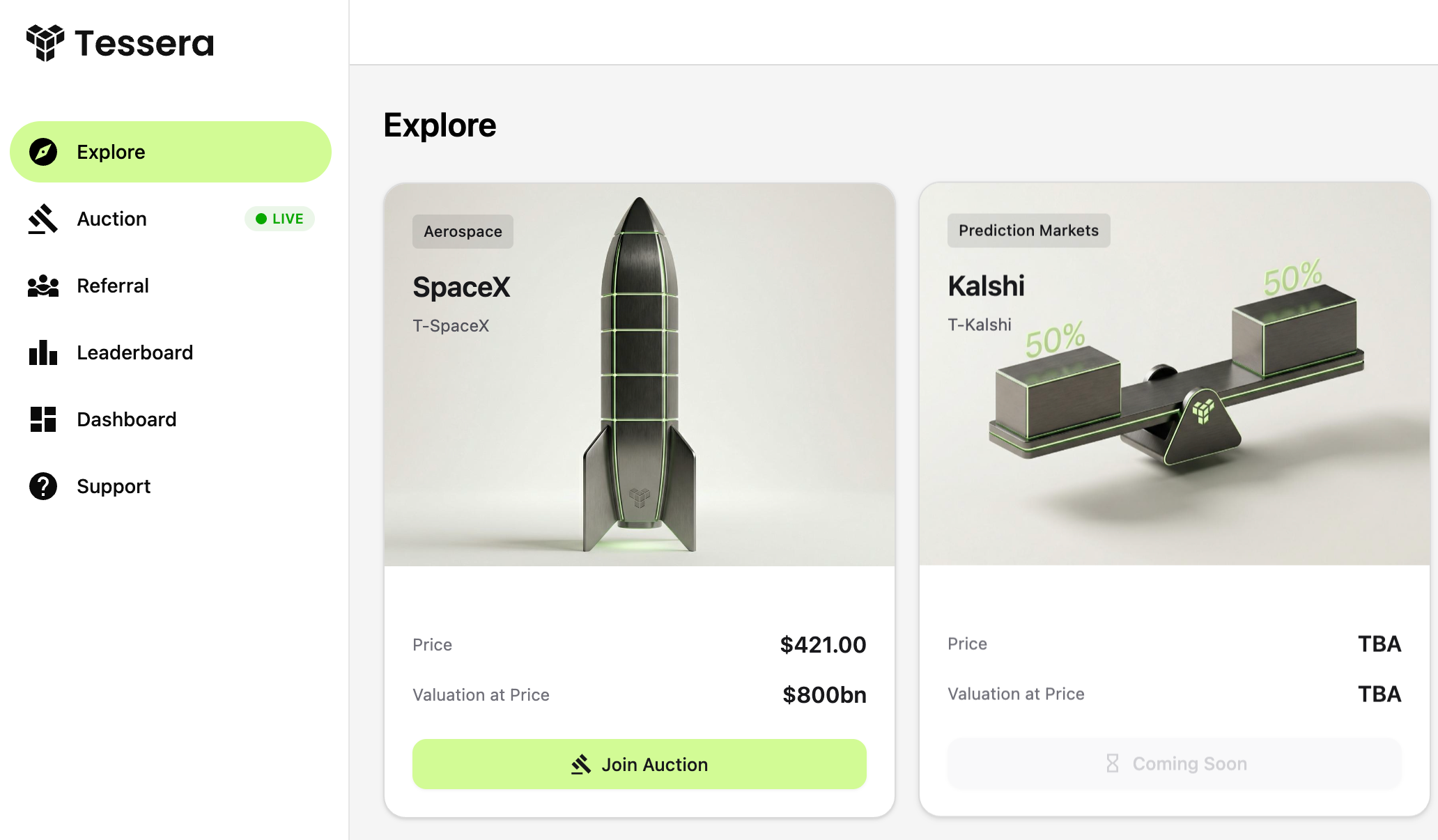
In addition, the latest tokenized stock trading platform, Tessera, plans to open equity public offerings in the future, which readers can also consider as an alternative reference (invitation code can be found here).
Combined with the relevant information mentioned in the previously published article by Odaily Planet Daily, "Data Calculation Shows Polymarket's Annual Revenue Exceeding 100 Million Is Not Difficult, Provided That...":

Based on a static calculation of the trading volume and fee ratio in the "15-minute cryptocurrency rise and fall" market on Polymarket, under the current trading volume level and structure, if Polymarket introduces a similar fee model in all markets, it is expected to bring annual revenue of $418 million to the platform.

As a prediction market platform with larger trading volume and higher fees, and taking advantage of the timing of the major sports year in 2026, Kalshi's annual revenue is expected to exceed this estimated revenue of Polymarket. From this perspective, the capital market may further raise the pre-market pricing of Kalshi stock in the future.


Domande pertinenti

QWhat is the current pre-market stock price range for Kalshi on PreStocks and Jarsy platforms?

AOn PreStocks, the pre-market stock price for Kalshi is around $369 (implied market cap) and $364 (capital market cap). On Jarsy, the pre-market price is around $504.

QWhat was the valuation of Kalshi after its Series E funding round last year?

AKalshi completed a $1 billion Series E funding round last year, valuing the company at $11 billion.

QWhat is the estimated reasonable pre-market stock price range for Kalshi based on a $11 billion valuation?

ABased on a $11 billion valuation, the reasonable pre-market stock price range for Kalshi is approximately $320 to $358.

QWhat is the optimistic estimated pre-market stock price range for Kalshi if its implied market cap reaches $15 billion?

AIf Kalshi's implied market cap reaches $15 billion, the optimistic estimated pre-market stock price range is approximately $358 to $423.

QHow does the article suggest Kalshi's future annual revenue might compare to Polymarket's estimated revenue?

AThe article suggests that Kalshi's annual revenue is expected to surpass Polymarket's estimated $418 million, especially with the advantage of the 2026 major sports events year, potentially leading to a higher pre-market stock valuation.

Letture associate

How Many Tokens Away Is Yang Zhilin from the 'Moon Chasing the Light'?

The article explores the intense competition between two leading Chinese AI companies, DeepSeek and Kimi (Moon Dark Side), and the mounting pressure on Yang Zhilin, the founder of Kimi. While DeepSeek re-emerged after 15 months of silence with its powerful V4 model—boasting 1.6 trillion parameters and low-cost, long-context capabilities—Kimi has been focusing on long-context processing and multi-agent systems with its K2.6 model. Yang faces a threefold challenge: technological rivalry, commercialization pressure, and investor expectations. Despite Kimi’s high valuation (reaching $18 billion), its revenue heavily relies on a single product with low paid conversion rates, while DeepSeek’s strategic silence and open-source influence have strengthened its market position and valuation prospects, now targeting over $20 billion. Both companies reflect broader trends in China’s AI ecosystem: Kimi aims for global influence through open-source contributions and agent-based advancements, while DeepSeek prioritizes foundational innovation and hardware independence, notably shifting to Huawei’s chips. Their competition is seen as vital for China’s AI progress, with the gap between top Chinese and U.S. models narrowing to just 2.7% on the Elo rating scale. Ultimately, the article argues that this rivalry, though anxiety-inducing for leaders like Zhilin, is essential for driving innovation and solidifying China’s role in the global AI landscape.

marsbit4 h fa

How Many Tokens Away Is Yang Zhilin from the 'Moon Chasing the Light'?

marsbit4 h fa

TechFlow Intelligence Bureau: ChatGPT Helps Amateur Mathematician Crack 60-Year-Old Problem, CFTC Sues New York Regulator Over Coinbase and Gemini

An amateur mathematician, with the assistance of ChatGPT, has solved a combinatorial mathematics puzzle originally proposed by Hungarian mathematician Paul Erdős in the 1960s. This marks another milestone in AI-aided mathematical research, demonstrating the evolving capabilities of large language models in formal reasoning. In other AI developments, OpenAI introduced a new privacy filter tool for enterprise API usage, automatically screening sensitive data. Meanwhile, the Qwen3.6-27B model achieved 100 tokens per second on a single RTX 5090 GPU using quantization, significantly lowering the cost barrier for local AI deployment. In crypto and Web3, the U.S. CFTC sued New York’s financial regulator, challenging its oversight of Coinbase and Gemini—a first-of-its-kind federal-state regulatory clash. Following a vulnerability, KelpDAO and major DeFi protocols established a recovery fund. Tether froze $344 million in assets linked to Iran’s central bank upon U.S. Treasury request, highlighting the centralized control risks in stablecoins. Separately, Litecoin underwent a 3-hour chain reorganization to undo a privacy-layer exploit. In the U.S., former President Trump invoked the Defense Production Act to address power grid bottlenecks affecting AI data centers and dismissed the entire National Science Board, raising concerns over research independence. A retail trader gained 250% on a $600k Intel options bet amid AI-related speculation. Xiaomi announced its first performance electric vehicle, targeting rivals like Tesla. Meanwhile, iPhone users reported devices automatically reinstalling a hidden app daily, suspected to be MDM-related. A Chinese securities report noted that A-share institutional crowding has reached its second-longest streak since 2007, signaling high valuations and potential style rotation. The day’s developments reflect a dual narrative: AI is enabling unprecedented individual breakthroughs, while centralized power structures—whether governmental or corporate—are becoming more assertive, underscoring that decentralization is as much a political-economic challenge as a technical one.

marsbit4 h fa

TechFlow Intelligence Bureau: ChatGPT Helps Amateur Mathematician Crack 60-Year-Old Problem, CFTC Sues New York Regulator Over Coinbase and Gemini

marsbit4 h fa

Trading

Spot
Futures
活动图片




