‘Just the beginning’: Paul Atkins signals SEC’s new crypto rule changes

ambcryptoPubblicato 2026-03-20Pubblicato ultima volta 2026-03-20

Introduzione

SEC Chair Paul Atkins announced the agency will soon issue formal proposed rules to codify its recent interpretive guidance, which classifies most crypto assets as non-securities and categorizes them into five groups: digital commodities, collectibles, tools, stablecoins, and securities. The SEC also plans to create a regulatory sandbox for experimentation. Atkins noted that while this is a significant step, courts could still deviate from the SEC’s interpretation. He described the move as a "bridge" as Congress progresses on the CLARITY Act. Senator Cynthia Lummis reported that stablecoin yield issues are "99% resolved" in the bill negotiations. Market optimism for the bill has improved slightly despite earlier setbacks.

Paul Atkins, the chairman of the U.S. Securities and Exchange Commission (SEC), has said the agency will soon issue formally proposed rules for the recent crypto asset classification guidance.

In the latest interpretive guidance, the SEC designated most crypto assets as non-securities. Additionally, the framework classified digital assets into five categories, including digital commodities, collectibles, tools, stablecoins, and securities. It also explained how they fit into the current U.S. law.

To codify the framework, Atkins said the agency will formalize it alongside creating a sandbox for experimenting with different crypto products. But he warned the court could still ‘deviate’ from its interpretation.

This is just an interpretation, and the courts can deviate from that if they don’t like our rationale.

He added,

We’ll shortly follow up with a proposed rule to put much more of this framework into effect. And construct a series of exemptions, equivalent of sandbox for people to experiment and develop proof-of-concept for their products.

SEC’s plans and CLARITY Act progress

For Atkins, SEC’s interpretation of crypto laws is ‘just a beginning,’ and the move would be a ‘bridge’ as the Congress works its way through the CLARITY Act. In fact, most of the guidance issued in the past few days and months covers key topics being discussed in the CLARITY Act. For others, the SEC’s proposed rulemaking on key issues would be sufficient for the market, even if the CLARITY Act’s momentum stalls.

That said, the stablecoin yield issue has been the key deal breaker dragging the crypto bill.

Even so, after the recent Senate Republican meeting on the bill, Senator Cynthia Lummis was ‘positive,’ terming it ‘productive,’ and added,

We’re 99% of the way there on stablecoin yield, and negotiations on the digital asset portions of the bill are in a good place.
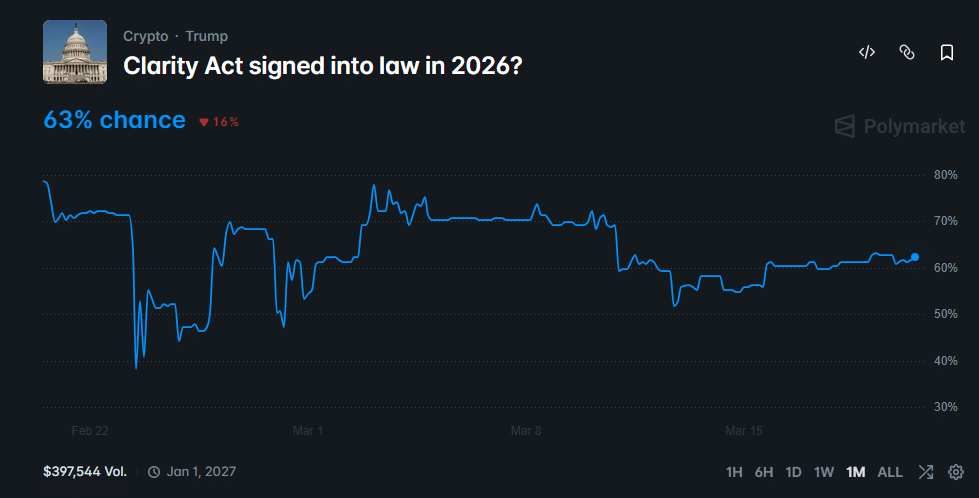
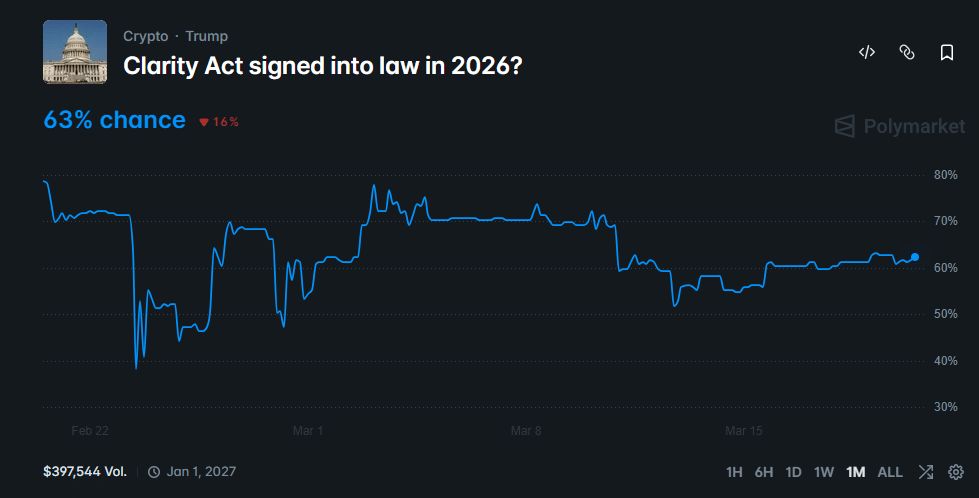
Source: Polymarket

As expected, market optimism on the bill’s passage improved slightly following the recent meetings and updates.

In early March, the chance of the CLARITY Act becoming law dropped to nearly 50% as the White House and the banking industry hit a snag over stablecoin yields.

Whatever the outcome, however, the crypto industry may still be in a better position for clear rules for the road if the SEC continues to issue and codify them.


Final Summary

  • SEC Chair reiterated plans to formalize rulemaking for its recent interpretive guidance on crypto asset classification and how current U.S. law applies to them.
  • According to Senator Lummis, the stablecoin yield issue was ‘99% resolved’ in CLARITY Act talks.

Domande pertinenti

QWhat did SEC Chairman Paul Atkins announce regarding crypto asset classification?

APaul Atkins announced that the SEC will soon issue formally proposed rules to codify its recent interpretive guidance on crypto asset classification, which designates most crypto assets as non-securities and categorizes them into five groups.

QHow did the SEC classify digital assets in its latest guidance?

AThe SEC classified digital assets into five categories: digital commodities, collectibles, tools, stablecoins, and securities, explaining how they fit under current U.S. law.

QWhat did Paul Atkins say about the role of courts in relation to the SEC's interpretation?

AAtkins warned that courts could deviate from the SEC's interpretation if they disagree with the rationale, emphasizing that the guidance is just an interpretation.

QWhat is the CLARITY Act, and how does it relate to the SEC's actions?

AThe CLARITY Act is a congressional bill addressing crypto regulation. The SEC's interpretive guidance covers key topics in the bill and is seen as a 'bridge' while Congress works on the legislation.

QAccording to Senator Cynthia Lummis, what progress has been made on the stablecoin yield issue in the CLARITY Act negotiations?

ASenator Lummis stated that the stablecoin yield issue is '99% resolved' and that negotiations on the digital asset portions of the bill are in a good place.

Letture associate

Goldman Sachs: July Smashes Through Crowded Trades, U.S. Stock Bull Market Not Broken but Harder to Navigate

Goldman Sachs: July Sees Crowded Trades Unwound, U.S. Bull Market Intact but Getting Tougher. The U.S. stock market in July did not see an index-level crash, but rather a significant unwinding of speculative positions. While the S&P 500 remained stable—trading within a narrow 3.5% range and staying within 2% of its high—underlying market dynamics were volatile. Heavily crowded trades, particularly in high-momentum tech, AI-linked stocks, and Asian strategies, faced severe pressure and forced deleveraging. Data indicates this was a meaningful cleanse, not a minor adjustment. Global tech exposure saw its largest sell-off in over five years, leverage in Korean equity ETFs plummeted, and Goldman's prime brokerage recorded the largest gross exposure reduction since late 2022. Leverage on momentum factors among fundamental long/short clients fell to the 28th percentile of its one-year range. The AI trade narrative shifted from pure potential to a focus on tangible returns. While Meta failed to show clear AI monetization, Microsoft and Amazon provided evidence that massive capital expenditure is translating into scalable revenue and product growth, preventing a blanket sell-off of the AI sector. The Federal Reserve's more opaque communication style and volatility in long-end Treasury yields have introduced new friction, particularly for rate-sensitive growth and tech stocks. The broader outlook for U.S. equities remains favorable, supported by a strong economy, robust earnings, and substantial AI capital expenditure. However, risk/reward is no longer cheap, and the market's upward elasticity has weakened. The Nasdaq 100's trajectory—up 12% year-to-date despite significant pullbacks—illustrates that the bull trend persists but the path is becoming more difficult. The key lesson from July is that the market no longer rewards crowded, highly leveraged trades, requiring more disciplined and liquid portfolio approaches.

marsbit58 min fa

Goldman Sachs: July Smashes Through Crowded Trades, U.S. Stock Bull Market Not Broken but Harder to Navigate

marsbit58 min fa

Interview with Robinhood Executive: Meme + Tokenized US Stocks as "Barbell" Customer Acquisition Strategy, All Business Lines Achieve Hundreds of Millions in Revenue

Interview with Robinhood executive Johann Kerbrat reveals the company's "barbell" customer acquisition strategy for its new Robinhood Chain, combining meme tokens with tokenized stocks. Three weeks after mainnet launch, the chain has seen over $3B in weekly DEX volume and 105M transactions. Kerbrat explains the logic behind the permissionless chain: meme tokens attract DeFi users, while tokenized real-world assets (RWA), currently over 90 US stocks and ETFs accessible in 120+ countries, serve global users. The goal is to bring Robinhood's 27 million funded accounts on-chain by simplifying DeFi with a user-friendly interface, exemplified by features like Robinhood Earn which offers yield without requiring wallet management. Built on Arbitrum's technology stack for its speed, low cost, and Ethereum's security, the chain focuses on financial products like Earn, spot trading, and perpetuals. Kerbrat downplays direct competition with platforms like Base, emphasizing the goal of expanding the overall market for on-chain assets. He details selective partnerships (e.g., Morpho, Lighter) based on compliance, unique UX, and differentiation. While regulatory clarity is pending for US perpetuals, the expansion continues via Bitstamp in Europe. Finally, Kerbrat positions Robinhood as a "super app" integrating stocks, options, crypto, banking, and AI trading, with all major business lines generating hundreds of millions in revenue. For the chain, current priority is driving adoption over maximizing gas fee revenue.

marsbit3 h fa

Interview with Robinhood Executive: Meme + Tokenized US Stocks as "Barbell" Customer Acquisition Strategy, All Business Lines Achieve Hundreds of Millions in Revenue

marsbit3 h fa

Fidelity Q3 Report: BTC, ETH, and SOL Continue to Build Bottoms; How Much Further Will This Crypto Bear Market Go?

Fidelity's Q3 Crypto Signal Report analyzes the current bear market, noting Bitcoin (BTC), Ethereum (ETH), and Solana (SOL) are in a prolonged bottoming phase. Key indicators like the weighted Net Unrealized Profit/Loss (NUPL) have turned negative (-0.01), signaling the market is slightly below its aggregate cost basis, with BTC acting as the primary stabilizing asset. BTC's dominance has risen to 68%, indicating a lack of capital rotation to other digital assets. Performance has been weak across the board, with BTC, ETH, and SOL down significantly year-to-date. Market sentiment is depressed, exacerbated by substantial outflows from spot ETPs and a challenging macro environment. The report compares the current ~203-day downtrend to historical ~300-day bottoming cycles, suggesting the process may be two-thirds complete, with late 2026 as a potential timeframe to monitor. For Bitcoin, NUPL at 0.09 indicates cautious sentiment, while momentum signals remain negative. The Yardstick metric points to potential undervaluation relative to network security (hashrate). Ethereum's NUPL is deep in the "capitulation" zone at -0.43, a historically positive signal for future returns, though its momentum and network fee revenue are negative. Solana shows the deepest NUPL at -0.72 but demonstrates relative resilience in on-chain activity and stablecoin transfer volume. The report concludes that while several metrics are near historical capitulation levels, a definitive market bottom has not yet been established. The path forward likely involves continued consolidation, with BTC's relative strength and fundamental on-chain usage for ETH and SOL providing key areas for investor observation.

marsbit3 h fa

Fidelity Q3 Report: BTC, ETH, and SOL Continue to Build Bottoms; How Much Further Will This Crypto Bear Market Go?

marsbit3 h fa

Trading

Spot
活动图片