July Trading Platform Rankings: Spot Market Falls 35%, Derivatives Trading Remains Resilient

marsbitPubblicato 2026-08-10Pubblicato ultima volta 2026-08-10

Introduzione

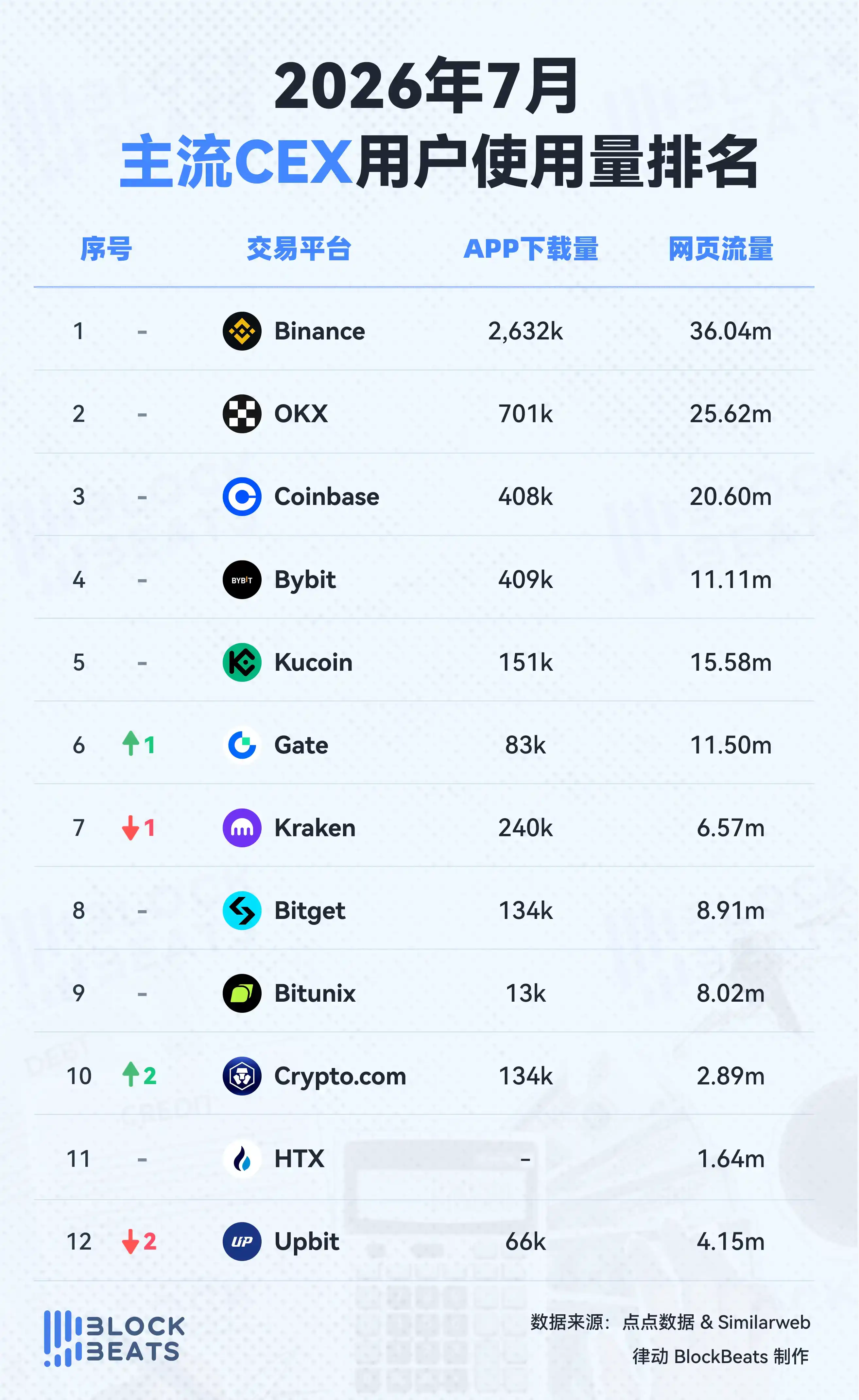
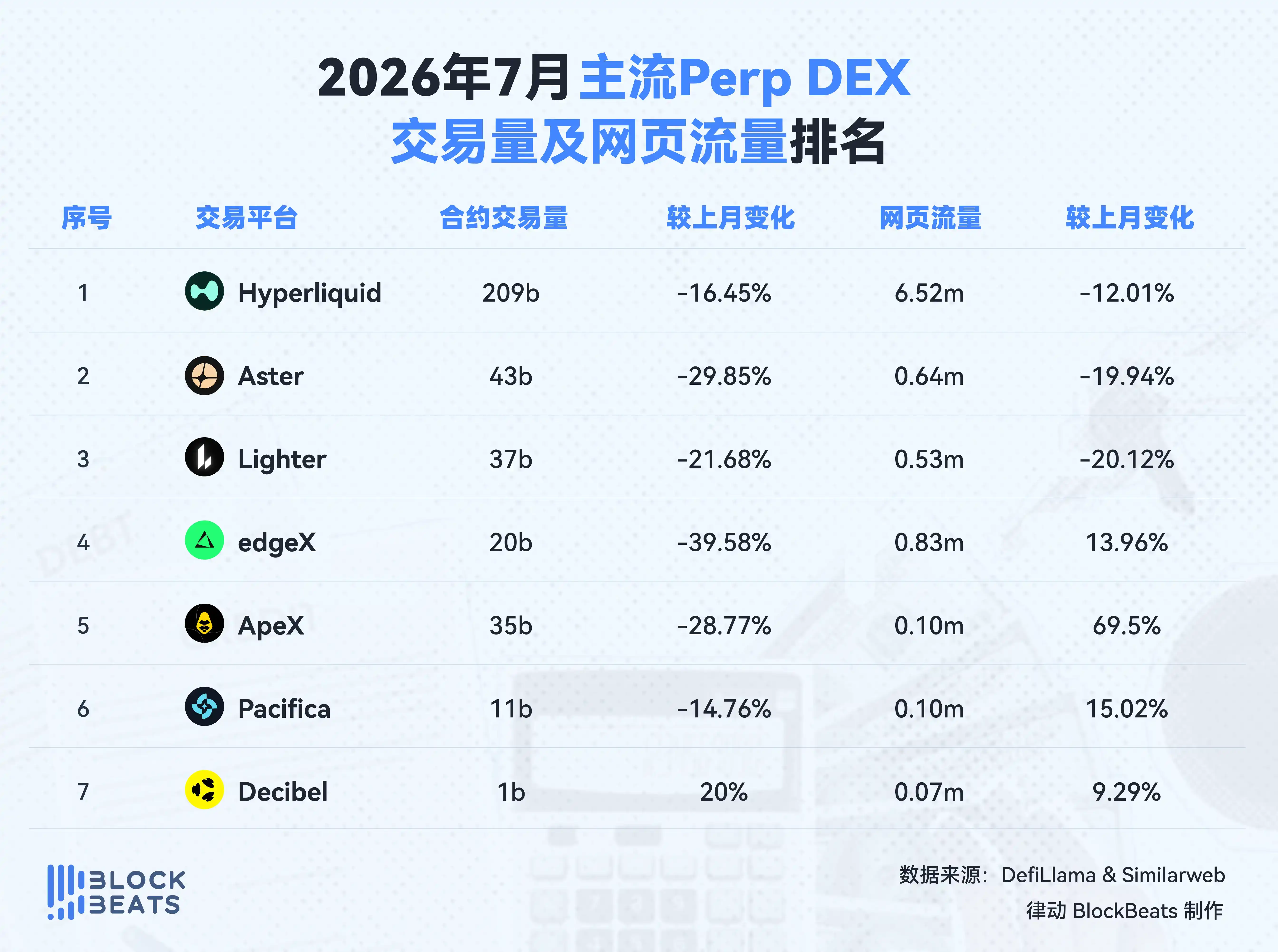
In July 2026, trading volume on mainstream Centralized Exchanges (CEX) showed a significant decline, with spot trading dropping 35.51% compared to June, while perpetual contract trading fell by a lesser 19.59%. This indicates that leveraged trading demand remained relatively more resilient despite an overall market cooldown. Interestingly, CEX website traffic increased by 3.00%, yet app downloads decreased by 2.09%, suggesting that increased user reach did not translate into higher trading activity, with market观望情绪 (wait-and-see sentiment) still dominant. The decentralized exchange (DEX) sector also experienced declines. Perpetual contract volume on mainstream Perp DEX platforms decreased by 26.88%, accompanied by a 10.57% drop in website traffic. A note accompanying the data cautions that部分数据可能存在严重的刷量 / 机器人嫌疑 (some data may be heavily suspected of wash trading/bot activity). Data sources include Coingecko for spot and derivatives, Similarweb for traffic, and点点平台 for download metrics.

In July 2026, the spot trading volume on mainstream CEXs decreased by 35.51% compared to June 2026, while the perpetual contract trading volume decreased by 19.59% compared to June 2026. The decline in spot trading was significantly greater than in derivatives, indicating the overall market is cooling down once again. However, the demand for leveraged trading showed relatively more resilience.
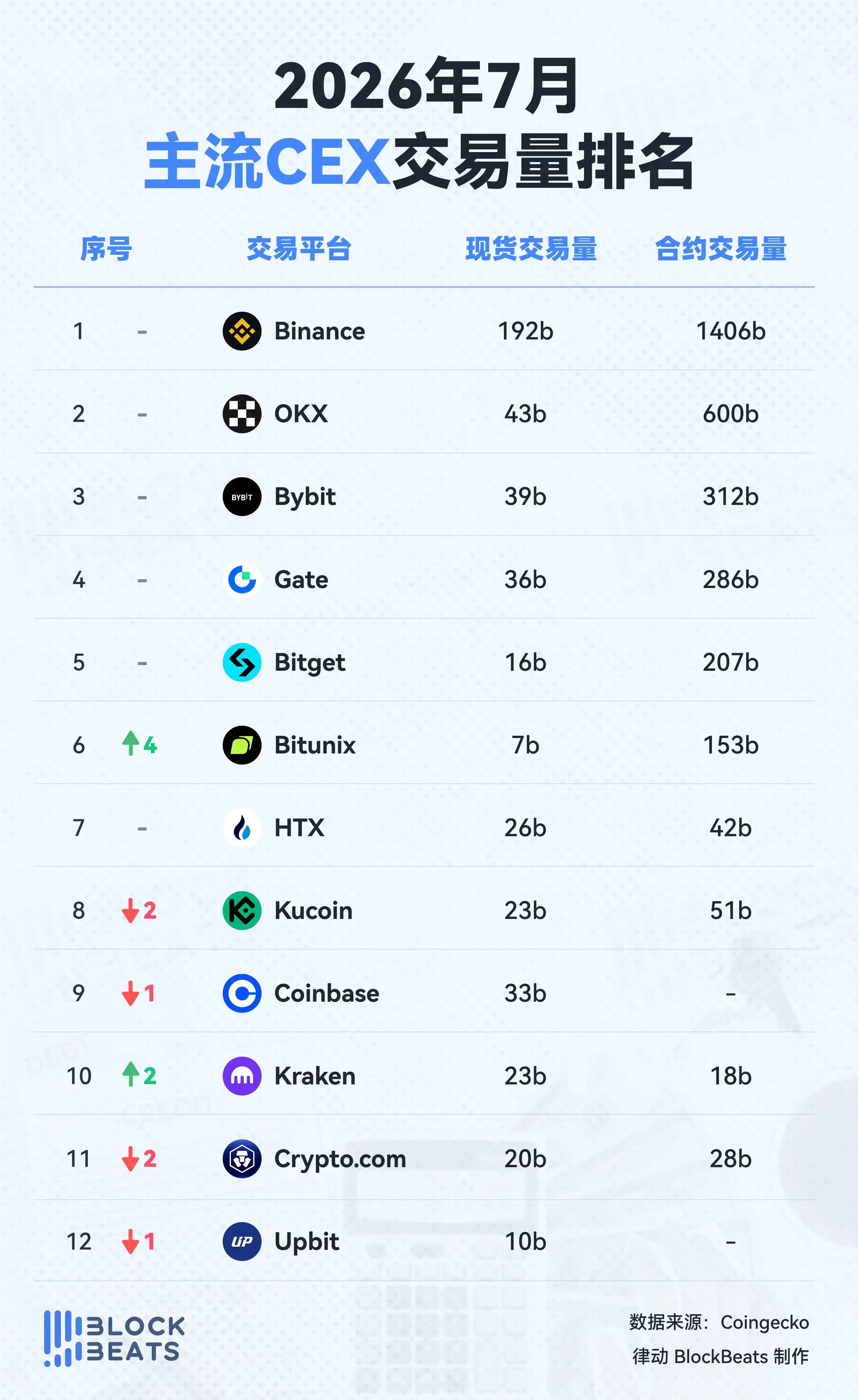
In July, website page views for mainstream CEXs increased by 3.00% compared to June 2026, while app downloads decreased by 2.09%. This user reach did not translate into trading activity, suggesting a dominant sentiment of market watchfulness remains.
In July, the perpetual contract trading volume on mainstream Perpetual DEXs decreased by 26.88% compared to June 2026, and website page views decreased by 10.57%.
Note: Some data may be heavily influenced by suspected wash trading/bot activity. Spot and derivatives data source: Coingecko; Traffic data source: Similarweb; Download data source: Diandian Platform.


Domande pertinenti

QAccording to the article, what were the key percentage changes in spot and perpetual contract trading volumes on mainstream CEXs from June to July 2026?

AFrom June to July 2026, spot trading volume on mainstream CEXs decreased by 35.51%, while perpetual contract trading volume decreased by 19.59%.

QWhat does the article suggest about the relative resilience of different types of crypto trading in July 2026?

AThe article suggests that while the overall market cooled down, leverage trading demand (perpetual contracts) showed relatively more resilience, as its decline was significantly smaller than the decline in spot trading volume.

QHow did website traffic and app download trends for mainstream CEXs in July 2026 contrast with the trading activity trends?

AWebsite traffic for mainstream CEXs increased by 3.00% in July, while app downloads decreased by 2.09%. This indicates user reach did not translate into trading activity, suggesting dominant market观望情绪 (watch-and-see sentiment).

QWhat was the reported change in trading volume and website traffic for mainstream Perpetual DEXs (Perp DEXs) in July 2026?

AFor mainstream Perp DEXs in July 2026, perpetual contract trading volume decreased by 26.88%, and website traffic decreased by 10.57%.

QWhat cautionary note does the article provide regarding the data presented?

AThe article notes that some of the data may be subject to significant刷量 / 机器人嫌疑 (volume inflation/bot activity suspicion).

Letture associate

Everyone Thinks Cryptocurrency is Dead, But He Says It's About to Explode

Title: A Bullish Case Amidst Doubt: Bitcoin's Path for Ordinary Investors While many declare crypto dead, Scott Melker argues the opposite. In a wide-ranging interview, he reflects on the industry's evolution into a more institutionalized landscape in 2026. Dismissing the myth of trading success, Melker advocates for "boring" investment as the key to financial freedom for the average person. His core advice is straightforward: buy Bitcoin, consistently dollar-cost average, and hold. He warns against trying to time the volatile market, calling it a dangerous path where most lose out. Melker shares his journey from a DJ and trader to a media entrepreneur, highlighting the importance of building a durable brand based on reputation rather than hype. He acknowledges the structural shifts in the market, noting that many tokens fail to accrue value to holders, while assets with real institutional adoption, like Bitcoin, Ethereum, and Solana, will thrive. The lessons from the 2022 bear market are clear: avoid unrealistic yield traps and focus on hard assets. For investors, he recommends an 80% Bitcoin, 10% Ethereum, 10% Solana portfolio, using strategies to generate cash flow to buy more Bitcoin. Melker's ultimate goal is promoting Bitcoin to the mainstream, viewing it as the most critical financial asset for escaping the inflationary "rat race." His philosophy for 2026 and beyond is simple: "Bitcoin and chill." He urges investors to stay the course, emphasizing that the current market, with its institutional adoption and ETFs, represents the industry's best era yet.

marsbit3 min fa

Everyone Thinks Cryptocurrency is Dead, But He Says It's About to Explode

marsbit3 min fa

Why Are Crypto VCs Focusing on Stablecoin Infrastructure?

Crypto VC Focuses on Stablecoin Payment Infrastructure Despite an overall cooling crypto VC market in Q1 2026, investment in stablecoin payment infrastructure is gaining momentum. Capital is concentrating on mature projects with existing users, transaction volume, and clearer revenue models over purely speculative token-based ventures. Stablecoins are evolving from trading tools into backend infrastructure for efficient, 24/7 cross-border payments (e.g., B2B, remittances, payroll). Startups are building along the entire payment stack—connecting stablecoins to bank accounts, cards, forex liquidity, and local compliance systems. Recent large funding rounds for companies like Rain (cards), OpenFX (cross-border), and RedotPay highlight this trend. VC interest stems from several factors: solving real inefficiencies in traditional cross-border settlement, established fee-based revenue models (transaction fees, forex spreads), stablecoins becoming an invisible backend tool for end-users, clearer US regulatory frameworks attracting traditional finance, and acquisition exits to companies like Stripe and Mastercard. However, challenges remain. High on-chain stablecoin volume doesn't equal real retail payment volume; funding is concentrated in a few top performers; services risk commoditization; global expansion requires navigating local banking and regulations per market; and large traditional payment firms are both potential clients and future competitors. Future investment may focus on cross-border B2B payments, bank-stablecoin connectivity, stablecoin-linked cards, multi-chain/asset payment orchestration platforms, and infrastructure for AI Agent payments. Ultimately, VCs are betting not on a single stablecoin's dominance, but on the critical infrastructure needed to integrate programmable, global settlement assets into the traditional financial system.

marsbit4 min fa

Why Are Crypto VCs Focusing on Stablecoin Infrastructure?

marsbit4 min fa

Billions in USDT Flee Korea. Police Powerless in the Fight Against Money Laundering

South Korea is facing a severe and rapidly escalating challenge with crypto-based money laundering. Police data shows cases surged 152-fold in the first half of 2026 compared to all of 2025, with laundering now constituting 79.4% of all detected crypto-related crimes. The primary method is the "Hwanchigi" scheme, which uses cryptocurrency transfers to move illicit funds overseas, bypassing the regulated banking system. Tether (USDT) is the preferred vehicle for converting proceeds from drug trafficking, illegal gambling, and phishing into dollars before moving them to offshore exchanges. Despite enhanced monitoring and enforcement efforts, a stark gap exists between detection and prosecution. While authorities tracked and blocked millions in illegal assets in high-profile cases, arrests have lagged dramatically. In the first half of 2026, only 18 arrests were made despite over 1,200 detected cases. Customs seized approximately $4.92 billion in illegal foreign exchange operations, with over 90% of crypto-related crimes for prosecution flowing through unlicensed channels. The situation highlights a systemic disconnect: blockchain analytics can track transactions nearly in real-time, but the judicial process moves slowly. This asymmetry raises questions about whether detection statistics alone are a meaningful measure of effectiveness in combating money laundering, as the low cost and high speed of these schemes allow criminal networks to scale faster than law enforcement can respond.

cryptonews.ru19 min fa

Billions in USDT Flee Korea. Police Powerless in the Fight Against Money Laundering

cryptonews.ru19 min fa

Trading

Spot
活动图片