Jito Foundation to return to US amid 'clearer rules' for digital assets

cointelegraphPubblicato 2025-12-17Pubblicato ultima volta 2025-12-17

Introduzione

The Jito Foundation, a nonprofit supporting the Solana-based MEV infrastructure platform Jito, has decided to return to the United States, citing clearer regulatory rules for digital assets. The organization had previously moved operations overseas due to debanking and regulatory hostility during what industry figures call "Operation Chokepoint 2.0." Jito Labs CEO Lucas Bruder stated that banks and vendors refused to work with them, creating significant legal risks. Recent developments, including the passage of the GENIUS stablecoin bill and progress on a crypto market structure bill, influenced the decision to return. Despite a more favorable regulatory environment under the new SEC leadership, some crypto industry executives report that debanking practices continue.

The Jito Foundation, the nonprofit organization facilitating the development of the Jito platform, said it will return to the United States, citing “clearer rules” for digital assets in the country.

Jito is a maximal extractable value (MEV) infrastructure builder for the Solana network. MEV refers to the profit that traders or validators can make by controlling the order, inclusion or exclusion of transactions in a blockchain block. By rearranging transactions before they are confirmed, MEV participants can capitalize on opportunities such as arbitrage or front-running to earn extra fees on transaction rewards.

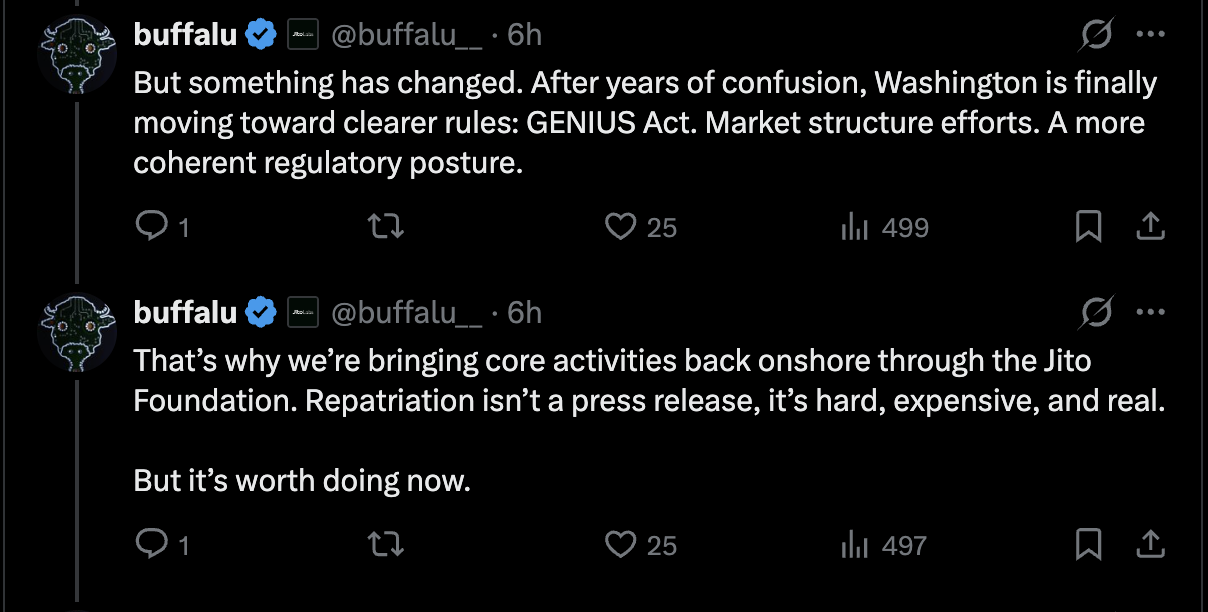
The Jito Foundation was forced to operate overseas due to the debanking of the crypto industry during the so-called Operation Chokepoint 2.0, according to Lucas Bruder, co-founder and CEO of Jito Labs. Bruder, pseudonymously known as “buffalu,” said:

“Banks wouldn’t service us. Vendors wouldn’t contract with us. Every product decision carried real but unquantifiable legal risk from a hostile and capricious regulatory agency gone rogue.”
Source: buffalu

Bruder cited recent regulatory changes, including the passage of the GENIUS stablecoin bill and lawmakers working on a crypto market structure bill, as reasons for the Jito Foundation returning to the US.

The announcement reflects the regulatory sea change in the US, particularly at the Securities and Exchange Commission (SEC), following the 2024 presidential election and the appointment of Paul Atkins as SEC chair.

Related: ‘Grow up... We debank Democrats, we debank Republicans:’ JPMorgan CEO

Crypto industry executives say Operation Chokepoint 2.0 is ongoing in 2025

Even with a pro-crypto administration in the White House and at the SEC, crypto industry executives continue to report being victims of debanking.

In November, Jack Mallers, the CEO of Bitcoin Lightning Network payments company Strike, said JPMorgan Chase closed his personal bank account.

The financial services giant did not specify the reason for closing the account, Mallers said, adding that his father had been a private client for over 30 years.
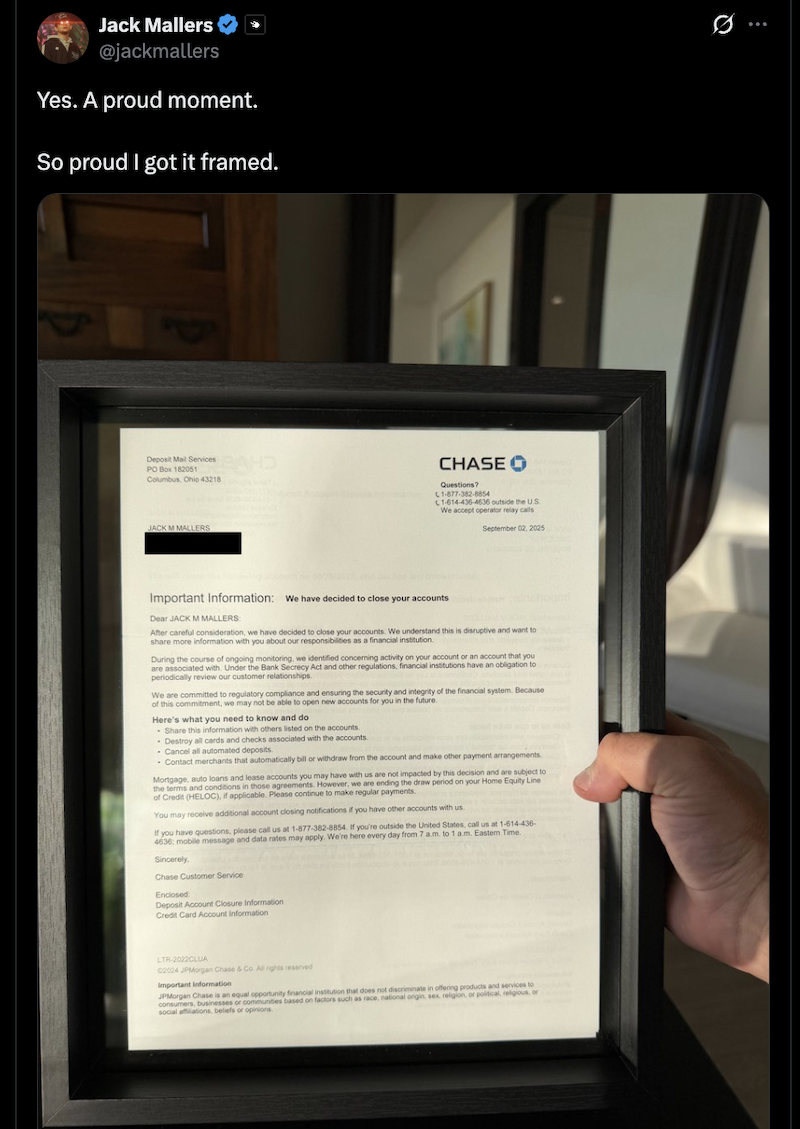
Jack Mallers shares a framed copy of the debanking letter he received from JPMorgan Chase. Source: Jack Mallers

In August, Alex Rampell, a general partner at venture capital firm Adreessen Horowitz, warned of the continuation of Operation Chokepoint by the banking industry through other tactics.

These tactics include banks charging excessive fees for clients moving crypto to wallets, centralized exchanges, Web3 applications and other digital asset service providers or outright blocking transfers to specific crypto platforms, Rampell said.

Magazine: Proton Mail exposing activists’ info showed the limits of encryption

Letture associate

Wall Street Capital Enters ARC, Circle Sparks a System-Level Competition for Stablecoins

Wall Street Capital Enters the ARC Arena as Circle Launches a System-Level Battle for Stablecoin Dominance On May 11, Circle successfully raised $222 million in a pre-sale funding round for its new blockchain and native token, ARC, giving the network a fully diluted valuation of $3 billion. The investor lineup, featuring Wall Street giants like BlackRock and Intercontinental Exchange alongside top-tier venture capital firms such as a16z and ARK Invest, signaled a collective strategic bet on future financial infrastructure. This move marks Circle's significant evolution from a stablecoin issuer (notably USDC) to a designer of financial systems. While USDC operates on external blockchains like Ethereum, making Circle dependent on their performance, ARC aims to create a dedicated infrastructure for the circulation, payment, and clearing of stablecoins. This would integrate currency issuance and circulation into one system, potentially shifting Circle's business model from asset management to infrastructure provision. The convergence of traditional finance and crypto-native capital in this funding round underscores a broader industry shift: stablecoins are transitioning from being mere trading tools to becoming core components of financial infrastructure. By controlling both the issuance (via USDC) and the流通 pathway (via ARC), Circle could establish a closed-loop system from issuance to settlement. If successful, this infrastructure could optimize costs, lower barriers for institutional adoption, and promote standardization in on-chain finance. Ultimately, it has the potential to challenge traditional systems like SWIFT in areas such as cross-border payments, representing a possible step toward the重构 of global financial infrastructure.

marsbit1 h fa

Wall Street Capital Enters ARC, Circle Sparks a System-Level Competition for Stablecoins

marsbit1 h fa

Circle's Three-Dimensional Valuation Framework: Where Is the Bottom, Where Is the Top

"Circle's 3D Valuation Framework: Where is the Bottom, Where is the Top?" - Article Summary The article analyzes Circle's valuation following its Q1 2026 earnings. While its core business generates substantial interest income from USDC reserves ($6.53B in Q1, up 17% YoY), this revenue is highly sensitive to interest rates and shared significantly with Coinbase. The author proposes a three-dimensional valuation framework: 1. **Interest Business (The Floor):** Valued like a bank (8-15x P/E) on net interest income after Coinbase's share. This provides a conservative valuation baseline. 2. **Payment & Platform Business (The Inflection Point):** Includes CPN (Circle Payments Network) and "Other Revenue" (transaction, integration services). This high-growth segment, not shared with Coinbase, is valued on a platform/network model (higher P/S multiples), similar to Visa/Mastercard. It represents Circle's shift beyond pure interest income. 3. **Arc Network & ARC Token (The Future / Optionality):** Arc is an institutional-focused, EVM-compatible L1 blockchain where USDC is the native gas token. A $222M ARC token pre-sale at a $3B FDV attracted major traditional finance players (BlackRock, Apollo, ICE). While Circle holds 25% of ARC tokens, their value is separate from CRCL equity. This dimension represents the long-term, high-upside bet on Circle becoming an "economic operating system." Current market cap (~$30B) prices in significant future growth beyond the sum-of-the-parts valuation derived from current earnings. The investment thesis hinges on believing in Circle's transition from a "stablecoin issuer" to a broader financial infrastructure and network platform. Key variables for the future include USDC adoption growth, CPN network effects, Arc's success, and potential renegotiation of the Coinbase revenue-sharing agreement.

marsbit2 h fa

Circle's Three-Dimensional Valuation Framework: Where Is the Bottom, Where Is the Top

marsbit2 h fa

Trading

Spot
Futures

Articoli Popolari

Come comprare US

Benvenuto in HTX.com! Abbiamo reso l'acquisto di Talus Network (US) semplice e conveniente. Segui la nostra guida passo passo per intraprendere il tuo viaggio nel mondo delle criptovalute.Step 1: Crea il tuo Account HTXUsa la tua email o numero di telefono per registrarti il tuo account gratuito su HTX. Vivi un'esperienza facile e sblocca tutte le funzionalità,Crea il mio accountStep 2: Vai in Acquista crypto e seleziona il tuo metodo di pagamentoCarta di credito/debito: utilizza la tua Visa o Mastercard per acquistare immediatamente Talus NetworkUS.Bilancio: Usa i fondi dal bilancio del tuo account HTX per fare trading senza problemi.Terze parti: abbiamo aggiunto metodi di pagamento molto utilizzati come Google Pay e Apple Pay per maggiore comodità.P2P: Fai trading direttamente con altri utenti HTX.Over-the-Counter (OTC): Offriamo servizi su misura e tassi di cambio competitivi per i trader.Step 3: Conserva Talus Network (US)Dopo aver acquistato Talus Network (US), conserva nel tuo account HTX. In alternativa, puoi inviare tramite trasferimento blockchain o scambiare per altre criptovalute.Step 4: Scambia Talus Network (US)Scambia facilmente Talus Network (US) nel mercato spot di HTX. Accedi al tuo account, seleziona la tua coppia di trading, esegui le tue operazioni e monitora in tempo reale. Offriamo un'esperienza user-friendly sia per chi ha appena iniziato che per i trader più esperti.

380 Totale visualizzazioniPubblicato il 2025.12.11Aggiornato il 2025.12.11

Come comprare US

Discussioni

Benvenuto nella Community HTX. Qui puoi rimanere informato sugli ultimi sviluppi della piattaforma e accedere ad approfondimenti esperti sul mercato. Le opinioni degli utenti sul prezzo di US US sono presentate come di seguito.

活动图片