Japan’s Finance Minister has shared her stance on crypto assets and the importance of stock exchanges in supporting the transition to a growth-oriented economy that opens up public access to digital assets.
Japan Enters Its ‘Digital Year’
On Monday, Japan’s Minister of Finance Satsuki Katayama endorsed the country’s efforts to integrate crypto assets and blockchain technology into the local financial markets, outlining her policy stance to support Japan’s development as an asset management nation, asserting that “there is still room for growth in shifting from savings to investment.”
In her New Year’s address at the Tokyo Stock Exchange’s (TSE) Grand Opening Ceremony, celebrated on January 5, Katayama declared that 2026 would be the “Digital Year” for the nation.
The Finance Minister pointed out that 2026 “is a turning point” for overcoming deflation, emphasizing the “importance of responsible, proactive fiscal policy and concentrated investment in growth sectors.”
Notably, Katayama has previously shared a positive approach to crypto and the Web3 sectors, the reports added. Last year, she declared that “with robust governance, the crypto asset and Web3 sectors can develop significantly, and the future is very bright.”
Local news media outlets reported that the Finance Minister expressed her support for integrating crypto assets into stock exchanges on Monday, highlighting the importance of existing financial infrastructure to increase exposure to crypto-related services.
“For citizens to benefit from digital assets and blockchain-based assets, the role of commodity and securities exchanges is crucial,” she stated.
During the New Year’s address, she also discussed the future of crypto-related investment products in Japan, underscoring how “In the U.S., ETFs (exchange-traded funds) are expanding as a means for citizens to hedge against inflation.”
Despite the success of US spot ETFs, Japanese regulators have been cautious about digital asset-based funds. The Financial Services Agency (FSA) has repeatedly expressed reservations about the investment products.
Nonetheless, Katayama suggested that similar initiatives to those of the US would be pursued in Japan, signaling a potential launch of crypto-based investment products this year.
She concluded her statement by declaring her support for the efforts carried out by exchanges in Japan to develop trading environments “utilizing such cutting-edge fintech and technology.”
2026 Framework To Reshape Local Crypto Landscape
Over the past few years, Japanese authorities have been working to review their regulatory system and develop policies for customer fund safety and innovation in a more reliable industry.
In December, the Liberal Democratic Party and the Japan Innovation Party published their upcoming FY2026 Tax Reform. As reported by Bitcoinist, the 2026 tax reform will introduce significant changes to the existing taxation system.
These changes, long requested by Japanese investors, are set to address the categorization and regulation of crypto assets, reclassifying them as financial products.
The proposal signals a shift from the assets’ previous treatment as speculative assets by Japanese financial authorities. Based on this, the reform is also studying the introduction of a separate taxation system for crypto income.
The current progressive tax system, where digital asset gains can be taxed at up to 55%, would be replaced with a system like the one used for stocks, with a flat 20% tax on crypto income.
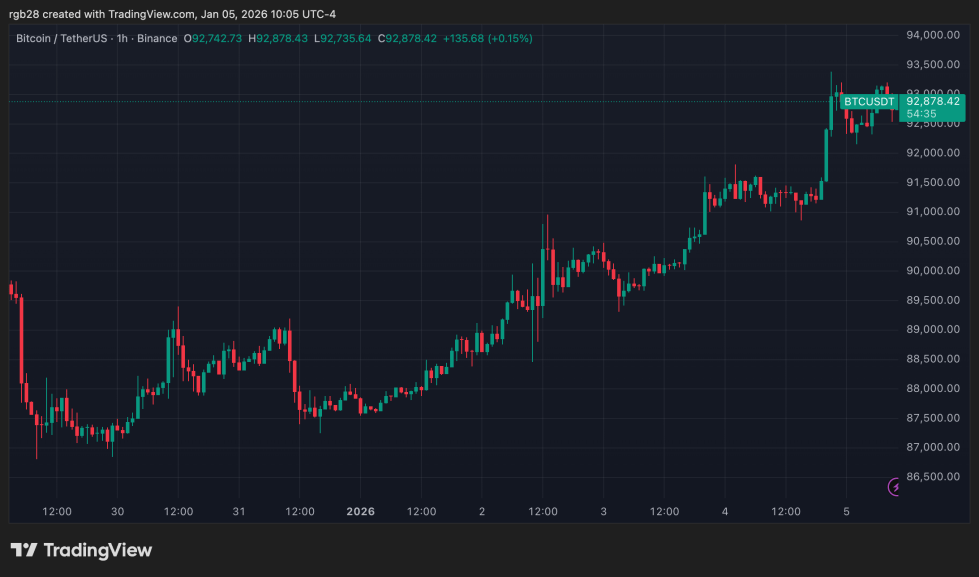
Bitcoin (BTC) trades at $92,876 in the one-week chart. Source: BTCUSDT on TradingView