Japanese Banking Giant Cuts Crypto Bets After Q3 Profit Slump

bitcoinistPubblicato 2026-02-03Pubblicato ultima volta 2026-02-03

Introduzione

Japan's largest brokerage firm Nomura announced it will temporarily reduce its cryptocurrency trading positions following a 10% decline in net income for the third quarter ending December 31. The profit slump, partly attributed to trading losses at its European crypto subsidiary Laser Digital, prompted tighter risk controls and position limits to manage earnings volatility. Despite this short-term pullback, Nomura remains committed to its long-term digital asset strategy, with Laser Digital actively seeking to expand services internationally, including applying for a U.S. trust bank charter. The firm aims to balance immediate risk management with continued development of crypto infrastructure and institutional services.

Nomura, Japan’s biggest brokerage and banking giant, said it will temporarily trim its cryptocurrency positions after a weak quarter that dented profits and tightened its short-term risk tolerance. The pullback looks aimed at smoothing swings to earnings while the firm keeps its longer-term plans for digital assets alive.

Bank Cuts Crypto Exposure After Profit Decline

According to earnings disclosures and company remarks, Nomura’s net income fell nearly 10 percent in the third quarter that ended December 31, leaving group profit lower than a year earlier and prompting management to curb some crypto trading positions to limit further hits.

Nomura’s European crypto arm, Laser Digital, had posted trading losses during the period, which management singled out as a key factor behind the move to tighten position limits.

Reports note that executives described the steps as temporary and targeted — not an exit from the market but a way to manage volatility while other parts of the business keep growing.

Short-Term Pullback, Long-Term Play

There is a split in the timeline. On one hand, Laser Digital has recently filed paperwork to expand its services abroad, including applying for a US national trust bank charter as it seeks to offer custody and trading to institutional clients.

On the other hand, trading desks that took losses are being put on a tighter leash so quarterly results don’t swing wildly. That two-track approach is what analysts say explains the seeming contradiction.

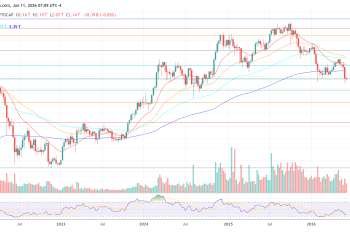
BTCUSD currently trading at $77,858. Chart: TradingView

Investors reacted quickly. Nomura’s shares slipped after the earnings update, reflecting market concern about the hit to European operations and the extra costs tied to a large acquisition completed in the period.

Management has flagged that one-off charges played a role in the weaker profit line, alongside the trading losses.

Risk Controls Tightened, Growth Goals Kept

Reports say Nomura has tightened risk controls around digital-asset positions and is conducting stricter oversight of exposures that can swing with crypto price moves.

At the same time, executives stressed the firm’s broader commitment to building crypto infrastructure and services over the medium to long term, rather than abandoning the sector outright.

The immediate effect is clear: fewer large directional bets in the trading book and more cautious position sizing. That reduces profit volatility but can limit upside if crypto prices rebound sharply.

Featured image from The Exchange Asia, chart from TradingView

Domande pertinenti

QWhy did Nomura decide to temporarily reduce its cryptocurrency positions?

ANomura decided to temporarily trim its crypto positions after a weak third quarter that saw a nearly 10% decline in net income, which tightened its short-term risk tolerance. Trading losses at its European crypto arm, Laser Digital, were a key factor behind this move.

QWhat was the performance of Nomura's net income in the third quarter ending December 31?

ANomura's net income fell nearly 10 percent in the third quarter that ended December 31, leaving group profit lower than it was a year earlier.

QWhat long-term plans does Nomura have for its digital assets business despite the short-term pullback?

ADespite the short-term reduction in crypto trading, Nomura remains committed to building crypto infrastructure and services over the medium to long term. Its European arm, Laser Digital, has filed to expand services abroad, including applying for a US national trust bank charter.

QHow did investors react to Nomura's earnings update and what were their concerns?

AInvestors reacted by pushing Nomura's shares lower. Their concerns were primarily about the hit to the firm's European operations and the extra costs associated with a large acquisition that was completed during the period.

QWhat specific measures has Nomura implemented to manage risk in its digital asset exposures?

ANomura has tightened risk controls around digital-asset positions and is conducting stricter oversight of exposures that are sensitive to cryptocurrency price movements. This includes reducing large directional bets and implementing more cautious position sizing.

Letture associate

Winter for Crypto IPOs: Consensys and Ledger Withdraw Applications

The crypto IPO window is tightening significantly in 2026, marked by prominent companies delaying or pausing their public listing plans. Following a successful 2025 "harvest year" that saw Circle, Bullish, and Gemini go public amidst a bull market, the tide has turned. Consensys, developer of MetaMask, recently postponed its IPO until at least fall 2026. Hardware wallet leader Ledger also suspended its planned US listing due to unfavorable market conditions, with Kraken having previously delayed its own plans. This shift is driven by a cooling market in 2026, characterized by a significant Bitcoin price correction, declining trading volumes, and reduced investor risk appetite for crypto stocks. The poor post-IPO performance of 2025 listings like Circle and Bullish, which saw major share price declines, has heightened investor caution. This contrasts sharply with the current AI sector, where companies like SpaceX, OpenAI, and Anthropic are commanding massive valuations and investor enthusiasm based on narratives of stable, exponential growth. Crypto companies now face pressure to transition from hype-driven models to demonstrating reliable cash flows and robust compliance. While the paused IPO plans may lead to valuation resets and affect ecosystem liquidity, they also accelerate industry consolidation toward stronger, more compliant infrastructure players. A potential recovery in Bitcoin's price and clearer regulations could reopen the IPO window in the latter half of 2026.

marsbit6 min fa

Winter for Crypto IPOs: Consensys and Ledger Withdraw Applications

marsbit6 min fa

ChatGPT Can Manage Your Money for You. Would You Trust It with Your Bank Account?

OpenAI has launched a personal finance tool for ChatGPT, currently in preview for US-based ChatGPT Pro users. This feature allows users to connect their bank and investment accounts (via Plaid, supporting over 12,000 institutions) directly to ChatGPT. It analyzes transactions, generates visual dashboards, and offers conversational financial advice—such as budgeting or planning for major purchases—based on the user's actual data. This move follows OpenAI's acquisitions of fintech startups Roi and Hiro Finance, signaling a strategic push into vertical "super assistant" applications, similar to its earlier health-focused feature. However, the launch has sparked significant privacy concerns. Critics question the safety of granting such sensitive financial access to an AI, especially amid ongoing lawsuits alleging OpenAI shared user chat data with third parties like Meta and Google. OpenAI emphasizes that ChatGPT only reads data (no transaction capabilities), deletes it within 30 days if disconnected, and offers opt-out options for model training. Yet, trust remains a major hurdle. The trend reflects a broader industry shift: AI companies like Anthropic and Perplexity are also targeting high-value, data-rich domains like finance and health. While technically promising, the tool operates in a regulatory gray area—it provides personalized guidance but disclaims formal financial advice or liability. Ultimately, OpenAI's challenge is convincing users to trust an AI with their most private financial information.

marsbit6 min fa

ChatGPT Can Manage Your Money for You. Would You Trust It with Your Bank Account?

marsbit6 min fa

Breaking: OpenAI Undergoes Major Reorganization, President Brockman Assumes Command

OpenAI has announced a major internal reorganization just months before its anticipated IPO. The company is merging its three flagship product lines—ChatGPT, Codex, and the API platform—into a single, unified product organization. The most significant leadership change involves co-founder and President Greg Brockman moving from a background technical role to take full, permanent control over all product strategy. This follows the indefinite medical leave of AGI Deployment CEO Fidji Simo. Additionally, ChatGPT's longtime lead, Nick Turley, has been reassigned to enterprise products, with former Instagram executive Ashley Alexander taking over consumer offerings. The consolidation, internally framed as a strategic move towards an "Agentic Future," aims to break down internal silos and create a cohesive "Super App." This planned desktop application would integrate ChatGPT's conversational abilities, Codex's coding power, and a rumored internal web browser named "Atlas" to autonomously perform complex user tasks. The reorganization occurs amid significant internal and external pressures. OpenAI has recently seen a wave of high-profile departures, including Sora co-lead Bill Peebles and other senior technical leaders, leading to concerns about a thinning executive bench. Externally, rival Anthropic recently secured funding at a staggering $900 billion valuation, surpassing OpenAI's own. Google's upcoming I/O developer conference also poses a competitive threat. Analysts suggest the dramatic restructure is a pre-IPO move to present a clearer, more focused narrative to Wall Street—streamlining operations and demonstrating decisive leadership under Brockman to counter internal turbulence and intense market competition.

marsbit3 h fa

Breaking: OpenAI Undergoes Major Reorganization, President Brockman Assumes Command

marsbit3 h fa

Trading

Spot
Futures
活动图片