Jack Ma Just Concluded an AI Mobilization Meeting, and the 'Soul Figure' of Qwen Left

marsbitPubblicato 2026-03-04Pubblicato ultima volta 2026-03-04

Introduzione

A major leadership shakeup has hit Alibaba's AI division following a high-level strategic meeting. Ma Yun, along with core executives from Alibaba and Ant Group, convened on March 3rd to signal a full commitment to AI. However, the very next day, Lin Junyang, the 32-year-old P10 technical lead and key architect behind Alibaba’s open-source Qwen large language models, abruptly announced his resignation on social media platform X. Reports suggest the departure was not voluntary. The trigger appears to be an internal restructuring plan for the Qwen team. The plan, from the Tongyi Lab, aimed to break up Lin’s vertically integrated, full-stack team into separate, horizontally divided modules reporting directly to the lab, which would significantly reduce his management scope. This clashed fundamentally with Lin's belief that deep collaboration within a full-process team is essential for LLM innovation. The incident highlights a growing tension within Alibaba between the open-source technical ideals championed by Lin and the company's increasing focus on commercial returns from AI. Despite Qwen's global open-source success—topping Hugging Face downloads with over 1 billion—internal skepticism about its revenue potential and pressure from competitors were mounting. Lin's resignation has sent shockwaves through the global AI community, prompting an outpouring of support. Several key Qwen team members have also resigned. His departure marks a pivotal moment for Alibaba AI, signalin...

Author: Hu Shixin, Deep Net · Tencent News Xiaoman Studio

Editor: Ye Jinyan

On March 3, Jack Ma, along with core executives from Alibaba and Ant Group such as Joe Tsai, Wu Yongming, Shao Xiaofeng, Jiang Fan, as well as Ant Group's Jing Xiandong and Han Xinyi, made a rare gathering at YunGu School in Hangzhou. This discussion, the first stop after the New Year's resumption of work, focused on the opportunities and challenges brought by AI, sending a strong strategic signal to the outside world that both groups are "All in AI".

Dramatically, on the early morning of the next day after this high-level discussion concluded, the technical leader who single-handedly pushed Alibaba's Qwen to the pinnacle of global open source, the youngest P10 in the group, Lin Junyang, suddenly posted on social platform X: "me stepping down. bye my beloved qwen." This update ignited the global AI community.

Overnight, Alibaba's Qwen lost its "helmsman".
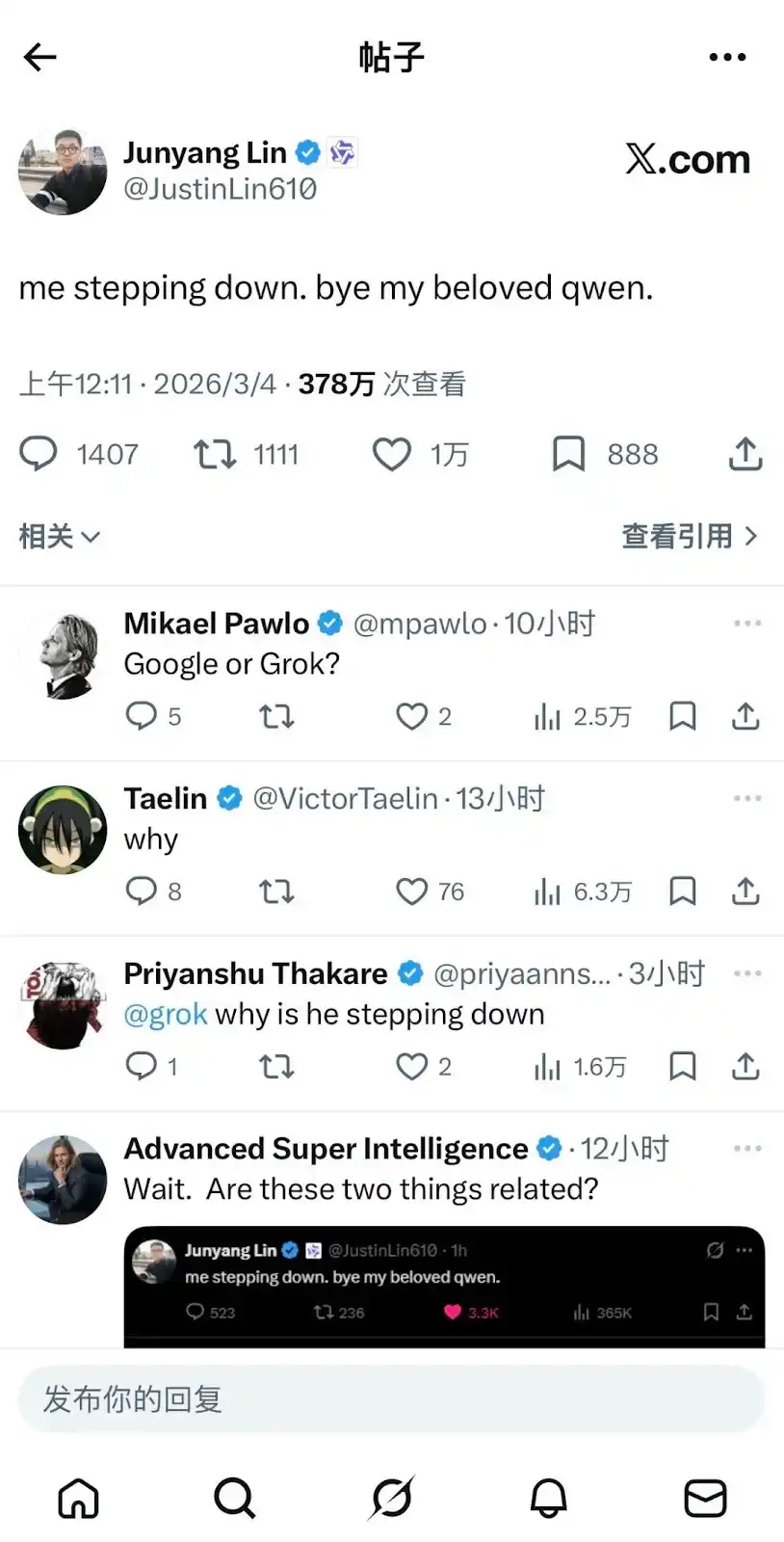
(Lin Junyang's latest update on X)

Was Lin Junyang's Departure Voluntary?

Based on information from multiple sources, we have reconstructed the key points of this departure incident.

On the evening of March 2, Lin Junyang's team released four small-scale open-source models of Qwen3.5, which immediately attracted global attention from the tech community. Elon Musk even commented that they showed "impressive intelligence density," and Lin Junyang himself reposted the comment to express gratitude. On the same day, Alibaba officially announced the unification of its B-end and C-end large model brands under "Qwen," establishing it as the group's core AI brand.

According to reports from LatePost and Phoenix Net Technology, on the afternoon of March 3, Lin Junyang left an internal meeting due to disagreements, submitted his resignation to Alibaba, and informed the Qwen team. Some colleagues were moved to tears upon hearing the news.

On the evening of March 3, Lin Junyang reposted the song "A Toast to Myself" on his WeChat Moments.

In the early hours of March 4, Lin Junyang publicly announced his resignation on platform X. As of 4 PM today, the post had received over 10,000 likes and more than 1,400 comments. Numerous industry developers left messages thanking him and the Qwen team for their contributions to the open-source field. Official accounts of AI companies like MiniMax also appeared in the comments to express recognition.

On the morning of March 4, Yu Bowen, head of Qwen post-training, and Li Kaixin, core contributor to Qwen3.5/VL/Coder, announced their resignations.

On the afternoon of March 4, Lin Junyang posted on his Moments: "Sorry friends, I won't be replying to messages and calls today. I really need to rest. Brothers of Qwen, keep working according to the original plan. It will be fine."

It is worth noting that Qwen team core contributor Chen Cheng said bluntly when forwarding Lin Junyang's post: "My heart is truly broken. I know leaving wasn't your choice. Just last night, we were standing side by side releasing the Qwen3.5 small models. I can't imagine what Qwen will be like without you."

This comment fueled the rapid spread of the involuntary departure theory within the industry. As of now, Alibaba has not publicly responded to this personnel change. A source close to Alibaba believes that Lin Junyang's resignation was not voluntary, and his quick posting of the resignation notice on X was likely due to an inability to control his emotions at the time.

Why Did He Leave?

Lin Junyang's sudden departure caused a huge shock in the industry, leading to widespread speculation. At its root, it was the concentrated eruption of long-standing multiple conflicts within Alibaba regarding organizational structure, technical路线 (path/approach), commercial goals, and talent landscape.

The trigger likely came from a team restructuring. According to LatePost, the Tongyi Lab planned to break the vertically integrated R&D model of the Qwen team. The original full-process closed-loop team covering pre-training, post-training, multimodal R&D, and infrastructure building was to be split into several independent horizontal modules, all directly managed and coordinated by the Tongyi Lab. Consequently, Lin Junyang's management authority and business scope would be narrowed.

Behind the structural adjustment lies a fundamental conflict in large model development philosophy between Lin Junyang and Alibaba's top management. Lin Junyang believes that the core competitiveness of large model R&D comes from the deep collaboration of a full-process team. Fragmented assembly-line division of labor would severely damage R&D efficiency and innovation space, and his team had already built a self-developed infrastructure system. The lab's direction of splitting and dispersing the work was completely contrary to his judgment of the development trend of large model technology.

Even harder to reconcile than the technical route分歧 (divergence/disagreement) is the deep-seated contradiction between the open-source route and the group's commercial goals. Under Lin Junyang's leadership, Qwen topped the global open-source large model rankings with a comprehensive open-source strategy, becoming a benchmark for Chinese large models going global. However, Alibaba's core assessment of Qwen has shifted from building technical influence to commercial落地 (landing/commercialization).

However, there have always been internal doubts about the revenue efficiency of the open-source model. It is reported that some executives even评价 (evaluated) the Qwen-3.5, which debuted on New Year's Eve, as an unfinished "semi-product." Coupled with the market pressure from the Qwen App's 3 billion RMB subsidy in the C-end not meeting expectations and the B-end AI cloud business facing aggressive competition from rivals, the misalignment between technical ideals and commercial goals became increasingly difficult to reconcile.

Behind this change, the restructuring of the talent landscape within the Tongyi Lab also led to a dilution of core decision-making power. Since 2025, Alibaba has continuously引入 (brought in) top global AI talent. After IEEE Fellow Xu Zhuhong transferred to the Tongyi Lab, the business he was responsible for overlapped significantly with Qwen's布局 (layout/plan). In early 2026, former DeepMind senior researcher Zhou Hao joined, reporting directly to the head of the lab, and was also set to take over the work of the departing post-training head Yu Bowen.

The lab's shift from a Lin Junyang-led single-core model to a "multi-power parallel" structure,叠加 (coupled with) the successive loss of Qwen's core founding team members, contributed to this industry-shaking departure incident.

Who Can Replace Lin Junyang?

The reason this departure caused连锁 (chain) reactions within Alibaba and the global open-source community lies in Lin Junyang's key industry status within the Qwen team, Alibaba's AI system, and even the global open-source large model field.

As a rare, entirely locally grown technical leader in China's AI industry, Lin Junyang, born in 1993, has an interdisciplinary background with a bachelor's degree in Computer Science from Peking University and a master's degree in Linguistics and Applied Linguistics. This also gave him a unique advantage in large language model R&D.

After graduating with his master's degree in 2019, he chose not to study abroad but joined Alibaba DAMO Academy directly, starting as a senior algorithm engineer. He was promoted four levels in 6 years, becoming Alibaba's youngest P10 technical expert at 32, standing shoulder to shoulder with technical leaders like Tang Jie from Zhipu AI, Yang Zhilin from MoonShot AI, and Yao Shunyu from Tencent (who have overseas PhD backgrounds), and跻身 (stepping into) the industry-recognized ranks of the "Four Heroes of Foundation Models" in China.

When Lin Junyang took over as technical lead of Tongyi Qianwen (Qwen) at the end of 2022, the domestic large model track was just emerging, and Alibaba's large model布局 (layout) had not yet formed a clear differentiated advantage. Under his leadership, Qwen embarked on a comprehensive open-source strategy, creating a model family covering full parameter sizes from 0.8B to 72B. The trillion-parameter flagship model Qwen3-Max, launched in 2025, surpassed同期 (contemporary) international mainstream models in多项 (multiple) evaluations like GPQA.

As of January 2026, the number of derivative models of the Qwen series on Hugging Face, the world's largest AI open-source community, exceeded 200,000, with downloads surpassing 1 billion, firmly ranking first globally for open-source large models. Stanford University's "2025 AI Index Report" showed that the performance gap between top Chinese and US AI large models narrowed to 0.3%, with Qwen's core model contribution ranking third globally.

After Lin Junyang's departure, two main doubts arose externally.

  • Who will succeed Lin Junyang? According to internal sources, due to the suddenness of the incident, there is currently no candidate who can fully replace Lin Junyang. His originally responsible full-stack management work will be decomposed into multiple parallel teams following the team split.
  • Where will Lin Junyang go? A long-time Alibaba industry observer stated that there is a high probability he will start his own business independently, or possibly join a明星 (star) team focused on embodied AI or world models. The probability of being persuaded to stay is very small.

For Alibaba AI, the primary heavy impact brought by this personnel change is the risk of a chain reaction of core team loss and dampened team morale. According to Phoenix Net Technology, Alibaba's top management is still communicating with him to try to retain Lin Junyang.

Within just three months, the technical lead, post-training lead, code lead, and other early core founding members of Qwen have resigned successively. This will not only directly affect the subsequent iteration rhythm of the Qwen model but may also trigger further talent loss.

Lin Junyang's departure is a标志性 (symbolic) node marking a comprehensive gear shift in Alibaba's AI strategy. This means Alibaba's large model will bid farewell to the stage focused on building technical benchmarks and global open-source ecosystem construction, and fully transition to a new cycle centered on commercial落地 (landing/commercialization).

But what lies ahead for Alibaba is the disruption to the R&D rhythm caused by the loss of the core team, fluctuations in trust within the global open-source ecosystem, and intense industry competition from rivals like ByteDance and Tencent. The chain reaction caused by this personnel shock will directly test the落地韧性 (landing resilience) of Alibaba's All in AI strategy.


Domande pertinenti

QWho is Lin Junyang and what was his role at Alibaba's Qwen project?

ALin Junyang was the technical leader of Alibaba's Qwen project, responsible for driving its open-source strategy and development. He was the youngest P10-level technical expert at Alibaba and a key figure in establishing Qwen as a leading global open-source large model.

QWhat event triggered Lin Junyang's sudden resignation from Alibaba?

ALin Junyang resigned following an internal meeting disagreement on March 3, where he reportedly left the meeting abruptly and submitted his resignation. The restructuring of the Qwen team and conflicts over technical and commercial strategies were key factors.

QHow did the global AI community react to Lin Junyang's departure?

AThe global AI community expressed shock and appreciation for Lin Junyang's contributions. His announcement on X received over 10,000 likes and 1,400 comments, with developers and AI companies like MiniMax thanking him for his work in open-source AI.

QWhat were the underlying reasons for the conflict leading to Lin Junyang's resignation?

AThe conflict arose from disagreements over team restructuring, technical approaches, and commercial goals. Lin advocated for integrated team collaboration, while Alibaba's leadership pushed for a divided, modular structure focused on commercialization, leading to irreconcilable differences.

QWhat impact might Lin Junyang's departure have on Alibaba's AI strategy?

AHis departure signals a shift in Alibaba's AI strategy from open-source ecosystem building to commercialization. It risks team morale, talent retention, and Qwen's development pace, while intensifying competition with rivals like ByteDance and Tencent.

Letture associate

North Korean Hackers Loot $500 Million in a Single Month, Becoming the Top Threat to Crypto Security

North Korean hackers, particularly the notorious Lazarus Group and its subgroup TraderTraitor, have stolen over $500 million from cryptocurrency DeFi platforms in less than three weeks, bringing their total theft for the year to over $700 million. Recent major attacks on Drift Protocol and KelpDAO, resulting in losses of approximately $286 million and $290 million respectively, highlight a strategic shift: instead of targeting core smart contracts, attackers are now exploiting vulnerabilities in peripheral infrastructure. For instance, the KelpDAO attack involved compromising downstream RPC infrastructure used by LayerZero's decentralized validation network (DVN), allowing manipulation without breaching core cryptography. This sophisticated approach mirrors advanced corporate cyber-espionage. Additionally, North Korea has systematically infiltrated the global crypto workforce, with an estimated 100 operatives using fake identities to gain employment at blockchain companies, enabling long-term access to sensitive systems and facilitating large-scale thefts. According to Chainalysis, North Korean-linked hackers stole a record $2 billion in 2025, accounting for 60% of all global crypto theft that year. Their total historical crypto theft has reached $6.75 billion. Post-theft, they employ specialized money laundering methods, heavily relying on Chinese OTC brokers and cross-chain mixing services rather than standard decentralized exchanges. Security experts, while acknowledging the increased sophistication, emphasize that many attacks still exploit fundamental weaknesses like poor access controls and centralized operational risks. Strengthening private key management, limiting privileged access, and enhancing coordination among exchanges, analysts, and law enforcement immediately after an attack are critical to improving defense and fund recovery chances. The industry's challenge now extends beyond secure smart contracts to safeguarding operational security at the infrastructure level.

marsbit12 min fa

North Korean Hackers Loot $500 Million in a Single Month, Becoming the Top Threat to Crypto Security

marsbit12 min fa

Circle CEO's Seoul Visit: No Korean Won Stablecoin Issuance, But Met All Major Korean Banks

Circle CEO Jeremy Allaire's recent activities in Seoul indicate a strategic shift for the company, moving away from issuing a Korean won-backed stablecoin and instead focusing on embedding itself as a key infrastructure provider within Korea’s financial and crypto ecosystem. Despite Korea accounting for nearly 30% of global crypto trading volume—with a market characterized by high retail participation and altcoin dominance—Circle has chosen not to compete for the role of stablecoin issuer. Instead, Allaire met with major Korean banks (including Shinhan, KB, and Woori), financial groups, leading exchanges (Upbit, Bithumb, Coinone), and tech firms like Kakao. This approach reflects a broader industry transition: the core of stablecoin competition is shifting from issuance rights to systemic positioning. With Korean regulators still debating whether banks or tech companies should issue stablecoins, Circle is avoiding regulatory uncertainty by strengthening its role as a service and technology partner. The company is deepening integration with trading platforms, building connections, and promoting stablecoin infrastructure. This positions Circle to benefit regardless of which entity eventually issues a won stablecoin. Allaire also noted the potential for a Chinese yuan stablecoin in the next 3–5 years, underscoring a regional trend of stablecoins becoming more regulated and integrated with traditional finance. Ultimately, Circle’s strategy highlights that future influence in the stablecoin market will belong not necessarily to the issuers, but to the foundational infrastructure layers that enable cross-system transactions.

marsbit40 min fa

Circle CEO's Seoul Visit: No Korean Won Stablecoin Issuance, But Met All Major Korean Banks

marsbit40 min fa

SpaceX Ties Up with Cursor: A High-Stakes AI Gambit of 'Lock First, Acquire Later'

SpaceX has secured an option to acquire AI programming company Cursor for $60 billion, with an alternative clause requiring a $10 billion collaboration fee if the acquisition does not proceed. This structure is not merely a potential acquisition but a strategic move to control core access points in the AI era. The deal is designed as a flexible, dual-path arrangement, allowing SpaceX to either fully acquire Cursor or maintain a binding partnership through high-cost collaboration. This "option-style" approach minimizes immediate regulatory and integration risks while ensuring long-term alignment between the two companies. At its core, the transaction exchanges critical AI-era resources: SpaceX provides its Colossus supercomputing cluster—one of the world’s most powerful AI training infrastructures—while Cursor contributes its AI-native developer environment and strong product adoption. This synergy connects compute power, models, and application layers, forming a closed-loop AI capability stack. Cursor, founded in 2022, has achieved rapid growth with over $1 billion in annual revenue and widespread enterprise adoption. Its value lies in transforming software development through AI agents capable of coding, debugging, and system design—positioning it as a gateway to future software production. For SpaceX, this move is part of a broader strategy to evolve from a aerospace company into an AI infrastructure empire, integrating xAI, supercomputing, and chip manufacturing. Controlling Cursor fills a gap in its developer tooling layer, strengthening its AI narrative ahead of a potential IPO. The deal reflects a shift in AI competition from model superiority to ecosystem and entry-point control. With programming tools as a key battleground, securing developer loyalty becomes crucial for dominating the software production landscape. Risks include questions around Cursor’s valuation, technical integration challenges, and potential regulatory scrutiny. Nevertheless, the deal underscores a strategic bet: controlling both compute and software development access may redefine power dynamics in the AI-driven future.

marsbit1 h fa

SpaceX Ties Up with Cursor: A High-Stakes AI Gambit of 'Lock First, Acquire Later'

marsbit1 h fa

Trading

Spot
Futures

Articoli Popolari

Cosa è DOGE M

Doge Matrix ($doge m): La Nuova Razza di Criptovaluta Guidata dalla Comunità Introduzione Nel panorama in continua evoluzione delle criptovalute, nuovi progetti emergono costantemente, ciascuno con l'obiettivo di catturare l'interesse di investitori ed appassionati. Uno degli ultimi ingressi in questo dominio è Doge Matrix, rappresentato dal simbolo ticker $doge m. Questo progetto ha attirato attenzione grazie alle sue radici nella popolare cultura dei meme che circonda Dogecoin, stabilendo il suo posto all'interno dello spazio web3. Questo articolo mira a fornire un'analisi completa di Doge Matrix, coprendo la sua panoramica, il creatore, gli investitori, la funzionalità, la cronologia e gli aspetti notevoli. Cos'è Doge Matrix ($doge m)? Doge Matrix è un progetto di criptovaluta guidato dalla comunità che apparentemente si basa sull'ampio appeal di Dogecoin, una valuta digitale nota per il suo mascotte Shiba Inu e le sue origini nei meme. Sebbene gli obiettivi generali di Doge Matrix non siano ampiamente definiti, è caratterizzato da un impegno a sfruttare il coinvolgimento e il supporto della comunità. A differenza delle criptovalute tradizionali che spesso enfatizzano l'utilità o il valore intrinseco attraverso tecnologie sottostanti, Doge Matrix si posiziona all'interno di uno spazio che abbraccia il fenomeno culturale delle criptovalute, particolarmente attraente per coloro che risuonano con l'etica degli asset basati sui meme. Attraendo i punti di forza della comunità di Dogecoin, Doge Matrix opera come parte di un ecosistema più ampio, invitando alla partecipazione e all'impegno degli utenti che condividono un interesse per le criptovalute e il panorama digitale. Chi è il Creatore di Doge Matrix ($doge m)? L'identità del creatore di Doge Matrix rimane sconosciuta. Questa mancanza di trasparenza non è un evento raro nello spazio delle criptovalute, dove alcuni progetti vengono lanciati senza rivelare le identità dei loro fondatori. L'assenza di informazioni riguardanti il team fondatore può sollevare domande tra i potenziali investitori sulla responsabilità e la direzione del progetto. Chi sono gli Investitori di Doge Matrix ($doge m)? Al momento, non ci sono informazioni pubblicamente disponibili che dettagliano gli investitori o le fondazioni di investimento che supportano Doge Matrix. Il progetto sembra fare affidamento principalmente sul supporto della comunità piuttosto che su investimenti istituzionali. Questo modello si allinea con la natura guidata dalla comunità dell'iniziativa, favorendo un ambiente in cui la direzione del progetto è plasmata dai suoi partecipanti piuttosto che essere dettata da un selezionato gruppo di finanziatori. Come Funziona Doge Matrix ($doge m)? I dettagli riguardanti i meccanismi operativi di Doge Matrix sono piuttosto vaghi, riflettendo una tendenza più ampia di progetti nello spazio delle meme coin in cui le funzionalità innovative non sono sempre chiaramente articolate. Tuttavia, Doge Matrix sembra essere progettato per sfruttare l'ecosistema esistente delle criptovalute incoraggiando la partecipazione degli utenti mentre attinge ai riferimenti culturali familiari associati a Dogecoin. Le sue potenzialmente uniche caratteristiche derivano dalle interazioni della comunità piuttosto che dai progressi tecnologici, enfatizzando esperienze condivise e collaborazione tra i detentori di token. Sebbene le esatte innovazioni non siano state esplicitamente delineate, il progetto sembra creare uno spazio in cui i membri della comunità possono impegnarsi, condividere idee e promuovere il potenziale del progetto. Cronologia di Doge Matrix ($doge m) Riflettendo sulla cronologia del progetto, emergono eventi notevoli che hanno definito il suo percorso fino ad ora: 25 Novembre 2024: Doge Matrix ha raggiunto il suo valore massimo storico, segnando un traguardo significativo nella sua storia iniziale. 1 Gennaio 2025: Al contrario, Doge Matrix ha toccato il suo valore minimo storico, illustrando la volatilità spesso associata alle criptovalute, specialmente nelle prime fasi del ciclo di vita di un progetto. In Corso: Il progetto continua ad essere attivamente scambiato e supportato dalla sua comunità, sebbene specifici traguardi o obiettivi futuri debbano ancora essere divulgati. Punti Chiave su Doge Matrix ($doge m) Focus sulla Comunità Al centro di Doge Matrix c'è un impegno per il coinvolgimento della comunità. Il progetto prospera sulla premessa della collaborazione e degli obiettivi condivisi tra i suoi membri, enfatizzando l'importanza dello sforzo collettivo. A differenza dei progetti centralizzati che spesso hanno una struttura di leadership definita, Doge Matrix attualmente mostra un approccio più fluido alla governance, dove la voce di ogni membro della comunità conta. Volatilità Il mercato delle criptovalute è noto per la sua volatilità, e Doge Matrix non fa eccezione. La sua storia dei prezzi riflette fluttuazioni significative tra valori alti e bassi, il che è tipico di molte nuove criptovalute ma sottolinea i rischi associati all'investimento in token emergenti. Mancanza di Informazioni Dettagliate Una delle caratteristiche più sorprendenti di Doge Matrix è la scarsità di informazioni dettagliate riguardanti le sue fondamenta tecnologiche e i meccanismi operativi. Questa ambiguità richiede che i potenziali investitori conducano un'accurata due diligence prima di impegnarsi con il progetto. Conclusione In sintesi, Doge Matrix ($doge m) illustra una nuova ondata di progetti di criptovaluta che si basano fortemente sul coinvolgimento della comunità e sulla rilevanza culturale. Sebbene manchi di alcuni dettagli—come una leadership chiara, obiettivi definiti e funzionalità dettagliate—il progetto è riuscito a generare interesse all'interno della comunità crypto, sfruttando l'appello consolidato della cultura dei meme. Come per qualsiasi investimento nello spazio delle criptovalute, comprendere i rischi intrinseci e condurre una ricerca approfondita è essenziale per i potenziali partecipanti. Doge Matrix si erge come un promemoria della natura dinamica, a volte imprevedibile, dell'industria crypto, caratterizzata da un'evoluzione costante e dall'entusiasmo per le iniziative guidate dalla comunità.

363 Totale visualizzazioniPubblicato il 2025.02.03Aggiornato il 2025.02.03

Cosa è DOGE M

Cosa è $M

Comprendere Mantis ($M): Una Nuova Era nell'Interoperabilità Cross-Chain Nel panorama in continua evoluzione del Web3 e delle criptovalute, nuovi progetti si sforzano di offrire soluzioni innovative mirate a migliorare l'esperienza dell'utente e ad ampliare le possibilità funzionali all'interno dell'ecosistema finanziario decentralizzato. Uno di questi progetti che sta attirando attenzione è Mantis ($M), un protocollo pionieristico fondato sui principi dell'interoperabilità cross-chain e dei pagamenti basati sull'intento. Questo articolo esplora gli aspetti essenziali di Mantis, inclusa la sua funzionalità principale, i creatori, il supporto agli investimenti, le caratteristiche innovative e le tappe fondamentali. Che cos'è Mantis ($M)? Mantis è descritto come un protocollo di regolamento dell'intento multi-dominio che semplifica le interazioni cross-chain, consentendo agli utenti di eseguire transazioni finanziarie complesse su varie piattaforme blockchain senza soluzione di continuità. Il protocollo opera attraverso tre livelli principali: Espressione dell'Intento: Gli utenti possono articolare i loro obiettivi di transazione utilizzando un linguaggio naturale facilitato dal DISE LLM, un avanzato modello di linguaggio AI. Ad esempio, un utente potrebbe esprimere il desiderio di scambiare Ethereum (ETH) con Solana (SOL) con una tolleranza di slippage specifica dell'1%. Esecuzione: Questo livello impiega una rete di risolutori che competono per soddisfare gli intenti degli utenti. Le transazioni vengono eseguite utilizzando meccanismi come la Coincidenza dei Desideri (CoWs) e le Aste sul Flusso degli Ordini (OFAs), che garantiscono che le richieste degli utenti siano soddisfatte in modo ottimale. Regolamento: Sfruttando il protocollo di Comunicazione Inter-Blockchain (IBC), Mantis consente transazioni atomic cross-chain, permettendo agli utenti di operare su varie catene supportate, tra cui Ethereum, Solana e Cosmos. Mantis è progettato per introdurre generazione di rendimento nativa per asset inattivi, impiegando prove crittografiche per mantenere l'integrità delle transazioni durante l'intero processo. Creatori e Team di Sviluppo Mantis è stato concepito dalla Composable Foundation, un'organizzazione orientata alla ricerca nota per il suo focus sulle soluzioni di interoperabilità blockchain. Questa fondazione collabora con istituzioni accademiche di prestigio, tra cui l'Università di Harvard e l'Università di Lisbona, contribuendo a sforzi di ricerca e sviluppo estesi che informano l'architettura e la funzionalità di Mantis. L'impegno della Composable Foundation a promuovere l'innovazione nello spazio blockchain posiziona Mantis come una soluzione robusta per la crescente domanda di interoperabilità tra più reti blockchain. Investitori e Supporto Sebbene i dettagli specifici sugli investitori individuali non siano stati resi pubblici, Mantis gode di un sostegno sostanziale da parte di vari enti, tra cui: Sovvenzioni ecosistemiche da catene abilitate IBC, che supportano la crescita e l'integrazione del protocollo all'interno degli ecosistemi finanziari decentralizzati. Partnership strategiche con fornitori di infrastrutture che migliorano le capacità di rete e le strategie di distribuzione di Mantis. Finanziamenti attraverso il tesoro della Composable Foundation, garantendo un supporto finanziario sostenuto per lo sviluppo continuo e i costi operativi. Questi sforzi collaborativi riflettono un consenso tra le parti interessate sull'importanza di migliorare la funzionalità cross-chain e il potenziale utilizzo delle innovazioni infrastrutturali di Mantis. Innovazioni Chiave Mantis si distingue attraverso diverse innovazioni pionieristiche che migliorano la sua funzionalità e utilità: Intenti Agnostici alla Catena: Gli utenti possono avviare transazioni da qualsiasi catena supportata mentre si regolano su un'altra. Questa flessibilità potenzia gli utenti, aumentando l'interazione tra diverse piattaforme. Interfaccia Potenziata dall'AI: L'integrazione del DISE LLM consente agli utenti di condurre operazioni DeFi complesse utilizzando un linguaggio naturale, semplificando così le interazioni e rendendo la tecnologia blockchain accessibile a un pubblico più ampio. Cattura MEV Cross-Domain: Mantis crea un mercato interno per il valore massimamente estraibile (MEV) attraverso competizioni tra risolutori. Questo approccio innovativo consente una maggiore efficienza e estrazione di valore in transazioni complesse. Strato di Regolamento Modulare: Il protocollo supporta vari metodi di verifica, comprese le prove a conoscenza zero e i rollup ottimistici, fornendo un framework versatile che può adattarsi alle tecnologie blockchain emergenti. Cronologia Storica Lo sviluppo di Mantis è contrassegnato da diverse tappe fondamentali che tracciano la sua traiettoria e crescita: | Anno | Tappa | |————|————————————————————————| | 2022 | Sviluppo del concetto iniziale all'interno della divisione di ricerca della Composable Foundation. | | Q3 2024 | Lancio del testnet con capacità di bridging tra Solana ed Ethereum. | | Q1 2025 | Evento di Generazione di Token (TGE) previsto insieme al lancio della mainnet. | | Q2 2025 | Integrazione attesa del DISE LLM e espansione delle capacità cross-chain. | | 2025 H2 | Supporto pianificato per oltre 15 catene attraverso ulteriori aggiornamenti IBC. | Questa cronologia delinea l'evoluzione di Mantis, dalle discussioni concettuali all'implementazione attiva e alle fasi di crescita future. Strategia di Crescita dell'Ecosistema La strategia di Mantis per la crescita dell'ecosistema include diverse iniziative progettate per incoraggiare la partecipazione degli utenti e il coinvolgimento degli sviluppatori: Sistema di Crediti: Gli utenti possono guadagnare crediti del protocollo fornendo liquidità e partecipando a programmi di referral. Questi crediti sono riscattabili per incentivi futuri, promuovendo una comunità utente robusta. Kit di Sviluppo Software Modulare (SDK): Questo toolkit consente agli sviluppatori di creare applicazioni basate su modelli guidati dall'intento utilizzando l'infrastruttura di Mantis, promuovendo così l'innovazione all'interno del suo ecosistema. Modello di Governance: Man mano che il protocollo matura, i detentori di token $M avranno voce in capitolo nella governance del protocollo, consentendo loro di votare su aggiornamenti e modifiche proposti, migliorando così il coinvolgimento della comunità e la decentralizzazione. Mantis rappresenta un significativo avanzamento nel campo dell'architettura cross-chain. Integrando senza soluzione di continuità algoritmi AI avanzati con un robusto framework di regolamento, Mantis cerca di affrontare i problemi di frammentazione all'interno degli ecosistemi multi-chain. Il suo approccio innovativo prioritizza il miglioramento delle esperienze degli utenti, mantenendo i principi fondamentali di decentralizzazione e sicurezza, stabilendo un nuovo standard per l'interoperabilità futura delle tecnologie blockchain. Man mano che Mantis continua il suo percorso di crescita e implementazione, promette di essere un progetto da seguire da vicino nel competitivo panorama del Web3 e della finanza decentralizzata. Con il suo focus sul superamento dei confini e sull'elevazione del coinvolgimento degli utenti, Mantis è destinato a diventare una parte integrante dei futuri sviluppi nel campo delle criptovalute.

46 Totale visualizzazioniPubblicato il 2025.03.18Aggiornato il 2025.03.18

Cosa è $M

Come comprare M

Benvenuto in HTX.com! Abbiamo reso l'acquisto di MemeCore (M) semplice e conveniente. Segui la nostra guida passo passo per intraprendere il tuo viaggio nel mondo delle criptovalute.Step 1: Crea il tuo Account HTXUsa la tua email o numero di telefono per registrarti il tuo account gratuito su HTX. Vivi un'esperienza facile e sblocca tutte le funzionalità,Crea il mio accountStep 2: Vai in Acquista crypto e seleziona il tuo metodo di pagamentoCarta di credito/debito: utilizza la tua Visa o Mastercard per acquistare immediatamente MemeCoreM.Bilancio: Usa i fondi dal bilancio del tuo account HTX per fare trading senza problemi.Terze parti: abbiamo aggiunto metodi di pagamento molto utilizzati come Google Pay e Apple Pay per maggiore comodità.P2P: Fai trading direttamente con altri utenti HTX.Over-the-Counter (OTC): Offriamo servizi su misura e tassi di cambio competitivi per i trader.Step 3: Conserva MemeCore (M)Dopo aver acquistato MemeCore (M), conserva nel tuo account HTX. In alternativa, puoi inviare tramite trasferimento blockchain o scambiare per altre criptovalute.Step 4: Scambia MemeCore (M)Scambia facilmente MemeCore (M) nel mercato spot di HTX. Accedi al tuo account, seleziona la tua coppia di trading, esegui le tue operazioni e monitora in tempo reale. Offriamo un'esperienza user-friendly sia per chi ha appena iniziato che per i trader più esperti.

362 Totale visualizzazioniPubblicato il 2025.07.02Aggiornato il 2025.07.02

Come comprare M

Discussioni

Benvenuto nella Community HTX. Qui puoi rimanere informato sugli ultimi sviluppi della piattaforma e accedere ad approfondimenti esperti sul mercato. Le opinioni degli utenti sul prezzo di M M sono presentate come di seguito.

活动图片