Israeli Military Catching Insiders on Polymarket

Odaily星球日报Pubblicato 2026-02-13Pubblicato ultima volta 2026-02-13

Introduzione

Israeli military and civilian prosecutors have charged a reservist soldier and a civilian with using classified military information to profit from bets on the prediction market platform Polymarket. The suspects allegedly leveraged insider knowledge on the timing of military operations to place winning bets, netting over $150,000. One user, identified as "Rundeep," reportedly achieved a 100% success rate in six Israel-related predictions, often betting when odds were below 50%. The case highlights concerns about insider trading on prediction markets, especially regarding sensitive areas like military actions, where such activities could compromise operational security and potentially influence real-world outcomes. Regulatory scrutiny may follow as these platforms face growing scrutiny over their role in public affairs betting.

Original | Odaily Planet Daily (@OdailyChina)

Author | Azuma (@azuma_eth)

Insider information providing an unfair competitive advantage has long been a controversial focus on prediction markets like Polymarket.

Previously, during the US military's operation to capture Venezuelan President Maduro, the odds for related events on Polymarket showed abnormal movements ahead of time (see "When War is Settled Before the News: How Prediction Markets 'Priced' the Maduro Capture Operation 6 Days Early"). If that suspected insider activity could still be explained away by fluctuations in the "Pizza Index," then this time, it can be said that there is definitely an insider on Polymarket, completely confirmed.

Israeli Military Catching "Insiders" Internally

On February 12, Israel's largest English-language newspaper, The Jerusalem Post, reported that the Tel Aviv District Court indicted an Israeli civilian and an Israel Defense Forces (IDF) reservist on Monday, accusing the two of using classified military information to place bets on Polymarket for profit. The court revealed on Thursday that Israeli authorities believe this behavior poses a serious operational security risk during wartime.

According to a statement approved for release by the prosecution, the suspects were arrested in a joint operation by the Israel Security Agency (Shin Bet), the investigation unit under the Ministry of Defense's security agency, and the Israeli police. Investigators suspect that some reservists are using the classified information they access through their military duties to bet on the timing of military operations and profit from it.

Following the investigation, the prosecution stated that it has obtained evidence of misconduct by the civilian and the reservist and has therefore decided to indict the two on charges of "serious security crimes" as well as bribery and obstruction of justice. Meanwhile, the prosecution requested the court to extend the suspects' detention until the conclusion of the trial.

Apart from the information released above, more details of the case remain under a legal gag order, including the identities of the defendants, the specific betting content, and the alleged information flow situation.

Tracing the Insider's Activities

Although we cannot learn the true identity and account information of this insider, the X community had already discovered an account on Polymarket with clearly abnormal behavior. The Jerusalem Post also included a screenshot of this account's profits in its report.
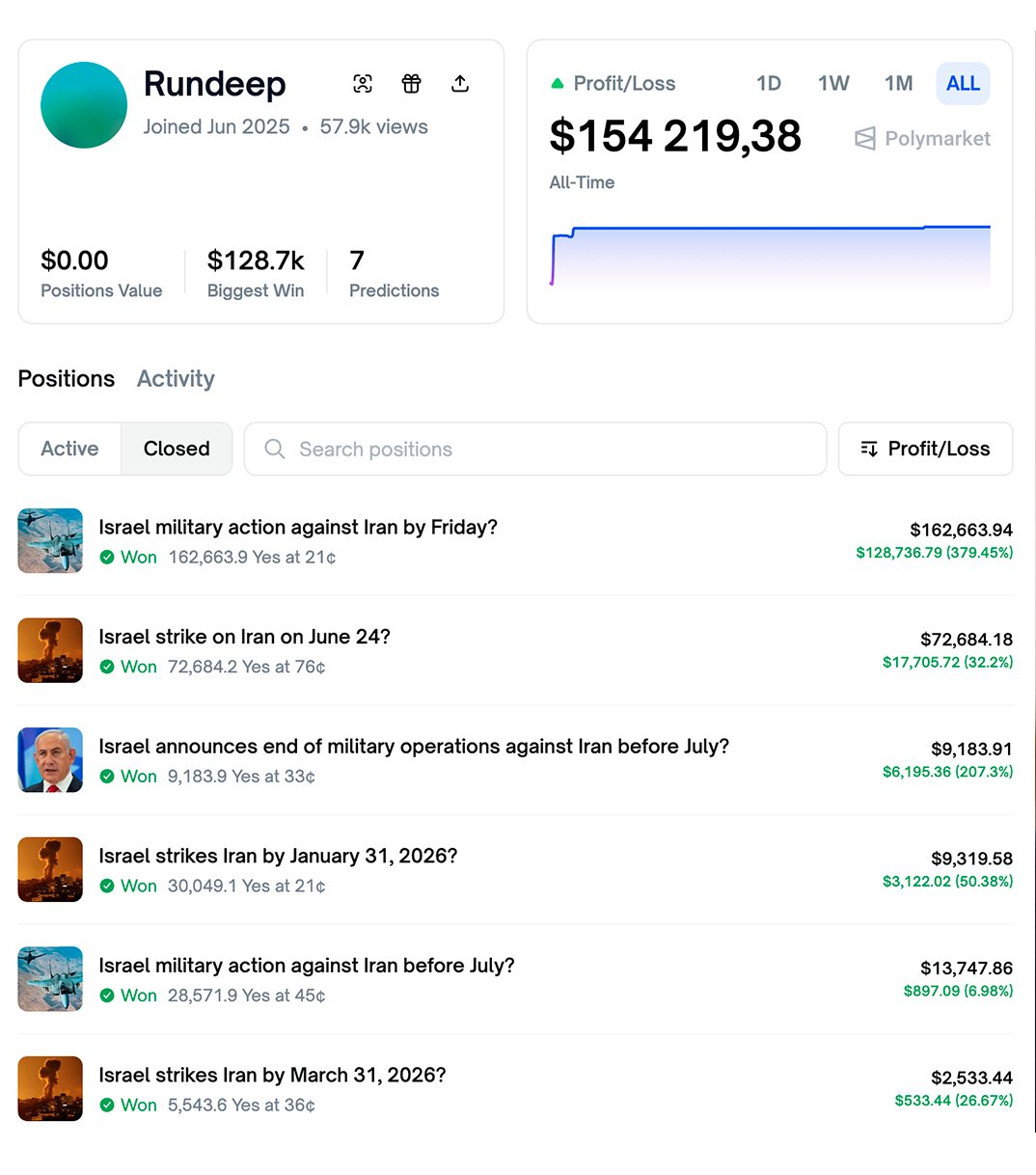
As shown in the image above, this user named Rundeep joined Polymarket in June 2025 and subsequently achieved a 100% win rate in six prediction markets related to Israeli military actions, with five of those bets placed when the probability was below 50%, ultimately profiting over $150,000.

It is worth mentioning that Odaily Planet Daily found that Rundeep had only one loss on Polymarket aside from these "six wins in six attempts." However, this failed prediction was not directly related to Israel but was about "whether the US military would take action against Iran before Saturday (June 21, 2025)"... It seems allied intelligence isn't very reliable after all.

The Real-World Repercussions of Prediction Markets, Truly Frightening to Ponder

Due to Polymarket's open, permissionless nature, anyone can freely place bets on the platform, which objectively provides a more convenient channel for "monetizing information" for those with intelligence advantages — driven by profit, those holding unequal information advantages find it hard to resist the temptation, making it inevitable that insiders will step in to make money.

If such things happened in conventional areas like sports or entertainment, the impact might still be somewhat controllable. But when similar insider betting events occur in sensitive areas like politics or even war, the potential连带 (liándài -连带 means连带, chain, related) terrifying consequences are hard to imagine.

Taking this article as an example, if opposing forces guessed the direction of an Israeli operation in advance through insider betting on Polymarket before the action took place, could it have a huge impact on the subsequent evolution of events? Most people might not easily sympathize with Israel, but in fact, such events could happen to any entity.

In traditional gambling, public affairs such as political elections, legislative outcomes, and wars are usually subject to clear restrictions. Whether prediction markets will face similar regulatory restrictions in the future may involve a long-term regulatory博弈 (bóyì -博弈 means game theory,博弈, struggle,博弈).


Domande pertinenti

QWhat is the main subject of the article regarding the Israeli military and Polymarket?

AThe article reports that the Israeli military is prosecuting a civilian and an IDF reservist for allegedly using classified military information to place bets and profit on the prediction market platform Polymarket.

QWhich user on Polymarket was identified by the X community as having suspiciously successful betting activity related to Israeli military actions?

AA user named Rundeep was identified, who achieved a 100% win rate across six prediction markets related to Israeli military actions, with five of those bets placed when the probability was below 50%, earning over $150,000.

QWhat potential risk does the article suggest that insider betting on platforms like Polymarket could pose in the context of military operations?

AThe article suggests that insider betting could pose a severe operational security risk in wartime, as opposing forces might detect upcoming military actions by observing suspicious betting patterns on the prediction market, potentially altering the course of events.

QWhat was the outcome of the single bet that the user Rundeep lost on Polymarket, and what was it about?

ARundeep's only lost bet was on the prediction 'Will the US military take action against Iran by Saturday (June 21, 2025)?', which was not directly related to Israeli operations.

QHow does the article contrast the regulation of traditional betting markets with prediction markets like Polymarket concerning public affairs?

AThe article notes that traditional betting markets often have explicit restrictions on public affairs like political elections, legislation, and war, and it suggests that prediction markets may face a long-term regulatory battle over similar restrictions in the future.

Letture associate

UNI Doubles in Two Months Against the Trend: A 5-Year-Overdue Value Realization

Amidst a generally stagnant crypto market in June and July, UNI, the governance token of Uniswap, saw a significant surge, nearly doubling in price from around $2.3 to $4.6. This rally represents a delayed but significant value reassessment, triggered by the practical implementation of its long-debated "fee switch" mechanism. The key turning point was the on-chain execution of the UNIfication proposal in December 2025. It activated a protocol fee on select pools, directed Unichain sequencer revenue (net of costs) to a communal treasury, executed a one-time burn of 100 million UNI, and established a system where all protocol revenue flows into a "TokenJar" contract. This treasury has a single exit: purchasing and permanently burning UNI via a "Firepit" contract. Initially, the market reacted tepidly as the generated revenue and corresponding burn rate were modest. The narrative shifted dramatically in July 2025 with two major developments. First, the launch of Robinhood Chain, tailored for tokenized stocks, rapidly became a primary source of volume and fees for Uniswap, at one point contributing nearly half of its weekly fees. Second, governance votes successfully expanded the fee mechanism to v4 pools and initiated a temperature check for fees on Robinhood Chain. The activation of v4 fees caused the protocol's daily revenue earmarked for UNI burns to nearly triple. The core of UNI's recent price action is the transition from a pure governance token to a cash-flow asset with a permanent, protocol-funded buyer. Its effectiveness is amplified by UNI's mature and widely distributed supply, with no major impending unlocks to dilute the impact of the buybacks. The sustainability of this rally now hinges on whether the transaction volume, particularly on Robinhood Chain, persists after its initial gas subsidies expire, determining if this is a genuine value realization or a subsidy-fueled spike.

marsbit1 h fa

UNI Doubles in Two Months Against the Trend: A 5-Year-Overdue Value Realization

marsbit1 h fa

Breaking: Google Earth Urgently Pulls Back Nano Banana 2 Image Generation Feature!

Google Earth's newly launched "Create image" feature, powered by the Nano Banana 2 AI image generation model, was abruptly withdrawn shortly after its release due to being "played" by users. The feature allowed users to generate and overlay AI-created visuals directly onto real-world satellite and 3D maps in Google Earth. The tool enabled creative applications like historical recreations (e.g., visualizing ancient Pompeii), generating informational graphics for landmarks, and envisioning architectural projects or futuristic cityscapes on real terrain. It operated under "geospatial grounding," meaning the AI respected the underlying geography, topography, and perspective of the chosen map view. The model also integrated with Gemini to retrieve relevant factual information. However, upon release, users quickly tested its limits. A prominent example involved reimagining Philadelphia's historic Independence Hall as a post-apocalyptic ruin overrun by "happy" zombies, evil clowns, and giant alien mechs. This highlighted both the feature's playful potential and its risks regarding the generation of inappropriate or misleading content on realistic maps, leading to its swift temporary removal. Google stated it would re-release the feature after implementing "enhanced guardrails." Analysts note this move strategically leverages Google's vast proprietary geospatial data, positioning its AI not just for artistic generation but for spatially accurate world visualization—a unique advantage in the competitive AI image generation landscape.

marsbit2 h fa

Breaking: Google Earth Urgently Pulls Back Nano Banana 2 Image Generation Feature!

marsbit2 h fa

Altman Admits: Overestimated AI Snatching Jobs! Huang Renxun: The Unemployment Narrative Is Completely Backwards

Sam Altman has revised his earlier predictions about AI rapidly replacing jobs, admitting he overestimated the speed at which AI would eliminate entry-level white-collar roles. Speaking on the "Invest Like the Best" podcast, he stated that people do not truly want an AI CEO, as accountability and human connection remain critical. He found that individuals prefer interacting with people who can be held responsible for decisions. Similarly, NVIDIA's Jensen Huang argued that the narrative of AI destroying jobs is misguided. He distinguishes between tasks and jobs, noting that while AI can automate specific tasks, entire jobs—encompassing communication, judgment, coordination, and accountability—are not eliminated. He cited examples like radiologists and software engineers, where demand for these roles has increased as AI handles repetitive tasks, allowing for business expansion and the creation of more positions. Data from a University of Maryland and LinkUp study supports this, showing that U.S. job postings for new graduates have actually risen, countering the fear of vanishing entry-level roles. However, a significant shift is occurring: the traditional entry-level tasks that help newcomers gain experience are being automated, making initial career access more challenging. The key insight is that as AI takes over standardized tasks, the enduring value of human work shifts toward areas of responsibility, trust-building, and final decision-making—aspects that AI cannot replicate. The real "moat" for professionals lies in these irreplaceable human elements.

marsbit2 h fa

Altman Admits: Overestimated AI Snatching Jobs! Huang Renxun: The Unemployment Narrative Is Completely Backwards

marsbit2 h fa

Trading

Spot
活动图片