Is the Fastest, Deepest Tech Stock Sell-Off in History Nearing Its End?

链捕手Pubblicato 2026-07-19Pubblicato ultima volta 2026-07-19

Introduzione

The tech sector is experiencing its most severe and rapid momentum-driven sell-off on record. According to Morgan Stanley data, the TMT momentum factor has plunged 40% from its peak in just 17 trading days, a pullback unprecedented in both speed and magnitude, affecting everything from semiconductors to credit markets. Goldman Sachs' Mark Wilson notes this "brutal rotation" stems primarily from crowded positioning and concentrated leverage, not a fundamental deterioration in the economy or corporate profits. Despite strong underlying fundamentals—such as robust U.S. bank earnings and TSMC raising its 2026 revenue guidance—prices have disconnected, creating a core market contradiction. Market risk structures are quietly unraveling beneath low index volatility. The volatility of Goldman's high-beta momentum basket is approximately 10 times that of the S&P 500, a disparity last seen during the 2020 pandemic shock. Simultaneously, the gap between single-stock and index volatility has widened to historic extremes. While Wilson believes the momentum unwinding is "approaching an end," significant near-term catalysts for a reversal are lacking. He warns that crowded positioning remains a key risk, valuations are still elevated, and the second derivative of earnings growth will become critical. The summer period may see new market leaders emerge, but with traditional asset correlations breaking down, portfolio construction and risk management have become significantly more complex.

Source: Wall Street News

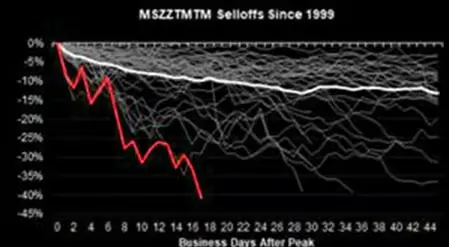
The tech momentum trade is experiencing its most severe unwinding in history. In just 17 trading days, the U.S. stock tech momentum factor (TMT MoMo) has plummeted 40% from its peak, setting a record for the fastest and deepest pullback ever, with effects rippling through semiconductors, hedge funds, and credit markets.

Mark Wilson, Goldman Sachs partner and head of EMEA Hedge Fund Business, provided a systematic review of this "brutal rotation" this week, noting that the speed and depth of this sell-off are historically rare. However, its root cause lies more in non-fundamental factors such as crowded positioning and concentrated leverage, rather than a substantial deterioration in the economy or corporate earnings. He stated that the unwinding process for the momentum factor is "nearing its end," but lacks an immediate catalyst for reversal in the short term.

Notably, this momentum collapse occurred against a backdrop of overall solid macro and corporate fundamentals. U.S. banks reported corporate loan growth of 17% year-over-year, TSMC raised its 2026 revenue growth guidance to over 40%, and inflation data also came in moderately below expectations. The divergence between this fundamental strength and market price action is precisely the core contradiction in the current market.

Tech Momentum Factor Hit by Sharpest Ever Sell-Off, Pullback Speed and Depth Exceed Historical Median

According to Morgan Stanley's Quantitative and Derivatives Strategy (MS QDS) team data, this momentum factor pullback has lasted 17 trading days, with a peak-to-trough decline of 28%. In comparison, the median momentum factor pullback since 1999 has been 22%, lasting an average of 33 trading days.

This means the current decline has exceeded the historical median in both speed and depth, representing the most severe pullback since the 29% decline between December 2022 and February 2023.

The situation in the tech sector is even more extreme. The TMT momentum factor (TMT MoMo) has fallen 40% from its peak. According to MS QDS data, this is the fastest and deepest sell-off ever recorded for the tech momentum factor.

Looking at specific sectors: the Korea Composite Stock Price Index (Kospi) is down 27% from its peak, U.S. AI tech beneficiaries are down 25%, global memory chip stocks are down 36%, and European semiconductors are down 23%. Memory chip stocks account for about two-thirds of the overall decline, while broader AI beneficiary stocks are down about 24% from their highs.
Low Surface Volatility Masks High Internal Intensity, Market Risk Structure Unraveling

Price decline is only the surface manifestation of this turmoil; changes in the market's internal risk structure are equally striking.

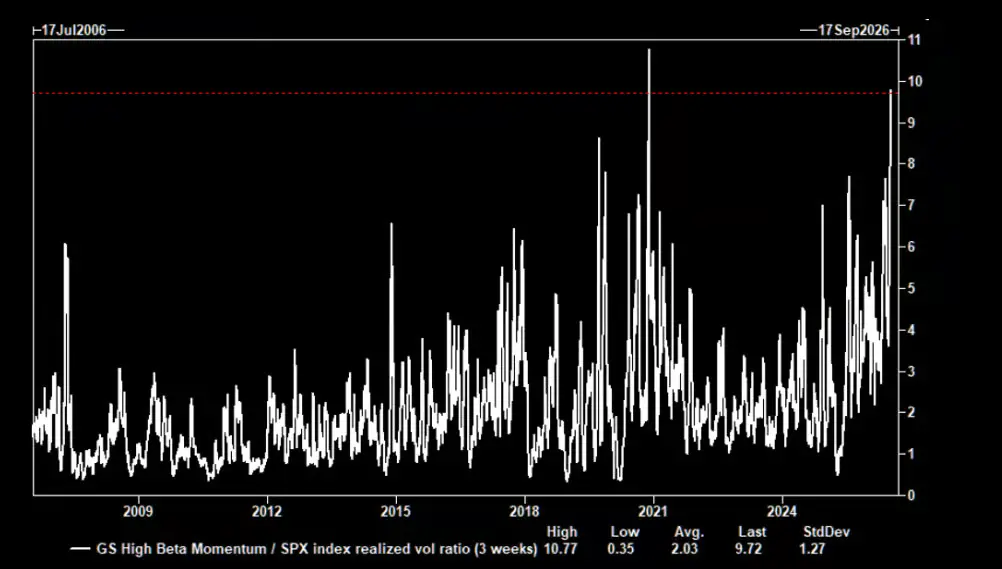
According to Goldman Sachs' Volatility Trading Desk data, the volatility of Goldman Sachs' High Beta Momentum portfolio (GSPRHIMO) is currently about 10 times that of the S&P 500 index. In historical backtests over the past 20 years, such a disparity in volatility ratios has only been comparable to the period of pandemic shock in November 2020.
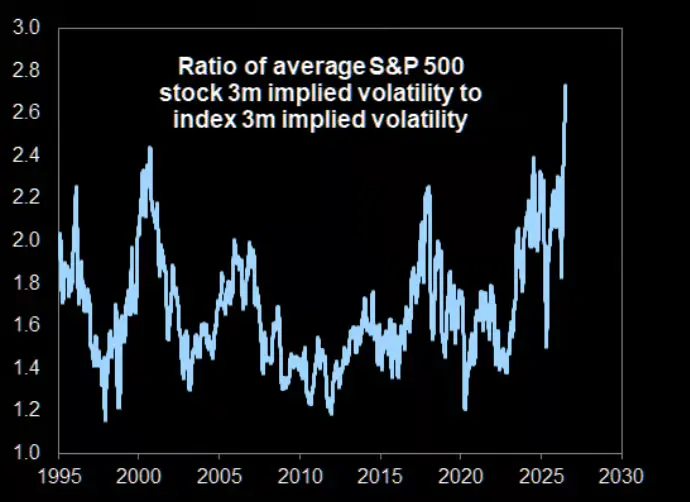
Simultaneously, the gap between single-stock volatility and index volatility has widened to historical extremes. Goldman Sachs data shows that the 3-month implied average correlation among S&P 500 components dropped to a record low of 0.14 this week. This has kept S&P 500 index volatility low, while the average implied volatility for single stocks is as high as 40%, 2.8 times the index's implied volatility, also setting a historical record.
Positioning Remains Crowded, Risk Not Yet Fully Cleared

Despite the recent historic pullback in the momentum factor, hedge funds' net exposure to it remains elevated from a long-term perspective. J.P. Morgan data indicates that the current combination of positioning levels and the magnitude of the pullback continues to position the momentum factor as one of the most concerning core risks in the market.

At the same time, Mark Wilson also noted that Goldman Sachs' High Beta Momentum factor has fallen 33% from its June high, with its year-to-date gain plummeting from 60% to just 12%.

He cited signs of deleveraging in the Korean market as evidence: reports indicated that roughly 1 in 30 Korean adults had their stock margin accounts forcibly liquidated this week, suggesting the deleveraging process is already significantly underway.

Fundamentals Intact, Risk Lies in Positioning and Structure

The unique aspect of this momentum collapse is that it occurred against a backdrop of generally positive corporate fundamentals and macro data.

Mark Wilson pointed out that U.S. bank earnings this week presented an "unmistakably positive read" on economic conditions: corporate loans grew 17% year-over-year, a record high, covering all economic sectors; U.S. consumer spending tracked mid-single-digit growth, with credit card spending up 6%; investment banking-related business lines collectively grew over 40%; and large banks' return on tangible common equity reached 19%, the highest since the financial crisis.

In terms of tech capital expenditure, TSMC raised its 2026 revenue growth guidance to over 40% (based on a revenue base exceeding $150 billion), while ASML's earnings sparked expectations of a 15% to 30% upward revision in its earnings per share over the next one to three years.

However, both companies' stock prices fell following their earnings announcements, displaying a typical "sell the news" pattern. In contrast, IBM's stock price suffered its largest single-day drop in over 20 years due to delays in large contracts and underperformance in its consulting business.

Mark Wilson emphasized that it is "difficult to find a clear fundamental signal" for this sell-off, reflecting more on structural factors such as positioning, leverage, crowding, and concentration.

Rotation Nearing End, But Reversal Catalysts Yet to Emerge

Mark Wilson stated that he leans towards the view that the unwinding process for the momentum factor is nearing its end, but also noted a lack of immediate summer catalysts that could drive a market reversal in the short term.

He also suggested that as efficiency and commercial viability improve, new market leadership will gradually emerge, leading to broader market participation—the Dow Jones Transportation Average breaking to new highs again this week serves as one example.

However, he also warned that the second derivative of earnings growth (i.e., the slowdown in the growth rate) will become increasingly important as the market digests Q2 earnings and moves into summer. Meanwhile, various valuation metrics indicate that tech sector valuations remain elevated.

Furthermore, correlations are breaking down abnormally both between and within traditional asset classes. For instance, the 3-month correlation between gold and crude oil has fallen to extreme inverse levels in its 35-year history, further increasing the difficulty of risk management and portfolio construction.


Domande pertinenti

QAccording to the article, what is the duration and peak-to-trough decline of the ongoing momentum factor sell-off in US tech stocks?

AThe ongoing momentum factor sell-off has lasted 17 trading days, with a peak-to-trough decline of 28% for the general momentum factor. The tech-specific TMT momentum factor (TMT MoMo) has dropped 40% from its peak.

QWhat does Goldman Sachs partner Mark Wilson attribute as the primary cause of this momentum factor collapse, rather than fundamental economic or earnings deterioration?

AMark Wilson attributes the primary cause of the momentum factor collapse to non-fundamental factors such as crowded positioning, concentrated leverage, and structural factors, rather than a significant deterioration in economic or corporate earnings fundamentals.

QWhat is the key contradiction highlighted in the market between fundamentals and price behavior?

AThe key contradiction is that the momentum collapse occurred against a backdrop of generally positive macroeconomic and corporate fundamental data, such as strong bank earnings and upgraded revenue guidance from key tech companies, creating a significant divergence from the sharp price declines.

QWhat is the current status of the momentum factor's unwinding process according to Mark Wilson, and what is a key limitation for a near-term reversal?

AMark Wilson believes the unwinding process for the momentum factor is approaching its end. However, he notes there is a lack of immediate catalysts in the short term (over the summer) that could drive a sharp market reversal.

QApart from price declines, what unusual internal market risk structure is detailed in the article, particularly regarding volatility?

AThe article details an extreme divergence in volatility. The volatility of Goldman Sachs's high-beta momentum portfolio (GSPRHIMO) is about 10 times that of the S&P 500, a level rarely seen historically. Additionally, the average implied volatility for single stocks is 40%, which is 2.8 times the implied volatility of the S&P 500 index, a record high gap.

Letture associate

Amidst Capital's Encirclement, Decentralization is the Sole Defense for Public Blockchains

In a landscape dominated by power and profit motives, the author argues that decentralization is not merely one desirable feature among many in blockchain design—it is the singular, non-negotiable defense against corporate and capital capture. The article adopts a Machiavellian, realist perspective on human institutions, positing that businesses will inevitably attempt to co-opt any valuable network to protect their profits and dominance. While external attacks like 51% forks are often discussed, the greater existential risk is internal capture—the gradual erosion of a protocol’s neutrality by vested interests, as seen historically with platforms like Visa and Google. The piece critiques permissioned chains, highly centralized “permissionless” layer-1s, and layer-2s without sufficient decentralization (e.g., single sequencers) as inherently vulnerable. These compromised systems, promoted by established financial players, are framed as delaying tactics to stifle truly open networks that threaten existing high-fee, inefficient business models. Real-world examples, such as closed enterprise consortiums that exclude competitors, illustrate how such systems cement oligopolies rather than foster innovation. The author concludes that while decentralized protocols like Ethereum are imperfect and costly to operate, they represent the only viable long-term equilibrium. In a market where value naturally flows to the most secure and neutral settlement layer, only maximally decentralized public blockchains can resist being subsumed by capital and powerful incumbents.

Foresight News11 min fa

Amidst Capital's Encirclement, Decentralization is the Sole Defense for Public Blockchains

Foresight News11 min fa

Who Decides the Rules of Bitcoin? BIP-110 Ignites Governance Debate

Bitcoin's governance is once again at the center of a heated debate, this time ignited by BIP-110, the "Reduced Data Temporary Softfork." This proposal aims to curb non-monetary data (like inscriptions and Runes) by introducing seven new consensus-layer restrictions over a year, such as limiting new output scripts to 34 bytes and restoring the OP_RETURN cap to 83 bytes. The controversy stems from BIP-110's fundamental shift: it moves the battle against "spam" from node relay and miner policies to the consensus layer, rendering currently valid transactions invalid. Supporters, arguing that default policy governance has failed (highlighted by Bitcoin Core v30's relaxation of OP_RETURN limits), see this as necessary to protect node resources and Bitcoin's monetary focus. Opponents, led by figures like Michael Saylor and Adam Back, warn it dangerously centralizes governance. Saylor listed 110 reasons against it, criticizing its low 55% miner activation threshold and potential for chain splits. Back emphasized Bitcoin's "permissionless" ethos, arguing no single group should impose value judgments via consensus rules. Further complicating matters, technical critiques suggest BIP-110 may be technically circumventable, and a "BlockSlop" vulnerability in its upgrade path poses a consensus risk. The debate has drawn in diverse stakeholders: miners (with pools like Ocean signaling support and Foundry polling clients), node operators (like Bitcoin Knots), and new players like corporate treasury holder MicroStrategy (Saylor), whose market influence adds a novel dimension. Ultimately, BIP-110 acts as a governance stress test, exposing the unresolved question: who decides Bitcoin's rules? It pits the authority of miners, node operators, developers, and capital holders against each other, with each side claiming to defend Bitcoin's core principles of neutrality and security.

marsbit27 min fa

Who Decides the Rules of Bitcoin? BIP-110 Ignites Governance Debate

marsbit27 min fa

Who Decides Bitcoin's Rules? BIP-110 Ignites Governance Debate

Title: Who Decides Bitcoin's Rules? BIP-110 Ignites Governance Debate A new technical proposal, BIP-110 (Reduced Data Temporary Softfork), has sparked a fundamental governance debate within the Bitcoin community. It aims to impose new consensus rules for one year to limit non-financial data (like inscriptions and Runes) on-chain, moving beyond simple node and miner policy filters to invalidate currently valid transactions. Supporters argue that default policies have failed due to workarounds, necessitating consensus-layer changes to protect Bitcoin's core monetary function from data spam. Critics, including Michael Saylor and Adam Back, contend this dangerously centralizes judgment, undermines permissionlessness, and sets a risky governance precedent. They advocate for market-based solutions like fees or Layer 2s instead. The debate exposes deeper tensions: miners are divided on activation; node operators assert their sovereignty; Bitcoin Core developers influence defaults without direct accountability; and large corporate holders like MicroStrategy now wield narrative influence. Technically, BIP-110 may not fully block data and carries a disclosed consensus bug risk. Ultimately, BIP-110 acts as a stress test, forcing the community to confront the unresolved question: who legitimately decides what Bitcoin is and how it evolves, amidst competing claims from miners, nodes, developers, and capital holders.

链捕手39 min fa

Who Decides Bitcoin's Rules? BIP-110 Ignites Governance Debate

链捕手39 min fa

Zcash's New Node Zakura Goes Live: Privacy Payments Can Reach 50,000 TPS, Aiming to Rival Visa and Mastercard

Zcash, a privacy-focused cryptocurrency, has launched a new full node software called Zakura version 1.0.0. Developed by Zcash co-founder Sean Bowe and Dev Ojha, with private ZEC donations, its goal is to enable Zcash to process over 50,000 transactions per second (TPS)—matching the scale of Visa and Mastercard—while maintaining full transaction privacy and verifiability. This addresses a key bottleneck, as Zcash currently handles only about 1 private transaction per second. Zakura is a fork of the Zcash Foundation's Zebra node. It features chain pruning and snapshots, reducing disk usage and allowing new nodes to sync in under two minutes. It also offers compatibility with the legacy `zcashd` client interface. The scalability challenge stems from the large data size of privacy proofs. Bowe's Tachyon project aims to use recursive proofs to reduce consensus-layer data needs from ~500 MB/s to ~100 MB/s. For wallet scalability, Valar Group is researching Private Information Retrieval (PIR) tech to allow wallets to fetch their data privately. Zakura supports fast block propagation and the upcoming "Ironwood" network upgrade (NU6.3), scheduled for activation around July 28th. Ironwood was created to contain a critical inflation bug discovered in the Orchard shielded pool in May 2024. The fix uses "turnstiles" to trap any counterfeit ZEC created during the vulnerability period within the shielded pool, preventing it from entering circulation and restoring supply integrity.

marsbit54 min fa

Zcash's New Node Zakura Goes Live: Privacy Payments Can Reach 50,000 TPS, Aiming to Rival Visa and Mastercard

marsbit54 min fa

Trading

Spot
活动图片