By: RWA Knowledge Circle
Edited by: RWA Knowledge Circle
Introduction
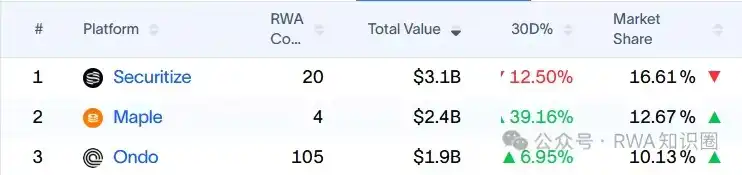
Recently, a noteworthy phenomenon has emerged in the RWA space. Securitize, ranked first in RWA market share, Ondo, ranked third, and leading digital asset exchange Coinbase have almost simultaneously focused their attention on the same thing—Equity RWA (tokenization of equity).
If this had happened a year or two ago, such "synchronization" would not have been common.
Securitize and Ondo both started with compliant financial asset RWA, with core products concentrated in U.S. Treasuries and cash-like assets; Coinbase has long been seen as an infrastructure platform for the crypto market, gradually expanding from exchanges and public chains to the application layer.
But recently, these three institutions have coincidentally begun to embrace on-chain stocks, which is clearly not a coincidence.
I. Not a Platform's "Whim," but Regulation Setting the Direction
Timing is crucial. On December 7, 2025, U.S. SEC Chairman Paul Atkins publicly stated:
In the next two years, the U.S. financial market will migrate entirely to the blockchain.
The SEC (U.S. Securities and Exchange Commission) is the core regulatory body for the U.S. capital market, responsible for securities issuance, exchange supervision, and market order. Public statements by the SEC Chairman often reflect not just personal views but the concentrated release of regulatory direction for the coming years.
Almost simultaneously, the Nasdaq exchange also clearly stated that it is advancing an on-chain trading solution for stocks.
These two signals, combined, make it clear: Equity on-chain is evolving from an "exploratory direction for Web3" to a recognized institutional migration path in traditional finance.
Against this backdrop, compliant RWA platforms like Securitize and Ondo, as well as platform infrastructure like Coinbase, entering equity tokenization is not radical innovation but a顺势而为 (going with the flow).
II. Industry Consensus Is Converging Toward an "On-Chain Capital Market"
Beyond regulation, internal industry judgments are also rapidly unifying.
On December 21, Sid Powell, co-founder and CEO of Maple Finance, the second-largest platform by RWA market share, stated:
In a few years, institutions will no longer distinguish between DeFi and TradFi; ultimately, all capital market activities will be completed on-chain.
Earlier, on October 8, Binance founder CZ also publicly expressed a similar judgment, believing that RWA is one of the most important directions for Web3 in the coming years because it truly enables systematic connection between blockchain and real-world assets.
From a market structure perspective, this consensus did not emerge out of thin air.
Currently, private credit and government bonds still dominate the RWA market, for practical reasons:
-
Not all real-world assets have high-frequency trading demand
-
Insufficient volatility limits on-chain liquidity
-
Regulatory recognition of RWA varies significantly across countries; whitelists, KYC, and permitted issuance are not yet unified
In contrast, the legal and regulatory paths for financial assets are highly mature, with clear ownership and transaction logic, making them more suitable for scaling first.
Thus, a clear trend is evident:
Larger institutions increasingly prefer to advance RWA along the mature path of Government Bonds → Stocks, rather than starting with assets from SMEs with complex equity structures.
III. Despite the Same Goal of "Stock RWA," the Three Offer Different Solutions
Interestingly, although the goal is the same, the implementation methods of the three institutions are completely different.
1. Ondo: Bringing the "Real Stock Market" On-Chain
Ondo Global Markets launched in September this year, offering over 100 types of on-chain tokenized stocks, allowing non-U.S. investors to participate in the U.S. stock market via blockchain settlement, 24/7.
Its biggest feature: Liquidity does not come from AMM pools but directly from Nasdaq and the NYSE.
In other words, Ondo's stock tokens are not "swapped on-chain with each other"; each token is 100% backed by real custodied shares, a model closer to the reserve mechanism of stablecoins. This results in almost no slippage for large trades. On compliance, Ondo has obtained FMA approval to offer tokenized U.S. stocks and ETFs in 30 European countries.
The data is also telling:
In the first week of December, the trading volume of Ondo stock tokens on the Bitget platform exceeded $88 million, capturing a 73% market share. Currently, Ondo Global Markets has reached a cumulative trading volume of $2 billion on Ethereum and BNB Chain, with a TVL exceeding $350 million.
On December 18, Ondo, together with LayerZero, launched Ondo Bridge, supporting 1:1 cross-chain transfer of 100+ stocks and ETFs across multiple chains.
2. Securitize: Native On-Chain Stocks, Leaning More Towards Institutional-Grade & Closed Structures
Securitize has chosen the path of highest complexity but also the most "institutionally native."
On December 17, Securitize announced plans to launch a native on-chain stock product in Q1 2026. Its core features are:
-
Real shares are issued directly on-chain
-
Simultaneously recorded in the issuer's official share register
-
Tokens represent full shareholder rights (dividends, voting, etc.)
More critically, Securitize itself is an SEC-registered transfer agent, ensuring token holders are legally direct shareholders, not indirect holders through an SPV or intermediary. However, it is important to note: This model does not equal "infinite fractionalization and free circulation."
In practice, whether circulation is open, whether whitelists are used, and whether transfer targets are restricted can still be fully controlled through compliant structures and company bylaws. This is why this model is more suitable for institutional-grade issuers, private placement structures, or directed equity arrangements.
3. Coinbase: Integrating Stocks into a "Financial Super App"
Coinbase's approach is more platform-oriented.
On December 18, Coinbase indicated it would introduce stock trading, prediction markets, and various other assets; on December 20, CEO Brian Armstrong announced: In-app stock trading is officially live. Currently, Coinbase supports:
-
24/7 stock trading
-
Crypto assets and perpetual contracts
-
Prediction markets (in partnership with Kalshi)
-
Integration of decentralized exchange functions
And plans to launch Coinbase Tokenize, an RWA service for institutions, early next year. Its goal is very clear: One account to trade all assets; one interface to complete all financial operations.
IV. On-Chain Equity Is Becoming a Significant Long-Term Variable
Stocks are one of the core asset forms in the modern financial system, and on-chain equity is moving from fringe exploration to a main direction driven by both institutions and industry. Whether it's Ondo's market-driven path, Securitize's institutionally native path, or Coinbase's platform integration path, they are essentially answering the same question:
When capital markets migrate on-chain, in what form should stocks exist?
Understanding this change does not mean immediately participating, but it helps build a cognitive framework for the future financial structure.
As RWA gradually moves from "concept" to "infrastructure," equity tokenization is likely one of the most symbolic milestones.



















