Author: Shao Jiadian
First, the conclusion: If a project is considering Poland solely because of "low cost and easy registration," the answer for 2026 is already no; if a project genuinely needs the Polish market, a more practical path might actually be to first obtain MiCA CASP authorization in another EU Member State, then enter Poland via passporting.
For the past few years, Poland had been a country that easily made it onto the candidate list for many crypto projects entering Europe.
The reasons weren't complex. The old VASP registration system was relatively lightweight, and the costs of company formation and operation were also attractive. For teams hoping to first secure a European regulatory identity and then gradually validate their business, Poland seemed to offer both the advantages of "cost" and "EU market access." Our early global crypto payment compliance map also once listed Poland as a potential low-cost path to an EU CASP, based on the legislative progress at that time.
But by August 2026, this logic has fundamentally changed.
The issue isn't even just that "CASP applications have become stricter"; it's that Poland finds itself in a more unique situation than other EU Member States:
The old VASPs are no longer valid, MiCA is fully applicable, but Poland's own domestic implementing legislation for MiCA is still not stably in place.
After July 1, 2026, Poland's Old VASPs Officially Lost Relevance
To understand the current situation in Poland, it's crucial to distinguish between two key dates.
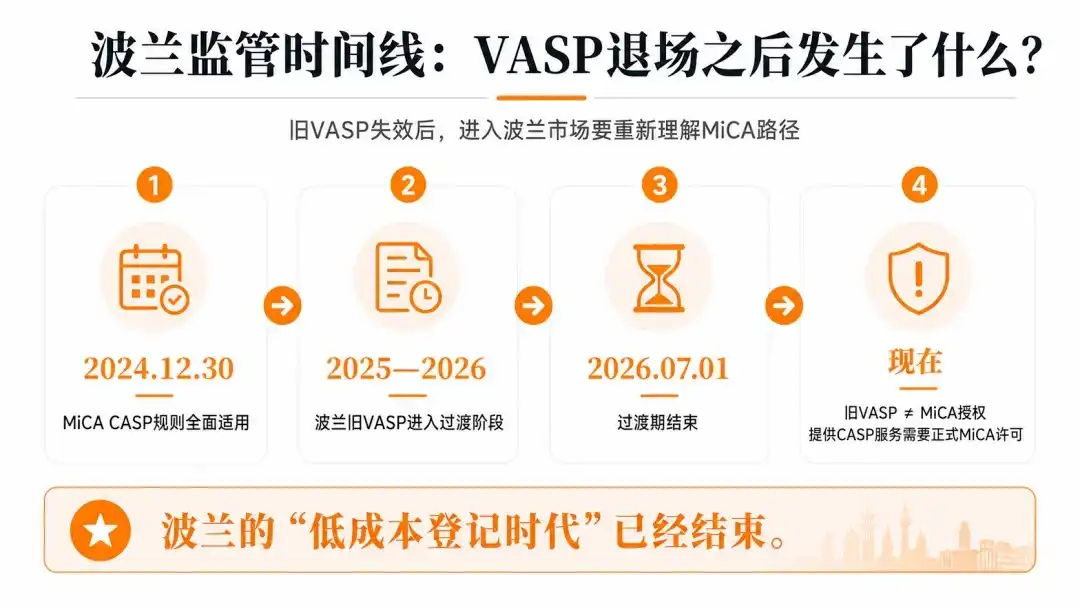
MiCA's main rules for CASPs became fully applicable from December 30, 2024. However, for virtual asset service providers already operating under a Member State's previous regime, MiCA allowed Member States to set transitional periods. Poland utilized a relatively long transitional arrangement, meaning existing VASPs could continue operating until around July 1, 2026.
But that window has now closed.
On June 30, 2026, the Katowice Tax Administration Chamber published an announcement on the Polish government website, clearly reminding market participants: after the end of the transitional period on July 1, 2026, the previous registration of virtual currency activities no longer constitutes authorization to provide crypto-asset services under MiCA.
The regulator further cautioned that an entity still lacking a MiCA authorization granted by an EU Member State as of July 1 should be considered a higher-risk service provider; the original registration authority itself also lacks the power to issue MiCA CASP authorizations.
Therefore, for project teams, purchasing, registering, or marketing a so-called "Polish VASP" today no longer solves the real problem of EU market access.
A More Unique Problem: Poland's Domestic MiCA Legislation is Still in Flux
If the change were simply from VASP to CASP, Poland and Lithuania wouldn't be fundamentally different.
What truly makes Poland unique is the progress of its domestic implementing legislation.
MiCA, as an EU Regulation, is directly applicable. However, Member States still need to clarify via national law the competent authorities for authorization, supervision, penalties, fees, and specific procedures. On June 23, 2026, the KNF publicly stated that as Poland's domestic law implementing MiCA had not yet come into force, Polish public administration bodies, including the KNF (at that time), had not been formally designated as competent authorities under MiCA, except for issuers of e-money tokens. Simultaneously, the KNF also indicated it had undertaken preparations to assume MiCA supervisory responsibilities.
The KNF itself stated publicly in May 2026 that it was prepared to take on market supervision duties for crypto-assets and pointed out that CASP licensing would involve scrutiny of management's knowledge and experience, capital, and other relatively stringent requirements.
The problem is that the domestic law has not yet been finalized and enacted.
On May 15, 2026, the Polish parliament passed a new version of the "Crypto-Asset Market Act"; on June 11, the President refused to sign the bill. The President's office publicly stated its support for establishing a regulatory framework for the crypto-asset market but believed the passed text still required adjustments.
Therefore, based on publicly available official Polish information accessible up to now, Poland has ended the old VASP transition period, but its domestic MiCA implementation framework is still undergoing legal adjustments.
This creates a very practical problem:
Projects should not currently view "registering a company in Poland and then directly applying for a Polish CASP" as a route as highly standardized as those in Lithuania or Malta.
Thus, the Phrase "Polish CASPs are Low-Cost" is No Longer Sufficient
In the past, projects choosing Poland typically compared a few numbers: company registration costs, local staff salaries, office expenses, legal fees, and VASP registration timelines.
These factors still exist today, but their importance has diminished.
After MiCA's implementation, regardless of the chosen home country, a CASP will not revert to the "light license" of the old VASP era.
More importantly, if a jurisdiction currently faces significant uncertainty regarding the very landing of its domestic licensing procedures, then for a company to save some operational costs while bearing the risk of unpredictable application windows, regulatory processes, and subsequent arrangements may not be a worthwhile trade-off.
So, today, when evaluating Poland, the question should shift from:
The Old Question:
Where is it cheapest to get a CASP?
To:
The Real Question:
Where can a project obtain a CASP more predictably and sustainably serve the Polish and other EU markets?
Wanting the Polish Market Does Not Necessarily Mean Getting a CASP in Poland
This is precisely one of the most important changes brought by MiCA's single licensing system.
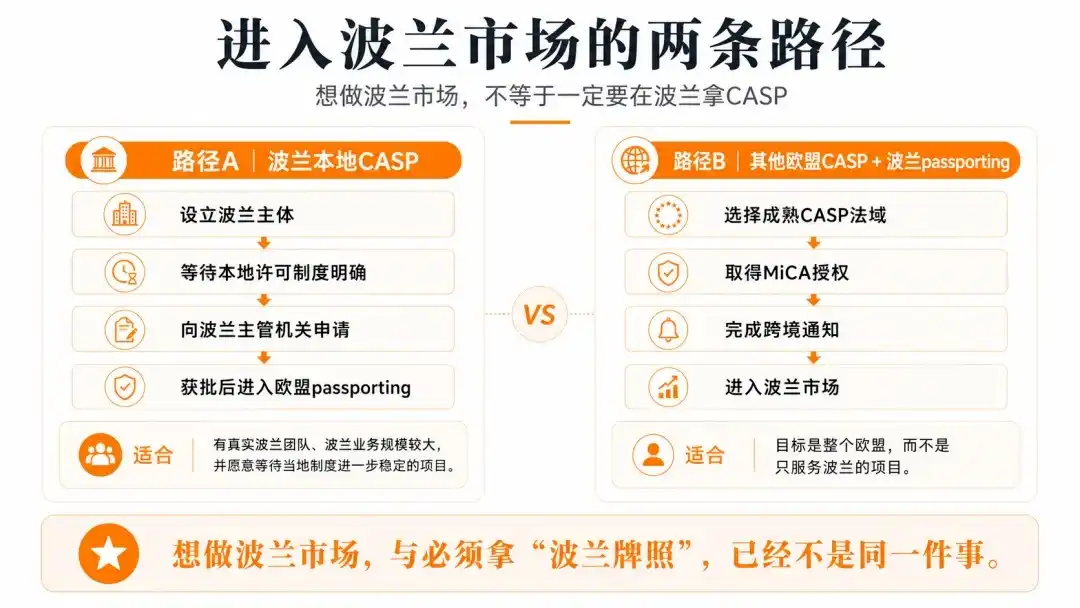
A MiCA CASP authorization is not limited to serving only the country where the license is issued. A CASP formally authorized under MiCA can, after completing a notification process, provide its permitted crypto-asset services in other EU Member States under the cross-border services rules. ESMA also clearly distinguishes between "operating under the old regime transition" and "formal MiCA authorization": old VASPs do not enjoy EU passporting rights; only after formally obtaining MiCA authorization can they enter the single cross-border mechanism.
Therefore, a project that clearly aims to serve Polish clients does not necessarily have to make Poland its CASP home country.
For example, a company could first compare Lithuania, Malta, France, Germany, or other Member States that have established stable CASP authorization mechanisms, determine the home country based on team, clients, banking, and regulatory communication; then, after obtaining CASP authorization, cover Poland via the MiCA cross-border notification mechanism.
This logic is completely different from the old VASP era.
Before: To enter Poland → Register a Polish VASP.
Now, it might be: To enter the entire EU → Choose the most suitable CASP home country → Then passport into Poland.
So, Is Poland Not Worth Considering at All?
Not exactly.
Poland remains an important EU market, and the KNF has clearly expressed its readiness and regulatory capacity to undertake MiCA supervisory duties. (knf.gov.pl)
If a project has its core team, technical personnel, client base, or long-term operational plans already in Poland, then waiting for the local regulatory framework to stabilize further and establishing Poland as the future CASP home country could still hold commercial rationale. Especially when a company genuinely intends to locate its main management, offices, compliance team, and client operations in Poland, a local CASP entity aligns more naturally with actual operations.
But if a project is merely drawn by the reputation of "low costs in Poland," planning to register a shell company while keeping its main team in Asia, targeting clients across Europe, and using banking and payment channels outside Poland, then there's no need to insist on a "Polish CASP" right now.
For such projects, it's usually more practical to prioritize comparing EU jurisdictions that can already stably accept MiCA applications.
A simple assessment can involve three questions:
First, is Poland your core market?
If not, and you just want to use Poland to access the EU, you should re-compare potential CASP home countries.
Second, do you plan to establish genuine operations in Poland?
Without local management, personnel, and long-term operational planning, the significance of cost advantages diminishes noticeably.
Third, do you currently need "low cost" more, or "predictability"?
For projects preparing to partner with banks, institutional clients, and major payment channels, predictability of the regulatory path is usually more important than saving some upfront costs.
How We Typically Support Such Projects
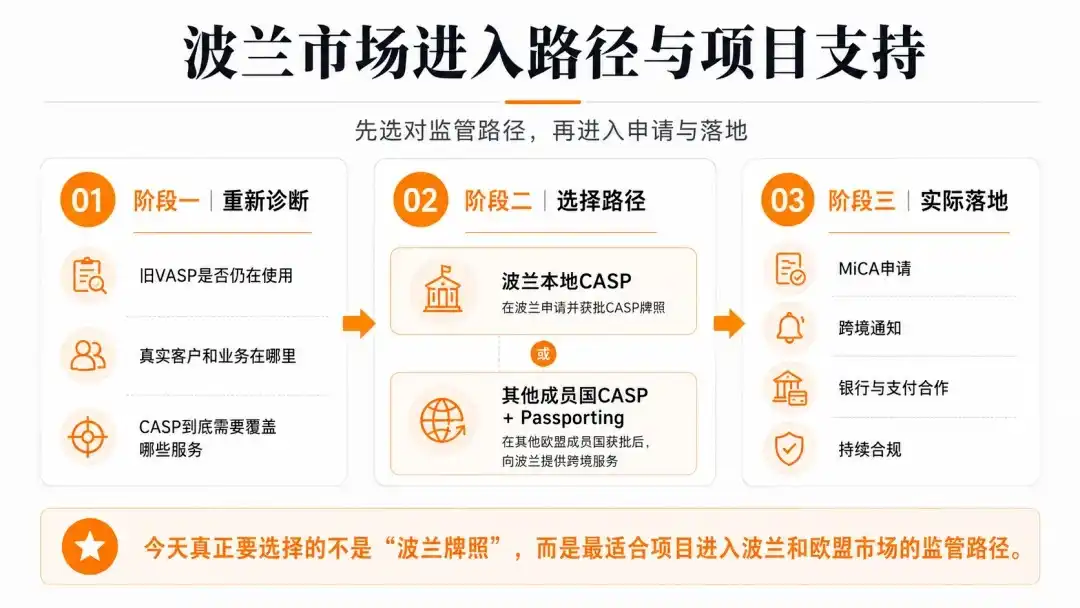
For projects originally planning to take the Polish VASP or Polish CASP route, the first step is usually not to proceed directly with the application but to reassess Poland's position within the overall European structure.
If a project simply needs to access the Polish client market, it can first compare the CASP authorization and passporting paths in other EU Member States; if Poland is indeed the main operational hub, it requires continuous monitoring of local legislation, competent authorities, and the formal application mechanism, while preparing teams and materials in advance according to MiCA standards.
In specific projects, we typically start by completing a "EU CASP Jurisdiction Comparison" and a "Business Functions & MiCA Service Scope Analysis," breaking down the business areas like client location, wallet control, stablecoin exchange, asset transfer, and fiat payment, before determining in which Member State to establish the CASP entity.
For teams already holding old Polish VASP registrations, a separate review is needed for existing clients, contracts, website marketing, and fund flows to avoid continuing to present the old registration as proof of MiCA market access. Polish authorities have made it clear that old VASP registrations no longer confer eligibility to provide MiCA crypto-asset services after July 2026.
If another EU Member State is ultimately chosen as the home country, it also requires simultaneous design of passporting notifications for the Polish market, local marketing, client agreements, banking and payment partnerships, as well as the service and liability boundaries between different entities within the group.
Conclusion: Is Poland Still a Low-Cost Choice?
If by "low-cost choice" one means, as in the old VASP era, quickly obtaining a European regulatory identity through a relatively light registration, then the answer is clear: that road has ended.
Since July 2026, old Polish VASPs can no longer support the provision of MiCA crypto-asset services; meanwhile, Poland's domestic MiCA implementing framework is still undergoing legislative adjustment. For a new project preparing to enter Europe now, prioritizing Poland as the CASP home country simply because of lower company and personnel costs can hardly be called truly "efficient." (Gov.pl)
But if a project genuinely needs the Polish market, MiCA actually provides a different answer.
Companies don't have to bind "clients are in Poland" with "the license must be in Poland." First establishing a CASP in an EU Member State with a more mature regulatory path that better matches the team and business, then serving Poland via passporting, can be a more worthy strategy to compare at the current stage. (European Securities and Markets Authority)
Poland has not lost its market value; what it has lost is the old narrative of "cheaply registering a license to enter Europe."