Is Dogecoin Dead Or Could The SpaceX IPO Lead To A Revival?

bitcoinistPubblicato 2026-06-11Pubblicato ultima volta 2026-06-11

Introduzione

Dogecoin is facing doubts about its future as its price hovers near multi-year lows and investor enthusiasm wanes. Lacking its previous narrative momentum and with modest institutional ETF inflows, it has struggled alongside the broader meme-coin downturn. However, the upcoming SpaceX IPO, seeking a massive $1.75 trillion valuation, is generating discussion as a potential catalyst. While the IPO has no direct link to Dogecoin, the event will refocus global attention on Elon Musk, whose past endorsements have significantly boosted the cryptocurrency. Some investors see this renewed spotlight as a chance for revived interest, though it remains uncertain if attention alone can drive a sustained recovery amid ongoing market challenges.

Dogecoin is once again facing questions about its future as prices hover near multi-year lows and investor enthusiasm continues to fade. Yet just as many traders are beginning to lose confidence, a massive event tied to Elon Musk’s business empire is generating fresh discussion about whether DOGE could be preparing for an unexpected second act.

Dogecoin’s Missing Spark

Dogecoin’s market position appears far weaker than in previous cycles. The cryptocurrency is trading around $0.084 and remains down nearly 57% over the past year, with losses across the weekly, monthly, and yearly timeframes. More importantly, Dogecoin is struggling with something deeper than price weakness. The narratives that once fueled demand and attracted new investors have steadily lost momentum.

For years, Elon Musk played a central role in Dogecoin’s rise. His comments and public references regularly generated excitement that pushed the cryptocurrency into headlines. However, recent developments suggest the market no longer responds with the same enthusiasm.

Meanwhile, institutional adoption has yet to fill the gap. Spot Dogecoin ETF inflows remain modest, with SoSoValue data showing total assets of about $12 million, while recent daily net inflows have largely stalled.
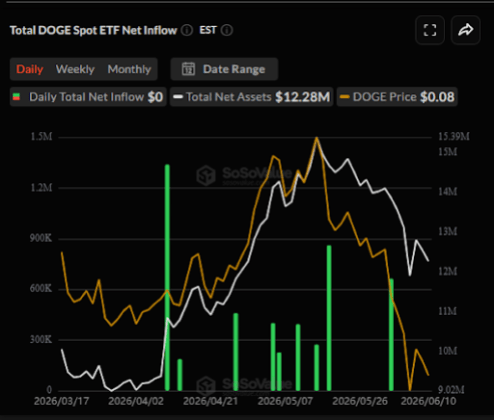
Source: SoSoValue

The broader market has also worked against the asset. Since peaking in 2024, the meme-coin sector has shed billions in value. As speculative capital exited the market, Dogecoin lost one of the strongest drivers behind its previous rallies.

Why SpaceX’s IPO Is In The Conversation

While Dogecoin’s recent performance has fueled concerns about its future, the upcoming SpaceX IPO has introduced a new element into the discussion.

According to details from SpaceX’s IPO filing, the company is seeking a valuation approaching $1.75 trillion, a figure that would make it one of the most valuable public companies in the world. The scale of the offering is significant, but what makes it relevant to Dogecoin is Elon Musk’s continued presence at the center of both stories.

The filing shows that Musk is expected to retain overwhelming voting control after the IPO, ensuring that SpaceX remains tied to his long-term vision. The public debut is also expected to place Musk and his growing network of businesses back in the global spotlight, attracting attention from global investors.

Historically, periods of heightened interest surrounding Musk have often spilled over into assets associated with him, and no cryptocurrency has benefited from that connection more than Dogecoin. Although the IPO has no direct link to the cryptocurrency, renewed attention surrounding Musk’s business empire could still influence market sentiment.

For that reason, some investors view the IPO as a potential catalyst for renewed interest in Dogecoin. Whether that translates into a lasting recovery remains uncertain, particularly as institutional participation remains limited and the broader meme-coin sector continues to recover from a downturn. However, with one of the largest IPOs in history approaching, Dogecoin may soon receive something that has repeatedly played a role in past rallies: widespread attention. Whether attention alone is enough to drive a sustainable revival is the question the market is now weighing.

DOGE begins another push upward | Source: DOGEUSDT on Tradingview.com

Domande pertinenti

QWhat is the current price and recent performance of Dogecoin, and what is the broader sentiment among traders?

ADogecoin is currently trading around $0.084 and is down nearly 57% over the past year, with losses on weekly, monthly, and yearly timeframes. Investor enthusiasm is fading, and many traders are beginning to lose confidence in its future.

QAccording to the article, what key factors are contributing to Dogecoin's current struggle beyond its price weakness?

ADogecoin's struggle extends beyond price. The narratives that once fueled its demand have lost momentum, Elon Musk's endorsements no longer generate the same market enthusiasm, and institutional adoption remains limited, as seen in modest Spot ETF inflows of about $12 million. The broader meme-coin sector downturn has also removed a key driver of its past rallies.

QHow is the upcoming SpaceX IPO connected to the discussion about a potential Dogecoin revival?

AThe SpaceX IPO is significant because it places Elon Musk and his businesses back in the global spotlight. Historically, periods of heightened interest in Musk have spilled over to assets associated with him, with Dogecoin being the primary cryptocurrency beneficiary. The IPO could act as a catalyst for renewed attention and market sentiment toward Dogecoin.

QWhat details from the SpaceX IPO filing does the article highlight as particularly relevant?

AThe IPO filing reveals that SpaceX is seeking a valuation approaching $1.75 trillion, which would make it one of the world's most valuable public companies. Crucially, Elon Musk is expected to retain overwhelming voting control post-IPO, keeping the company tied to his vision and influence.

QWhat is the article's conclusion regarding the potential for a Dogecoin revival driven by the SpaceX IPO?

AThe article concludes that while the SpaceX IPO could bring Dogecoin the widespread attention that has fueled past rallies, it is uncertain if attention alone can drive a sustainable revival. Factors like limited institutional participation and a recovering meme-coin sector mean the market is weighing whether this catalyst will be enough.

Letture associate

Podcast Notes | Conversation with GSR Asset Management Head: To Determine if This Crypto Rally is Real, Just Watch the Lending Rates on Aave

Podcast Summary: Dialogue with GSR's Head of Asset Management: To Determine if This Crypto Rally is Real, Just Check Lending Rates on Aave Andy Baehr, Managing Director of Asset Management at GSR, discusses the current crypto market, characterizing it as stuck in a state of "ambivalence" with short-lived, unsustainable rallies. He outlines a simple framework: the market moves between "ambivalence" and "conviction" (sustained upward momentum). Currently, every rally resembles a single-stage rocket booster that quickly fizzles out. Baehr identifies three key signals to watch: 1) DeFi lending rates, 2) the potential passage of the CLARITY Act, and 3) the market forming a consensus on the "Fed hawkish peak." He emphasizes that the most immediate indicator for the sustainability of the recent CPI-triggered rally is the USDC borrowing rate on Aave, currently around 3.75%—close to U.S. Treasury yields. The absence of a credit spread indicates low leverage demand and a lack of market energy. He explains that a healthy, sustained rally requires layered buying pressure. Last year's rally progressed from an ETH short squeeze to crypto-native trader influx and finally to ETF inflows. Currently, this structure is missing. Other potential structural buyers like Digital Asset Treasury (DAT) companies are absent, and ETF flows have proven transient. Baehr notes that while small-cap crypto tokens outperformed large caps in Q2—a potential sign of capitation in major assets—capital is also flowing to more exciting opportunities like AI stocks and tech IPOs, leaving crypto sidelined. Regarding DeFi, he highlights that platforms like Aave provide a clear, real-time signal of leverage demand through their supply/demand-driven interest rates. A significant, sustained rate increase would signal genuine market conviction. He also observes the quiet emergence of fixed-income-like products and vaults in DeFi. On regulation, the probability of the CLARITY Act passing before the August 7th deadline has dropped linearly from 75% to below 40% on Polymarket. Baehr suggests its passage would be treated as a bullish surprise, a potent driver for price movement. However, political hurdles, including ethical clause debates and disclosures about the First Family's crypto profits, remain significant obstacles. Ultimately, the market awaits clarity on the Fed's terminal rate under Chair Warsh. Until the "Fed Solstice"—the point where the market collectively understands the peak of hawkish policy—sustained conviction will be difficult to achieve.

marsbit28 min fa

Podcast Notes | Conversation with GSR Asset Management Head: To Determine if This Crypto Rally is Real, Just Watch the Lending Rates on Aave

marsbit28 min fa

7 Months After the Collapse of Huiwang, Southeast Asia's Escrow Platforms Undergo a Major Reshuffle

Following the collapse of Huione Pay—dubbed the "Alipay of Southeast Asia"—seven months ago, the region's underground financial guarantee platform sector is undergoing a significant reshuffle. This power vacuum has been swiftly filled by emerging platforms such as XinBi, Tiger/Navigator, JinBei (renamed JinBo), Dali/Tiancheng, and FullyLight. These platforms, operating largely via Telegram and offering services like escrow for illicit transactions, have absorbed the vast user base and markets left behind by Huione. While positioning themselves as "trust intermediaries," their primary clientele consists of networks involved in online scams, money laundering, illegal gambling, and even human trafficking. For instance, the Tiger/Navigator platform explicitly provides "escrow" services for kidnapping-for-ransom operations ("强押车交易"). Data underscores the immense scale: Huione alone processed over $103 billion in cryptocurrency payments and facilitated over $31 billion through its escrow market before its downfall, linking it to Cambodia's notorious Prince Group. Since its collapse, competitors have seen explosive growth. For example, the XinBi platform has accumulated over $1.6 billion in total USDT revenue, while platforms like NewPay, OkPay (under Dali), and FullyLight Wallet collectively processed over $4.8 billion in USDT in a single year. This ecosystem thrives in regions like Cambodia and Myanmar, where regulatory gaps allow these platforms to act as critical financial infrastructure for sprawling cybercrime industries, from scam compounds to online casinos. The article concludes that the moniker "Southeast Asian Alipay" is a misnomer, obscuring the platforms' fundamental role in enabling serious criminal enterprises rather than representing legitimate financial innovation.

Odaily星球日报1 h fa

7 Months After the Collapse of Huiwang, Southeast Asia's Escrow Platforms Undergo a Major Reshuffle

Odaily星球日报1 h fa

Trading

Spot
活动图片





