Is Bitcoin’s Reset Complete? BTC Steadies Above $70K as Markets Debate the Next Move

bitcoinistPubblicato 2026-02-10Pubblicato ultima volta 2026-02-10

Introduzione

After a sharp decline to $60,000, Bitcoin has stabilized above $70,000, though the recovery remains fragile. On-chain data shows significant deleveraging, with a major whale selling over $340 million in BTC and reducing holdings from $11 billion to $2.2 billion. Open interest also fell sharply, indicating reduced market leverage and momentum. While some view the sell-off as a healthy reset, others caution it may be a bull trap. Key support is at $60,000, with resistance near $73,000–$75,000. Broader factors like equity market rebounds and ETF inflows provide some stability, but the market awaits clearer signals from macro conditions and institutional conviction.

After one of its sharpest swings in over a year, Bitcoin (BTC) is attempting to find balance. Prices have stabilized above $70,000 following a rapid drop to $60,000 last week, but the calm has done little to settle the broader debate; is this a completed reset, or just a pause before another move lower?

The recent volatility has flushed out leverage, forced large players to cut risk, and shifted sentiment from optimism to caution. While dip buyers have returned, on-chain data, derivatives metrics, and macro signals suggest the market remains in a fragile holding pattern rather than a clear recovery.
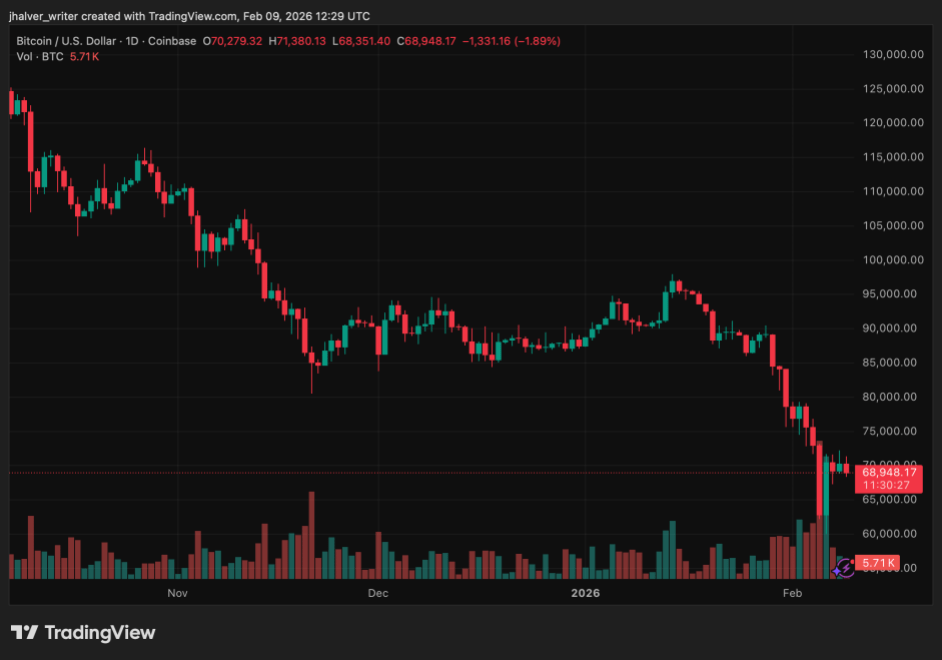
BTC's price trends to the downside on the daily chart. Source: BTCUSD on Tradingview

Whales Step Back as Leverage Unwinds

One of the clearest signs of the reset came from whale activity. On-chain data shows that the so-called Hyperunit whale sold more than $340 million in Bitcoin, sending the funds to Binance after months of aggressive, leveraged trading across crypto markets. The move followed a major liquidation on a large Ethereum position, which reportedly resulted in losses of roughly $250 million.

At its peak, the wallet held over $11 billion in Bitcoin. Holdings have since fallen to about $2.2 billion, signaling a shift away from expansion toward capital preservation.

The selling coincided with a broader decline in Bitcoin open interest, which fell from around $61 billion to near $49 billion, pointing to widespread deleveraging rather than fresh short positioning.

This reduction in leverage has eased immediate downside pressure but has also reduced momentum, leaving Bitcoin without strong directional conviction.

Bitcoin Price Stabilizes, But Signals Remain Mixed

Bitcoin was trading around $70,000–$71,000 in Asian hours on Monday, holding steady after last week’s rapid rebound. Technical indicators still show weak momentum, with subdued volume and no clear signs of either buyers or sellers being firmly in control.

Market participants are split. Some analysts argue that the recent washout has removed excess risk and created conditions for a healthier base. Others warn that similar rebounds in this cycle have turned into bull traps, especially when driven by short-term traders rather than long-term accumulation.

Support near $60,000 remains a key level to watch, while resistance between $73,000 and $75,000 is seen as a test for any sustained upside.

Macro, Sentiment, and Structural Questions

Beyond price action, broader factors are shaping the debate. Global equity markets rebounded, helping risk assets stabilize, while US spot Bitcoin ETFs recorded modest inflows as investors selectively bought the dip.

At the same time, concerns around long-term narratives, from Bitcoin’s safe-haven role to emerging discussions about quantum computing risks, continue to hover in the background.

Bitcoin’s ability to hold above $70,000 suggests the forced reset may be largely complete. Whether that turns into a durable recovery or another leg lower will depend on liquidity, conviction from larger players, and how markets respond to upcoming macro data.

Cover image from ChatGPT, BTCUSD chart on Tradingview

Crypto di tendenza

Domande pertinenti

QWhat is the current price range of Bitcoin and what key level is being watched for support?

ABitcoin is currently trading around $70,000–$71,000, with the key support level to watch near $60,000.

QWhat significant action did the 'Hyperunit whale' take, and what did it signal?

AThe 'Hyperunit whale' sold more than $340 million in Bitcoin, sending the funds to Binance. This move, which followed a major liquidation on a large Ethereum position, signaled a shift away from aggressive, leveraged trading toward capital preservation.

QWhat does the decline in Bitcoin open interest indicate about the market?

AThe decline in Bitcoin open interest, which fell from around $61 billion to near $49 billion, points to widespread deleveraging across the market rather than the establishment of fresh short positions.

QAccording to the article, what are the two opposing views among analysts regarding the recent price action?

ASome analysts argue the recent washout has removed excess risk and created conditions for a healthier base, while others warn that similar rebounds have turned into bull traps, especially when driven by short-term traders rather than long-term accumulation.

QBesides price, what broader factors are influencing the Bitcoin market debate?

ABroader factors include the rebound in global equity markets, modest inflows into US spot Bitcoin ETFs, and lingering concerns around long-term narratives such as Bitcoin's safe-haven role and emerging discussions about quantum computing risks.

Letture associate

Bitcoin Mining Farms Are Becoming AI Factories

Bitcoin mines are transforming into AI factories. This shift is driven by the convergence of three key assets from the previous crypto cycle: infrastructure, talent, and capital. Crypto mining companies like Crusoe, CoreWeave, and Bitdeer are repurposing their core competency—securing power, land, and grid connections in remote locations—to build data centers for AI clients. These firms are signing multi-billion dollar, long-term contracts with companies like Anthropic, AWS, and Microsoft, as AI's demand for reliable, high-capacity compute surpasses the profitability of Bitcoin mining. Simultaneously, crypto entrepreneurs and engineers are applying their skills to new AI ventures. Examples include OpenSea's co-founder launching OpenRouter (an AI model aggregator), and former Coinbase engineers building Fal.ai (a generative media infrastructure platform). Their experience in building scalable, global software networks translates effectively to the AI space. Furthermore, capital accumulated during the crypto boom is now fueling AI. Figures like Jed McCaleb (co-founder of Ripple) funded Voltage Park, a large-scale GPU cloud provider. Notably, some crypto investments, like FTX's early bets on Anthropic and Cursor, have generated astronomical paper returns, demonstrating how high-risk crypto capital flowed into AI before it became mainstream. The transition is not just about repurposing hardware, but about redirecting critical resources—power infrastructure, distributed systems expertise, and venture funding—to the next technological frontier: artificial intelligence.

链捕手16 min fa

Bitcoin Mining Farms Are Becoming AI Factories

链捕手16 min fa

Morpho Launches Fixed-Rate Product Midnight: Lenders and Borrowers Set Their Own Rates, Ending the Era of Interest Rate Models

Morpho Launches Fixed-Rate Product Midnight: Lenders and Borrowers Set Their Own Rates, Ending the Era of Algorithmic Interest Models On-chain lending has grown to $60 billion but remains minuscule compared to traditional finance's $200 trillion annual credit volume. Morpho identifies the lack of fixed rates and maturity dates as key bottlenecks. Institutions need predictability, not the passive floating rates set by algorithmic models. Midnight allows lenders and borrowers to directly quote rates, set terms, and become price makers, not takers. Fixed-rate lending is now viable due to cheaper, faster blockchains and the entry of institutions demanding control and certainty over returns, costs, and duration. Morpho Blue previously gave users control over risk; Midnight adds control over interest rates. Past attempts at on-chain fixed-rate lending failed primarily because they were built on top of floating-rate pools (creating unpredictability) or lacked sufficient active participants. Midnight avoids these pitfalls as a standalone primitive with fixed rates at its core, built upon Morpho Blue's existing large and active user base. Midnight offers distinct value: institutions gain predictable term structures and full control; fintech companies can offer tailored fixed-rate products; lenders/borrowers achieve predictability and efficiency; and curators can now differentiate by configuring both risk and interest rates. Morpho Midnight is not a replacement for Morpho Blue. The Morpho network will now feature two complementary market structures: floating-rate/open-term (Blue) for flexibility and fixed-rate/fixed-term (Midnight) for predictability. Liquidity can flow between them. The launch will be gradual, prioritizing security. Initially, it will support direct lending on Base network with one trading pair (cbBTC/USDC) and limited maturity dates. Advanced features like auto-rollovers will be introduced later.

marsbit16 min fa

Morpho Launches Fixed-Rate Product Midnight: Lenders and Borrowers Set Their Own Rates, Ending the Era of Interest Rate Models

marsbit16 min fa

human.tech Launches Clean SDK for Privacy-First Web3 Apps

human.tech has launched the Clean SDK, a toolkit enabling developers to build privacy-first Web3 applications with transparent accountability. Released alongside Aztec's version 5, the SDK provides components for integrating zero-knowledge identity verification, sanctions screening, and private transactions, without developers handling sensitive user data or building compliance infrastructure from scratch. It uses zero-knowledge proofs and programmable verification to allow apps to confirm user legitimacy and sanctions compliance while keeping identities confidential. The first application built on the SDK, Shield, a privacy bridge to Aztec, also launched. It allows users to transfer assets privately while proving a unique human is behind each transfer and that funds have passed sanctions checks, as verified by a May 2026 audit. The SDK offers three core verification techniques: Proof of Innocence (sanctions screening against 23 sources), Proof of Personhood (simpler verification via Human Passport), and Proof of Clean Hands (higher-assurance zero-knowledge government ID checks). This allows apps to authenticate users and transactions without exposing personal data. Designed for Aztec builders, the SDK lets developers add programmable privacy to decentralized apps, eliminating the need to create their own verification and ZK infrastructure. Shield demonstrates its practical use for private bridges, but the SDK aims to enable a wider ecosystem of private, accountable financial apps and services. The launch addresses growing demand for infrastructure that balances privacy and accountability. The SDK avoids traditional identity databases, storing encrypted data off-chain, screening at both entry and exit points, and including a gated disclosure mechanism for legal requests. human.tech's products, including the Clean SDK, focus on using zero-knowledge technology to enable verifiable personhood and privacy in digital systems.

TheNewsCrypto53 min fa

human.tech Launches Clean SDK for Privacy-First Web3 Apps

TheNewsCrypto53 min fa

Trading

Spot

Articoli Popolari

Come comprare MOVE

Benvenuto in HTX.com! Abbiamo reso l'acquisto di Movement (MOVE) semplice e conveniente. Segui la nostra guida passo passo per intraprendere il tuo viaggio nel mondo delle criptovalute.Step 1: Crea il tuo Account HTXUsa la tua email o numero di telefono per registrarti il tuo account gratuito su HTX. Vivi un'esperienza facile e sblocca tutte le funzionalità,Crea il mio accountStep 2: Vai in Acquista crypto e seleziona il tuo metodo di pagamentoCarta di credito/debito: utilizza la tua Visa o Mastercard per acquistare immediatamente MovementMOVE.Bilancio: Usa i fondi dal bilancio del tuo account HTX per fare trading senza problemi.Terze parti: abbiamo aggiunto metodi di pagamento molto utilizzati come Google Pay e Apple Pay per maggiore comodità.P2P: Fai trading direttamente con altri utenti HTX.Over-the-Counter (OTC): Offriamo servizi su misura e tassi di cambio competitivi per i trader.Step 3: Conserva Movement (MOVE)Dopo aver acquistato Movement (MOVE), conserva nel tuo account HTX. In alternativa, puoi inviare tramite trasferimento blockchain o scambiare per altre criptovalute.Step 4: Scambia Movement (MOVE)Scambia facilmente Movement (MOVE) nel mercato spot di HTX. Accedi al tuo account, seleziona la tua coppia di trading, esegui le tue operazioni e monitora in tempo reale. Offriamo un'esperienza user-friendly sia per chi ha appena iniziato che per i trader più esperti.

290 Totale visualizzazioniPubblicato il 2024.12.13Aggiornato il 2026.06.02

Come comprare MOVE

Discussioni

Benvenuto nella Community HTX. Qui puoi rimanere informato sugli ultimi sviluppi della piattaforma e accedere ad approfondimenti esperti sul mercato. Le opinioni degli utenti sul prezzo di MOVE MOVE sono presentate come di seguito.

活动图片