Iran’s Hidden Crypto Trails Exposed As Arkham Publishes Public Wallet Map

bitcoinistPubblicato 2026-05-14Pubblicato ultima volta 2026-05-14

Introduzione

Blockchain intelligence firm Arkham has published a public, searchable map of cryptocurrency wallets linked to Iran's central bank, Bank Markazi. The core of the map is two Tron-based wallets that were sanctioned by the U.S. Treasury on April 24, identified as property of the bank and tied to the IRGC-Qods Force and Hezbollah. Approximately $344 million in crypto was frozen in the action, with Tether complying to freeze the funds. Arkham's research aims to serve as a starting point for tracing transaction flows. Analysis reveals a complex, layered system where Iranian oil revenues move through brokers, intermediary wallets, and DeFi protocols to obscure their origin before reaching central bank-linked accounts. While the Tron network itself cannot monitor transactions, it points to a joint financial crime unit with Tether and TRM Labs to flag illicit activity. The exposed wallets are part of a larger trend. Estimates indicate Iran's total crypto transaction volume reached roughly $11.4 billion in 2024 and $10 billion in 2025. Furthermore, Iran is reportedly considering charging crypto tolls for ships in the Strait of Hormuz, signaling digital assets' expanding role beyond sanctions evasion.

Blockchain analytics firm Arkham has built a public, searchable map of crypto wallets it links to Iran’s central bank — a move that puts Tehran’s alleged digital holdings in plain sight of investigators and anyone else curious enough to look.

How Iran Moves Money Through Crypto

The map centers on two Tron-based wallets that were added to the US Treasury’s Specially Designated Nationals list on April 24. Treasury identified both addresses as property of Bank Markazi Jomhouri Islami Iran — the country’s central bank — citing ties to the Islamic Revolutionary Guard Corps-Qods Force and Hezbollah.

Around $344 million in crypto was frozen as part of the action, Treasury Secretary Scott Bessent said, describing the goal as cutting off Tehran’s ability to generate, move, and bring home funds.

Stablecoin issuer Tether confirmed it had frozen the funds at the request of US authorities, citing activity tied to unlawful conduct, without naming Iran directly in its public statement.
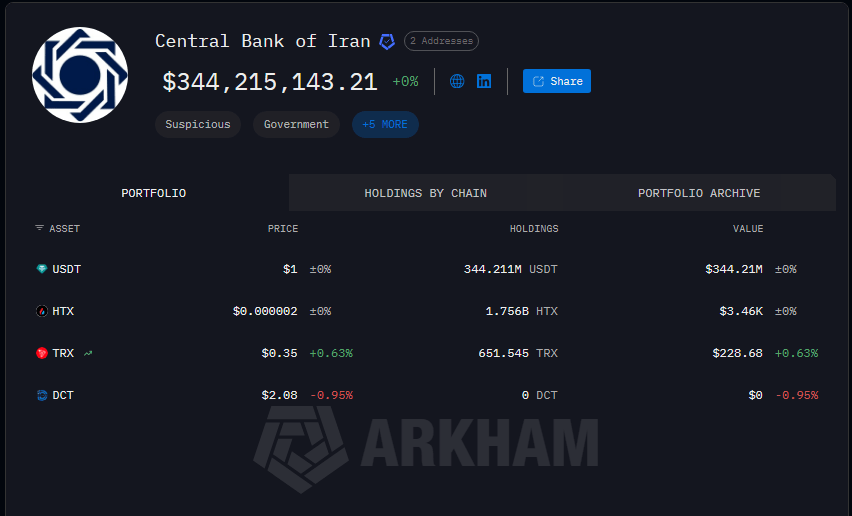
Arkham published its research on May 11, grouping the sanctioned addresses under a Central Bank of Iran entity page that it says can be used as a starting point to trace connected wallets and transaction flows.

The firm said the wallets hold TRC-20 tokens — a token standard that runs on the Tron network and includes USDT, the world’s largest stablecoin.

A Layered System Built To Hide

The money trail is not simple. According to Chainalysis, Iranian oil revenues passed through brokers, intermediary wallets, cross-chain bridges, and decentralized finance protocols before ending up in accounts linked to Iran’s central bank and IRGC-connected entities. The pipeline was built for concealment, layered step by step to obscure its origins.

A TRON spokesperson said the network itself cannot monitor or block individual transactions, but pointed to the T3 Financial Crime Unit — a joint effort between TRON, Tether, and TRM Labs launched in 2024 — as its main tool for flagging abuse.

BTCUSD trading at $80,564 on the 24-hour chart: TradingView

The unit works with law enforcement to freeze hundreds of millions in funds tied to sanctioned groups and terrorism financing, the spokesperson said. Tether declined to comment separately.

Iran’s Crypto Activity Runs Deep

The exposed wallets are just one piece of a much larger picture. Based on estimates from TRM Labs and Chainalysis, Iran’s total crypto transaction volume reached roughly $11.4 billion in 2024 and $10 billion in 2025.

Meanwhile, Iran is said to be looking into charging crypto-denominated tolls to ships passing through the Strait of Hormuz — a sign that digital assets are being considered as a revenue channel well beyond sanctions evasion.

Featured image from Bitcoin Policy Institute, chart from TradingView

Domande pertinenti

QWhat did the blockchain analytics firm Arkham do regarding Iran's crypto activity?

AArkham built a public, searchable map of crypto wallets it links to Iran's central bank, exposing Tehran's alleged digital holdings.

QWhat was the amount of crypto frozen by the US Treasury action related to Iran, and what were the cited reasons?

AAround $344 million in crypto was frozen. The US Treasury identified the wallets as property of Iran's central bank, citing ties to the Islamic Revolutionary Guard Corps-Qods Force and Hezbollah.

QHow does the article describe the complexity of Iran's money trail involving crypto?

AThe money trail is described as not simple; it involved a layered system built for concealment, passing through brokers, intermediary wallets, cross-chain bridges, and DeFi protocols to obscure origins before reaching accounts linked to Iran's central bank.

QAccording to estimates mentioned, what was Iran's estimated total crypto transaction volume in 2024 and 2025?

ABased on estimates from TRM Labs and Chainalysis, Iran's total crypto transaction volume reached roughly $11.4 billion in 2024 and $10 billion in 2025.

QWhat is one potential future use of digital assets by Iran mentioned in the article, beyond sanctions evasion?

AIran is said to be looking into charging crypto-denominated tolls to ships passing through the Strait of Hormuz, indicating digital assets are being considered as a broader revenue channel.

Letture associate

Who Funds the Agents?

**Summary: Who Funds AI Agents?** OpenAI recently shut down a feature allowing AI agents to shop for users, highlighting the challenge of creating a secure and regulated environment for agent-driven transactions. While payment infrastructure exists, a crucial governance layer—defining spending limits, fraud detection, tax handling, and return policies—is largely missing. The potential is enormous: AI agents already processed $73M across 176M transactions last year, with McKinsey forecasting this could grow to $3-5T in global consumer commerce by 2030. The core competition isn't just about processing payments, which can be very cheap (especially with crypto-based settlement), but about controlling the rules that govern agent spending. Key players like Stripe and Coinbase are racing to dominate this governance layer. Stripe's acquisition of wallet provider Privy allows it to set spending policies, identity checks, and human-in-the-loop approvals directly at the wallet level. Similarly, Coinbase's stack, including its x402 protocol and AgentKit, embeds governance rules. This vertical integration across settlement, wallet, and governance layers is becoming the dominant strategy. Control over the governance layer is where significant future value lies. If agents handle trillions in transactions, even a small fee for managing compliance, fraud prevention, and policy enforcement could generate billions in annual revenue. The companies that successfully integrate across the payment stack will capture value from idle agent balances, transaction fees, and governance services, positioning themselves as the foundational banks of the AI agent economy.

marsbit23 min fa

Who Funds the Agents?

marsbit23 min fa

A Nation Blocks Chips, a Giant Buys a Nuclear Power Plant: Why It's Time to Seriously Consider DeAI

**Title: Great Powers Blockade Chips, Giants Buy Nuclear Plants: Why It's Time to Seriously Consider DeAI** In May 2026, the US closed loopholes for Chinese firms to acquire advanced NVIDIA chips via overseas subsidiaries. That same month, Kenya halted a $1B geothermal data center project involving Microsoft, fearing its immense energy consumption. Meanwhile, Huawei announced mass production of its Ascend AI chip. These disparate events underscore a new reality: the competition for computing power ("compute") has escalated beyond the tech industry, becoming a geopolitical and infrastructural battleground. A new era of oligopoly is forming, with control over the AI stack—from GPU chips (NVIDIA) and cloud platforms (AWS, Azure, Google Cloud) to foundational models (OpenAI, Anthropic)—concentrating in a few Western "AI Octopus" corporations. This centralization creates systemic risks: pricing power and platform lock-in for users, infrastructure fragility, and a widening "compute divide" that threatens to marginalize nations without independent AI capacity. An "AI Iron Curtain" is deepening through export controls. In response, some nations like Saudi Arabia and the UAE are investing heavily to buy compute power, aiming to transition from oil to AI economies. The EU seeks to triple its compute capacity by 2030 to reduce dependency. However, the spending gap is vast, with four US tech giants alone planning ~$750B in AI capex for 2026. The race is increasingly constrained by energy, with AI tasks consuming up to 1000x more power than web searches, pushing firms to even acquire nuclear plants. This landscape is fueling interest in Decentralized AI (DeAI). It proposes a third way: using open protocols to coordinate a global network of idle GPUs, independent developers, and data centers, creating an AI infrastructure without a single controlling entity. Leveraging blockchain and cryptographic verification, DeAI aims to break market concentration, disperse energy demands, reduce geopolitical dependencies, and enhance transparency. While still nascent in performance and stability, DeAI's core promise is not immediate superiority but providing a crucial alternative architecture to resist monopoly, censorship, and centralized power. As specialized AI hardware costs fall and open-source models flourish, the window to build this foundation is open. The very existence of such competition serves as a vital check against the inevitable abuse of concentrated power.

marsbit1 h fa

A Nation Blocks Chips, a Giant Buys a Nuclear Power Plant: Why It's Time to Seriously Consider DeAI

marsbit1 h fa

Trading

Spot
Futures
活动图片





