Jinzi Ham, once renowned in the A-share market for its 'Jinhua Ham' gold-lettered signboard, is now venturing into chip investment, committing a hefty 3 billion yuan in one go.
Recently, Jinzi Ham announced that its wholly-owned subsidiary, Jinzi Semiconductor, intends to invest up to 200 million yuan in a second round of capital increase for Zhong Sheng Microelectronics. Upon completion of this round, Jinzi Semiconductor will collectively hold no more than 20% of Zhong Sheng Micro's equity.
According to the announcement, in November 2025, Jinzi Semiconductor completed the first round of capital increase of 100 million yuan, acquiring a 9.0909% stake in Zhong Sheng Micro. As of now, the conditions stipulated in the framework agreement for the second round of capital increase have been met, and the company intends to initiate the second round investment of 200 million yuan.
Public information shows that Zhong Sheng Micro is a semiconductor chip company focusing on core electrical chips for 400G, 800G, and 1.6T high-speed optical communications, and has been listed multiple times in the quasi-unicorn rankings.
Jinzi Ham's 3 billion yuan investment is a 'chasing the light' gamble on the high-speed optical module electrical chips within the AI and optical communication sectors.
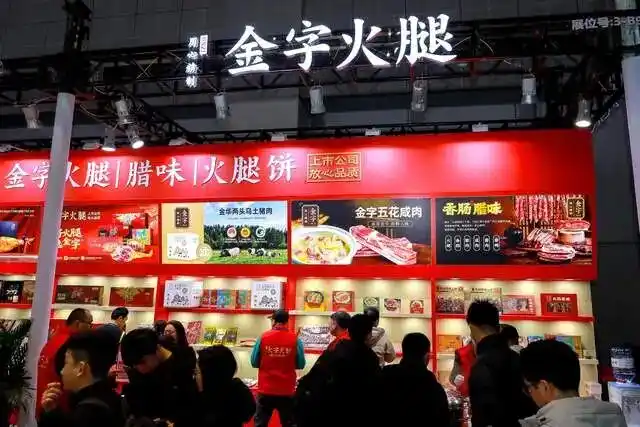
A decade ago, Jinzi Ham's cross-industry move would have been novel, but by 2026, it's not an isolated case.
The parent company of the 'Six Walnuts' beverage, Yang Yuan Beverage, invested 1.6 billion yuan in Yangtze Memory; protein powder and health supplement seller By-Health invested in 5 AI companies; apple juice seller Andili plans to spend 600-800 million yuan acquiring an electronic materials company...
These food manufacturing enterprises flocking to cross into technology sectors isn't merely simple investing and buying; it's preparation for their own future survival.
Jinzi Ham's 2026 interim report shows that revenue in the first half of the year decreased by 9.26% year-on-year, net profit attributable to the parent company turned from profit to loss, with a loss of 8.128 million yuan. Revenue from its core ham products decreased by 26.35% year-on-year, to some extent dragging down the company's performance.
Traditional industries are declining, so they must embrace the future.
However, since its listing, Jinzi Ham has made multiple cross-industry investments. Diversification has not only failed to open a second growth curve but has also dragged down company profits. Is this financial investment in an optical chip company a precise layout to capture industrial dividends, or yet another short-term chase of a trend?
Two Rounds of Investment Totaling 300 Million: 'Ham' Chasing Optical Chips
Jinzi Ham's chase for optical chips began in September last year.
In September 2025, Jinzi Ham released an announcement regarding its wholly-owned subsidiary's external investment and the signing of a framework agreement. It stated that its wholly-owned subsidiary, Jinzi Semiconductor, optimistic about the AI industry trend and the market prospects of the optical communication industry, intends to acquire no more than 20% equity in Zhong Sheng Micro through capital increase with funds not exceeding 300 million yuan. This transaction would be conducted in two rounds.
In October of the same year, Jinzi Ham announced the first round of capital increase in Zhong Sheng Micro, investing 100 million yuan to acquire 9.0909% equity. A month later, Jinzi Ham announced the completion of the first 100 million yuan capital increase.
On July 28, 2026, Jinzi Ham announced again, stating that the conditions for the second round of capital increase as stipulated in the Framework Agreement had been met. Jinzi Semiconductor intends to carry out the second round of capital increase of 200 million yuan in Zhong Sheng Micro according to the relevant agreement. Based on the latest agreement, this round's investment corresponds to a pre-money valuation of the target company of 1.35-1.85 billion yuan, with the upper valuation limit increasing by up to 85% compared to the 1 billion yuan valuation at the first round investment in 2025.
Jinzi Ham has spent a total of 300 million yuan in two rounds of capital increase chasing Zhong Sheng Micro in the optical chip field.
To hedge risks, the transaction between the two parties set multiple constraints: Zhong Sheng Micro's actual controller committed that net profits for 2026-2028 would be losses not exceeding 9.8 million yuan, not less than 18.8 million yuan, and not less than 100.25 million yuan respectively, with cumulative net profits for three years not less than 109 million yuan.
IPO conditions were also agreed upon: stipulating submission of IPO application materials or being acquired by no later than December 31, 2029. If not achieved, the investor has the right to require the actual controller or the target company to repurchase the equity at the principal plus an 8% annualized return.
However, observing Zhong Sheng Micro's financial situation, there is a significant contradiction between the high valuation and continuous losses. The pre-money valuation for the second round is 1.35-1.85 billion yuan, while the company's audited net asset value at the end of 2025 was 116 million yuan, indicating a valuation multiple exceeding ten times the book value, posing a risk of long-term equity investment impairment provision.
In terms of performance, audited 2025 figures show revenue of 2.4136 million yuan and a net loss of 107 million yuan. According to Jinzi Ham's 2026 interim report, Zhong Sheng Micro reported first-half revenue of 20.5069 million yuan and a net loss of 17.6992 million yuan. The loss for the first half has already exceeded the condition of not exceeding a loss of 9.8 million yuan promised for 2026. To fulfill the annual commitment, the company's profit in the second half must approach nearly ten million yuan.
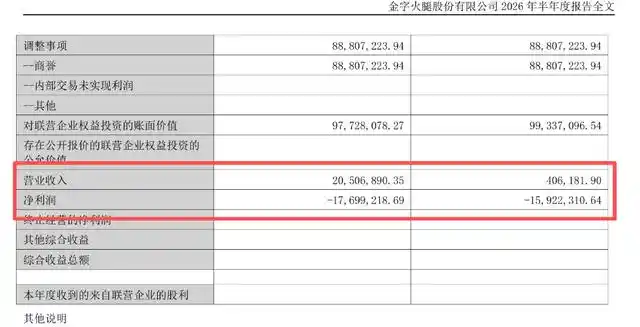
Furthermore, in the first half of 2026, Jinzi Ham's investment income showed a loss of 1.3058 million yuan, mainly due to the accrual of investment losses in Zhong Sheng Micro under the equity method.
Why would a company still reporting losses and already dragging down Jinzi Ham's performance warrant a second round of capital increase? The answer likely lies in preparing for future survival.
Ham Products Under Pressure, First Semi-Annual Loss Since Listing
Founded in 1994, Jinzi Ham is a leading enterprise in the Jinhua ham industry. Ham products have long contributed over 90% of the company's revenue, forming the fundamental base of its performance.
In recent years, dietary trends emphasizing low-fat and low-salt have become mainstream, while high-salt, high-fat ham inherently stands in opposition to this trend. According to media reports, research institution data shows that from 2022 to 2024, the entire cured meat product online market shrank by over 30%.
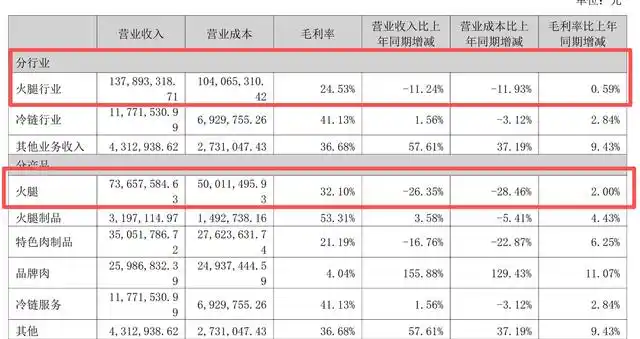
Looking at Jinzi Ham's business, in the first half of 2026, revenue from its ham industry decreased by 11.24% year-on-year. By product, ham revenue decreased by 26.35% year-on-year.
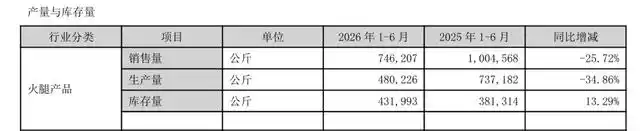
Moreover, in the first half of 2026, the sales volume of Jinzi Ham's ham products decreased by 25.72% year-on-year; production volume decreased by 34.86% year-on-year, while inventory volume increased by 13.29% year-on-year.
To sustain operations, Jinzi Ham began vigorously promoting branded meat (chilled meat business). The sales volume and production volume of the branded meat business in the first half of 2026 both increased by over 200% year-on-year. Consequently, revenue from the branded meat business increased by 155.88% year-on-year in the first half.
However, the revenue contribution from branded meat remains relatively small and is insufficient to offset the revenue decline gap caused by pressure on core ham product sales. Jinzi Ham saw revenue decline and net profit turn to a loss in the first half of the year.
The net loss in the first half of 2026 also marked Jinzi Ham's first semi-annual loss since its listing on the Shenzhen Stock Exchange in 2010.
Jinzi Ham attributed the main business loss to multiple external and internal factors: cyclical fluctuations in raw material pig prices squeezing meat product gross margins; substantial depreciation and amortization from new production base relocation and equipment debugging, raising fixed costs; weak consumer market demand, simultaneous contraction in offline distribution channels and online e-commerce channels, etc.
According to news released by Jinzi Ham, at the end of April 2026, the company's super intelligent factory with a total investment of 1 billion yuan and an annual capacity of 1.5 million hams officially transitioned to fixed assets and commenced production. This should have been an opportunity to enhance the company's capacity, but the timing was unfortunate, coinciding with pressure on the main ham business, instantly turning it into a financial burden.
In the 2026 interim report, the company's administrative expenses reached 20.7332 million yuan, an increase of nearly 12 million yuan, or nearly 150%, year-on-year. The company stated that the increase in administrative expenses was mainly due to depreciation of the new factory and increased employee compensation, among other factors.
Against the backdrop of continuously shrinking main business profitability, hot capital market sectors have become a backup path for the company to hedge performance fluctuations. Compared to the long-term investment required for deepening meat product upgrades and channel expansion, the AI and semiconductor sectors offer high growth and high valuation imagination space. Sharing industry dividends through financial investment has become management's choice for quickly seeking a second growth curve.
However, in over a decade since listing, Jinzi Ham has not just once crossed into trendy sectors. Historical experience proves that Jinzi Ham's diversification path has long been caught in a cycle of 'chasing trends, struggling execution, dragging down the main business.'
Repeated Crossovers Yield Little Significant Effect; Will 'Chasing Light' Succeed?
Jinzi Ham is an old hand at cross-industry ventures in the capital market. This pursuit of optical chips can be considered the company's fifth crossover 'sector shift.' Most previous cross-industry investments ended in losses or divestments. The diversification strategy has not delivered on growth expectations and has instead repeatedly dragged down the listed company's performance.
From 2012 to 2013, demand for new energy and permanent magnet materials expanded rapidly. As a strategic and scarce resource, rare earth prices continued to rise, and rare earth-related mining concepts became hot in the capital market.
At that time, Jinzi Ham had only been listed for three years. In January 2013, founder Shi Yanjun led the company to acquire a 67.5% controlling stake in Zhejiang Chuangyi Investment Co., Ltd. for 87.75 million yuan, officially entering the rare earth and energy investment sector. After the transaction, Jinzi Ham indirectly held a 1.15% stake in Shenhua Baorixile Energy Co., Ltd. through its control of Zhejiang Chuangyi, leveraging the underlying assets to deploy in rare earth-related mineral and energy investment businesses.
The company stated that entering the rare earth sector was based on optimism about the long-term value of rare earths as a rigid demand resource for high-end manufacturing, with industry prosperity expected to provide sustained profit space, aiming to build a dual-core business structure of 'consumer goods + resources.' Simultaneously, relying on equity investment to share in mineral value appreciation and dividend income would quickly boost the listed company's profits, compensating for bottlenecks in ham business growth.
In the initial stages, it indeed brought some returns. The 2013 annual report showed that Zhejiang Chuangyi contributed approximately 16.39 million yuan in investment income to Jinzi Ham for the year, forming a significant increment in overall profit.
However, the rare earth mining sector is a typical cyclical industry. From 2014 to 2016, with the implementation of domestic rare earth supply regulation and cooling downstream demand for permanent magnet materials, bulk rare earth commodity prices continued to fall, and mining company profits contracted sharply.
Zhejiang Chuangyi's investment income plummeted year by year, significantly reduced in 2014, and by 2016, it contributed only 7.7 million yuan to Jinzi Ham, nearly halved compared to the initial period, completely dashing profit expectations from resource investment. Moreover, the company's meat products and mining businesses had almost zero synergy. Under pressure, the company completely divested in 2017, declaring the entire four-year rare earth crossover a comprehensive failure.
During this four-year rare earth investment process, Jinzi Ham also attempted to cross into the internet finance sector.
Around 2014, with the pilot liberalization of private banks in China, internet finance experienced a boom. At that time, Jinzi Ham announced plans to invest up to 120 million yuan to participate in the establishment of MYbank, corresponding to 3% of the registered capital. In March 2015, Jinzi Ham completed full capital verification, with the entire 120 million yuan in place, officially becoming one of MYbank's founding shareholders.
However, Jinzi Ham held only a small 3% equity stake, positioned as a pure financial investor with no board representation, no participation in daily bank operational decisions, and no business influence.
Additionally, Jinzi Ham invested 126 million yuan to take stakes in Shanghai Huishuo and Weimob, deploying in micro-commerce SaaS platforms, attempting to simultaneously bet on internet finance and online e-commerce, constructing a dual-drive narrative of 'meat products + internet finance.'
However, Jinzi Ham's shareholdings were relatively small. MYbank's investment income remained sporadic, minor, and non-recurring, never becoming a stable source of profit for the company. Furthermore, after 2016, as national regulatory policies for internet finance tightened, Jinzi Ham also halted additional investments in the financial field and ceased expanding its financial sector layout.
At this moment, the pharmaceutical sector quietly entered Jinzi Ham's field of view.
Around 2016, the domestic pharmaceutical industry welcomed policy dividends, with innovative drugs and healthcare M&A funds becoming hot sectors. The 'Listed Company + PE' M&A model was all the rage in the capital market.
In July 2016, Jinzi Ham announced an investment, acquiring a 43% equity stake in Zhongyu Capital with 430 million yuan in cash. In December of the same year, the company added a 163 million yuan capital increase. The two rounds totaled 593 million yuan, raising the shareholding to 51%, achieving absolute control. Zhongyu Capital officially became the company's core platform for deploying in pharmaceuticals and healthcare.
According to Jinzi Ham's announcement, Zhongyu Capital, as an investment institution focused on the big health sector, held project resources in dozens of pharmaceutical enterprises. What Jinzi Ham didn't anticipate was that the cross-industry investment in pharmaceuticals and healthcare would become its 'most painful' project.
In 2018, Jinzi Ham reported its first loss since listing, with a net loss of 8.1299 million yuan. The significant profit decline entirely stemmed from the pharmaceutical segment. Zhongyu Capital incurred a preliminary loss of 68.54 million yuan for the year, and the company made a 15.5462 million yuan impairment provision for the substantial goodwill generated from the acquisition.
Faced with Zhongyu Capital's losses, Jinzi Ham urgently divested all pharmaceutical assets, completely exited the pharmaceutical sector, and terminated all big health M&A plans.
After stumbling in the pharmaceutical sector, Jinzi Ham began crossing into the then-hot computing power sector in 2023. In December 2023, Jinzi Ham announced an investment, subscribing to a new capital increase of 70 million yuan in Zhejiang Yindun Cloud Technology Co., Ltd. with 401 million yuan of its own funds, corresponding to a 12.2807% equity stake, with the remaining 331 million yuan fully allocated to the target's capital reserve.
Zhejiang Yindun Cloud Technology Co., Ltd.'s core asset is a large-scale GPU computing power cluster, primarily engaged in AI large model training, cloud computing, and edge computing solutions.
Unlike crossovers into rare earths or pharmaceuticals, this computing power investment was a pure financial minority stake with no involvement in the target's operations. However, in a dramatic turn, this large investment was rapidly sold off in less than a year. After making a small profit of 30.1491 million yuan, the company completely exited the computing power sector.
Having experienced four failed external cross-industry investments, Jinzi Ham now has its sights set on the hot optical communication sector, chasing optical chips. Comparing past crossovers reveals similarities and differences.
In terms of similarities, the optical chip communication sector is also a technology-intensive, long-cycle industry, where short-term continuous losses could erode profits; synergy between the two business lines is low, with little interchange in technology, channels, or customers; risk is hedged relying on performance commitments and equity repurchase guarantees, but there is uncertainty regarding fulfillment; under pressure on the main business, core funds continue to be diverted.
In terms of differences, compared to past investments in rare earths and pharmaceuticals, this chase for optical chips is also just a financial investment with no dispatch of management teams, somewhat reducing operational management risks.
From rare earths and internet finance to pharmaceuticals, computing power, and now high-speed optical chips, over more than a decade, setbacks seem never to dampen Jinzi Ham's enthusiasm for crossing industries. In its current pursuit of optical chips, will Jinzi Ham succeed, or will it replicate past failures? We will continue to watch!
This article is from WeChat Official Account "Delin Society" (ID: delinshe), author: Measure Business