Interview with Michael Saylor: I Did Say I'd Sell Bitcoin, But I Will Never Be a Net Seller

marsbitPubblicato 2026-05-11Pubblicato ultima volta 2026-05-11

Introduzione

**Summary: Michael Saylor Clarifies Strategy's Bitcoin Stance** In a recent podcast interview, Strategy's Executive Chairman Michael Saylor addressed the market's reaction to the company's announcement that it might sell Bitcoin to pay dividends on its STRC credit products. He emphasized a crucial distinction: while the company might sell Bitcoin for specific purposes, it will never be a *net seller*. Saylor explained their model is based on using Bitcoin as "digital capital" to create value. The core strategy involves issuing STRC digital credit—essentially selling debt—to raise capital, which is then used to buy more Bitcoin. He estimates Bitcoin appreciates at roughly 40% annually. A small portion of these capital gains (e.g., ~2.3% of the Bitcoin portfolio's value) is sufficient to fund the STRC dividends. Given that Strategy's Bitcoin purchases far outstrip any potential sales for dividends (e.g., buying $3.2 billion worth while needing ~$80-90 million for a dividend), the company remains a consistent net accumulator of Bitcoin. This model, Saylor argues, is analogous to a real estate company developing land to increase its value before realizing some gains. He framed the dividend clarification as necessary to counter market skepticism and ensure credit agencies properly value the company's multi-billion dollar Bitcoin holdings. Saylor reiterated his personal advice: individuals should aim to be net accumulators of Bitcoin, spending it only if they can replenish and g...

Article Source: David Lin

Compiled by | Odaily Planet Daily (@OdailyChina); Translator | Azuma(@azuma_eth)
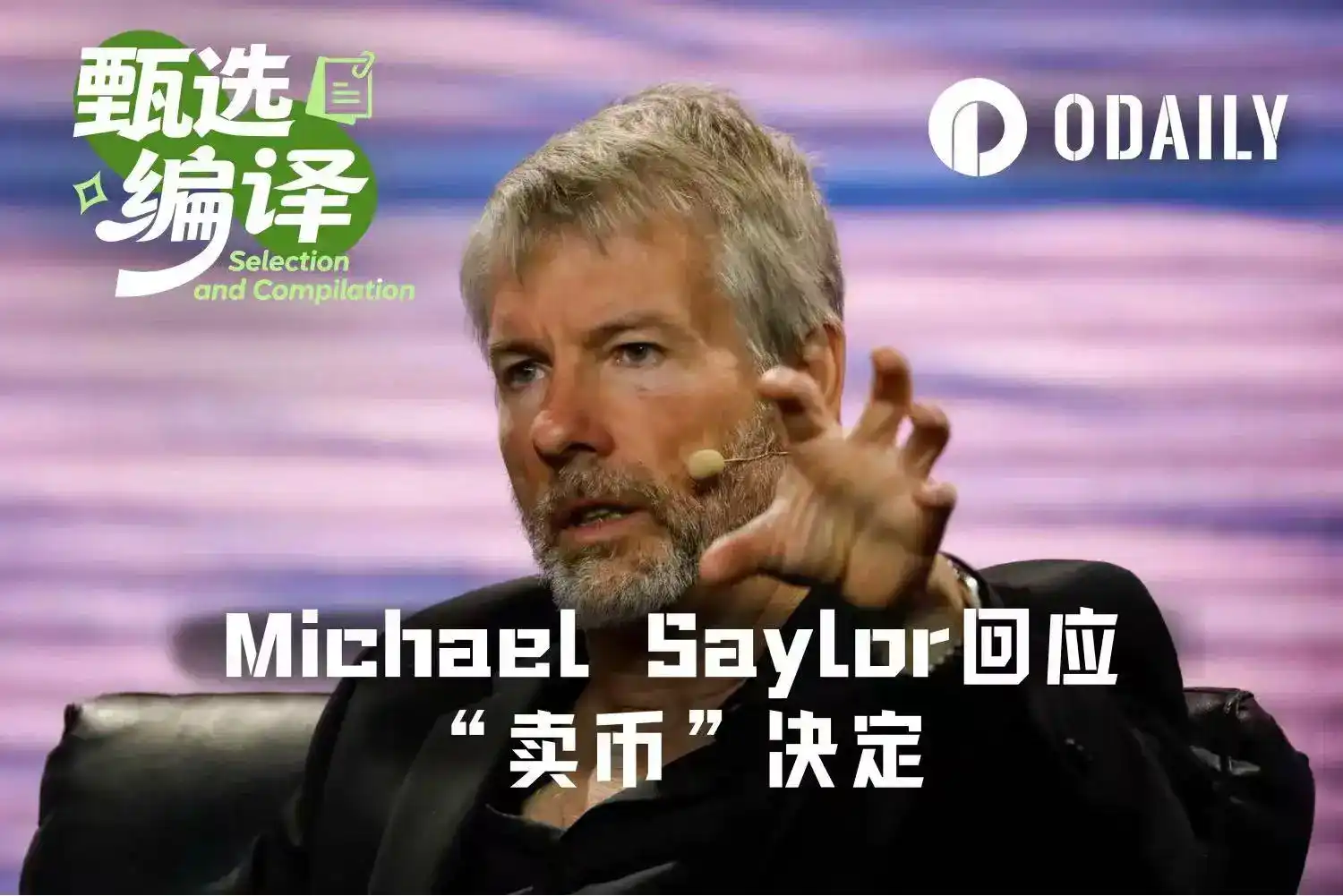
Editor's Note: During last Monday's earnings call, MicroStrategy first mentioned being "prepared to sell Bitcoin if necessary to pay dividends," a statement that immediately sparked intense market debate about its "abandonment of faith."

In response, MicroStrategy Executive Chairman Michael Saylor recently provided an in-depth analysis of the underlying logic behind this decision while appearing on David Lin's podcast, emphasizing that he only said "will sell," not "will be a net seller." Saylor also mentioned that MicroStrategy is leveraging Bitcoin's exceptional appreciation property as "digital capital" to achieve arbitrage by issuing digital credit instruments (like STRC), thereby ensuring the continuous net growth of its holdings. Below is the full content (edited) of the podcast, compiled by Odaily Planet Daily.

Podcast Interview

David Lin (Host A): It is my great honor to co-host this exciting interview with MicroStrategy Executive Chairman Michael Saylor, and my co-host is Bonnie Chang. We'll start with MicroStrategy's recent announcement and Michael Saylor's posts on social media. Bonnie, let's begin.

Bonnie Chang (Host B): Last week you announced something that shocked the entire world.

Michael Saylor: Uh, you're probably referring to our statement on the earnings call — we are prepared to sell Bitcoin if necessary to pay STRC dividends.

Bonnie Chang: I believe that was a carefully considered decision. What was the thinking behind it?

Michael Saylor: The most important point is that we want the market to understand that Bitcoin's capital gains can be used to fund credit dividends. When we sell $1 million worth of STRC credit products, we turn around and buy $1 million worth of Bitcoin. Our expectation for Bitcoin is about 30% annual appreciation, and in reality, it's closer to 40% per year. We can strip out roughly the initial 11% of those capital gains and pay that out as dividends.

The market was confused about what we would use to pay dividends. For most of history, we paid dividends by selling common stock (MSTR equity). MSTR equity is a derivative of Bitcoin and typically trades at a premium to Bitcoin. So, we were selling a Bitcoin derivative, but some people worried we might not be able to sell equity in the future.

Then there were bearish arguments saying we would have to sell equity; others said the company would never sell its Bitcoin. These arguments devolved into — 'Well, if they don't intend to sell Bitcoin, then Bitcoin must have no value, they can never sell it. And if they can't sell it, then we can't count Bitcoin as an asset on the balance sheet.'

If you own something worth $65 billion and people want to value it at zero, that's not great, right? We don't want credit rating agencies to think the company's assets are zero. We want them to think we have $65 billion in assets. Also, online there were these 'haters' constantly complaining it's a Ponzi scheme because we funded the preferred stock dividends by selling equity.

What we want to do is reinforce this business model — selling credit to invest in Bitcoin; over time, that investment appreciates faster than the dividends accumulate; then we realize those capital gains and pay the dividends.

We thought the best way to clarify this was to state clearly that 'the company will never need to sell common stock,' we can just sell Bitcoin, which has appreciated significantly, to pay dividends. That is essentially using capital gains to pay credit dividends.

I think it's like a real estate development company that raises money by issuing credit instruments, buys land at $10,000 an acre, develops it, making it worth $100,000 an acre, then realizes that capital appreciation. You could sell the land at $100,000 an acre, lease it after full development, or refinance it. No one questions a real estate development company that makes capital investments with credit proceeds, and we are doing the same thing with Bitcoin. We need to ensure the market understands this.

I became famous for saying 'never sell your Bitcoin,' which is why the internet exploded when they heard we might sell. But if I were more precise, it should be 'never be a net seller of Bitcoin.' It's just that 'never be a net seller' isn't as catchy or easy to spread.

I think in these times, even if we were to sell 1 Bitcoin, we would buy 10 to 20 more. So, you're talking about a situation of 'buy 10, sell 1, net buy 9.' Once people understand, it shouldn't be an issue anymore, but for now, it's a controversial topic.

Bonnie Chang: Can you explain how you can sell 1 Bitcoin while buying 10?

Michael Saylor: Yes. MicroStrategy's primary Bitcoin accumulation engine is STRC. We sold $3.2 billion worth of STRC in April, so we bought $3.2 billion worth of Bitcoin. The dividend is around $80 to $90 million. So, in this month where we raised $3 billion, we only need $80 or $90 million to pay the dividend — essentially, you're buying 30 Bitcoin while selling 1.

Our 'break-even rate' is roughly 2.3%. This means that if the credit debt we issue equals 2.3% of our Bitcoin holdings, then even if we sell Bitcoin to pay dividends, we will always be a net buyer of Bitcoin. Another point is, if Bitcoin appreciates 2.3% annually, we can pay dividends permanently and continuously create value, all without selling any common stock.

In the first four months of this year, we've already sold about $5 billion worth of STRC. At that rate, the issuance rate for the year will be 15% to 20%. As long as the company is growing, it will buy more Bitcoin than it sells. I anticipate that in every month and quarter going forward, we will be a net buyer of Bitcoin.

Bonnie Chang: I have another question. Many investors adhere almost religiously to the advice 'never sell Bitcoin.' Do you think they should still follow that advice?

Michael Saylor: Yes, I think you should be a 'net accumulator' of Bitcoin. When I said 'never sell your Bitcoin,' I meant if you're going to spend it on something, make sure you replenish it after spending.

Many crypto or Bitcoin believers say they want to buy things with Bitcoin. I'd say, fill the gap after spending. Don't be a net seller of Bitcoin because Bitcoin is capital. At the end of every year, you should have more Bitcoin than you started with.

To draw an analogy, if Google spends $1 billion building a data center and makes $10 billion from it, they net $9 billion. That doesn't crash the dollar market, right? No one gasps 'Google sold dollars to buy a data center.' The dollar will be fine; it doesn't undermine Google's business model. They spent $1 billion investing in the business — that's normal, it's rational. Sometimes you spend money to make more money.

So, if you spend 1 Bitcoin to make 10 Bitcoin, I think that's good for Bitcoin and good for the company... When equity capital markets are less liquid than the Bitcoin market, we want to be able to utilize that market.

Whenever a company takes options off the table, saying 'we will never ever do something,' whatever it is, regret is often the result. For example, if we said we 'absolutely will never repurchase our own stock, we will only sell stock,' then short sellers would hammer our stock down to $1. When the stock price is at a huge discount to net asset value (NAV), if we can buy it back, those short sellers would lose a lot. By exploiting their irrationality, we can make a lot of money.

So, what we were really saying on the earnings call is — we'll trade STRC for MSTR, we'll trade BTC for MSTR, we'll use BTC or MSTR to pay dividends, we'll do whatever is in the company's best interest. But over time, we expect to be a net accumulator of Bitcoin. This doesn't change how we trade assets day-to-day. Whether we sell credit debt, sell equity, or sell Bitcoin capital will depend on market conditions and mispricing.

The other thing we said yesterday is that we are prepared to repurchase our bonds. Currently, our corporate debt is trading cheap, undervalued, so it makes sense to buy it back, not to sell it. We won't sell undervalued assets; we will buy undervalued assets and arbitrage any opaque inefficiencies. If the market knows we will do this, the market will assign a fair value to all these assets. That benefits investors in all these instruments and, ultimately, that's our fiduciary duty.

David Lin: One of your biggest critics, Peter Schiff, wrote this morning: 'Yesterday, Saylor admitted MSTR (MicroStrategy) would sell Bitcoin if needed to pay STRC dividends. I think that pledge is meant to keep the so-called Ponzi scheme going a bit longer. But I'm guessing when push comes to shove, he'll opt to suspend the dividend and let STRC collapse rather than let Bitcoin collapse.' What is your response to that?

Michael Saylor: Peter thinks Bitcoin is a Ponzi scheme. Peter doesn't really like anything in this space. Bitcoin is 'digital capital,' and we've created a digital finance company by selling equity and credit instruments to buy that capital. I think Bitcoin will persist because it represents tokenized global economic wealth with full property rights.

We built a credit instrument, STRC, on top of it, which simply strips out volatility, reduces risk, and extracts or 'distills' yield from the digital capital. If you don't acknowledge Bitcoin as legitimate, you'll never acknowledge any derivative on it as legitimate. But for those who believe Bitcoin can store economic wealth in tokenized form, what we're doing is very straightforward.

STRC employs an overcollateralization model: for every $5 of Bitcoin, sell $1 of credit debt, and that $1 of credit debt has a clear yield. There are many people who believe Bitcoin is a legitimate asset but just can't stomach its volatility. They don't want to put money for their child's fall tuition into Bitcoin because they have to pay in 12 weeks. So, for them, digital credit makes a lot of sense because the principal is protected, more stable. Plus, they can get 3 to 4 times the yield of money markets through STRC, which is a trait of Bitcoin being superior to other capital assets, allowing us to pay this high dividend yield.

David Lin: Here's a theory I'd like to ask you about, then I'll hand it back to Bonnie. Some traders have noticed that whenever STRC pays a dividend, the ex-dividend price trades below par for a period (maybe a day or two). Once it reaches par, that's when MicroStrategy goes to buy Bitcoin. So, they've started 'front-running' by buying Bitcoin before STRC reaches par, betting that you and MicroStrategy will buy Bitcoin at par. Can you comment on that?

Michael Saylor: What happens near the dividend date is that demand for STRC is huge because there's about a 90-cent dividend after the record date. So, there are billions, tens of billions of dollars of STRC traded before the record date, and the day after the record date, it trades down 60 or 70 cents, then gradually recovers to par over the next week or two.

So that's normal. Those people are arbitrageurs. Their idea is that by tying up capital for about 12 days a year, they can capture roughly a 42% annualized yield. They have their own calculations. That's fine; it's good for us too because it creates liquidity and engagement, and it will continue.

As for the second idea, can you front-run the Bitcoin market? The Bitcoin derivatives market has $50 billion in daily volume. So, I don't think anyone has enough capital to move that market.

My view is that Bitcoin is a bit like 'the square of tech capital.' The factors driving the Bitcoin market are trade wars, hot wars, foreign policy, national situations, the Iranian situation in the Strait of Hormuz, then currency wars — like whether we expect SOFR to drop to 200 basis points or if the yield curve is being twisted. You can see that right now we are in a fairly tight monetary environment, so these macro factors are the main drivers of Bitcoin.

I can tell you as a fact, we have bought $100 million worth of Bitcoin in an hour, and it didn't move the price; we've bought $200 million in an hour, and it didn't move the price; we've bought $200 or $300 million in an hour and stopped, and the price actually went up.

So, no one has enough power to move the price of Bitcoin... Well, if you're going to throw $30 billion at the market in an afternoon, maybe. But I've spent a lot of money; we've bought more Bitcoin than anyone I know, we've probably bought $62 billion worth. I believe it's a global market with its own momentum.

So, statements about us being able to influence the price are flattering, but I don't think so.

Bonnie Chang: Why do you say the price doesn't budge when you buy so much Bitcoin?

Michael Saylor: Because the market liquidity is extremely deep. Suppose I were to buy $1 billion today; even that is only 1/50th of a $50 billion volume.

If you ask traders, they'll say spot market daily volume is sometimes $20 billion, and derivatives sometimes hit $80 billion. In a market with such deep liquidity, what is $100 million? That's the beauty of it. On the weekend, if you want to put on a $1 billion position with 20x leverage, you can do it in the Bitcoin market; if you want a $1 billion credit line within an hour, you can get it in the Bitcoin market.

I do think macro factors drive Bitcoin, and sometimes Bitcoin has a life of its own. Micro factors also drive it — I mean industry factors, like the formation of digital credit, the formation of bank credit, and investor sentiment towards Bitcoin assets. But I think Bitcoin is more powerful than all of us, and that's why we have confidence in it — because no single participant can prop it up or hold it back.

David Lin: If the Strait of Hormuz remains closed for the foreseeable future, several forces will intertwine. First, some say inflationary pressures will persist; second, the Fed may eventually need to cut rates because they are trapped by high inflation. So, what ultimately happens to liquidity? What happens to Bitcoin if the Fed remains trapped?

Michael Saylor: I think when you're facing tight monetary policy, high global trade tensions, and high geopolitical tensions due to foreign policy or war (whether in Ukraine or Iran), all of these are somewhat constraining; they are headwinds. I think when these reverse, they become tailwinds.

But regardless, Bitcoin will grind up. This is because the organic supply from miners is only about $10 to $12 billion per year, only 450 Bitcoin per day. Do the math yourself. Then, whenever we raise another $10 billion in capital, we've bought up the entire year's supply. So, if a bank creates $10 billion in credit, that's 'one turn of the axle'; if we sell $10 billion in STRC digital credit, that's 'a second turn of the axle'; when $10 billion flows into IBIT (BlackRock's Bitcoin spot ETF), that's 'a third turn of the axle.'

So, capital flows, digital credit, digital capital wrapper tools, and bank credit — all of these are driving the market's fundamentals, and they are all positive. Regardless of macro factors, you'll see continued adoption. The role of macro winds is just that, when we should grind up 30%, tailwinds make us surge to 50%, while headwinds somewhat slow us down.

David Lin: Has your logic for Bitcoin changed?

Michael Saylor: No change. But I would say it's now clear that Bitcoin is 'digital capital,' and over the past 12 months, one thing has become very clear — one of Bitcoin's killer applications is digital credit.

Many people have wondered, what is the killer app for a $1.5 trillion asset class with hundreds of billions in daily trading volume? The answer is: collateral for credit. Since digital capital is the best-performing capital asset (and it is), outperforming the S&P 500 by two to three times, then it follows that we can create the best-performing credit assets on top of this capital asset.

What we've seen over the past year is that STRC is the most liquid credit instrument; it's the most liquid preferred stock in the entire market and the largest preferred stock in the market. It has the highest Sharpe ratio. We've successfully created an instrument with a Sharpe ratio of 3 and a dividend yield of 11% to 12%.

The highest Sharpe ratio in stocks is Nvidia, around 1.7; the S&P 500 is about 0.9... nothing exceeds 1. Even the top hedge funds you can find can't exceed a Sharpe ratio of 2.2.

So, digital credit actually has better risk-adjusted returns than all other financial strategies and all publicly traded instruments in the public capital markets. I couldn't have told you this 12 months ago. But now the logic works — if Bitcoin is the best-performing capital, then convertible bonds backed by Bitcoin become the best-performing convertibles, and credit instruments like STRCh, become the best-performing preferred stock.

By the way, do you know what percentage of the preferred stock market we accounted for this year?

Bonnie Chang: I'd guess over 70%?

Michael Saylor: 60% of all preferred stock issued in the United States this year was issued by us. Last year and this year, we are the largest credit issuer in the US. We revived the preferred stock market; STRC has grown explosively.

So, I think what's novel is the idea of 'digital capital drives digital credit.' As you see on the show, digital credit is a stepping stone to digital currency. Because now there's a whole host of stable yield coins/tokens pegged to the dollar paying 8% or 9% yields. Apex created one, growing from 0 to $300 million in 8 weeks; Saturn created another, growing from 0 to $110 million in 6 weeks.

There's been an explosion of innovation in digital assets, crypto, and traditional finance driven by digital credit. And Bitcoin is the foundational rock that makes digital credit possible. That might be the most exciting thing this year.

Bonnie Chang: One last question. Did 'Have Space Suit—Will Travel' inspire you to go to MIT? Let's go back before MIT, before this book and Bitcoin. Say something to your younger self.

Michael Saylor: You know, when I was in first grade, my parents wanted to motivate me; they told me they'd give me 10 cents for every book I read. I was addicted to comic books at the time, and I remember comic books cost 25 cents each. So the calculation was, I had to read two and a half 'real books' to get one comic book. I was highly motivated.

That summer I read about 100 books. I'd go to the library and check out 10 at a time. Then I discovered science fiction, discovered Heinlein, Clark, and Asimov. I read 'The Moon is a Harsh Mistress' and 'Have Space Suit—Will Travel' before third grade. By third or fourth grade, I had devoured them all.

I'd say reading those science fiction books drove my intellectual development. Grade school boys are very impressionable. I remember in 'Have Space Suit—Will Travel,' the protagonist is an alpha male. He fixes a space suit, gets picked up by a ship, travels the universe, and saves humanity from 'bug-eyed monsters.' What's the reward for saving humanity? He gets a full scholarship to MIT. I thought, if MIT is good enough for the hero who saved humanity, it's probably good enough for me. So, come hell or high water, I was going there.

David Lin: If Elon Musk invited you to Mars, would you accept?

Michael Saylor: That would depend on what kind of vehicle he offers to take me there.

Domande pertinenti

QWhat is the key distinction Michael Saylor makes between selling Bitcoin and being a 'net seller' of Bitcoin for MicroStrategy?

AMichael Saylor clarifies that while MicroStrategy may sell some Bitcoin to pay dividends on its STRC credit product, the company will remain a 'net accumulator' or 'net buyer' of Bitcoin. This means for every Bitcoin sold, the company will buy back many more, ensuring its overall Bitcoin holdings increase over time. He uses the example of selling $1 in Bitcoin for dividends after buying $10 to $20 worth, resulting in a net gain.

QAccording to Saylor, what is the 'break-even rate' for MicroStrategy's STRC issuance, and what does it signify?

AThe 'break-even rate' is approximately 2.3%. It signifies that if MicroStrategy issues credit debt (like STRC) equal to 2.3% of its total Bitcoin holdings, the yield from that debt issuance will be sufficient to cover the dividend payments. Therefore, even if the company sells Bitcoin to pay those dividends, it can still be a perpetual net buyer of Bitcoin without needing to sell any equity, as long as Bitcoin appreciates at least 2.3% annually.

QHow does Michael Saylor characterize Bitcoin's primary 'killer app' that has become clear in the last 12 months?

ASaylor states that Bitcoin's primary 'killer app' is serving as collateral for 'Digital Credit.' He explains that as the best-performing capital asset, Bitcoin enables the creation of superior credit instruments. MicroStrategy's STRC, a digital credit tool, exemplifies this by offering high yields (11-12%) with a high Sharpe ratio, making it one of the top-performing preferred shares in the market.

QWhy does Michael Saylor believe individual or institutional buying pressure does not significantly move the Bitcoin market price?

ASaylor attributes this to the Bitcoin market's immense depth and liquidity. He cites daily trading volumes of hundreds of billions of dollars across spot and derivatives markets. Even large purchases by MicroStrategy (e.g., hundreds of millions in an hour) are a small fraction of the total daily volume. Therefore, he argues that macro factors like geopolitics and monetary policy, not individual actors, are the primary drivers of Bitcoin's price.

QWhat was the childhood inspiration that motivated Michael Saylor to attend MIT?

ASaylor was inspired by the science fiction book 'Have Space Suit—Will Travel' by Robert A. Heinlein. In the story, the protagonist saves humanity and is rewarded with a full scholarship to MIT. As a young boy, Saylor reasoned that if MIT was good enough for a fictional hero, it was good enough for him, which solidified his determination to attend the university.

Letture associate

"JUST 6th Anniversary x GasFree Super Carnival Month" Grandly Arrives: Enjoy "0" Gas Transfer Freedom & Share the 10,000 USDT Bonus Pool

The "JUST 6th Anniversary x GasFree Super Carnival Month" event has launched, celebrating the JUST ecosystem's six-year milestone within the TRON network. Running from May 18th to June 7th, the event features a 10,000 USDT prize pool and is designed to promote the GasFree smart wallet. GasFree, a key product of the JustLend DAO protocol, allows users to pay transaction fees directly with the token being transferred (e.g., USDT), eliminating the need to hold the network's native token (TRX) for gas. This innovation aims to simplify on-chain transactions and lower the entry barrier for new users. The carnival offers five main activities: 1. **GasFree Activation Challenge:** New users can earn random rewards (5.2-522 USDT) for activating GasFree and completing their first transfer. 2. **Transfer Rebate:** 200 users daily are randomly selected to receive a 100% rebate on their activation and transaction fees. 3. **Bitcoin Pizza Day Special:** A dedicated event with custom rewards to celebrate crypto culture. 4. **JUST 6th Anniversary Lucky Draw:** Special anniversary reward packages for lucky participants. 5. **Knowledge Quiz:** A trivia contest where users can win prizes by answering questions about JUST and GasFree. To participate, users need a compatible wallet like TronLink (recommended), Klever, Guarda, or NOW Wallet. They must then find the GasFree feature, fund it with USDT, and complete at least one USDT transfer to qualify for the rewards. The article highlights GasFree's significant adoption, reporting over 872 billion USD in cumulative transaction volume and more than 612 million USD in saved user fees since its launch. The event underscores JUST's commitment to enhancing the DeFi user experience by making on-chain interactions more accessible and cost-effective.

链捕手24 min fa

"JUST 6th Anniversary x GasFree Super Carnival Month" Grandly Arrives: Enjoy "0" Gas Transfer Freedom & Share the 10,000 USDT Bonus Pool

链捕手24 min fa

BNB Chain Releases Research Report, Exploring Post-Quantum Cryptography Migration Path for BSC

BNB Chain, a leading Layer-1 blockchain ecosystem, has released a research report exploring the potential migration path for BNB Smart Chain (BSC) to post-quantum cryptography. The study evaluates replacing traditional cryptographic systems with quantum-resistant alternatives, specifically examining the use of ML-DSA-44 for transaction signing and pqSTARK for aggregating validator consensus signatures. While quantum computers are not currently a practical threat to existing blockchain cryptography, the research represents a proactive effort to ensure long-term network security and infrastructure resilience. The report assessed several core areas of the BSC tech stack, including post-quantum transaction signing, validator signature aggregation, transaction validation, public key storage, and network performance under increased data loads. A key finding is that achieving post-quantum readiness is technically feasible today but requires significant trade-offs in scalability. Test data indicates: • Transaction size would increase from ~110 bytes to ~2.5 kilobytes. • Block size would grow from ~110 kilobytes to ~2 megabytes. • Native transfer TPS would decrease from 4,973 to 2,997. The primary performance bottleneck is not signature verification itself, but the increased network transmission overhead caused by larger transaction and block sizes. Conversely, the pqSTARK aggregation technology proved highly efficient, compressing validator signatures by an approximately 43:1 ratio, which helps manage consensus-layer overhead. The report notes that post-quantum alternatives for areas like P2P handshakes and KZG commitments were not within the scope of this evaluation and require further research and broader ecosystem coordination. BNB Chain emphasizes this work is a research-oriented exploration and not a response to any imminent security threat.

marsbit1 h fa

BNB Chain Releases Research Report, Exploring Post-Quantum Cryptography Migration Path for BSC

marsbit1 h fa

Trading

Spot
Futures

Articoli Popolari

Cosa è BITCOIN

Comprendere HarryPotterObamaSonic10Inu (ERC-20) e la sua posizione nel mondo delle criptovalute Negli ultimi anni, il mercato delle criptovalute ha assistito a un aumento della popolarità delle meme coin, catturando l'interesse non solo dei trader, ma anche di coloro che cercano coinvolgimento comunitario e valore di intrattenimento. Tra questi token unici c'è HarryPotterObamaSonic10Inu (ERC-20), un progetto intrigante che mescola riferimenti culturali nel tessuto delle criptovalute. Questo articolo esplora gli aspetti chiave di HarryPotterObamaSonic10Inu, analizzando i suoi meccanismi, l'etica guidata dalla comunità e il suo coinvolgimento con il panorama crittografico più ampio. Che cos'è HarryPotterObamaSonic10Inu (ERC-20)? Come suggerisce il suo nome, HarryPotterObamaSonic10Inu è una meme coin costruita sulla blockchain di Ethereum, classificata secondo lo standard ERC-20. A differenza delle criptovalute tradizionali che possono enfatizzare l'utilità pratica o il potenziale investimento, questo token prospera grazie al valore di intrattenimento e alla forza della sua comunità. Il progetto mira a creare un ambiente in cui gli utenti coinvolti possono riunirsi, condividere idee e partecipare ad attività ispirate a diversi fenomeni culturali. Una caratteristica notevole di HarryPotterObamaSonic10Inu è la zero tassa sulle transazioni. Questo elemento allettante tende a incoraggiare il trading e il coinvolgimento della comunità, privo di costi aggiuntivi che possono scoraggiare i trader di piccole dimensioni. L'offerta totale della moneta è fissata a un miliardo di token, un numero che segna la sua intenzione di mantenere una circolazione sostanziale all'interno della comunità. Creatore di HarryPotterObamaSonic10Inu (ERC-20) Le origini di HarryPotterObamaSonic10Inu sono avvolte in un certo mistero; i dettagli sul creatore rimangono sconosciuti. Lo sviluppo di questo token non presenta un team identificabile o un piano esplicito, cosa non rara nel settore delle meme coin. Invece, il progetto è emerso organicamente, con il suo progresso fortemente dipendente dall'entusiasmo e dalla partecipazione della sua comunità. Investitori di HarryPotterObamaSonic10Inu (ERC-20) Per quanto riguarda investimenti esterni e finanziamenti, HarryPotterObamaSonic10Inu rimane ambiguo. Il token non elenca alcuna fondazione di investimento conosciuta o un sostegno organizzativo significativo. Invece, la linfa vitale del progetto è la sua comunità di base, che informa la sua crescita e sostenibilità attraverso azioni collettive e coinvolgimento nello spazio crittografico. Come funziona HarryPotterObamaSonic10Inu (ERC-20)? In quanto meme coin, HarryPotterObamaSonic10Inu opera principalmente al di fuori delle strutture tradizionali che governano spesso il valore degli asset. Ci sono diversi aspetti distintivi che definiscono il funzionamento del progetto: Transazioni senza tasse: Senza costi fiscali sulle transazioni, gli utenti possono comprare e vendere liberamente il token senza preoccuparsi di costi nascosti. Coinvolgimento della comunità: Il progetto prospera sull'interazione della comunità, sfruttando le piattaforme social per creare entusiasmo e facilitare il coinvolgimento. Discussioni, condivisione di contenuti e coinvolgimento sono elementi cruciali che aiutano ad espandere la sua portata e a favorire la lealtà tra i sostenitori. Nessuna utilità pratica: Va notato che HarryPotterObamaSonic10Inu non offre un'utilità concreta all'interno dell'ecosistema finanziario. Piuttosto, è classificato come un token principalmente per attività di intrattenimento e comunitarie. Riferimento culturale: Il token incorpora astutamente elementi della cultura pop per attirare interesse, collegandosi a appassionati di meme e seguaci delle criptovalute. HarryPotterObamaSonic10Inu esemplifica come le meme coin operino in modo diverso rispetto ai progetti di criptovalute più tradizionali, entrando nel mercato come costrutti sociali innovativi piuttosto che come asset utilitari. Cronologia di HarryPotterObamaSonic10Inu (ERC-20) La storia di HarryPotterObamaSonic10Inu è segnata da diversi traguardi notevoli: Creazione: Il token è emerso da un meme virale, catturando l'immaginazione di molti appassionati di criptovalute. Le date di creazione specifiche non sono disponibili, sottolineando la sua crescita organica. Inserimento negli scambi: HarryPotterObamaSonic10Inu ha fatto il suo ingresso in vari scambi, consentendo un accesso e un trading più facili da parte della comunità. Iniziative di coinvolgimento della comunità: Attività in corso volte a migliorare l'interazione della comunità, comprese gare, campagne sui social media e generazione di contenuti da parte di fan e sostenitori. Piani di espansione futura: La tabella di marcia del progetto include il lancio di una collezione NFT, merchandising e un sito di eCommerce relativo ai suoi temi culturali, coinvolgendo ulteriormente la comunità e cercando di aggiungere più dimensioni al suo ecosistema. Punti chiave su HarryPotterObamaSonic10Inu (ERC-20) Natura guidata dalla comunità: Il progetto dà priorità al contributo collettivo e alla creatività, garantendo che il coinvolgimento degli utenti sia al centro del suo sviluppo. Classificazione come meme coin: Rappresenta l'epitome delle criptovalute basate sull'intrattenimento, distinguendosi dai veicoli d'investimento tradizionali. Nessuna affiliazione diretta con Bitcoin: Nonostante la somiglianza nel nome del ticker, HarryPotterObamaSonic10Inu è distintivo e non ha alcuna relazione con Bitcoin o altre criptovalute consolidate. Focus sulla collaborazione: HarryPotterObamaSonic10Inu è progettato per creare uno spazio per la collaborazione e la condivisione di storie tra i suoi detentori, fornendo un canale per la creatività e il legame comunitario. Prospettive future: L'ambizione di espandersi oltre il suo presupposto iniziale verso NFT e merchandising delinea un percorso per il progetto per potenzialmente entrare in strade più mainstream all'interno della cultura digitale. Poiché le meme coin continuano a catturare l'immaginazione della comunità crittografica, HarryPotterObamaSonic10Inu (ERC-20) si distingue per i suoi legami culturali e il suo approccio centrato sulla comunità. Anche se potrebbe non adattarsi al modello tipico di un token orientato all'utilità, la sua essenza risiede nella gioia e nella camaraderia coltivate tra i suoi sostenitori, evidenziando la natura in evoluzione delle criptovalute in un'epoca sempre più digitale. Con la continuazione dello sviluppo del progetto, sarà importante osservare come le dinamiche della comunità influenzano la sua traiettoria nel panorama in continuo cambiamento della tecnologia blockchain.

1.5k Totale visualizzazioniPubblicato il 2024.04.01Aggiornato il 2024.12.03

Cosa è BITCOIN

Come comprare BTC

Benvenuto in HTX.com! Abbiamo reso l'acquisto di Bitcoin (BTC) semplice e conveniente. Segui la nostra guida passo passo per intraprendere il tuo viaggio nel mondo delle criptovalute.Step 1: Crea il tuo Account HTXUsa la tua email o numero di telefono per registrarti il tuo account gratuito su HTX. Vivi un'esperienza facile e sblocca tutte le funzionalità,Crea il mio accountStep 2: Vai in Acquista crypto e seleziona il tuo metodo di pagamentoCarta di credito/debito: utilizza la tua Visa o Mastercard per acquistare immediatamente BitcoinBTC.Bilancio: Usa i fondi dal bilancio del tuo account HTX per fare trading senza problemi.Terze parti: abbiamo aggiunto metodi di pagamento molto utilizzati come Google Pay e Apple Pay per maggiore comodità.P2P: Fai trading direttamente con altri utenti HTX.Over-the-Counter (OTC): Offriamo servizi su misura e tassi di cambio competitivi per i trader.Step 3: Conserva Bitcoin (BTC)Dopo aver acquistato Bitcoin (BTC), conserva nel tuo account HTX. In alternativa, puoi inviare tramite trasferimento blockchain o scambiare per altre criptovalute.Step 4: Scambia Bitcoin (BTC)Scambia facilmente Bitcoin (BTC) nel mercato spot di HTX. Accedi al tuo account, seleziona la tua coppia di trading, esegui le tue operazioni e monitora in tempo reale. Offriamo un'esperienza user-friendly sia per chi ha appena iniziato che per i trader più esperti.

3.8k Totale visualizzazioniPubblicato il 2024.12.12Aggiornato il 2025.03.21

Come comprare BTC

Cosa è $BITCOIN

ORO DIGITALE ($BITCOIN): Un'Analisi Completa Introduzione all'ORO DIGITALE ($BITCOIN) L'ORO DIGITALE ($BITCOIN) è un progetto basato su blockchain che opera sulla rete Solana, con l'obiettivo di combinare le caratteristiche dei metalli preziosi tradizionali con l'innovazione delle tecnologie decentralizzate. Sebbene condivida un nome con Bitcoin, spesso definito “oro digitale” a causa della sua percezione come riserva di valore, l'ORO DIGITALE è un token separato progettato per creare un ecosistema unico all'interno del panorama Web3. Il suo obiettivo è posizionarsi come un asset digitale alternativo valido, anche se i dettagli riguardanti le sue applicazioni e funzionalità sono ancora in fase di sviluppo. Cos'è l'ORO DIGITALE ($BITCOIN)? L'ORO DIGITALE ($BITCOIN) è un token di criptovaluta esplicitamente progettato per l'uso sulla blockchain di Solana. A differenza di Bitcoin, che fornisce un ruolo di stoccaggio di valore ampiamente riconosciuto, questo token sembra concentrarsi su applicazioni e caratteristiche più ampie. Aspetti notevoli includono: Infrastruttura Blockchain: Il token è costruito sulla blockchain di Solana, nota per la sua capacità di gestire transazioni ad alta velocità e a basso costo. Dinamiche di Offerta: L'ORO DIGITALE ha un'offerta massima fissata a 100 quadrilioni di token (100P $BITCOIN), sebbene i dettagli riguardanti la sua offerta circolante siano attualmente non divulgati. Utilità: Sebbene le funzionalità precise non siano esplicitamente delineate, ci sono indicazioni che il token potrebbe essere utilizzato per varie applicazioni, potenzialmente coinvolgendo applicazioni decentralizzate (dApp) o strategie di tokenizzazione degli asset. Chi è il Creatore dell'ORO DIGITALE ($BITCOIN)? Attualmente, l'identità dei creatori e del team di sviluppo dietro l'ORO DIGITALE ($BITCOIN) rimane sconosciuta. Questa situazione è tipica tra molti progetti innovativi nel settore blockchain, in particolare quelli allineati con la finanza decentralizzata e i fenomeni delle meme coin. Sebbene tale anonimato possa favorire una cultura guidata dalla comunità, intensifica le preoccupazioni riguardo alla governance e alla responsabilità. Chi sono gli Investitori dell'ORO DIGITALE ($BITCOIN)? Le informazioni disponibili indicano che l'ORO DIGITALE ($BITCOIN) non ha alcun sostenitore istituzionale noto o investimenti di venture capital prominenti. Il progetto sembra operare su un modello peer-to-peer incentrato sul supporto e sull'adozione della comunità piuttosto che su percorsi di finanziamento tradizionali. La sua attività e liquidità si trovano principalmente su exchange decentralizzati (DEX), come PumpSwap, piuttosto che su piattaforme di trading centralizzate consolidate, evidenziando ulteriormente il suo approccio di base. Come Funziona l'ORO DIGITALE ($BITCOIN) Le meccaniche operative dell'ORO DIGITALE ($BITCOIN) possono essere elaborate in base al suo design blockchain e alle caratteristiche della rete: Meccanismo di Consenso: Sfruttando il proof-of-history (PoH) unico di Solana combinato con un modello di proof-of-stake (PoS), il progetto garantisce una validazione efficiente delle transazioni contribuendo all'alta performance della rete. Tokenomics: Sebbene meccanismi deflazionistici specifici non siano stati dettagliati ampiamente, l'ampia offerta massima di token implica che potrebbe soddisfare microtransazioni o casi d'uso di nicchia che devono ancora essere definiti. Interoperabilità: Esiste il potenziale per l'integrazione con l'ecosistema più ampio di Solana, inclusi vari piattaforme di finanza decentralizzata (DeFi). Tuttavia, i dettagli riguardanti integrazioni specifiche rimangono non specificati. Cronologia degli Eventi Chiave Ecco una cronologia che evidenzia traguardi significativi riguardanti l'ORO DIGITALE ($BITCOIN): 2023: Il dispiegamento iniziale del token avviene sulla blockchain di Solana, contrassegnato dal suo indirizzo di contratto. 2024: L'ORO DIGITALE guadagna visibilità poiché diventa disponibile per il trading su exchange decentralizzati come PumpSwap, consentendo agli utenti di scambiarlo contro SOL. 2025: Il progetto assiste a un'attività di trading sporadica e a un potenziale interesse per impegni guidati dalla comunità, sebbene non siano state documentate partnership significative o avanzamenti tecnici fino ad ora. Analisi Critica Punti di Forza Scalabilità: L'infrastruttura sottostante di Solana supporta alti volumi di transazioni, il che potrebbe migliorare l'utilità di $BITCOIN in vari scenari di transazione. Accessibilità: Il potenziale basso prezzo di trading per token potrebbe attrarre investitori al dettaglio, facilitando una partecipazione più ampia grazie a opportunità di proprietà frazionata. Rischi Mancanza di Trasparenza: L'assenza di sostenitori, sviluppatori o di un processo di audit pubblicamente noti potrebbe generare scetticismo riguardo alla sostenibilità e all'affidabilità del progetto. Volatilità del Mercato: L'attività di trading è fortemente dipendente dal comportamento speculativo, il che può comportare una significativa volatilità dei prezzi e incertezze per gli investitori. Conclusione L'ORO DIGITALE ($BITCOIN) emerge come un progetto intrigante ma ambiguo all'interno dell'evolvente ecosistema di Solana. Sebbene tenti di sfruttare la narrativa dell'“oro digitale”, la sua partenza dal ruolo consolidato di Bitcoin come riserva di valore sottolinea la necessità di una chiara differenziazione della sua utilità e struttura di governance. L'accettazione e l'adozione future dipenderanno probabilmente dall'affrontare l'attuale opacità e dalla definizione più esplicita delle sue strategie operative ed economiche. Nota: Questo rapporto comprende informazioni sintetizzate disponibili a ottobre 2023, e potrebbero essersi verificati sviluppi oltre il periodo di ricerca.

99 Totale visualizzazioniPubblicato il 2025.05.13Aggiornato il 2025.05.13

Cosa è $BITCOIN

Discussioni

Benvenuto nella Community HTX. Qui puoi rimanere informato sugli ultimi sviluppi della piattaforma e accedere ad approfondimenti esperti sul mercato. Le opinioni degli utenti sul prezzo di BTC BTC sono presentate come di seguito.

活动图片














