"Internet Queen's" Fund Leads Investment, AI Music Unicorn Valued at $5.4 Billion

marsbitPubblicato 2026-06-04Pubblicato ultima volta 2026-06-04

Introduzione

AI music generation leader Suno announced a $400 million Series D funding round on Wednesday, valuing the company at $5.4 billion. The round was led by Mary Meeker's Bond Capital, with participation from other major investors like IVP and Lightspeed Venture Partners. This marks a doubling of Suno's valuation from $2.45 billion just seven months prior. Suno's platform allows users to create complete songs from text prompts and has amassed over 2 million subscribers, progressing toward an annual recurring revenue target of $300 million. The company's journey reflects a shift in the music industry's stance on AI tools, evolving from legal battles with major record labels to securing a licensing deal and collaboration with Warner Music. CEO Mikey Shulman stated the new capital will accelerate hiring, product development, and ambitious new projects. Suno plans to expand its current workforce of 200 by up to 70% by year-end. The funding underscores strong investor confidence in the AI music sector, solidifying Suno's position as the highest-valued company in the field.

AI music generation leader Suno announced on Wednesday that it has completed a $400 million Series D funding round,with a post-money valuation reaching $5.4 billion (approximately RMB 36.5 billion).
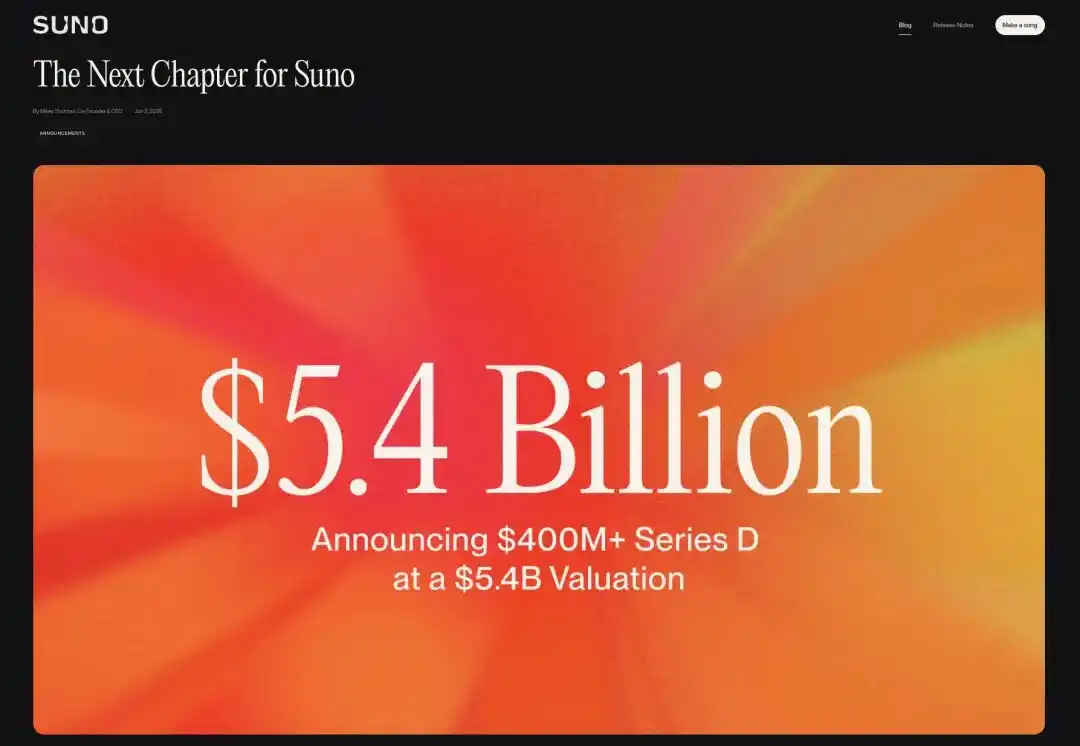
(Source: Company website)

The announcement shows that this round of financing was led by Bond Capital, founded by "Internet Queen" Mary Meeker. Other well-known institutions such as IVP, Union Square Ventures, and Lightspeed Venture Partners also participated in this round.

Suno's previous funding round occurred last November, when the company raised $250 million at a valuation of $2.45 billion. Its valuation doubled in just seven months, demonstrating investors' optimistic expectations for the "AI + music" sector and making Suno the highest-valued company in this field.

As one of the most common AI music generation tools on creative platforms like YouTube and Bilibili, Suno allows users to create music from scratch through text prompts. Users can specify music style, timbre, instruments, and lyrics, and the system can almost instantly generate complete digital audio works.

The company reached the milestone of over 2 million subscription users in February this year. At that time, the company also disclosed it was progressing towards an Annual Recurring Revenue (ARR) level of $300 million.

From "Industry Pariah" to "Taking the Stage"

Suno's series of developments in recent years not only reflect the rapid progress of AI-generated music technology but also bear witness to the shift in attitude from the traditional music industry towards AI tools.

As the "ChatGPT of the music industry," Suno initially gained popularity by allowing anyone to generate complete music with simple prompts. As the volume of AI-generated music surged, the three major record companies (Universal, Sony, Warner) all sued Suno for copyright infringement in 2024.

Times have changed, and with more and more professional creators using AI tools, the industry's attitude has also shifted.

Late last year, Suno reached a settlement with Warner Music and obtained copyright licensing from the latter. The two parties plan to launch a collaborative AI generation product in the coming months, similar to Suno's current tool but with added capabilities for using and referencing Warner songs.

In Wednesday's latest announcement, Suno also mentioned that, as usual, this round of financing received investments from artists, producers, songwriters, and industry executives, but did not disclose specific names.

Co-founder and CEO Mikey Shulman told media on Wednesday that the company decided to raise funds again after receiving interest from external investors following the previous funding round.

To justify its soaring valuation, Suno not only needs to excel as an application for professional musicians but also needs to attract millions of "non-musicians" to create songs—similar to how Anthropic's Claude Code enables people who have never coded to build websites and applications.

Shulman revealed that the company plans to use the funds to accelerate hiring, develop new products, and further drive growth on top of a strong start to the year. Suno currently has about 200 employees and plans to expand its workforce by up to 70% by year-end.

"Having more capital means we can operate the company differently and attempt some bolder projects," Shulman said.

This article is from the WeChat public account "Venture Daily," author: Shi Zhengcheng

Domande pertinenti

QWho is the lead investor in Suno's latest $400 million funding round, and what is the company's new post-money valuation?

AThe lead investor in Suno's latest $400 million Series D funding round is Bond Capital, founded by 'Queen of the Internet' Mary Meeker. The company's new post-money valuation is $5.4 billion.

QHow has Suno's valuation changed in the last 7 months, and what does this indicate about the 'AI + music' sector?

ASuno's valuation has doubled in the last 7 months, from $2.45 billion in November to $5.4 billion. This rapid growth indicates strong investor optimism and high expectations for the 'AI + music' sector.

QWhat is Suno's core product, and what key user milestone did the company achieve earlier this year?

ASuno's core product is an AI music generation tool that allows users to create complete music tracks from scratch using text prompts. Earlier this year, the company surpassed 2 million paying subscribers.

QHow did the relationship between Suno and major record labels evolve, and what specific agreement was recently announced?

AThe relationship evolved from initial lawsuits for copyright infringement by the three major labels (Universal, Sony, Warner) to collaboration. Suno recently announced a settlement and licensing deal with Warner Music Group, and they plan to launch a co-developed AI music product together.

QWhat does Suno plan to do with the new funding, particularly regarding company growth and development?

ASuno plans to use the new funding to accelerate hiring, develop new products, and fuel further growth. The company, which currently has about 200 employees, aims to increase its workforce by up to 70% by the end of the year.

Letture associate

Intern, Earning 120,000 Monthly

An article titled "Intern, Monthly Income of 120,000 RMB" discusses the intense competition for top AI talent in China, highlighted by a viral social media post. A Tsinghua University student from the prestigious Yao Class reportedly received a staggering internship offer from the AI company DeepSeek with a daily salary of 5,500 RMB (pre-tax), translating to over 120,000 RMB per month. This case exemplifies the fierce "talent war" raging among major tech firms. Companies like DeepSeek, Huawei, Tencent, and ByteDance are aggressively recruiting interns and fresh graduates with unprecedented compensation packages, high conversion rates to full-time positions, and even company stock options for top performers like those in Moonshot AI's "Time Travel Plan." The trend shows recruitment starting earlier, even targeting high school students. The driving force is the belief that a few exceptional individuals can be pivotal in the AI race. Salaries for elite AI researchers have skyrocketed from around one million RMB annually to tens of millions. Young, highly-educated talents from top schools, seen as adaptable "AI Natives," are being placed at the forefront of core projects. Examples include Tencent appointing a 27-year-old former OpenAI researcher as its Chief AI Scientist. In essence, the competition is shifting from just models and computing power to a battle for talent density. A new generation of young experts is rapidly rising to central roles, poised to reshape the future AI landscape.

marsbit5 h fa

Intern, Earning 120,000 Monthly

marsbit5 h fa

Trading

Spot
活动图片