Interest Rates May Not Be Cut This Year

marsbitPubblicato 2026-04-14Pubblicato ultima volta 2026-04-14

Introduzione

The article discusses how a war in the Persian Gulf, leading to Iran's blockade of the Strait of Hormuz, has driven up oil prices, with Brent crude surging from $70 to over $118 per barrel. This energy shock has pushed U.S. retail gasoline prices above $4 per gallon, contributing significantly to inflation. The CPI rose to 3.3% in March, the largest monthly increase since June 2022, with energy costs affecting broader sectors like food and logistics. As a result, the likelihood of the Federal Reserve cutting interest rates in 2026 has diminished. Market predictions now show a high probability of zero rate cuts, compared to pre-war expectations of multiple cuts. The Fed faces a dilemma between addressing inflation risks and supporting the economy. Politically, the situation poses challenges for President Trump and the Republican Party, as high inflation could impact the upcoming midterm elections. Trump's efforts to negotiate with Iran have stalled due to irreconcilable demands, and Iran's拖延 tactics may further strain U.S. economic and political stability. The article concludes that the prolonged conflict and sustained high oil prices could keep inflation elevated, delaying any monetary easing.

The price sign at gas stations is the fastest way for ordinary Americans to understand inflation.

In March, the average retail gasoline price in the United States exceeded $4 per gallon for the first time in nearly four years. Not because of OPEC production cuts, not because of declining shale oil output, but because of a war. A war fought in the Persian Gulf, more than ten thousand kilometers away from the U.S. mainland.

The recent breakdown in negotiations means we will continue to bear the impact of the war, such as the possibility that interest rates may not be cut this year.

Could a War Push Inflation Back to 2022 Levels?

On February 28, the United States and Israel jointly launched a military strike against Iran. This is a timeline that redefines the trajectory of the U.S. economy in 2026.

Brent crude oil surged from about $70 per barrel before the conflict erupted to $118 per barrel by the end of March. Although oil prices have since retreated, they remain high at around $96 per barrel recently. The more than 50% increase in oil prices is tied to a crucial waterway: the Strait of Hormuz.

Iran has effectively blockaded shipping traffic through the Strait of Hormuz, which transports about one-fifth of the world's oil supply. Reports indicate that even during negotiations, the blockade largely remained in place.

This is not just an oil price issue. The gasoline price index accounted for almost three-quarters of the increase in all items in the monthly CPI, with a month-on-month surge of 21.2% and a year-on-year increase of 18.9%. Every refueling, every bill, punishes ordinary American families in specific and detailed ways. Starting last week, the average retail gasoline price in the U.S. exceeded $4 per gallon for the first time in nearly four years.

The energy shock is also spreading throughout the entire economy.

Rising diesel prices are pushing up food transportation costs; fertilizers, another key export commodity shipped through the Strait of Hormuz, face supply disruptions that could increase costs for farmers and consumers. CPI data show food prices rose 2.7% year-on-year.

It's not just food. Amazon will impose a 3.5% fuel and logistics surcharge on third-party sellers in the U.S. and Canada, while delivery companies like UPS and FedEx have also raised fuel surcharges since the Iran conflict began. The tentacles of inflation are reaching into every corner.

Based on the correlation between year-on-year oil price changes and U.S. CPI inflation rates from 2020 to 2025, if Brent crude prices remain between $85 and $100 per barrel throughout 2026, the year-on-year increase in oil prices could reach 30% to 50%, potentially raising the U.S. CPI inflation rate by 1 to 2 percentage points.

And this is just the beginning. Even if a ceasefire holds, considering the damage to energy infrastructure and supply chain disruptions that are difficult to repair quickly, oil prices, although down from their peak, may remain above pre-conflict levels in the medium term, potentially boosting the year-on-year CPI for several months.

Ryan, an economist at Capital Economics, stated that some inflationary effects from energy prices may take months to filter through supply chains to the consumer end, with an impact that "could be very broad."

A war pushed U.S. inflation from 2.4% in February directly back to 3.3% in March, meaning the month-on-month CPI increase was 0.9%, the "largest single-month increase since June 2022."

The Door to Rate Cuts is Half Shut

Before the war, the market assumed the Trump administration had a carefully crafted political script:

On January 30, 2026, Trump formally nominated former Federal Reserve Governor Kevin Warsh as the next Fed Chair. Powell's era came to an end. The market quickly began pricing in: a new chairman taking office, a clear path to rate cuts. After Warsh's nomination, most market futures traders expected two rate cuts this year.

There was a fairly clear political interpretation of this personnel arrangement. Wilkes, Director of U.S. Economic Research at Bloomberg Economics, stated that whoever ultimately gets nominated will face external skepticism upon taking office, with people believing he must have promised to carry out the U.S. President's directives at the Fed, the first and most important being to aggressively push for a significant cut in the federal funds rate regardless of inflationary consequences.

Therefore, in almost all economic analyses and macro forecasts at the beginning of the year, the actual pace of Fed monetary policy easing in 2026 was expected to be faster than market expectations, with 2 to 3 rate cuts totaling 50 to 75 basis points for the year.

But after the war, the data changed dramatically.

Polymarket currently gives a 44% probability of zero rate cuts for the entire year of 2026. Before the war erupted, the probability of zero cuts this year was only 4%. But since the war began, the probability of no rate cuts this year has been rising steadily, and from the end of March onwards, the probability of zero cuts has consistently been the highest forecast on that market. Additionally, the probability of a single 25-basis-point cut is currently 26%. Another prediction platform, Kalshi, sets the probability of a zero-cut scenario at 38.5%. The trading volumes on these platforms reflect real money bets.
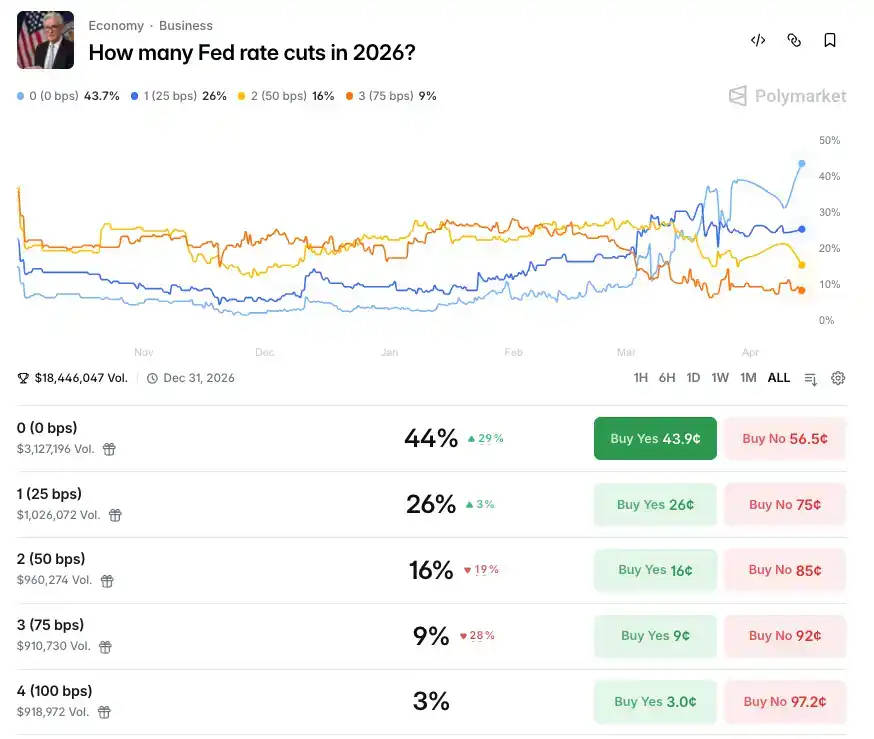
The recently released minutes of the Fed's FOMC meeting on March 17-18 showed that most officials were concerned the war could harm the labor market, necessitating rate cuts; simultaneously, many policymakers emphasized inflation risks, which might ultimately require rate hikes. The Fed kept rates unchanged in the 3.5% to 3.75% range at its March meeting.

One set of minutes contained the possibility of both rate cuts and hikes. This might be one of the most awkward situations in Fed history.

Persistently strong inflation has led some economists to believe the Fed will not cut rates this year. Federal funds rate futures pricing indicates a probability of over 70% for rates remaining unchanged within the year.

Chris Zaccarelli of Northlight Asset Management pointed out that the duration of the war and the situation in the Strait of Hormuz are crucial. If the supply shock is temporary, the economy can withstand it, and the Fed has a chance to cut rates within the year. But if the inflation shock is more persistent, they may have to hold steady all year.

Gregory Daco, Chief Economist at EY-Parthenon, cautiously predicted that looking ahead to the fourth quarter and year-end of 2026, there might be factors prompting the Fed to ease monetary policy, but that would be for the wrong reasons. He also raised a realistic possibility: the Fed's next move could be a rate hike.

This is no longer a question of "rate cuts being a few months late." This is a policy crisis where the script has been completely disrupted.

The Republican Party's Situation is Quite Grim

Trump's governing logic has always been highly pragmatic. Rate cuts are never just monetary policy; they are a pillar of Trump's political agenda.

The reasoning is simple. Rate cuts lower borrowing costs, stimulate consumption, push up the stock market, and make ordinary people feel that money is easier to earn. And this feeling is reflected in votes. With the reality of midterm elections at the end of the year, as of the time of writing, Polymarket data shows the probability of Democrats winning the House of Representatives is as high as 86%, and the probability of winning the Senate has reversed from a disadvantaged 36% before the war to a leading 56%.

The Republican Party's situation is already quite severe.
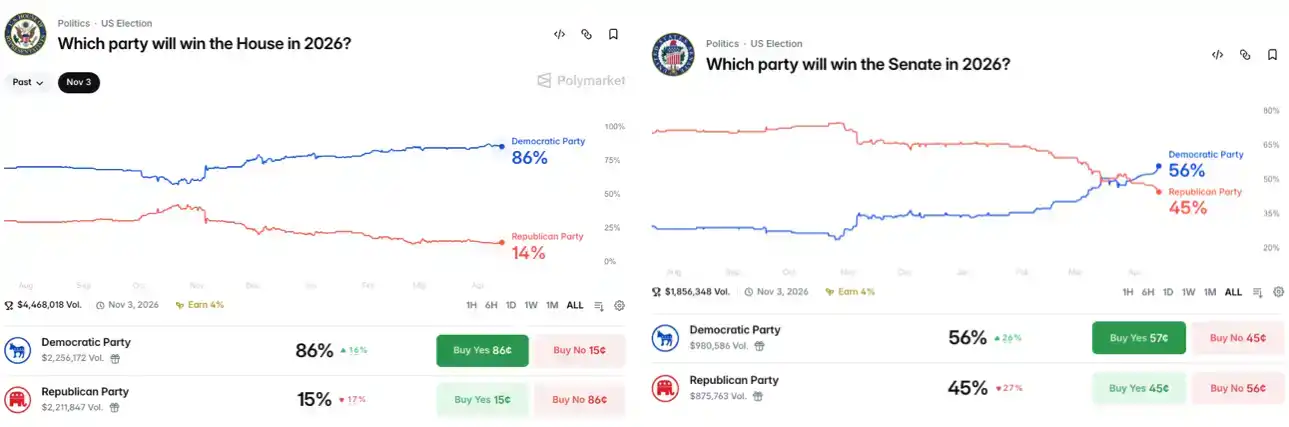
The problem is that the political fundamentals of the midterm elections are largely locked in by June. From now on, the time window is running out.

To focus on preparing for the upcoming midterm elections, Trump needs to quickly achieve de-escalation of the conflict to stabilize capital markets and secure political achievements.

Otherwise, the inflation caused by rising oil costs will eventually become clearly evident in the U.S. economy and in American consumers' spending, which would be a blow to Trump's midterm elections and his popular support.

This is precisely why Trump is so eager to seek negotiations with Iran.

Iran Uses Delaying Tactics

And Iran sees this clearly.

Negotiations that began in Islamabad on April 10 broke down just two days later. On April 12, U.S. Vice President Vance announced in Islamabad that the talks had broken down over Iran's nuclear weapons issue, and the U.S. delegation left Pakistan to return to Washington.

The failure of the talks was no accident.

The gap in conditions was on the table even before the talks began. According to analysis, U.S. demands include: Iran must unconditionally open the Strait of Hormuz, must stop all nuclear activities, the quantity and variety of Iranian missiles must be restricted (with no missiles capable of reaching Israel in the future), and must cut off all ties with proxy groups. Iran's conditions for the U.S. were equally high: demanding the complete withdrawal of all U.S. troops from the entire Middle East, the cessation of all U.S. and Israeli military actions in the Middle East, the lifting of all economic sanctions imposed on Iran over the past 47 years, and war reparations from the U.S. to Iran.

These are not two close proposals. These are demands from two parallel universes.

Some U.S. think tanks believe Iran may choose a "protracted game," using the midterm elections as a "pressure point" against the U.S.

Understanding this requires understanding a fundamental asymmetry between the U.S. and Iran: Trump has a term limit; Iran does not. As an authoritarian state, the Islamic Republic has existed for nearly half a century, with no pressure from electoral changes. Iran does not need to accomplish anything by the end of 2026. It only needs to wait. Wait for Trump's midterm election window to close, wait for the Republican Party to feel pressure in the House, wait for the political cost in Washington to become high enough, wait for the U.S. to find its own reason to back down.

If Trump continues the war effort and sends ground troops into Iran, it means the U.S. is once again entangled in this war, potentially getting bogged down long-term with Iran. This does not align with U.S. national security strategy and would also impact many of Trump's own domestic and foreign policy agendas.

Trump himself acknowledged the difficulties in the negotiations. He stated that the negotiations were going well, with agreement reached on most issues, but the one truly important point—the nuclear issue—was not settled. The nuclear issue is precisely the bottom line Iran will not concede in the short term.

The entire situation now is this: Trump holds the demands for rate cuts, the pressure of midterm elections, and the military burden of war with Iran, all pressing on a clock that is accelerating towards November. Iran doesn't need to win. It only needs to hold on, to let these negotiations continue to drag out.


Domande pertinenti

QWhat is the main reason for the potential delay in interest rate cuts this year according to the article?

AThe main reason is the ongoing war in the Persian Gulf, which has caused a significant surge in oil prices, leading to higher consumer inflation and complicating the Federal Reserve's monetary policy decisions.

QHow has the conflict impacted oil prices and inflation in the United States?

AThe conflict caused Brent crude oil prices to surge from around $70 per barrel to $118 per barrel, with current prices remaining high at about $96 per barrel. This has driven U.S. retail gasoline prices above $4 per gallon for the first time in nearly four years, contributing significantly to a rise in CPI inflation.

QWhat are the political implications for Trump and the Republican Party due to the ongoing war and economic situation?

AThe war and resulting inflation have increased economic pressure on American consumers, which could negatively impact Trump's popularity and the Republican Party's chances in the upcoming midterm elections. Current predictions show a high probability of Democrats winning both the House and Senate.

QWhy did the negotiations between the U.S. and Iran fail, and what were the key sticking points?

AThe negotiations failed due to vastly incompatible demands. The U.S. required Iran to unconditionally open the Strait of Hormuz, halt all nuclear activities, limit missile capabilities, and cut ties with proxy groups. Iran demanded full U.S. military withdrawal from the Middle East, an end to all U.S. and Israeli military actions, removal of all sanctions, and war reparations.

QHow are market expectations for Federal Reserve interest rate changes shifting due to the conflict?

AMarket expectations have shifted significantly, with the probability of zero rate cuts in 2026 rising from 4% before the conflict to 44% afterward. There is also increased speculation that the Fed's next move could potentially be a rate hike if inflationary pressures persist.

Letture associate

Should You Buy SpaceX Stock at $1.7 Trillion? Here's What the Market Is Worried About

SpaceX is preparing for a massive IPO aiming to raise around $75 billion at a valuation of approximately $1.75 trillion. While its achievements in reusable rockets and the profitable Starlink satellite internet service are clear, the market is concerned about the aggressive valuation. Key issues include: the current $1.75 trillion valuation, which is about 94 times 2025 revenue, seems to price in not just existing businesses but also unproven future ventures like AI infrastructure and orbital data centers. Financially, while Starlink is profitable, the AI division, bolstered by the acquisition of xAI, is incurring massive losses and consuming the majority of capital expenditures. This acquisition also introduced complex related-party financing arrangements and debt onto SpaceX's balance sheet. Furthermore, corporate governance poses a challenge. SpaceX's dual-class share structure ensures founder Elon Musk retains absolute control, limiting ordinary shareholders' influence over high-risk, long-term strategic decisions. The future success of ambitious projects like the Starship rocket—critical for lowering costs and enabling new services—remains a significant variable for the valuation. In summary, the market's apprehension (FUD) centers not on doubting SpaceX's past technological triumphs but on questioning how much premium public investors should pay for a future that combines proven profits with highly speculative and capital-intensive new ventures, all under a governance structure that offers limited shareholder oversight.

marsbit24 min fa

Should You Buy SpaceX Stock at $1.7 Trillion? Here's What the Market Is Worried About

marsbit24 min fa

Breaking the DeFi Cascading Liquidation Curse: Vitalik Proposes a New Solution

Vitalik Buterin has proposed a new DeFi design to eliminate the automatic liquidation mechanism that causes market instability during sharp downturns. The current system, used by protocols like Aave, triggers forced sales when collateral value falls below a threshold, often exacerbating price drops and creating systemic selling pressure. Buterin's alternative model is based on splitting an asset like ETH into two synthetic option-like tokens, P and N, pegged to a price index. Their combined value always equals one ETH. Instead of sudden liquidation, a position's value gradually drifts from its target peg if the market moves. Users must proactively rebalance their holdings to maintain their desired exposure, transferring the management burden from the protocol to the user or automated tools. A key advantage is the reduced reliance on real-time oracles. Pricing decisions are deferred until contract expiry, allowing for more robust, fault-tolerant oracle designs. This removes a clear liquidation threshold that speculators can target for manipulation or MEV extraction. However, significant challenges remain. Frequent rebalancing could incur high slippage and transaction costs, necessitating new liquidity provider models. The design is better suited for hedging instruments than for stablecoins requiring a rigid 1:1 peg. While not an immediate replacement for existing systems, the proposal challenges the foundational assumption that instantaneous forced liquidation is an unavoidable necessity in DeFi, opening the door for fundamentally different risk management architectures.

marsbit29 min fa

Breaking the DeFi Cascading Liquidation Curse: Vitalik Proposes a New Solution

marsbit29 min fa

The End of Single-Factor Cryptography

The article "The End of Single-Factor Crypto" posits a fundamental shift in the cryptocurrency ecosystem. It argues the era where crypto asset valuations were predominantly driven by, and correlated with, Bitcoin's price is ending. The space is bifurcating into two distinct economies: endogenous and exogenous. The endogenous economy represents traditional crypto, where token and project values are directly tied to crypto market prices. The emerging exogenous economy comprises projects and businesses that may utilize blockchain technology or tokens but derive their fundamental value from external, non-crypto factors like consumer demand, subscription revenue, or real-world utility. Examples include AI inference platforms like Venice, fintech lenders using blockchain for efficiency, and stablecoin/payment infrastructure companies acquired by giants like Mastercard and Stripe. This shift means investment analysis must change. For exogenous assets, evaluating traditional business fundamentals—such as revenue streams, unit economics, and competitive moats—becomes more critical than tracking Bitcoin charts. While endogenous assets like Bitcoin remain relevant, the growth of the exogenous category is driven by measurable demand independent of crypto price cycles, paving the way for a new, more diversified market phase. Consequently, crypto is evolving from a single-factor, reflexive asset class into a multifaceted ecosystem with varied drivers and investment theses.

marsbit29 min fa

The End of Single-Factor Cryptography

marsbit29 min fa

Morning Post | Bitmine Plans to Raise $300 Million Through Preferred Stock Issuance; Polymarket Accuses Kalshi of Commercial Espionage

ChainCatcher's Daily Crypto Brief: Key developments from the past 24 hours include significant funding moves, regulatory actions, and market predictions. Bitmine announced a $300 million preferred stock fundraising. Polymarket accused rival prediction platform Kalshi of corporate espionage, citing numerous suspicious coincidences in product launches, a claim Kalshi strongly denied. The U.S. Department of Justice, in a joint "Disruption Week" anti-fraud operation with companies like Coinbase and Meta, froze over $3.8 million in cryptocurrency linked to scams. In infrastructure news, Macau completed its integration with the multi-central bank digital currency bridge, mBridge, aiming to build efficient cross-border payment channels. Cosmos Labs acquired the block explorer Mintscan. Market-wise, Geoffrey Kendrick, Standard Chartered's Head of Digital Assets Research, stated Bitcoin is nearing a bottom around $63,000, maintaining a year-end target of $100,000. He noted stability in U.S. spot Bitcoin ETF holdings. Ahead of SpaceX's anticipated IPO, internal insiders at Rocket Lab (RKLB) sold over $18.41 million in stock. In tokenization, Goldman Sachs partnered with Apex and Archax to launch a tokenized real estate fund. The meme token tracker GMGN reported the top trending tokens: on Ethereum, HEX, SHIB, LINK, PEPE, mUSD; on Solana, TROLL, swarms, WORLDCUP, neet, Buttcoin; and on Base, PEPE, toby, ODDS, ELSA, SKI.

链捕手44 min fa

Morning Post | Bitmine Plans to Raise $300 Million Through Preferred Stock Issuance; Polymarket Accuses Kalshi of Commercial Espionage

链捕手44 min fa

Trading

Spot
Futures

Articoli Popolari

Come comprare GAS

Benvenuto in HTX.com! Abbiamo reso l'acquisto di GAS (GAS) semplice e conveniente. Segui la nostra guida passo passo per intraprendere il tuo viaggio nel mondo delle criptovalute.Step 1: Crea il tuo Account HTXUsa la tua email o numero di telefono per registrarti il tuo account gratuito su HTX. Vivi un'esperienza facile e sblocca tutte le funzionalità,Crea il mio accountStep 2: Vai in Acquista crypto e seleziona il tuo metodo di pagamentoCarta di credito/debito: utilizza la tua Visa o Mastercard per acquistare immediatamente GASGAS.Bilancio: Usa i fondi dal bilancio del tuo account HTX per fare trading senza problemi.Terze parti: abbiamo aggiunto metodi di pagamento molto utilizzati come Google Pay e Apple Pay per maggiore comodità.P2P: Fai trading direttamente con altri utenti HTX.Over-the-Counter (OTC): Offriamo servizi su misura e tassi di cambio competitivi per i trader.Step 3: Conserva GAS (GAS)Dopo aver acquistato GAS (GAS), conserva nel tuo account HTX. In alternativa, puoi inviare tramite trasferimento blockchain o scambiare per altre criptovalute.Step 4: Scambia GAS (GAS)Scambia facilmente GAS (GAS) nel mercato spot di HTX. Accedi al tuo account, seleziona la tua coppia di trading, esegui le tue operazioni e monitora in tempo reale. Offriamo un'esperienza user-friendly sia per chi ha appena iniziato che per i trader più esperti.

231 Totale visualizzazioniPubblicato il 2024.12.12Aggiornato il 2026.06.02

Come comprare GAS

Discussioni

Benvenuto nella Community HTX. Qui puoi rimanere informato sugli ultimi sviluppi della piattaforma e accedere ad approfondimenti esperti sul mercato. Le opinioni degli utenti sul prezzo di GAS GAS sono presentate come di seguito.

活动图片








