Interactive Brokers Opens 'Stablecoin Deposits': Why Is the Wall Street Giant Tearing Down the 'Payment Berlin Wall' at This Moment?

marsbitPubblicato 2025-12-16Pubblicato ultima volta 2025-12-16

Introduzione

Interactive Brokers (IBKR), a major global electronic brokerage, has announced a landmark update allowing clients to deposit funds using stablecoins—primarily USDC—to trade traditional assets like stocks, futures, and forex. This move effectively bridges a significant gap between crypto and traditional finance (TradFi), addressing long-standing inefficiencies in fiat payment channels. Traditionally, cross-border wire transfers via SWIFT are slow (taking 1-3 business days), costly, and limited to banking hours. By leveraging blockchain technology, IBKR enables near-instant, 24/7 settlements, drastically reducing friction and improving capital efficiency for traders. Behind the scenes, IBKR likely partners with regulated entities like Paxos or Circle to convert USDC to USD seamlessly, ensuring compliance while using the blockchain as a new settlement layer. This strategic shift aims to attract crypto-native high-net-worth clients and institutions holding significant wealth in stablecoins, offering them a secure, compliant path to invest in traditional markets. It also signals the evolution of stablecoins from mere trading instruments to a foundational global payment infrastructure. However, challenges remain, including stringent KYC/AML requirements, address screening, and enhanced tax transparency. Despite these hurdles, IBKR’s move is a decisive step toward erasing the boundaries between crypto wallets and securities accounts, setting a new standard for the industry.

Author: BlockWeeks

Between the cryptocurrency market and the traditional financial market (TradFi), there has long been an invisible wall: the friction cost of fiat currency channels.

Recently, the globally renowned electronic broker Interactive Brokers (IBKR) announced a milestone update: it now officially supports clients using stablecoins (primarily USDC) to deposit funds into their accounts for trading traditional assets such as stocks, futures, and foreign exchange.

At first glance, this might seem like a simple payment function update. But to observers well-versed in the transformation of financial infrastructure, this is a substantive acknowledgment of the "on-chain settlement network" by a top-tier Wall Street broker. When the US Dollar becomes USDC, and when SWIFT becomes ERC-20, it reflects a paradigm shift in the efficiency of global capital flow.
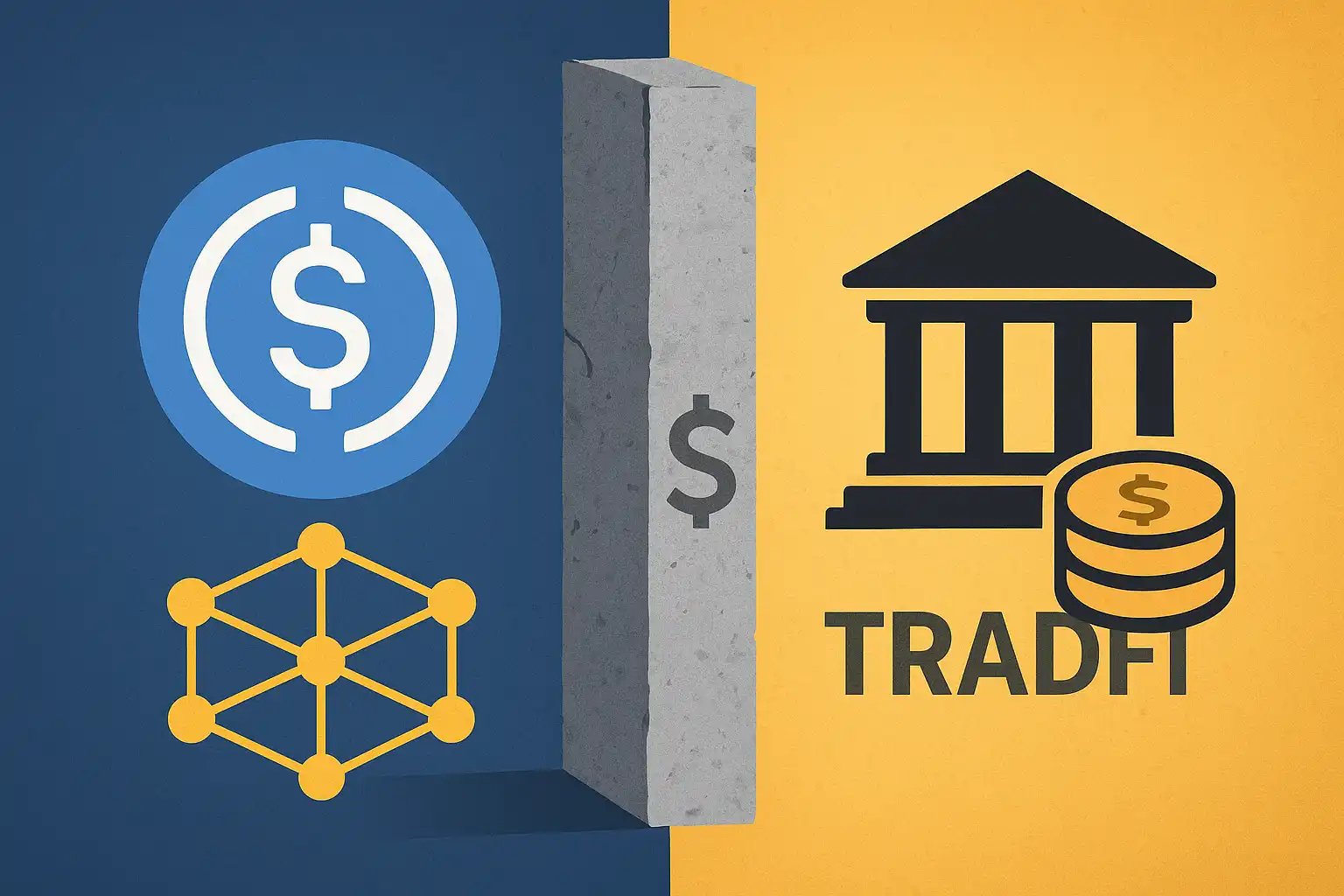
I. Breaking the Wall: A Dimensional Reduction Strike from "T+N" to "7×24"

For a long time, the biggest pain point for global investors (especially non-U.S. investors) using U.S. stock brokers has been depositing funds.

The traditional wire transfer path is: local bank foreign exchange purchase -> SWIFT cross-border transfer -> intermediary bank -> U.S. receiving bank -> broker account crediting. This process not only involves high fees (wire transfer fee + intermediary fee) but is also limited by bank working hours and the inefficiency of the SWIFT system, typically taking 1-3 business days.

Interactive Brokers' introduction of stablecoin deposits is essentially using blockchain as a "new clearing layer" to launch a dimensional reduction strike against traditional bank wire transfers:

  1. 24/7 Liquidity: On-chain transfers have no concept of "bank closing time." A deposit on Friday night no longer has to wait until Monday morning to be processed.

  2. Instant Settlement: Compared to the multi-layer confirmation of SWIFT, on-chain confirmation of USDC takes only seconds to minutes.

  3. Capital Efficiency Revolution: For high-frequency traders and cross-market arbitrageurs, the seamless transfer of funds between on-chain (Web3) and securities accounts (Web2) means a drastic reduction in capital occupancy costs.

Technical Black Box Revealed: It is important to clarify that Interactive Brokers does not directly "hold" these tokens for stock settlement. Its backend logic likely involves cooperation with compliant institutions like Paxos or Circle: users transfer in USDC -> the partner exchanges it 1:1 for USD -> instantly transfers it to the IBKR client's fiat balance. Superficially, it's coins; fundamentally, it's still money, but the channel has become the chain.

II. Open Strategy: Competing for the Asset Pricing Power of "Web3 Nouveau Riche"

Interactive Brokers is known for serving professional traders and institutions, with famously strict risk control. Why would such a conservative giant take the first step?

The answer lies in the competition for incremental wealth.

The past two bull markets have created a large number of "Crypto Natives" and Web3 institutions holding millions or even billions of dollars in assets. The wealth of this group primarily exists on-chain in the form of USDT/USDC or ETH.

In the past, if they wanted to allocate to U.S. stocks (such as buying NVIDIA or Coinbase stock), they had to go through a painful "off-ramp" process, facing not only the risk of bank risk control freezing their accounts but also enduring significant exchange rate losses.

Interactive Brokers' move is a typical "capital attraction open strategy":

  • For users: It is the safest "off-ramp channel." Depositing USDC into IBKR to buy U.S. Treasuries or the S&P 500 is currently the most compliant path for "traditionalizing crypto assets."

  • For IBKR: It directly locks in a group of high-net-worth clients with the most abundant liquidity and highest risk appetite globally. This is not just to earn commissions but also to accumulate huge amounts of client margin (Float).

III. Signal: Stablecoins Are Evolving into a "Supranational Version of SWIFT"

Zooming out, this event is a reverse mapping of the RWA (Real World Assets) narrative.

If RWA is about "moving" U.S. Treasuries onto the chain, then Interactive Brokers supporting stablecoin deposits is about "moving" liquidity from the chain back to traditional finance. This marks a qualitative change in the historical positioning of stablecoins (Stablecoin):

  • Era 1.0: Trading chips on exchanges.

  • Era 2.0: Safe-haven assets in DeFi protocols.

  • Era 3.0 (Now): A true global payment and settlement infrastructure.

When a Nasdaq-listed brokerage giant starts using a blockchain network instead of the SWIFT network to handle client funds, it indicates that the security, compliance, and efficiency of blockchain as a "payment pipeline" have passed the most stringent stress tests on Wall Street.

IV. Concerns and Games: The Sword of Damocles of Compliance

Despite the bright prospects, we cannot ignore the regulatory games involved.

  • KYC/AML Penetration Challenges: Interactive Brokers supporting stablecoin deposits will inevitably require extremely strict on-chain address reviews. Has the user's deposit address interacted with sanctioned entities (like Tornado Cash)? How to identify "black U"? This will test IBKR's compliance technology capabilities.

  • Tax Transparency: The opening of this channel also means a strong binding between on-chain assets and real-name securities accounts. For users hoping to avoid taxes through cryptocurrency, this channel is tantamount to "surrendering" to the tax authorities. This could be a double-edged sword.

Conclusion: The First Brick in Tearing Down the Berlin Wall

The small step taken by Interactive Brokers is a big step for financial integration.

It预示着 that within the next five years, the boundary between "securities accounts" and "crypto wallets" will completely blur. Future investors may not need to care whether they hold dollars in a bank ledger or USDC on the chain; they will only care about the appreciation of their assets.

For other brokers (such as Charles Schwab, Futu, etc.), the time left to follow suit is running out. In an era where liquidity is justice, whoever masters the stablecoin channel holds the key to the Web3 wealth vault.


Domande pertinenti

QWhat is the significance of Interactive Brokers (IBKR) announcing support for stablecoin deposits?

AIt represents a major step in bridging the gap between crypto and traditional finance by allowing clients to use stablecoins like USDC for funding accounts to trade stocks, futures, and forex, leveraging blockchain for faster, cheaper, and more efficient settlements compared to traditional banking systems like SWIFT.

QHow does using stablecoins for deposits improve upon traditional wire transfers?

AStablecoin deposits offer near-instant settlement (seconds to minutes), 24/7 availability without banking hours restrictions, and lower transaction costs, eliminating the delays and fees associated with multi-day SWIFT transfers and intermediary banks.

QWhy is Interactive Brokers targeting crypto-native users with this feature?

ATo attract high-net-worth individuals and institutions from the Web3 space who hold significant wealth in stablecoins, providing them a compliant and efficient path to invest in traditional assets like stocks and bonds, thereby capturing new sources of liquidity and client assets.

QWhat does the move signal about the evolution of stablecoins?

AIt indicates that stablecoins are transitioning from being mere trading instruments or DeFi assets to becoming a global payment and settlement infrastructure, capable of handling cross-border transactions with efficiency that meets Wall Street's rigorous standards.

QWhat are the regulatory challenges associated with stablecoin deposits in traditional finance?

AKey challenges include ensuring robust KYC/AML compliance to prevent interactions with sanctioned addresses or illicit funds, and addressing tax transparency issues as stablecoin transactions linked to verified accounts increase visibility for tax authorities.

Letture associate

Within Strategy's Framework, STRC's Dividend Yield Remains at 12% as Share Price Stays Below Par Value

Michael Saylor, Executive Chairman of Strategy (MSTR), confirmed that the dividend rate for its STRC perpetual preferred shares will remain at 12.00% through August 2026. The rate has increased from 9% at its July 2025 launch to the current high via a "ratchet" mechanism, which permanently raises the rate by 0.5% whenever the share price falls below $95. This mechanism is intended to push the price back toward its $100 par value and support Strategy's "at-the-market" (ATM) program for issuing new shares to fund Bitcoin purchases. However, the mechanism has not worked as intended. STRC shares closed at $89.46 on July 31, remaining about 10-11% below par value despite the record-high dividend. Competition from rival Strive's higher-yielding SATA securities has pressured demand. The persistent discount has forced Strategy to suspend new STRC issuances via its ATM program, limiting this funding channel for Bitcoin acquisitions. STRC's struggles reflect Bitcoin's own volatility, as the preferred shares historically move in tandem. Analysts have warned the ratchet structure carries long-term, one-way risk. A law firm is investigating Strategy's ability to maintain dividend payments if Bitcoin's price stays low. Retail investors own roughly 83% of outstanding STRC shares, a group seen as prone to panic selling during downturns. In response, Strategy has established financial reserves, including a liquidity cushion covering about 26 months of dividend/interest obligations, and a $2 billion share buyback program alongside a Bitcoin monetization framework, though the company emphasized it is not obligated to sell any Bitcoin.

cryptonews.ru7 min fa

Within Strategy's Framework, STRC's Dividend Yield Remains at 12% as Share Price Stays Below Par Value

cryptonews.ru7 min fa

Analyst: Bitcoin's Price Will Drop to $60k in August, Then Rebound to $70k

Financial analyst Andrey Poroshin has provided a new forecast for Bitcoin's price dynamics in August. Poroshin, an analyst at the Bitbanker exchange, expects the cryptocurrency market to experience a downturn this month, with prices retesting the $60,000 level due to a lack of supportive macroeconomic catalysts. He noted that the recent US Federal Reserve decision to hold interest rates did not significantly impact the market, while inflation remains above the 2% target. Poroshin stated that Bitcoin is ending July under pressure from moderate volatility and a lack of new macroeconomic stimuli, leading to continued market caution. According to his base scenario, Bitcoin will drop to a range of $60,000 to $62,000 before recovering to $70,000. He pointed out that even $70,000 remains below the cost of mining in the US, which has prompted some miners to shift towards AI data center operations. Poroshin cited the winding down of BitMEX's operations as a potential catalyst for a price rebound, suggesting the exit of weaker players often coincides with market reversals and reduced short-term selling pressure. He believes Bitcoin is currently less susceptible to geopolitical shocks, such as the Iran-US conflict, and does not expect significant market changes in August related to the pending CLARITY Act. Looking ahead, Poroshin forecasts that September will bring more active price fluctuations driven by potential Fed rate decisions and possible discussions or approval of the CLARITY Act.

cryptonews.ru8 min fa

Analyst: Bitcoin's Price Will Drop to $60k in August, Then Rebound to $70k

cryptonews.ru8 min fa

Trading

Spot
活动图片




