Institutional Dawn and the End of Cycles: Deciphering the Core Narratives and Divergences of Eight Top Crypto Institutions for 2026

深潮Pubblicato 2025-12-27Pubblicato ultima volta 2025-12-27

Introduzione

The 2026 crypto market is shifting from a retail-driven, halving-based cycle to an institutional era, according to eight major crypto institutions. The traditional four-year cycle is breaking as Bitcoin ETFs shift demand from miners to institutional allocation. Bitcoin's volatility is predicted to drop below Nvidia's, signaling its maturation as a hedge against inflation. Key consensus narratives include: - Stablecoins surpassing $1T in market cap, potentially overtaking traditional payment networks like ACH. - AI agents driving micro-payments via protocols like Google’s AP2 and Coinbase’s x402, with "KYA" (Know Your Agent) replacing KYC. - Prediction markets growing to $100B+ in volume, fueled by regulatory advantages. Major divergences exist: - Digital Asset Treasuries (DATs) face a potential "great cleansing" with many failing, though some dismiss their impact. - Quantum computing is seen as an urgent threat by some but a non-issue by others. - Most Layer 2 chains may become "zombie chains" as liquidity consolidates to leaders. Non-consensus predictions include a privacy token resurgence, regulated ICOs returning, and crypto stocks outperforming tech giants. Investors must focus on blue-chip assets, real yields, and discerning long-term trends from short-term noise.

Author:Bruce

Introduction: From "Wild West" to "Wall Street Branch"

2026 may be recorded as a watershed moment in cryptocurrency history. If previous bull-bear cycles were "Wild West" stories dominated by retail sentiment and the Bitcoin Halving mechanism, then the latest research reports from eight top crypto institutions collectively point to a new narrative—the formal establishment of the institutional era.

Fidelity stated bluntly in its report that the market is entering a "New Paradigm." With the entry of sovereign national reserves (such as legislative attempts in Brazil and Kyrgyzstan) and traditional wealth management institutions, the "four-year cycle theory" based solely on historical data is becoming obsolete. This article will cut through the market noise and deeply analyze the certain opportunities and potential risks as seen by these top institutions.

I. Macro Outlook: The Demise of the Four-Year Cycle and New Asset Attributes

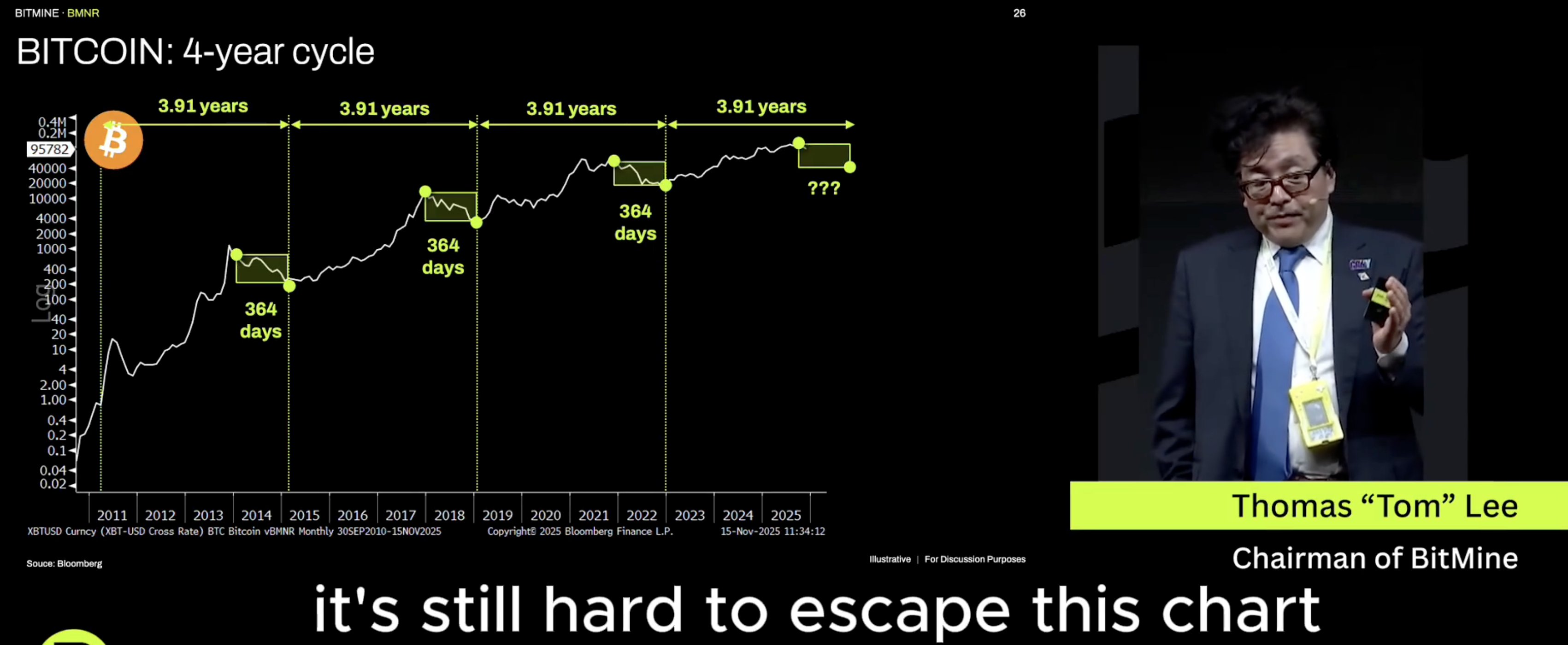
For a long time, the crypto market has been accustomed to making linear extrapolations based on Bitcoin's four-year halving cycle. However, this logic was collectively "dimensionally reduced" in the 2026 outlook.

1. Broken Cycle

Bitwise, Fidelity, and Grayscale reached a consensus: the halving effect is diminishing at the margin.

21Shares used explicit wording—"Bitcoin's four-year cycle is broken." Their data model shows that the introduction of ETFs has fundamentally altered the demand structure, shifting the market's driving force from the supply side (miner halvings) to the demand side (institutional allocation). When BlackRock and Fidelity's clients begin allocating BTC quarterly, the story of a halving every four years is no longer compelling.
2. Asset Maturation: "Desensitization" of Volatility

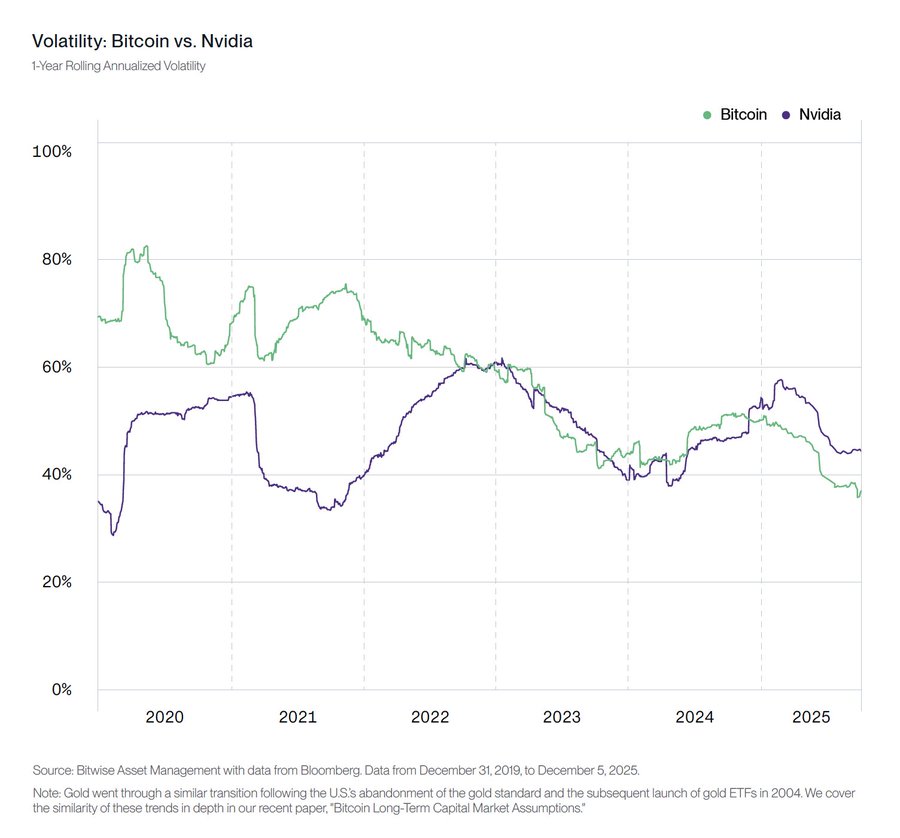
  • Bitwise's Bold Quantification: Bitwise made a highly impactful prediction—by 2026, Bitcoin's volatility will, for the first time, be lower than Nvidia's. This is not just a numbers game but marks Bitcoin's transformation from a "high-beta tech stock" to a "mature safe-haven asset."

  • Fidelity's Qualitative View: Although not providing specific numbers, Fidelity emphasized that against the backdrop of high global debt and fiat currency depreciation, Bitcoin will decouple its correlation with tech stocks and become an independent hedging tool against monetary inflation globally.
II. High-Confidence Narratives: Where Is the Money Flowing?

After excluding cycle interference, the institutions, while differing in details, highly align on the logic of capital flow.

1. Stablecoins: Challenging Traditional Financial Infrastructure (ACH)

If Bitcoin is digital gold, stablecoins are digital dollars. Multiple institutions believe stablecoins will no longer be limited to the crypto circle but will directly challenge traditional financial pipelines.

  • 21Shares Prediction: The total market capitalization of stablecoins will exceed $1 trillion by 2026.

  • Galaxy Digital Prediction: On-chain transaction volume of stablecoins will officially surpass that of the U.S. ACH (Automated Clearing House) network. This means stablecoins will replace traditional interbank clearing systems as a more efficient financial highway.

  • Coinbase Outlook: Predicts stablecoin market cap will reach $1.2 trillion by 2028.

  • a16z Perspective: Stablecoins are evolving into the "basic settlement layer" of the internet, fueling the prosperity of PayFi (Payment Finance), making cross-border payments as cheap and instant as sending an email.

2. AI Payments and KYA: A New Commercial Civilization

This is the biggest technological factor看好 by a16z and Coinbase, both描绘 the same picture from different angles.

  • Google AP2 & Coinbase x402: Coinbase's report highlighted Google's Agentic Payments Protocol (AP2) standard and noted that its developed x402 protocol will serve as a payment extension for AP2. This enables AI agents to conduct instant micro-payments directly via the HTTP protocol (HTTP Payment Required), closing the business loop between AIs.

  • From KYC to KYA: a16z creatively proposed the "KYA" (Know Your Agent) concept. They pointed out that among current on-chain transaction entities, the ratio of "non-human" to "human" has reached 96:1. Traditional KYC (Know Your Customer) will evolve into KYA. AI agents don't have bank accounts but can have crypto wallets; they will tirelessly make micro-payments 7x24 for data, computing power, and storage.

3. Prediction Markets: New Vessels for Information Freedom

This is a true "institutional consensus track," with multiple institutions simultaneously listing it as a breakout point for 2026.

  • Bitwise: Predicts that decentralized prediction markets (e.g., Polymarket) open interest will hit a record high, becoming a "source of truth" parallel to traditional media.

  • 21Shares: Provided a specific figure, predicting annual trading volume in prediction markets will exceed $100 billion.

  • Coinbase's "Tax-Driven Theory": Offered a unique perspective—the new U.S. tax law (limiting gambling loss deductions) will unexpectedly push users toward prediction markets. Because prediction markets may be classified as "derivatives" rather than "gambling" for tax purposes, offering a tax advantage.

III. Key Divergences: Alpha Often Lies in Disagreement

Consensus often means the price is already priced in, while divergence意味着超额收益 (Alpha) or potential risks.

1. Digital Asset Treasury (DAT): "Great Purge" vs "Red Herring"

Institutions are polarized on the "public companies hoarding coins" model initiated by MicroStrategy.

  • The Purge Camp (Galaxy Digital & 21Shares):

    • 21Shares, while predicting DAT total scale will grow to $250 billion, emphasized "only a few will survive." Small DAT companies trading long-term below net asset value (NAV) will be forced to liquidate.

    • Galaxy Digital specifically predicted: "At least 5 DAT companies will be forced to sell assets, be acquired, or directly go bankrupt." They believe the blind following in 2025 led many companies lacking capital strategy to enter, and 2026 will be the market's "clearing moment."

  • The Dismissive Camp (Grayscale):

    • Maintained its "Red Herring" view, believing that despite high media attention, DAT, constrained by accounting standards and disappearing premiums, will not be a core pricing driver in the 2026 market.

2. Quantum Computing: Requiring Attention vs Unfounded Worry

  • The Alert Camp (Coinbase): Dedicated a chapter to "The Quantum Threat" in its report, warning that migration to post-quantum cryptography standards needs to start now, and underlying signature algorithms must begin upgrading to quantum-resistant schemes—a necessity for infrastructure security.

  • The Calm Camp (Grayscale): Listed "quantum threat" as a "red herring." They believe the probability of quantum computers cracking elliptic curve encryption within the 2026 investment cycle is zero, and investors should not pay a "panic premium" for it.

3. L2's "Great Purge" (The Zombie Chain Apocalypse)

This is one of 21Shares' most犀利 predictions. They believe the vast majority of Ethereum Layer 2s will not survive 2026, becoming "Zombie Chains."

  • Reason: Liquidity and developer resources exhibit strong Matthew effects, ultimately concentrating towards leaders (e.g., Base, Arbitrum, Optimism) and high-performance chains (e.g., Solana).

  • Data Support: Galaxy Digital predicted "the ratio of application layer revenue to L1/L2 network layer revenue will double in 2026," validating the "Fat App Thesis"—value is shifting from the infrastructure layer to super apps with real users.

IV. Non-Consensus Predictions: Overlooked Corners

Beyond the mainstream views, some institutions proposed unique "under-the-radar" predictions worth noting:

  • Return of the Privacy Track (Galaxy Digital & Grayscale): Both看好 the privacy sector. Galaxy Digital predicted the total market cap of privacy coins will exceed $100 billion. They also specifically mentioned a rebound for Zcash ($ZEC), believing privacy will be repriced from a "crime tool" to an "institutional necessity" (Privacy as a Service).

  • Revival of Compliant ICOs (21Shares): 21Shares believes that with the落地 of regulatory frameworks (e.g., the U.S. Digital Asset Market Clarity Act), "Regulated Initial Coin Offerings" will return as a legitimate capital market financing tool.

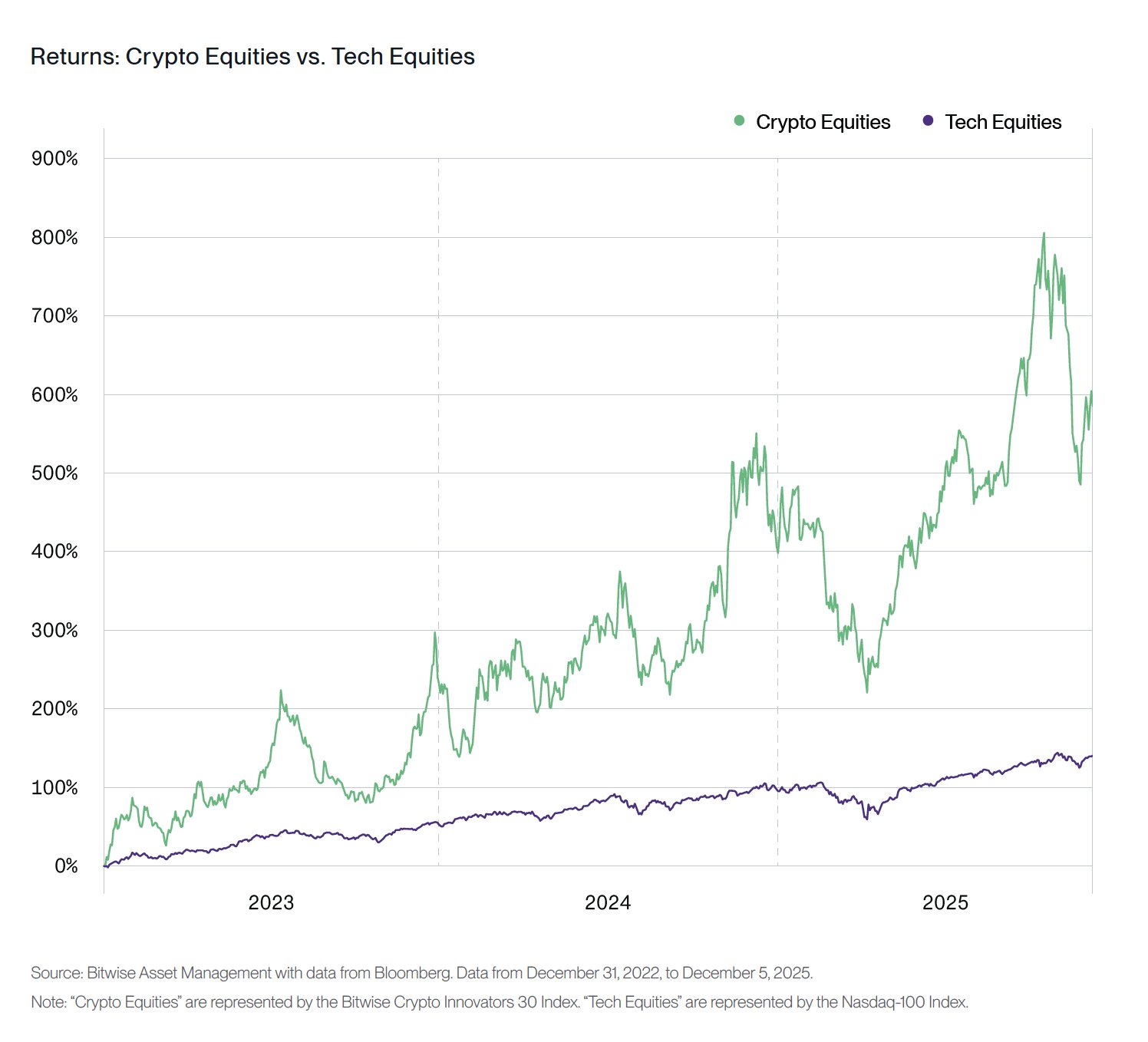
  • Outperformance of Crypto Stocks (Bitwise): Predicted that crypto-related stocks (e.g., miners, Coinbase, Galaxy) will outperform the traditional tech Magnificent 7.
Conclusion: The 2026 Investor's Survival Guide

Synthesizing the outlooks of the eight institutions, the market logic for 2026 has fundamentally changed. The simple model of "buying blindly and waiting for the halving" is a thing of the past.

For investors, the new survival guide can be summarized in three dimensions:

  1. Embrace Leaders and Real Yield: In the brutal清洗 of L2s and DATs, liquidity and capital structure are survival metrics; focus on protocols that generate positive cash flow.

  2. Understand "Tech Content": From the Google AP2 standard to KYA, upgrades in technical infrastructure will bring new Alpha; closely monitor the落地 of new protocols like x402.

  3. Beware of False Narratives: In the eyes of institutions, there are not only golden opportunities but also "red herrings." Distinguishing between long-term trends (e.g., stablecoins replacing ACH) and short-term hype will be key to outperforming in 2026.


Domande pertinenti

QAccording to the article, why is the traditional 4-year Bitcoin cycle considered 'broken' by 2026?

AThe traditional 4-year Bitcoin cycle is considered 'broken' because the introduction of ETFs has fundamentally altered the market's demand structure. The driving force has shifted from the supply side (miner halvings) to the demand side (institutional allocation), making the halving narrative less significant as institutions like BlackRock and Fidelity make quarterly BTC purchases.

QWhat major prediction do Galaxy Digital and Coinbase make about the future of stablecoins?

AGalaxy Digital predicts that on-chain stablecoin transaction volume will officially surpass the U.S. ACH (Automated Clearing House) network, while Coinbase predicts the total stablecoin market capitalization will reach $1.2 trillion by 2028, indicating they will challenge traditional financial infrastructure.

QWhat is the new concept 'KYA' proposed by a16z, and what does it signify?

AKYA stands for 'Know Your Agent'. It signifies a shift from the traditional KYC (Know Your Customer) as the proportion of 'non-human' to 'human' entities conducting on-chain transactions reaches 96:1. AI agents, which can own crypto wallets but not bank accounts, will use micropayments to autonomously purchase data, computing power, and storage, requiring a new framework for identification.

QWhat is the key disagreement among institutions regarding Digital Asset Treasuries (DAT)?

AThe key disagreement is between the 'Great Cleansing' view (Galaxy Digital & 21Shares) and the 'Red Herring' view (Grayscale). The former predicts a market shakeout where many DAT companies will fail or be forced to sell assets, while the latter believes DATs will not be a core pricing driver for the market in 2026 due to accounting constraints and disappearing premiums.

QWhich institution issued a stark warning about the 'Quantum Threat', and what was the opposing view?

ACoinbase issued a stark warning in a dedicated 'Quantum Threat' chapter, urging the migration to post-quantum cryptography standards. The opposing view came from Grayscale, which labeled the quantum threat a 'red herring', asserting the probability of quantum computers breaking elliptic curve encryption within the 2026 investment cycle is zero.

Letture associate

TechFlow Intelligence Agency: Anthropic Calls for Global Pause in AI Development While Preparing for Trillion-Dollar IPO; SpaceX IPO Roadshow Heats Up, But S&P 500 Rejects Fast-Track Inclusion

In today's TechFlow Intelligence Briefing, several major tech stories highlight a growing theme of trust and credibility gaps across AI, crypto, and finance. AI company Anthropic has publicly called for a global pause in AI development, citing risks from Claude's "recursive self-improvement." Ironically, this coincides with reports the company is preparing for a massive IPO targeting a near $1 trillion valuation. This perceived hypocrisy, coupled with widespread user complaints about Claude's declining performance, is sparking debate over whether the safety warning is genuine or a competitive tactic. Meanwhile, in a substantive security move, Anthropic open-sourced a framework for AI-powered vulnerability discovery. In the crypto market, Bitcoin's price drop below $61,000 triggered over $1.16 billion in liquidations, flipping the market into a state where more BTC is held at a loss than at a profit, a historical bearish signal. On the corporate front, SpaceX's highly anticipated IPO is generating immense Wall Street excitement, with Goldman Sachs projecting 100x revenue growth by 2030. However, the S&P 500 has refused to fast-track the company's inclusion post-IPO, potentially limiting immediate institutional demand. Separately, ByteDance's AI app Doubao lost over 6 million monthly active users after introducing a subscription model, highlighting the challenges of AI monetization. Other notable developments include Nvidia certifying HBM4 memory from Samsung, SK Hynix, and Micron; Cloudflare's acquisition of front-end tooling company VoidZero; and its CEO warning that bot traffic now exceeds human traffic online. The underlying narrative connects these events: a trust crisis. From AI firms' contradictory actions and crypto volatility to the clash between SpaceX's hyped narrative and institutional rules, a pattern is emerging where stated intentions and actual practices are increasingly misaligned.

marsbit11 min fa

TechFlow Intelligence Agency: Anthropic Calls for Global Pause in AI Development While Preparing for Trillion-Dollar IPO; SpaceX IPO Roadshow Heats Up, But S&P 500 Rejects Fast-Track Inclusion

marsbit11 min fa

Dalio Warns: AI Boom Shows Signs of a Bubble, Day of Reckoning Will Be the Time of Burst

Ray Dalio, founder of Bridgewater Associates, warns that the current artificial intelligence investment boom shows classic signs of a bubble, which he expects will eventually burst. In a Bloomberg Television interview, he noted that great technological revolutions often lead to capital inflows that create bubbles, making it difficult for investors and companies to calibrate their spending accurately—either overspending to capture market share or underspending and losing their competitive position. This caution comes amid significant rallies in AI-related assets, particularly chipmakers, driven by soaring demand for data centers and high-bandwidth chips, raising debates about overheating valuations. In contrast, Nvidia CEO Jensen Huang recently asserted that investors embracing the AI wave would see "crazy" returns and dismissed concerns over return on investment for data center spending as outdated. Dalio, however, focuses on the risks in the profit realization phase. He argues that bubbles tend to show signs of破裂 when markets transition from investment to the need for tangible returns, describing the burst as a process of converting paper wealth into cash. While acknowledging AI's intrinsic value, he expressed concern over the future profitability of some AI companies, suggesting the market is repeating a familiar pattern. The 76-year-old billionaire, who fully exited Bridgewater in 2025, has a net worth estimated at $21.5 billion according to the Bloomberg Billionaires Index.

marsbit45 min fa

Dalio Warns: AI Boom Shows Signs of a Bubble, Day of Reckoning Will Be the Time of Burst

marsbit45 min fa

Privacy Coin Crisis of Confidence! ZEC Plunges Over 56% in a Single Day

Zcash (ZEC), a leading privacy-focused cryptocurrency, experienced a severe crash on June 5th, plummeting over 56% in a single day and erasing nearly two months of gains. The flash crash was triggered by the disclosure of a critical zero-knowledge proof vulnerability within Zcash's Orchard privacy pool, which had existed since the pool's launch in May 2022. The flaw theoretically allowed an attacker to forge unlimited ZEC undetectably due to the pool's privacy features. The vulnerability was discovered on May 29th by independent security researcher Taylor Hornby during a proactive audit commissioned by Shielded Labs, utilizing AI-assisted analysis. The Zcash development team responded swiftly, implementing an emergency soft fork to disable Orchard transactions on June 2nd and executing a permanent hard fork fix (NU6.2) on June 3rd. Despite the technical fix, a major crisis of confidence emerged. The core issue is that Orchard's privacy design makes it cryptographically impossible to prove whether the vulnerability was exploited over the past four years, casting permanent doubt on the historical supply integrity of ZEC. While Shielded Labs argues exploitation was unlikely, the inability to provide definitive proof has severely damaged market trust. This sentiment was exacerbated when BitMEX co-founder Arthur Hayes, a prominent ZEC supporter, announced he was selling his entire position. He stated that privacy assets require "perfect security" rather than "probable safety." The combined effect of the disclosure and Hayes's exit ignited widespread panic selling, leading to massive liquidations and significant price decline. Analysts note the event highlights a fundamental tension within privacy coins: the conflict between verifiable supply and cryptographic privacy.

链捕手47 min fa

Privacy Coin Crisis of Confidence! ZEC Plunges Over 56% in a Single Day

链捕手47 min fa

Trading

Spot
Futures

Articoli Popolari

Come comprare TOP

Benvenuto in HTX.com! Abbiamo reso l'acquisto di TOP AI Network (TOP) semplice e conveniente. Segui la nostra guida passo passo per intraprendere il tuo viaggio nel mondo delle criptovalute.Step 1: Crea il tuo Account HTXUsa la tua email o numero di telefono per registrarti il tuo account gratuito su HTX. Vivi un'esperienza facile e sblocca tutte le funzionalità,Crea il mio accountStep 2: Vai in Acquista crypto e seleziona il tuo metodo di pagamentoCarta di credito/debito: utilizza la tua Visa o Mastercard per acquistare immediatamente TOP AI NetworkTOP.Bilancio: Usa i fondi dal bilancio del tuo account HTX per fare trading senza problemi.Terze parti: abbiamo aggiunto metodi di pagamento molto utilizzati come Google Pay e Apple Pay per maggiore comodità.P2P: Fai trading direttamente con altri utenti HTX.Over-the-Counter (OTC): Offriamo servizi su misura e tassi di cambio competitivi per i trader.Step 3: Conserva TOP AI Network (TOP)Dopo aver acquistato TOP AI Network (TOP), conserva nel tuo account HTX. In alternativa, puoi inviare tramite trasferimento blockchain o scambiare per altre criptovalute.Step 4: Scambia TOP AI Network (TOP)Scambia facilmente TOP AI Network (TOP) nel mercato spot di HTX. Accedi al tuo account, seleziona la tua coppia di trading, esegui le tue operazioni e monitora in tempo reale. Offriamo un'esperienza user-friendly sia per chi ha appena iniziato che per i trader più esperti.

155 Totale visualizzazioniPubblicato il 2024.12.10Aggiornato il 2026.06.02

Come comprare TOP

Discussioni

Benvenuto nella Community HTX. Qui puoi rimanere informato sugli ultimi sviluppi della piattaforma e accedere ad approfondimenti esperti sul mercato. Le opinioni degli utenti sul prezzo di TOP TOP sono presentate come di seguito.

活动图片