Institutional Adoption of Prediction Markets Stuck at the Third Stage

marsbitPubblicato 2026-04-17Pubblicato ultima volta 2026-04-17

Introduzione

Prediction markets are transitioning from niche platforms focused on elections and sports to mainstream financial tools, as highlighted at Kalshi Research's inaugural conference. While sports still dominate trading volume (around 80%), non-sports categories like macroeconomics, politics, and entertainment are growing faster, signaling a shift from entertainment-based trading to information and risk management tools. Institutions, including Wall Street firms, are increasingly using prediction markets for data reference (Stage 1 adoption), with some progressing to system integration (Stage 2). However, full-scale trading (Stage 3) is limited due to the lack of margin trading, requiring full collateral for positions—a barrier for leverage-dependent entities. Kalshi is working with regulators to introduce margin mechanisms. Key insights from participants like Goldman Sachs and CNBC emphasize the value of real-time pricing for events (e.g., Fed decisions, tariffs), providing benchmarks previously unavailable. The path to maturity mirrors historical financial instruments like options, with expectations that prediction markets will become institutional staples within five years. Political leaders, including Trump and Schumer, now cite Kalshi odds, underscoring its growing influence. The platform rewards domain expertise over traditional finance backgrounds, attracting diverse participants from fields like music and poker. Ultimately, prediction markets are evolving into critical i...

Original Title:Prediction Markets: They Grow Up So Fast, Author: Alex Immerman(@aleximm)

Compiled | Odaily Planet Daily(@OdailyChina); Translator | Asher(@Asher_ 0210)

Editor's Note: At the end of March this year, prediction markets, once considered a niche area, reached a critical moment. Kalshi Research, the research arm of Kalshi, hosted its inaugural research conference in New York, bringing together academics, Wall Street executives, former politicians, and frontline traders. The composition of attendees sent a clear signal—prediction markets are moving from the fringe to the mainstream.

The conference opened with a dialogue between Kalshi co-founders Tarek Mansour and Luana Lopes Lara, moderated by Bloomberg reporter Katherine Doherty. This article excerpts and summarizes key insights from the conference.

Prediction Markets Are More Than Just Elections and Sports

For a long time, prediction markets have been defined by certain "highlight moments"—U.S. elections, the Super Bowl, March Madness. These events dominate news cycles and naturally consume most of the trading volume, leading outsiders to mistakenly believe that prediction markets' value stops there.
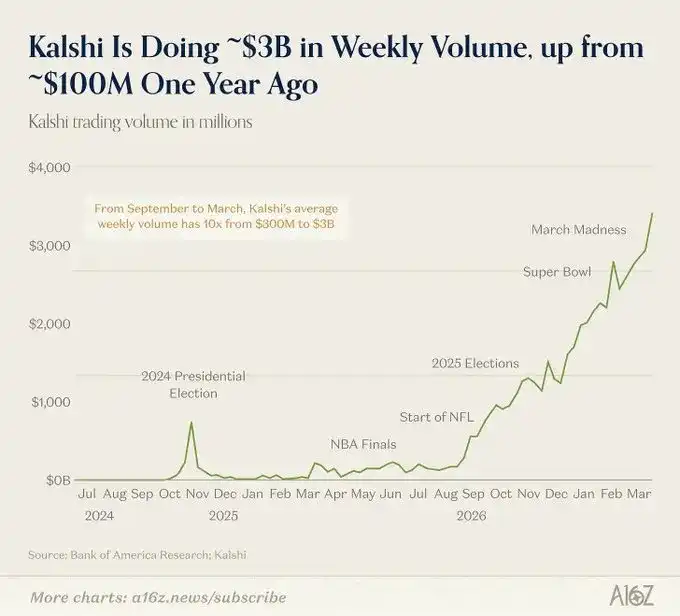
But this impression is being shattered. Just as the conference was held, weekly trading volume for sports predictions had nearly reached $3 billion, accounting for about 80% of Kalshi's total trading volume. While this seems dominant, it hides a more critical trend: sports' share is actually at a historical low.

In other words, all other categories are growing faster. Entertainment, crypto, politics, culture, and other areas are driving stronger user growth and more stable retention. Sports act more like an entry product—they are intuitive, emotionally driven, and have clear rhythms, making them suitable for attracting mass participation. Meanwhile, long-tail markets, which account for over 20% of total trading volume, are growing rapidly. These markets will play an important role in institutional hedging and information pricing in the future.
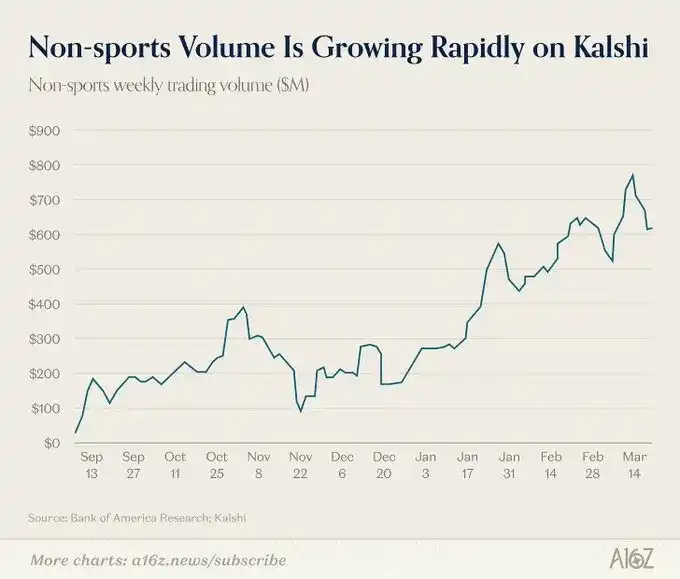
This is also confirmed on the institutional side. Cyril Goddeeris, Global Co-Head of Equity Business at Goldman Sachs, stated that predictions related to macro events and CPI are the categories Wall Street is most focused on currently; Sally Shin, Head of Growth Platforms at CNBC, mentioned that she already uses predictions related to the Fed Chair and non-farm payroll data as narrative tools; Troy Dixon, Global Co-Head of Markets at Tradeweb, envisioned a future where large investment banks will establish dedicated prediction market trading desks, with financial contracts as core products.

Prediction markets are shifting from "recreational trading" to "information and risk tools."

Why Kalshi Has Attracted Wall Street's Attention

Traditional financial markets operate efficiently largely because various assets have recognized benchmarks—the S&P 500 represents the average performance of 500 stocks, and crude oil has the ICE benchmark price. But for political and economic events (such as who will win an election, whether a certain tariff will pass, or the outcome of a Supreme Court case), there was almost no widely accepted, dynamically updated "benchmark" before.

Prediction markets change this. Now, almost any future event can have a real-time, liquid price benchmark. When the market can provide credible pricing for "the probability of a 30% tariff passing," institutions can trade around this price or hedge other risks in their portfolios. This makes the event itself a directly tradable object.

As Tradeweb's Troy Dixon said: "If you go back to when Trump was first elected, many people were hedging in the stock market, such as shorting the S&P, because they thought his election would cause the market to fall. But this was the wrong trade. The question is, how should these events be priced? Where is the benchmark?"

Tarek also mentioned that one motivation for founding Kalshi came from his previous work at Goldman Sachs, where he provided trading advice around the 2024 election and Brexit. Without prediction markets, when institutions hedge political or macro events through related assets, they actually need to make two layers of judgment—they must judge both the outcome of the event itself and the relationship between the event and the traded asset, with the latter carrying a separate risk of failure.

When the event itself has a direct price benchmark, the originally dispersed dual risks are merged into a single judgment. As Tarek said, the market has already begun pricing various events.

The Three Stages Toward Institutional Adoption

It is still too early to say that Wall Street institutions are participating in Kalshi trading on a large scale. Currently, most institutions use it primarily for data reference rather than actual trading.

However, Luana pointed out that the path to institutional adoption is already clear and can be divided into three stages:

  • The first stage is data access: Integrating prediction market prices into institutions' daily workflows, such as having Goldman Sachs investment managers view Kalshi odds like they view the VIX index. This stage has already been achieved to some extent. Jonathan Wright, a professor at Johns Hopkins University and former Fed official, stated that for Fed decisions, unemployment rates, and GDP, Kalshi is almost the only reference source;
  • The second stage is system integration: Including compliance approval, legal confirmation, technical access, and internal education, i.e., incorporating prediction markets into the usable financial tool system;
  • The third stage is actual trading: Institutions begin hedging risks on the platform, trading volume and liquidity gradually accumulate, forming a positive feedback loop. More hedgers attract more speculators, tighter spreads attract more hedgers, and benchmark prices continuously strengthen.

Currently, most institutions are still in the first stage, some have entered the second stage, and only a few have reached the third stage.

A major obstacle preventing institutions from entering the third stage is that current prediction market trading requires full margin—a $100 position requires depositing $100. This is acceptable for retail investors but is a significant limitation for hedge funds or banks that rely on leverage and capital efficiency. As Tarek said, if you want to hedge $100, you must put in $100, which is too costly for institutions; firms like Citadel or Millennium won't adopt this method. Kalshi has already received permission from the National Futures Association and is working with the Commodity Futures Trading Commission to introduce margin trading mechanisms.

What Happens Next?

Michael McDonough, Head of Market Innovation at Bloomberg, gave the most direct judgment: The sign of success is when these things become boring. He compared prediction markets to the options market in the 1970s, which also faced controversies over manipulation and regulatory uncertainty, but these issues were eventually resolved, evolving into an almost taken-for-granted infrastructure.

Toby Moskowitz, Partner at AQR, stated that he is willing to bet on the development of prediction markets. Within five years, or even sooner, it will become a viable tool at the institutional level.

Garrett Herren of Vote Hub described the final form: The question is no longer whether to use prediction markets, but how to use them. Once the discussion shifts to this level, it means they have become indispensable. In fact, although prediction markets are still relatively small, the hedging market itself is extremely large.
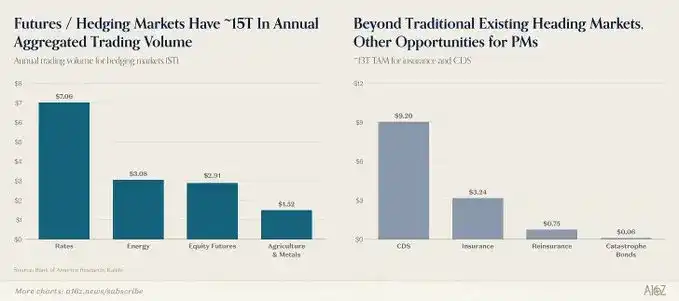
The normalization of prediction markets is already happening.

In discussions of political issues, former Congressman Mondaire Jones mentioned that senior figures from both parties, including Trump, House Minority Leader Jeffries, and Senate Minority Leader Schumer, have begun publicly citing Kalshi odds. Scott Tranter of DDHQ also confirmed that prediction market data has now become an important input for intra-party decision-making. Meanwhile, Vote Hub announced that it has directly integrated Kalshi data into its midterm election prediction model.

All of this barely existed two years ago. Back then, the most successful traders on Kalshi were still seen as amateurs. But now, the situation has changed, and it's even hard to define them with that term anymore.

In a roundtable, four traders shared their paths—one spent eleven years studying the Billboard charts, another has been participating in prediction markets since 2006—when it was still a cashless, somewhat geeky interest area. They did not come from the finance industry but from backgrounds in music, politics, and poker. But they agreed that the platform truly rewards deep domain knowledge, not resumes.

Summary

Prediction markets have come a long way. They were once seen as academic experiments, later became brief highlights during election cycles, and were also viewed as an extension of sports betting.

The message from this conference is clear: Prediction markets are gradually evolving into an infrastructure for pricing uncertainty, serving a wide range of participants from retail investors to large institutions and diverse application scenarios.


Domande pertinenti

QWhat are the three stages of institutional adoption of prediction markets as described in the article?

AThe three stages are: 1) Data Access - integrating prediction market prices into daily workflows; 2) System Integration - involving compliance approval, legal confirmation, technical access, and internal education; 3) Actual Trading - where institutions begin hedging risk on the platform, with trading volume and liquidity building up.

QWhat is identified as a major barrier preventing institutions from reaching the third stage of adoption on Kalshi?

AThe requirement for full margin trading, where a $100 position requires depositing $100, is a major barrier. This is cost-prohibitive and inefficient for hedge funds and banks that rely on leverage.

QAccording to the article, what significant shift is occurring in the perception of prediction markets' primary value?

APrediction markets are shifting from being seen as 'entertainment trading' towards becoming 'information and risk tools' for institutions, moving beyond just elections and sports.

QHow did the composition of the attendees at Kalshi Research's conference signal a change for prediction markets?

AThe presence of academia, Wall Street executives, former politicians, and frontline traders signaled that prediction markets are moving from a niche interest into the mainstream.

QWhat historical financial market does Michael McDonough compare the current state of prediction markets to, and what does he say is the marker of success?

AHe compares it to the options market of the 1970s. He states that the marker of success is when these tools become 'boring' and evolve into a fundamental, taken-for-granted infrastructure.

Letture associate

The Essence of AI Layoffs: Why More AI Adoption Leads to More Corporate Anxiety?

The author, awaiting potential inclusion on an 8000-person layoff list, analyzes the true nature of recent "AI-driven" layoffs. They argue that while AI use, particularly tools like Claude for code generation, has skyrocketed and boosted developer output (e.g., 2-5x more code commits), this has not translated into proportional business growth or revenue. The core issue is a misalignment between increased "Input" (code) and tangible "Outcomes" (user value, revenue). AI acts as a costly B2B SaaS, inflating operational expenses without guaranteed returns. Two key problems emerge: 1) The friction that once filtered out bad ideas is gone, as AI allows cheap pursuit of even weak concepts. 2) Organizational "alignment tax"—the difficulty of coordinating across teams—becomes crippling when development velocity outpaces consensus-building. Thus, layoffs serve two immediate purposes: 1) To offset ballooning AI costs (Token consumption) and maintain cash flow, as rising input costs without outcome growth destroys unit economics. 2) To reduce organizational bloat and alignment friction by simply removing teams, thereby speeding up execution in the short term. Therefore, these layoffs are fundamentally caused by AI, even if AI doesn't directly replace roles. They represent a painful correction until companies learn to convert AI-driven productivity into real business outcomes and streamline organizational coordination to match the new pace of work. The cycle will continue until this learning curve is mastered.

marsbit4 min fa

The Essence of AI Layoffs: Why More AI Adoption Leads to More Corporate Anxiety?

marsbit4 min fa

Can the Solana Foundation and Google's Collaboration on Pay.sh Bridge the Payment Link Between Web2 and Web3 in the Agent Economy?

Solana Foundation, in collaboration with Google Cloud, has launched Pay.sh, a payment gateway designed to bridge the gap between AI agents and enterprise-grade service infrastructure. The initiative aims to solve a key bottleneck in the "agent economy": existing payment systems are ill-suited for autonomous AI agents. Traditional methods like credit cards require human verification, while newer on-chain protocols like x402 and MPP create a separate, Web3-native system that raises barriers for service providers. Pay.sh functions as a universal payment layer. It allows users to fund a Solana wallet via credit card or stablecoin, which then acts as an identity and payment proxy for AI agents. When an agent needs to access a paid API service (e.g., Google Cloud, Alibaba Cloud), Pay.sh handles the transaction seamlessly. It leverages the HTTP 402 status code ("Payment Required") to initiate payments, intelligently choosing between one-time transfers (x402-style) or session-based authorizations (MPC-style) based on the service's billing model. This spares agents from manual account registration and API key management. A key feature for service providers is low integration effort. They can adopt Pay.sh by providing a declarative configuration file, enabling features like tiered pricing, free tiers, and automatic revenue splitting to multiple addresses (e.g., for royalties, cloud costs). Providers can also list their APIs in a central Pay Skill Registry for agent discovery. The collaboration with Google Cloud provides crucial infrastructure for API proxying, traffic routing, and compliance logging, aiming to keep agent activities within regulated boundaries. By connecting Web2 services with Web3 payment rails, Pay.sh positions the Solana wallet as a foundational identity and payment tool for AI agents, potentially driving more transaction volume to the Solana ecosystem. However, the report notes challenges. The service registry currently lacks robust vetting, risking exposure to unauthorized or malicious third-party APIs. Pay.sh also inherits security and compatibility risks from its underlying payment protocols (x402, MPC). Furthermore, adoption may be hindered by varying regional data privacy and payment compliance regulations among API providers. Despite these hurdles, Pay.sh represents a significant step towards integrating Web2 and Web3 for autonomous agent commerce.

marsbit11 min fa

Can the Solana Foundation and Google's Collaboration on Pay.sh Bridge the Payment Link Between Web2 and Web3 in the Agent Economy?

marsbit11 min fa

Bitcoin's Bull-Bear Cycle Indicator Turns Positive for the First Time in 7 Months: End of Bear Market or False Breakout?

Bitcoin's "Bull-Bear Market Cycle Indicator" from CryptoQuant has turned positive for the first time since October 2025. This gauge, based on the P&L Index relative to its 365-day moving average, suggests a potential shift from a bear market phase. Concurrently, the Bull Score Index rose to a neutral reading of 50 in late April. The indicator's move into positive territory follows a roughly 35% price rebound from a low near $60,000 in February to above $81,000. The recovery over approximately three months was faster than the 12-month period observed during the 2022 bear market. However, analysts caution against premature optimism, citing a historical precedent from March 2022. Back then, the Bull Score Index briefly hit 50, but it proved to be a false signal as Bitcoin's price subsequently plunged further. Structural differences exist in the current cycle, including consistent inflows into spot Bitcoin ETFs and an increase in large holder addresses. Yet, some models, referencing the four-year halving cycle, suggest a potential deeper bottom near $50,000 might still be possible around late 2026. In summary, while on-chain data shows marked improvement and the worst panic may be over, market participants remain cautious. A convincing trend reversal confirmation likely requires Bitcoin to sustainably break above key resistance, such as the 200-day moving average near $82,000.

marsbit18 min fa

Bitcoin's Bull-Bear Cycle Indicator Turns Positive for the First Time in 7 Months: End of Bear Market or False Breakout?

marsbit18 min fa

How to Automate Any Workflow with Claude Skills (Complete Tutorial)

This is a comprehensive guide to mastering Claude Skills, a feature for creating permanent, reusable instruction sets that automate specific workflows. Unlike simple saved prompts, Skills function like trained employees, delivering consistent, high-quality outputs by defining the entire task process, standards, error handling, and output format. The guide is structured in four phases: **Phase 1: Installation (5 minutes).** Skills are folders containing a `SKILL.md` file. The user is instructed to find a relevant Skill online, install it, test it on a real task, and compare its performance to one-off prompts. **Phase 2: Building Your First Custom Skill.** Start by rigorously defining the Skill's purpose, trigger phrases, and providing a concrete example of perfect output. The `SKILL.md` file has two parts: a YAML frontmatter with a specific name/description/triggers, and a detailed, step-by-step workflow written in natural language with examples and quality standards. **Phase 3: Testing & Optimization for Production.** Test the Skill in three scenarios: 1) a standard, common task; 2) edge cases with missing or conflicting data; and 3) a pressure test with maximum complexity. Any failure indicates a needed instruction. Implement a weekly optimization cycle to continuously refine the Skill based on real usage. **Phase 4: Building a Complete Skill Library.** The goal is to create a team of Skills for all repetitive tasks. Examples are given for industries like real estate, marketing, finance, consulting, and e-commerce. The user should list their tasks, prioritize them, and build one new Skill per week, maintaining a master document to track their library. The conclusion emphasizes the compounding time savings: ten Skills saving 30 minutes each per week reclaims over 260 hours (6.5 work weeks) per year, fundamentally transforming one's work system.

marsbit42 min fa

How to Automate Any Workflow with Claude Skills (Complete Tutorial)

marsbit42 min fa

Trading

Spot
Futures
活动图片




