Institutional Adoption Isn't Adding Value, It's Bleeding Crypto Dry

Odaily星球日报Pubblicato 2026-02-24Pubblicato ultima volta 2026-02-24

Introduzione

The article argues that institutional adoption of crypto is not about supporting the ecosystem but rather a strategy to extract value from it. Traditional financial institutions, such as Tether, Coinbase, Circle, and BlackRock, are generating billions in revenue from crypto through stablecoins, ETFs, and other financial products, often capturing more economic value than the protocols themselves. The piece highlights that institutions are primarily focused on profit maximization, using crypto to create new revenue streams rather than reduce costs. The author warns that without building strong native crypto institutions to retain economic benefits on-chain, the crypto economy risks being absorbed by traditional finance, leading to value drainage rather than genuine growth. The call to action is for the crypto community to prioritize developing its own financial infrastructure to keep value within the ecosystem.

Author | Meltem Demirors

Compiled by | Odaily Planet Daily (@OdailyChina)

Translator | DingDang (@XiaMiPP)

Institutions have finally "entered crypto"—but they're not here to take over your bags. They're here to turn the crypto economy into a fee-generating machine for their AUM (Assets Under Management) accumulation. This isn't a judgment or criticism, just an observation of fact.

The following thoughts primarily address crypto as a digital currency/token economy, rather than merely as financial infrastructure blockchains (the latter, in the vast majority of cases, does not require a native token, as proven by the architecture of most DeFi governance tokens).

This is a view I've held since last year's Digital Assets Summit, where the title of my opening speech was "Believe in Something." Everything that has happened in the past twelve months hasn't changed my view, only made the picture clearer.

Recently, my friends Evgeny from Wintermute and Dean from Markets Inc wrote two great articles discussing what so-called "institutional adoption of crypto" really means and its impact on market cycles. This inspired me to write a third piece, building on their foundation and adding a new perspective—the changing capital landscape and the erupting AUM war.

If you're short on time, here's the one-sentence summary:

"Institutional adoption" is not a mission; it's an extraction strategy. The only real question left is: Can crypto build and fund its own institutions fast enough to keep economic value on-chain, rather than letting it continuously leak out to TradFi?

TradFi is Already Extracting Most of the Value from the Crypto Economy

Just follow the money flow to see who the real winners are in the current crypto world: not DeFi protocols, but the very financial companies that Satoshi Nakamoto sought to replace in the Bitcoin whitepaper.

  • Just the two major stablecoins, USDT and USDC, generate approximately $10 billion in net interest income annually, belonging to Tether (a private company), Coinbase, and Circle (public companies). These companies are certainly important participants in the crypto economy, but they serve their shareholders first.
  • Cantor Fitzgerald—led by current US Secretary of Commerce Howard Lutnick—earns hundreds of millions of dollars annually by holding US Treasuries for Tether and organizing trades around digital asset companies and investment products.
  • Former US President Trump, his family, and partners have also cumulatively profited billions of dollars through expanding crypto projects and token vehicles.
  • BlackRock's Bitcoin ETF, IBIT, grew to approximately $100 billion AUM in about 18 months, becoming the fastest-growing ETF in history and one of the company's most profitable products (more on that later).
  • Apollo Global Management and its peers are quietly funneling crypto collateral and corporate treasury balances into their own credit and multi-asset funds.

Every year, traditional financial institutions extract tens of billions of dollars in assets and profits from the crypto economy—and in many cases, they capture more economic upside than the protocols that initially created the value.

Those "institutional innovators" cheering for "adoption" at countless conferences and the trench warriors obsessing over memecoins on Twitter are more alike than you think. We should stop licking boots and start using our brains.
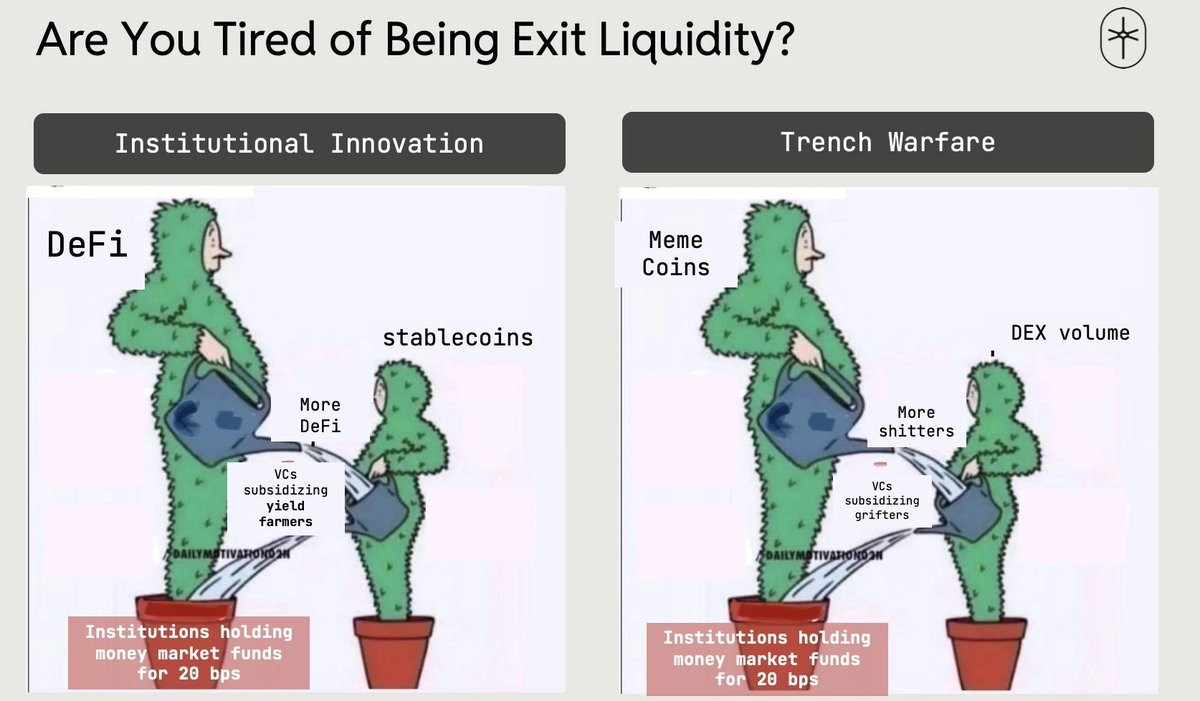
How Do Institutions Actually Think?

Corporations have one core function: profit maximization. Cryptocurrency can achieve this in two ways:

  • Cost Side: Distributed ledgers, on-chain collateral, and instant settlement can significantly reduce back and middle-office operational costs, improving collateral liquidity and utilization (see my previous notes on fungible liquidity).
  • Revenue Side: Packaging crypto as ETFs, tokenized funds, structured products, custody services, basis trade packages, lending, treasury management solutions... all throw off hefty fee streams, plus mindless hype from the crypto community on Twitter.

Over the past decade, institutions focused primarily on the first way.

When we founded DCG in 2015, I spent three full years pitching the advantages of Bitcoin's global ledger and final settlement mechanism to almost every financial institution. At that time, financial services firms did not see crypto as a new revenue source. It was considered too risky; and the potential gains from pushing altcoins were not enough to convince boards to take on the reputational and compliance risks.

After leaving DCG, I joined CoinShares in early 2018. The company's AUM grew from tens of millions to billions of dollars gradually. The few independent investment managers who dared to embrace Bitcoin—like Cathie Wood, Murray Stahl, Ross Stevens—were ultimately richly rewarded for their courage.

Early 2024 became a watershed moment. Institutions began using crypto as a tool for the second path: a new revenue source.

Although there had been sporadic institutional participation before, the launch of BlackRock's IBIT Bitcoin ETF blew the dam wide open. IBIT became the most successful ETF ever, significantly boosting BlackRock's earnings. Key numbers:

  • IBIT reached $70 billion AUM in its first year, becoming the fastest ETF to reach that size in history, about five times faster than the previous record holder, SPDR Gold Shares (GLD).
  • After IBIT options launched in late 2024, it attracted over $30 billion in new inflows, while competitors' flows largely stalled, giving it over half the market share of all Bitcoin ETF AUM.
  • IBIT's current ~$100 billion AUM can generate hundreds of millions of dollars in annual fee revenue for BlackRock, making it even more profitable than the company's nearly trillion-dollar S&P 500 index fund.

The conclusion is clear: IBIT showed the playbook to all major asset managers and financial services institutions—take Bitcoin or other digital asset → package into traditional fund structure → list it → become a stable, hefty fee stream. Everything that follows—DATs, tokenized treasuries, on-chain money market funds—is just running that playbook over and over.

The AI Capex Supercycle: A Black Hole Devouring Capital

Switching gears slightly to discuss another major trend—this is also the reason we launched Crucible immediately after IBIT's launch in 2024. The energy-compute value chain is reshaping the global capital stack in real-time.

Building the AI economy—chips, data centers, power, factories, etc.—will require trillions of dollars in capital expenditure over the next decade, and that money has to come from somewhere. All liquid assets not directly tied to AI—crypto, non-AI stocks, even credit assets—are being sold to chase those perceived as "must-have" AI plays.

Simultaneously, many LPs are overallocated in private markets, with slower distributions and dividends, and are quietly cutting back or delaying new private credit and PE commitments. This leads to longer, more uneven, harder-to-predict fundraising cycles, and a fierce battle for quality AUM channels between asset managers and PEs. The result is that anything that looks like a capital pool will be drained.

On-Chain Capital: The Next AUM Frontier

In this AUM war, crypto is no longer a quirky toy but trillions in potential management size, sitting there plainly visible.

IBIT has proven that crypto is both a money printer and a "honeypot" for attracting institutional allocators. The Trump administration has also made it clear it will create an extremely permissive environment for all sorts of crypto innovation.

On-chain asset management and treasury size already amounts to hundreds of billions of dollars:

  • ~$300 billion in stablecoin supply, with ~60% being USDT and 25% USDC;
  • DeFi Total Value Locked (TVL) of ~$90–100 billion, spread across Ethereum, Solana, BSC, Hyperliquid, etc.;
  • Hundreds of billions more in Real World Asset (RWA) products via tokenized money market funds (like BlackRock's BUIDL), tokenized gold (like Tether Gold, PAXG), and consumer credit products (like Figure's tokenized HELOCs).

But the average yield on this on-chain capital is only 2–4%, while traditional money market funds offer ~4.1%, and even Lido's $18 billion stETH pool only yields ~2.3%.

To a hungry asset accumulation machine, this isn't "DeFi TVL"; it's under-monetized cash flow—ready to be packaged, staked, re-lent, and fee'd upon. For institutions, this is as natural as breathing.
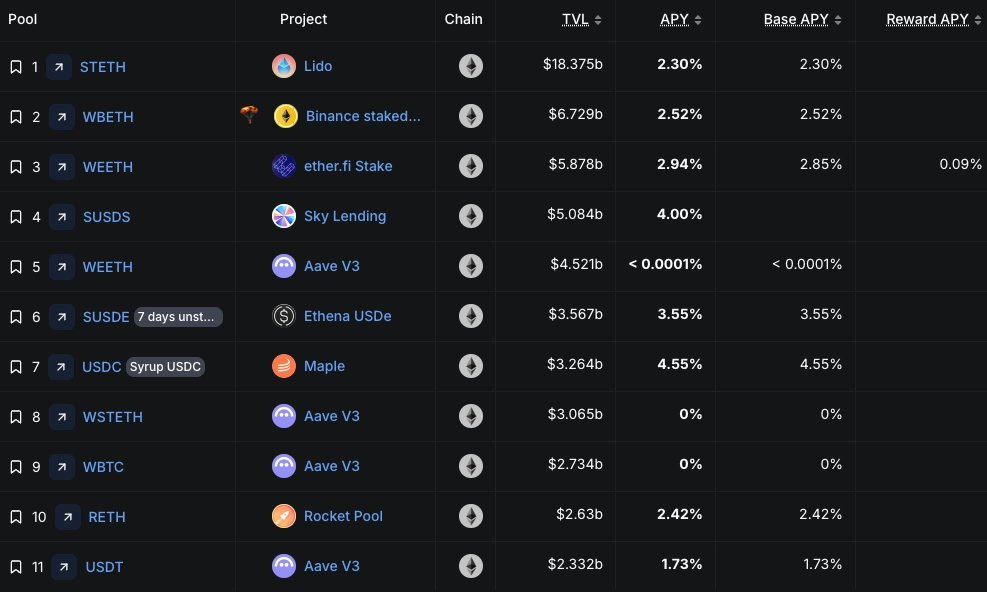
Image from DefiLlama

Tokenization and regulated wrapper products have turned previously "untouchable" crypto capital into fee-generating AUM that fits existing custody and risk frameworks. As companies, DAOs, and protocols accumulate large crypto treasuries and seek safer external yield, asset managers can repackage these assets into tokenized funds, money market funds, and structured products. For companies facing fundraising pressure and saturated traditional channels, "raiding" crypto balance sheets is one of the cleanest paths to grow fee AUM.

A Wake-Up Call

Just as Western economies introduced populations that did not share their culture and values and are now suffering the social and economic consequences, crypto stands on the brink of a similar existential crisis. The crypto economy and its leading thinkers are introducing financial institutions that do not share our values, institutions that are not here to co-build native economic growth, and our industry will soon taste the same social and economic bitterness.

If allowed to develop unchecked, the crypto economy will become just another liquidity silo for traditional financial AUM machines. The only way out is to accelerate the building and scaling of our own native institutions—on-chain asset managers, risk managers, underwriters, financial products, crypto-native allocators—to compete for treasury AUM, design products that truly serve crypto's long-term interests, and keep more economic value inside the crypto ecosystem rather than leaking out to corporate P&Ls.

If we don't prioritize working with crypto-native institutions now, "institutional adoption" won't be a victory; it will be an annexation.

Believe in something. Otherwise, we'll have nothing left.

Related Reading

The War Between Stablecoins and Banking Probably Doesn't Exist

Domande pertinenti

QWhat is the main argument presented in the article regarding institutional adoption of crypto?

AThe article argues that institutional adoption is not a mission to build up the crypto economy but an extraction strategy. Traditional financial institutions are entering crypto not to support its growth but to siphon off value, turning it into a source of fees and assets under management (AUM) for themselves, often extracting more economic upside than the protocols that created the value.

QWhich traditional financial entities are highlighted as major beneficiaries of the current crypto economy?

AMajor beneficiaries include Tether (a private company), Coinbase and Circle (public companies) which profit from stablecoin interest, Cantor Fitzgerald which earns billions from holding U.S. Treasuries for Tether and organizing trades, former President Trump and associates profiting from crypto projects, BlackRock with its highly profitable Bitcoin ETF IBIT, and Apollo Global Management redirecting crypto collateral to its funds.

QHow does the article describe the shift in how institutions view cryptocurrency around 2024?

AAround 2024, institutions shifted from viewing crypto primarily as a tool for cost reduction (e.g., through distributed ledgers and instant settlement) to seeing it as a new revenue source. This was catalyzed by the success of BlackRock's IBIT Bitcoin ETF, which demonstrated that crypto could be packaged into traditional fund structures to generate substantial, stable revenue streams.

QWhat challenge does the AI capital expenditure supercycle pose to other asset classes like crypto?

AThe AI capital expenditure supercycle, requiring trillions in spending on chips, data centers, and power over the next decade, is creating a massive capital drain. Liquidity from assets not directly tied to AI—including crypto, non-AI stocks, and credit assets—is being sold off to chase 'must-have' AI investments, intensifying competition for AUM.

QWhat solution does the article propose to prevent crypto from being absorbed by traditional finance?

AThe article proposes accelerating the creation and growth of native crypto institutions—such as on-chain asset managers, risk management firms, underwriters, and crypto-native financial products—to compete for treasury AUM, design products that serve crypto's long-term interests, and keep economic value within the crypto ecosystem rather than letting it leak out to traditional finance.

Letture associate

Must-Watch Events Next Week|CLARITY Act Could Face Senate Vote; SpaceX, Circle to Report Earnings (8.3-8.9)

**Summary: Key Events and Developments to Watch (August 3-9)** The upcoming week is marked by significant financial disclosures, key legislative deadlines, and notable product updates. **Major Financial Events:** Several companies are scheduled to release their Q2 2026 earnings. American Bitcoin (ABTC) will report on August 3, followed by SpaceX and Hut 8 Mining Corp. on August 4, and Circle on August 5. Notably, a significant portion of SpaceX shares (up to 12% of total shares) will be unlocked on August 6 following their earnings release. **Key Legislative Deadline:** The U.S. Senate faces an August 7 deadline to secure 60 votes for the CLARITY Act, a bipartisan bill aiming to establish a federal regulatory framework for cryptocurrencies. The Senate may hold a full vote on the bill during the week. **Economic Data:** The U.S. July Non-Farm Payrolls report will be released on August 7, providing crucial labor market data. **Technology & Product Updates:** * **Shutdowns:** DeFi portfolio tracker Zapper and wallet app Ctrl Wallet will cease operations on August 3. * **Upgrades:** LayerZero will deprecate its v1 relayers on August 3. XRP Ledger's new version 3.3.0, featuring five new functions, is expected next week. * **AI:** Elon Musk announced that the advanced Grok 4.6 AI model is set for release around August 7. * **Bitcoin:** The BIP-110 forced signaling for a potential Bitcoin network change is scheduled to begin around August 8. **Other Notable Events:** Chinese robotics firm Unitree Tech has set its preliminary price inquiry for its IPO for August 5. South Korean exchange Upbit will delist AQT and AERGO tokens on August 3.

marsbit30 min fa

Must-Watch Events Next Week|CLARITY Act Could Face Senate Vote; SpaceX, Circle to Report Earnings (8.3-8.9)

marsbit30 min fa

Stocks Are Plummeting More Sharply Than Cryptocurrencies. Where Has the Money Gone?

Stock Markets Plunge Deeper Than Cryptocurrencies: Where Did the Money Go? In late July, Seoul's Kospi index triggered circuit breakers for two consecutive days, plummeting over 40% from its June high. The collapse was led by heavyweight stocks like SK Hynix, whose record profits still disappointed investors, and devastating leveraged ETFs, with one major product losing over 83% of its value. This signaled a global, forced deleveraging targeting the most crowded trades. Interestingly, while stocks exhibited extreme volatility akin to crypto markets, Bitcoin rose nearly 15% in July after a prior steep drop. Analysis shows the money fleeing equities did not flow into Bitcoin. Instead, Bitcoin had already absorbed its sell-off in May-June, when U.S. spot Bitcoin ETFs saw historic outflows. The true safe-haven beneficiary was gold, whose price rose over 20% year-on-year, highlighting a decoupling between Bitcoin and gold as "digital gold." The sell-off was a targeted unwinding of leveraged positions in tech and semiconductors, accelerated by broker-dealer risk management and shifts in the AI narrative, including new competition from Chinese memory chipmakers. The retreat path was clear: from high-valuation tech stocks to cash and U.S. Treasuries, then to gold. For Bitcoin to attract sustained institutional inflows, conditions like eased global liquidity pressure, a "soft-landing" Fed rate cut, and U.S. regulatory clarity via legislation like the stalled CLARITY Act are needed. Currently, Bitcoin is not a safe haven but an already-cleared asset. Its low correlation with tech stocks, however, makes it a potential diversification play for institutional portfolios once the storm passes. The money isn't here yet, but the positioning is underway.

marsbit30 min fa

Stocks Are Plummeting More Sharply Than Cryptocurrencies. Where Has the Money Gone?

marsbit30 min fa

In Conversation with Ray Dalio: We Are Currently in an AI Bubble, with 1% of My Portfolio in Bitcoin

Ray Dalio, founder of Bridgewater Associates, warns in an interview that the current AI boom shows classic bubble characteristics, which could lead to significant economic downturns as seen in past cycles like 1929 or 2000. He explains that speculative enthusiasm, fueled by debt and overvaluation, often precedes a crash when rising rates or taxation force asset sales, causing widespread losses and recession. Dalio also outlines his "Big Cycle" theory, describing an approximate 80-year pattern where widening wealth gaps, massive government deficits, and shifting geopolitical power (like China's rise) create internal conflict and global instability. He emphasizes that we are in a late-cycle, transitional phase where traditional powers like the US and UK face decline. For personal wealth protection, Dalio advises diversification beyond cash into assets like stocks, bonds, real estate, and particularly gold, which he prefers over Bitcoin. While he holds about 1% of his portfolio in Bitcoin as a non-printable hard asset, he views gold as more secure from technological or governmental threats. Regarding AI's impact, Dalio believes it will disproportionately benefit capital owners, worsening inequality by replacing both physical and cognitive labor. He suggests that human intuition and emotional intelligence, combined with AI, will be key for future workers. On taxation, Dalio argues that wealth taxes are impractical and risk triggering asset sell-offs, reducing productive investment. He points to the UK as a cautionary example of debt, low productivity, and political strife. Geopolitically, Dalio foresees a more regionalized world, with the US showing weakness in prolonged conflicts like with Iran, akin to past imperial declines. The ideal outcome, he suggests, is coexisting powerful blocs (e.g., Americas, China-Asia Pacific) without major war.

marsbit4 h fa

In Conversation with Ray Dalio: We Are Currently in an AI Bubble, with 1% of My Portfolio in Bitcoin

marsbit4 h fa

Daily 7.2 Trillion KRW: Foreign Capital's Record Net Buying on Friday! Wall Street Says Headwinds for Korean Stock Fund Flows Have Subsided

South Korean stock market sees a dramatic shift in fund flows. On July 31, foreign investors made a record net purchase of approximately KRW 7.2 trillion in KOSPI stocks, marking a fundamental reversal from the persistent large-scale net outflows seen in previous months. This contributed to a significant narrowing of foreign net selling in July to KRW 9.8 trillion, down sharply from KRW 48.4 trillion in June and KRW 44.5 trillion in May. Simultaneously, domestic institutional pressure eased. South Korean pension funds and asset managers turned to a net buying position in July, purchasing KRW 1.0 trillion worth of KOSPI shares, contrasting with net sales in May and June. Market volatility is expected to be dampened by new financial regulations. Effective July 31, the Financial Services Commission tightened access for retail investors to single-stock leveraged ETFs by raising the minimum cash deposit requirement. Trading volumes for these products subsequently dropped to about 50% of their monthly average. Citigroup Research maintains its year-end KOSPI target of 10,000 points. The firm cites several supportive factors: the substantial easing of headwinds from capital outflows, a robust fundamental outlook for the semiconductor sector, historically low market valuations, strong economic fundamentals, and the potential for policy support from financial authorities if needed.

marsbit4 h fa

Daily 7.2 Trillion KRW: Foreign Capital's Record Net Buying on Friday! Wall Street Says Headwinds for Korean Stock Fund Flows Have Subsided

marsbit4 h fa

Trading

Spot
活动图片





