Inflation Has Not Improved. Will Warsh Support a Rate Hike on Friday?

marsbitPubblicato 2026-08-27Pubblicato ultima volta 2026-08-27

Introduzione

U.S. inflation remained stubbornly high in July, with the PCE price index holding at a year-on-year increase of 3.7%, unchanged from June and still far above the Federal Reserve's 2% target. The core PCE index also stayed flat at 3.3%. While inflation did not worsen, the fact that it did not improve either has increased market expectations for further interest rate hikes. Futures pricing now indicates a higher probability of a rate increase in September and fully prices in one hike by year-end. The economic backdrop is mixed. Second-quarter GDP growth was revised to 1.5%, but underlying components like consumer spending and business investment were robust. However, inflation-adjusted consumer spending stalled in July, and real incomes have barely grown over the past year, eroding purchasing power. The data provides arguments for both sides of the policy debate. The "wait-and-see" camp points to the lack of acceleration in inflation and upcoming methodological changes that may lower reported figures. The "pro-hike" camp highlights that inflation remains hotter than forecasts, sticky services prices, rising diesel and chip costs, and renewed trade tensions with Canada. All eyes are now on Fed Chair Kevin Warsh's upcoming speech at Jackson Hole for clarity on his policy stance. With inflation persistently above target for over five years and midterm elections approaching where prices are a key issue, the pressure for decisive action is mounting. The speech carries significant...

Early Wednesday morning, the U.S. Commerce Department released the latest inflation figures.

The inflation rate, as measured by the PCE price index, rose 3.7% year-on-year in July, exactly the same as in June. This marks its 65th consecutive month above the Federal Reserve's 2% target. Second-quarter GDP grew at an annualized rate of 1.5%, identical to the initial estimate from last month and slower than the first quarter's 2.1%. Meanwhile, after adjusting for inflation, consumer spending in July did not increase at all.

The New York Times summarized the report in one sentence: America's stubborn inflation problem did not get worse in July, but it did not get better either. The issue is that in the current atmosphere within the Federal Reserve, "not getting better" is itself an answer.

Why Does "Unchanged" Raise Rate Hike Odds?

Because economists expected it to fall. A Reuters survey predicted 3.6%, while the actual figure came out at 3.7%. The month-on-month figure also exceeded expectations, with overall prices rising 0.2% (expected 0.1%), compared to a 0.1% decline in June, which had been the weakest month since April 2020. Core PCE (excluding volatile food and energy) rose 3.3% year-on-year, again identical to June, with the month-on-month rate increasing from 0.1% to 0.2%.

Upon the data release, fed funds futures showed the probability of a September rate hike jumped from about 36% to around 44%. Traders have fully priced in one rate hike by the end of the year.

Omair Sharif, founder of the forecasting firm Inflation Insights, gave the shortest possible assessment: "This is a rate-hike supportive report."

Heather Long, Chief Economist at Navy Federal Credit Union, was more comprehensive: "The United States still has an inflation problem. The latest data gives (Warsh) time to wait and see, but he must be clearer about what he's watching closely and what circumstances would lead him to hike."

The dollar hit its biggest gain in nearly four weeks that day, recouping roughly half of the losses incurred after Treasury Secretary Besant intervened to support the bond market last week. The Bloomberg Dollar Spot Index rose as much as 0.3%, while the yen fell 0.2% to 159.45.

How Did Rate Hike Probability Get Here?

PCE peaked at 7.2% in June 2022, and the steepest round of rate hikes since the 1980s subsequently pulled it back onto a path toward 2%. That path was interrupted last year. A round of import tariffs following Trump's return to the White House pushed up prices for a wide range of goods.

In late February this year, the U.S. and Israel took action against Iran. Before the war started, PCE was 2.9%. The conflict shut down roughly one-fifth of global oil supply, sending energy prices spiraling upward and pushing PCE to a three-year high of 4.1% in May.

Six months on, a final resolution to the conflict remains distant, but the intensity of fighting has decreased, and oil prices along with the wave of inflation they fueled have receded from their late-spring highs.

They receded to 3.7%, and then stalled there.

The trouble is, new tariff pressures are on the way: Last Friday, U.S. negotiations with its second-largest trading partner, Canada, broke down. New tariffs on $20 billion worth of Canadian goods have taken effect, and both sides have since announced additional retaliatory measures set to take effect in the coming months.

The nuance of this report is that both the camp advocating for patience and the camp advocating for a rate hike can find ammunition in it.

The camp advocating for patience sees that: inflation did not worsen; high oil prices, aside from specific categories like airfare, have barely spread throughout the broader economy; and starting next month, the Bureau of Economic Analysis will change how it calculates prices for a subset of services (portfolio management services, software, and computer accessories) – an adjustment that is likely to lower measured inflation.

The camp advocating for a rate hike sees that: both headline and core inflation in July were hotter than forecasters expected; service prices excluding housing (an indicator some officials view as a gauge of underlying price pressure) rose faster than in June; diesel prices are near record highs, which will push up the cost of far more than one category of goods; the AI boom is pushing up chip prices; and the trade war with Canada has just reignited.

And the most fundamental argument has nothing to do with the monthly data: inflation has been above target for over five years. The argument from this camp is that the central bank must act decisively, or risk losing credibility.

But in reality, the economy is cooling. This is the most easily overlooked, and most critical, half of the report.

In July, inflation-adjusted consumer spending saw zero growth, after posting strong gains in the previous two months. In nominal terms, personal income rose 0.4% and consumer spending rose 0.2%, both exceeding expectations; but after subtracting inflation, real growth was zero.

Even more telling is income: compared to a year ago, inflation-adjusted income rose only 0.2%, and it had been negative for many months prior.

In other words, even as the inflation rate number is coming down, five years of cumulative price increases have eroded incomes. This explains why in consumer confidence surveys, most Americans remain pessimistic about the economy and their own financial situation.

What Will Warsh Say on Friday?

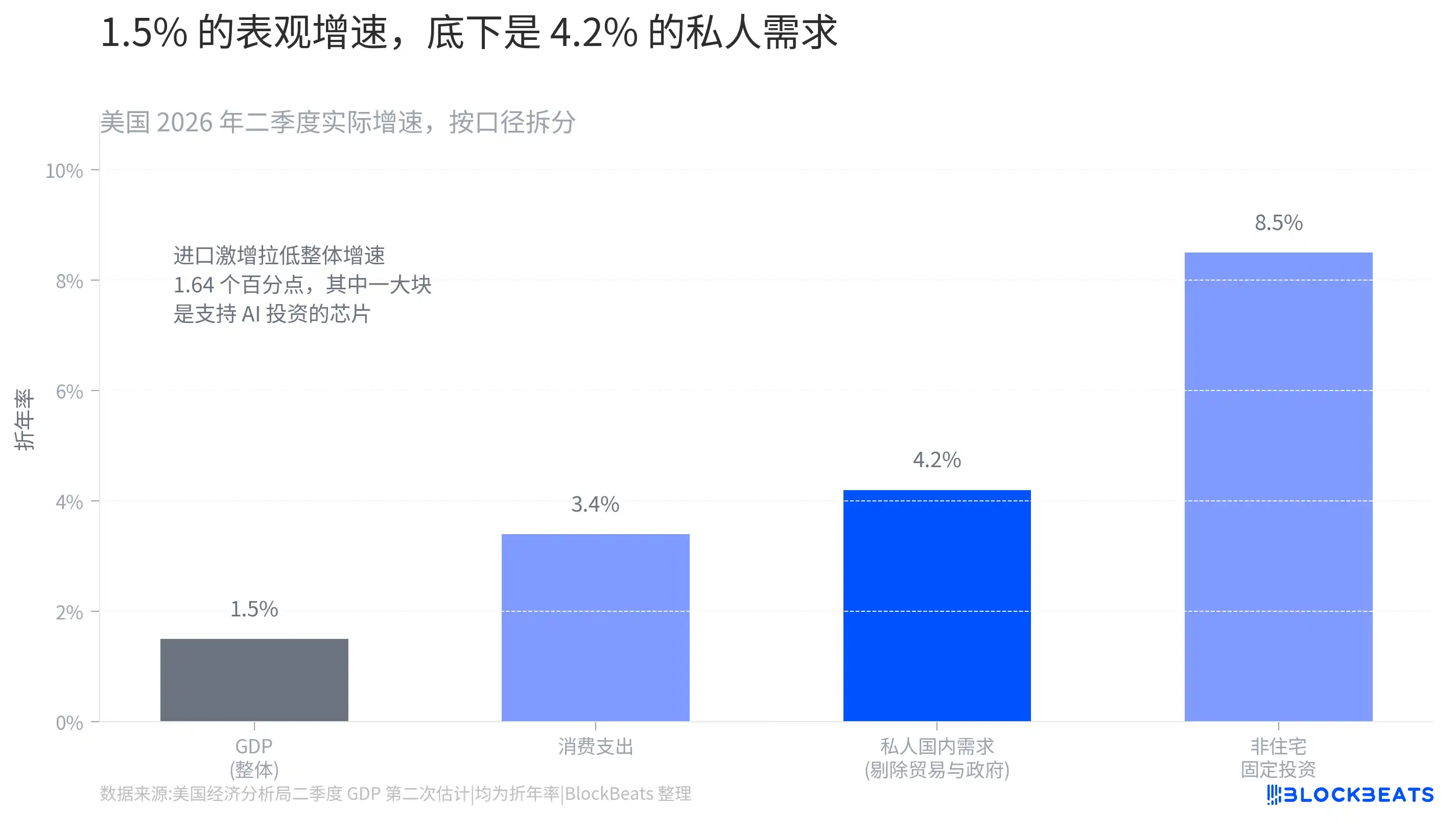
Second-quarter GDP at 1.5% sounds mediocre. But the underlying structure is nothing like that.

Consumer spending, which accounts for over two-thirds of U.S. economic activity, grew at an annualized rate of 3.4%, revised up from the initial estimate of 3.2%; in the first quarter, this figure was only 0.5%. Business investment excluding residential structures grew 8.5%, reflecting the heat of AI investment. And a specific measure of the economy's intrinsic strength – final sales to private domestic purchasers, which strips out volatile government spending and trade – grew 4.2%, the strongest in over three years, revised up from the initial 3.9%; in the first quarter, it was 1.7%.
Housing investment also rose, for the first time since late 2024.

So what dragged the 1.5% figure down? Imports.

Imports surged at a 12.5% annualized rate in the second quarter, with a significant chunk being computer chips and related products supporting AI investment. GDP only counts domestic production, and imports are subtracted – this single item alone knocked off 1.64 percentage points. Government spending fell 1%, with non-defense outlays pulling back sharply, also acting as a drag.

Thus, a strange picture emerges: chips bought to build AI are depressing this country's growth number.

The second-quarter GDP will have a third and final revision, to be released on September 30th.

The landing point for all this data is the podium at Jackson Hole this Friday.

Federal Reserve Chairman Kevin Warsh will deliver his first major speech since taking office. He has promised to end above-target inflation but has yet to give any hint as to whether he believes inflation can subside on its own without a rate hike. Wednesday's data did not show that it can.

The policy rate has been parked in the 3.5% to 3.75% range since last December. At the July meeting, three officials voted against, advocating for a 25 basis point rate hike.

Bank of America FX strategist Alex Cohen highlighted the uncertainty surrounding the speech: "There is clear two-way risk around Warsh's Jackson Hole speech. It remains a wild card."

And beyond all this, there is another timeline: the midterm elections are 10 weeks away. Gasoline prices remain high due to the war with Iran, the president is threatening new tariffs on Canada and China, and AI infrastructure spending is pushing up prices for computers, gaming consoles, and semiconductors.

Prices are becoming a core issue in this election.

Domande pertinenti

QAccording to the article, why did the unchanged July PCE inflation rate of 3.7% actually increase the probability of a Fed rate hike?

AThe unchanged rate of 3.7% was seen as increasing the probability of a rate hike because economists had forecast a decrease to 3.6%. The 'no improvement' outcome, along with monthly figures coming in hotter than expected, was interpreted by markets as data supporting a more hawkish Fed stance.

QWhat are the two main opposing views within the Fed cited in the article, based on the July inflation report?

AOne view advocates for waiting, citing that inflation did not worsen, high oil prices haven't broadly diffused, and upcoming methodological changes may lower measured inflation. The other view advocates for hiking rates, citing that overall and core inflation were hotter than forecasts, certain service prices are rising faster, and prolonged above-target inflation risks damaging the Fed's credibility.

QHow does the article explain the paradox of a seemingly weak 1.5% Q2 GDP growth rate alongside strong underlying economic components?

AThe article explains that components like consumer spending (3.4%) and business investment (8.5% excluding housing) were strong. The weak 1.5% headline figure was primarily dragged down by a surge in imports (12.5%), especially AI-related chips, which are subtracted in GDP calculation, and a decrease in government spending.

QWhat key uncertainty does the article highlight regarding Fed Chairman Kevin Warsh's upcoming Jackson Hole speech?

AThe article highlights that a key uncertainty is whether Chairman Warsh will signal a belief that inflation can fall back to target without further rate hikes. His speech presents 'clear two-way risk' as he has promised to end above-target inflation but hasn't yet hinted at his policy leaning.

QBeyond the immediate economic data, what two broader factors does the article mention as contributing to ongoing price pressures and political significance?

AThe article mentions upcoming new tariffs following the collapsed U.S.-Canada trade talks and the high price of gasoline due to the Iran conflict as factors contributing to price pressures. It notes that prices have become a core issue with the midterm elections 10 weeks away.

Letture associate

Former Nvidia AI Director Overturns Transformer, Creates 5 Trillion-Context Physical AI That Can Simulate the Entire Universe

Former NVIDIA AI Director Anima Anandkumar and her co-founder Benedikt Jenik have unveiled a groundbreaking "Physical AI" model through their startup, Accelerated Understanding. This model departs entirely from the dominant Transformer architecture, instead utilizing "Neural Operators" to directly understand and simulate physical phenomena in their full 4D spacetime (3D space + time). It achieves a staggering inference-time context window of over 5 trillion tokens—reportedly 5 million times larger than current top LLMs—enabling it to generate complete 4D trajectories of complex physical systems in a single, one-shot inference without subsampling or chunking. The model, pre-trained with 1 trillion parameters and scaled to 35 trillion in experiments, functions as a universal physics simulator capable of handling diverse domains from weather to materials science. It establishes a "simulate → improve → simulate" loop for reality validation. The founders notably turned down a lavish offer from Jeff Bezos's Project Prometheus, which included 35% equity, a $2M salary, and over $20B in committed funding. Industry speculation points to NVIDIA CEO Jensen Huang, who previously championed Anandkumar's work, as a potential key supporter behind the scenes. This development signals a paradigm shift from language/image-centric AI to physics-first intelligence.

marsbit7 min fa

Former Nvidia AI Director Overturns Transformer, Creates 5 Trillion-Context Physical AI That Can Simulate the Entire Universe

marsbit7 min fa

NVIDIA Earnings Report Quick Read: Quarterly Revenue on the Verge of Breaking the $100 Billion Mark, Can Still Grow 70% Next Year

NVIDIA Q2 FY2027 Earnings Report: Record Revenue Nears $100 Billion, Projects 70% Growth for Next Year NVIDIA reported exceptional Q2 FY2027 results, with revenue reaching $96.22 billion (up 106% YoY) and non-GAAP net income of $53.95 billion (up 118% YoY). Q3 revenue guidance of $108 billion signals the company's imminent entry into a "quarterly $100 billion revenue" era. The most striking projection came from the CFO, who forecasted approximately 70% revenue growth for FY2028, significantly above Wall Street's 45% expectation, and notably stated this outlook excludes any data center revenue from China. The data center segment remained the core driver, generating $89 billion (up 117% YoY), representing over 90% of total revenue. Growth continues to be primarily fueled by capital expenditures from hyperscale cloud providers like Amazon, Microsoft, Google, and Meta. A key product milestone was the confirmation that the Vera Rubin platform has entered full-scale production and begun shipments. Management stated that every 1 GW of Vera Rubin compute deployed represents a roughly $40 billion revenue opportunity, with the platform expected to contribute about 20% of data center revenue in Q3. CEO Jensen Huang noted its ramp-up is the fastest in company history, providing confidence for the strong future outlook. Management emphasized that AI demand is not slowing but accelerating and broadening into new areas like inference, enterprise AI, and robotics. The primary constraint on growth is now supply, not demand. Huang indicated that without supply limitations, the FY2028 outlook would be "much higher." Bottlenecks include components like HBM, advanced packaging, and data center power. In response, NVIDIA is expanding its role, collaborating with financial firms to mobilize over $500 billion in third-party capital for AI infrastructure and securing key resources like land and power. Crossing the $100 billion quarterly revenue mark represents a new scale for NVIDIA, while the 70% growth projection for next year suggests it may just be the starting point for the next phase.

Odaily星球日报10 min fa

NVIDIA Earnings Report Quick Read: Quarterly Revenue on the Verge of Breaking the $100 Billion Mark, Can Still Grow 70% Next Year

Odaily星球日报10 min fa

Trading

Spot
活动图片