Indices Strong, Natural Gas Soars | TradeXYZ Weekend Market Watch

marsbitPubblicato 2026-08-10Pubblicato ultima volta 2026-08-10

Introduzione

Weekend Market Observations: Indices Show Strength, Natural Gas Surges Key regional developments centered on Iran. Iran and Oman indicated negotiations over reopening a key shipping channel are nearing completion, with Oman calling for a halt to military actions to facilitate an agreement. However, talks are stalled as Iran has raised its demands, linking Strait reopening to conditions like US sanctions relief, troop withdrawal, and war reparations—terms previously associated with nuclear talks. Iran's Revolutionary Guard stated it will maintain control until all demands are met. In response, the US administration has adopted a lower-key approach, describing a state of "semi-negotiations" while observing Iran's economic pressures. Amid this, reported attacks on a Saudi refinery and an Emirati vessel added to regional tensions. **Crude Oil & Indices:** Crude oil (CL) experienced volatility, initially dipping on comments from Iran's president before recovering. Prices later rose toward $79 after the US signaled a shift toward economic pressure over military escalation. Major equity indices (SP500, XYZ100) posted modest gains (0.13%, 0.22% respectively), demonstrating resilience despite rising oil prices. **Individual Stocks:** The market saw mixed sector performance. Memory stocks were divided (Micron up, SK Hynix down). The optical communications sector was strongest, with MRVL and LITE both gaining around 2.4%. Crypto-related stocks rebounded in pre-market trading after a...

This weekend, both Iran and Oman stated that negotiations on shipping channels were nearing completion, with Oman also calling on all parties to cease military actions in the Strait region to create conditions for the implementation of an agreement.

What is really stalling the talks is that Iran has raised its price for reopening the Strait. Iranian Foreign Minister Araghchi refused to resume direct negotiations with the United States, citing the US's continued violation of the provisional peace understanding signed by both sides in June. Tehran's demands include lifting the maritime blockade, withdrawing US troops deployed around Iran, canceling sanctions, unfreezing assets, compensating for war losses, and halting military actions against Iran and its regional allies.

These demands were previously used more in nuclear deal negotiations but are now placed as prerequisites for reopening the Strait. Iran's Revolutionary Guard stated it would continue to control the Strait until all conditions are accepted. The previously reported tripartite passage management arrangement between Iran, Oman, and the US has therefore been shelved for several days and still requires approval from Iran's highest decision-making level.

Trump, meanwhile, noticeably toned down his rhetoric. He said on Sunday that the US was "taking it easy" on Iran and that the two sides were only in a state of "half-negotiation." The US side currently chooses to observe Iran's high inflation and financial pressure, relying on the maritime blockade to continue applying pressure.

The diplomatic window remains open, with both sides waiting for the other to make the first concession. In the meantime, the Houthis claimed an attack on the Saudi Jizan refinery, and the UAE reported that a vessel belonging to a national oil company was attacked by Iran.

Crude Oil / Indices
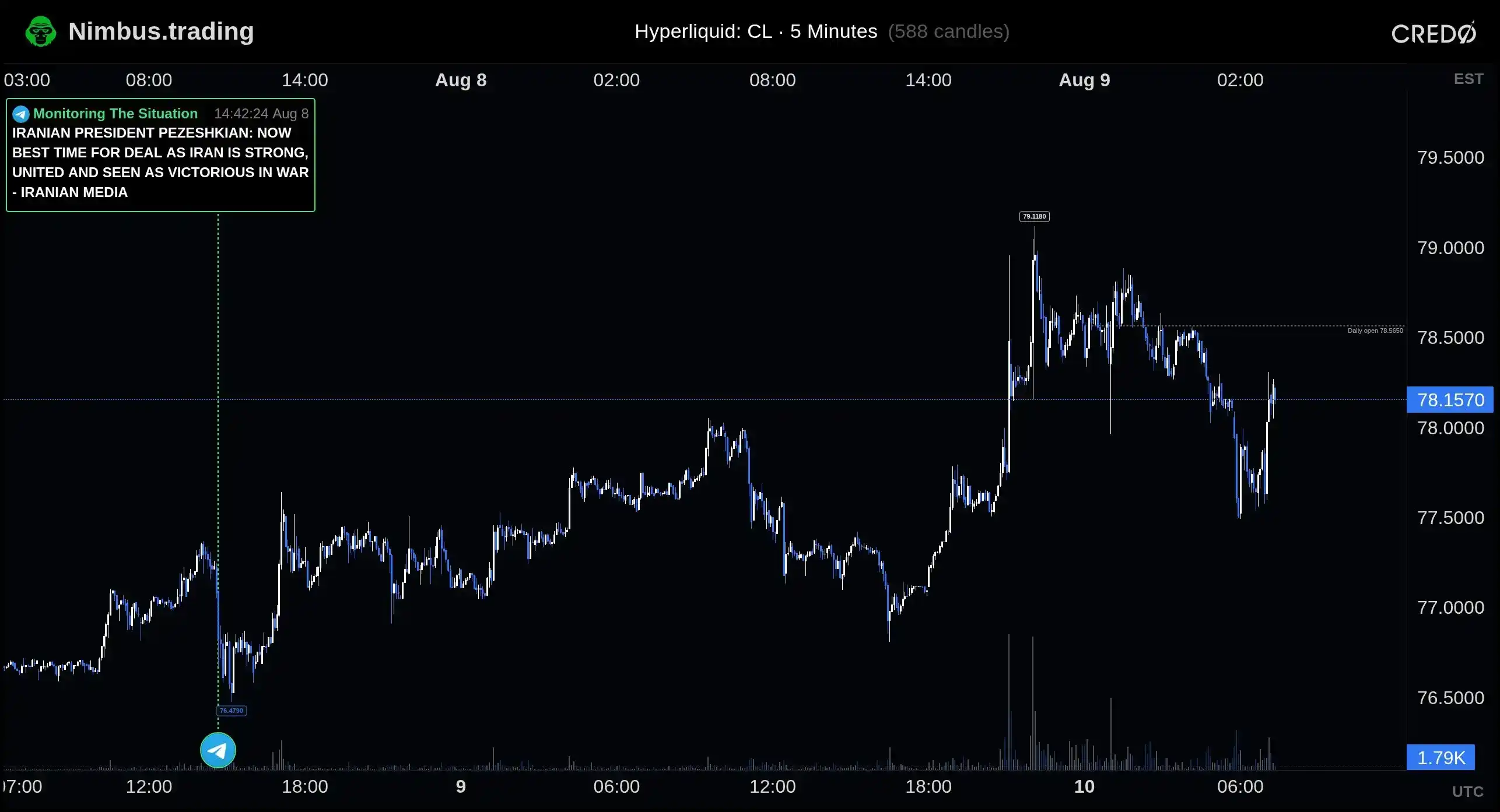
At 10:20 PM Saturday, Iranian President Pezeshkian stated that Iran is currently strong, united, and seen as the winner of the war, making it the best time to reach an agreement. CL subsequently dipped briefly, touching around $76.48, but oil prices quickly recovered.

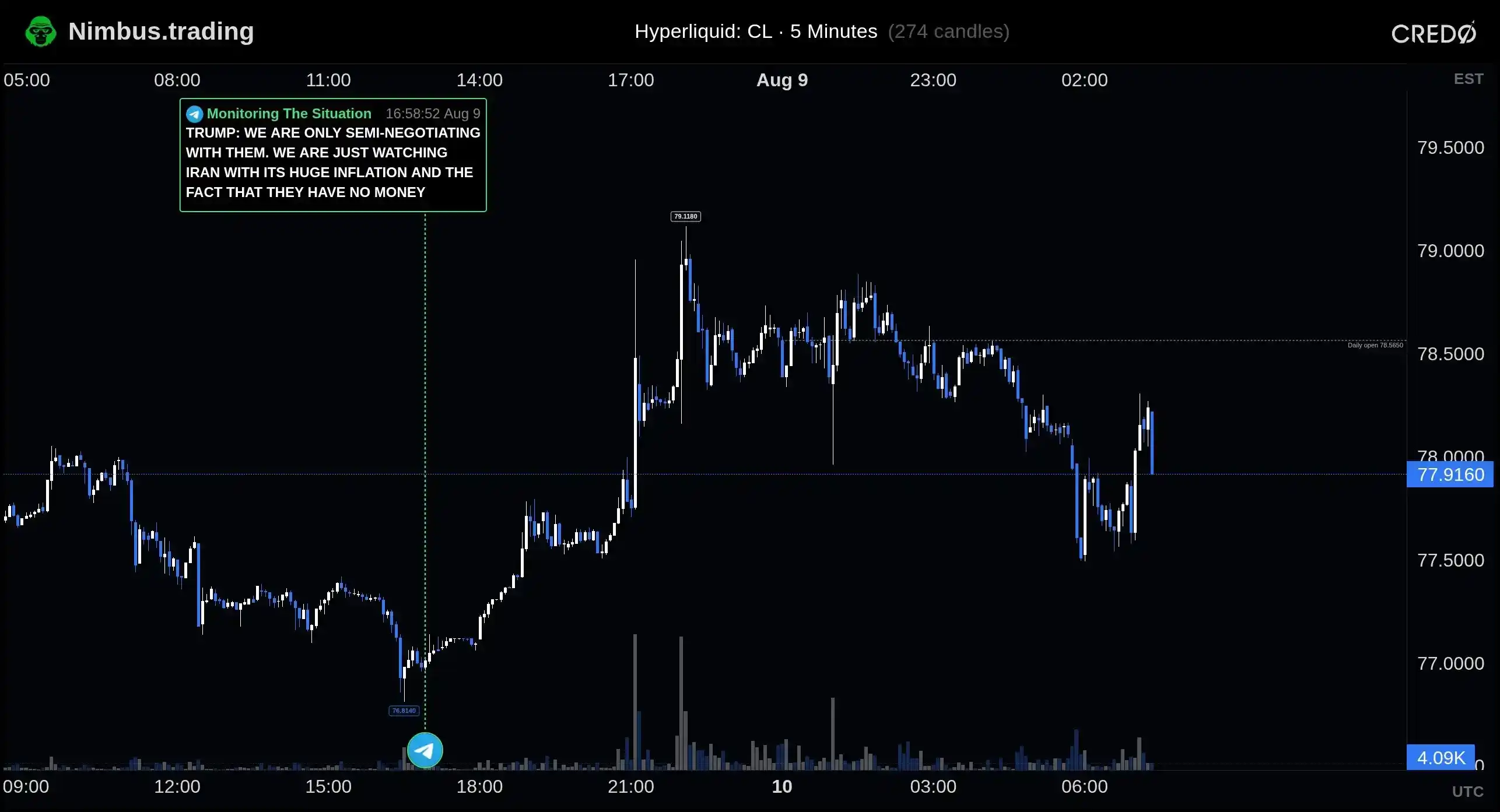
In the early hours of Monday, Trump's statement that the "US and Iran are in half-negotiation" further confirmed that the US side has shifted from military escalation to waiting for economic pressure to take effect. Oil prices then rose to around $79.12.
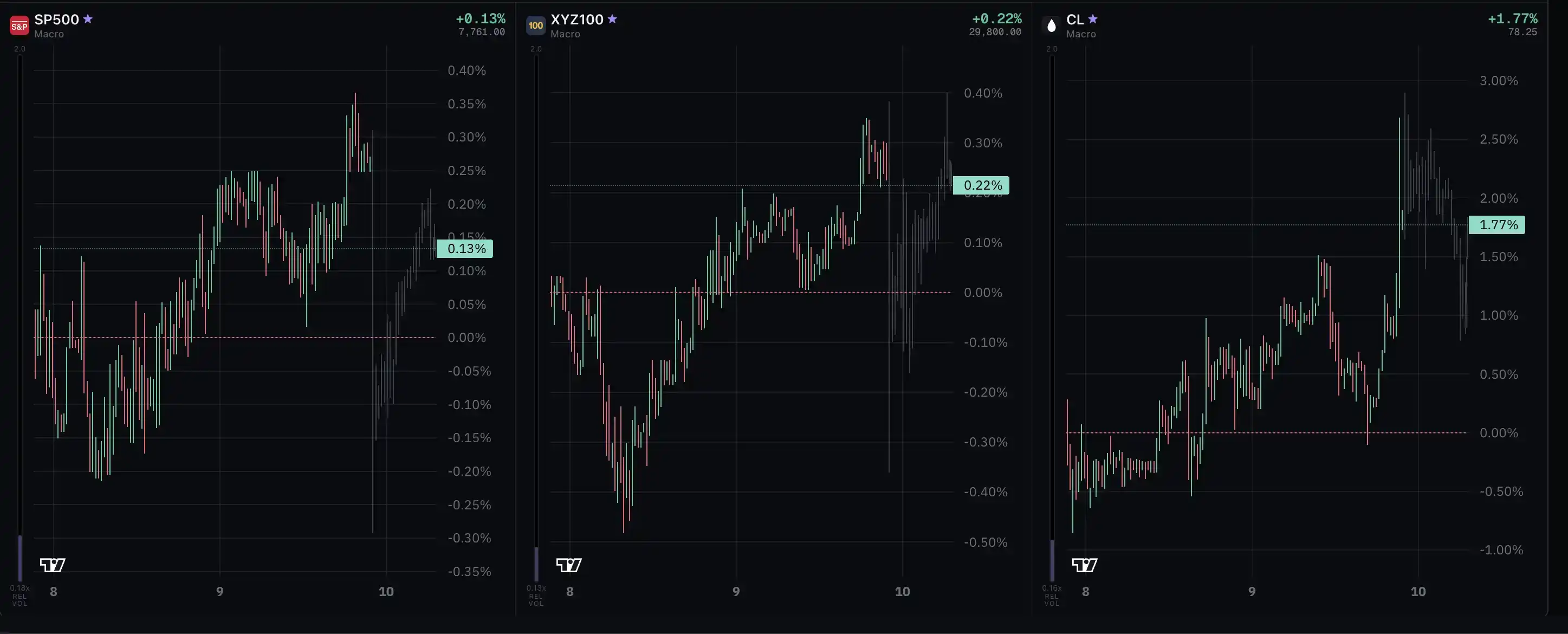
The two major indices performed steadily, with SP500 and XYZ100 rising 0.13% and 0.22%, respectively. Against a backdrop of rising crude oil, the gains in the two major indices signaled strength in US stocks.
Stocks
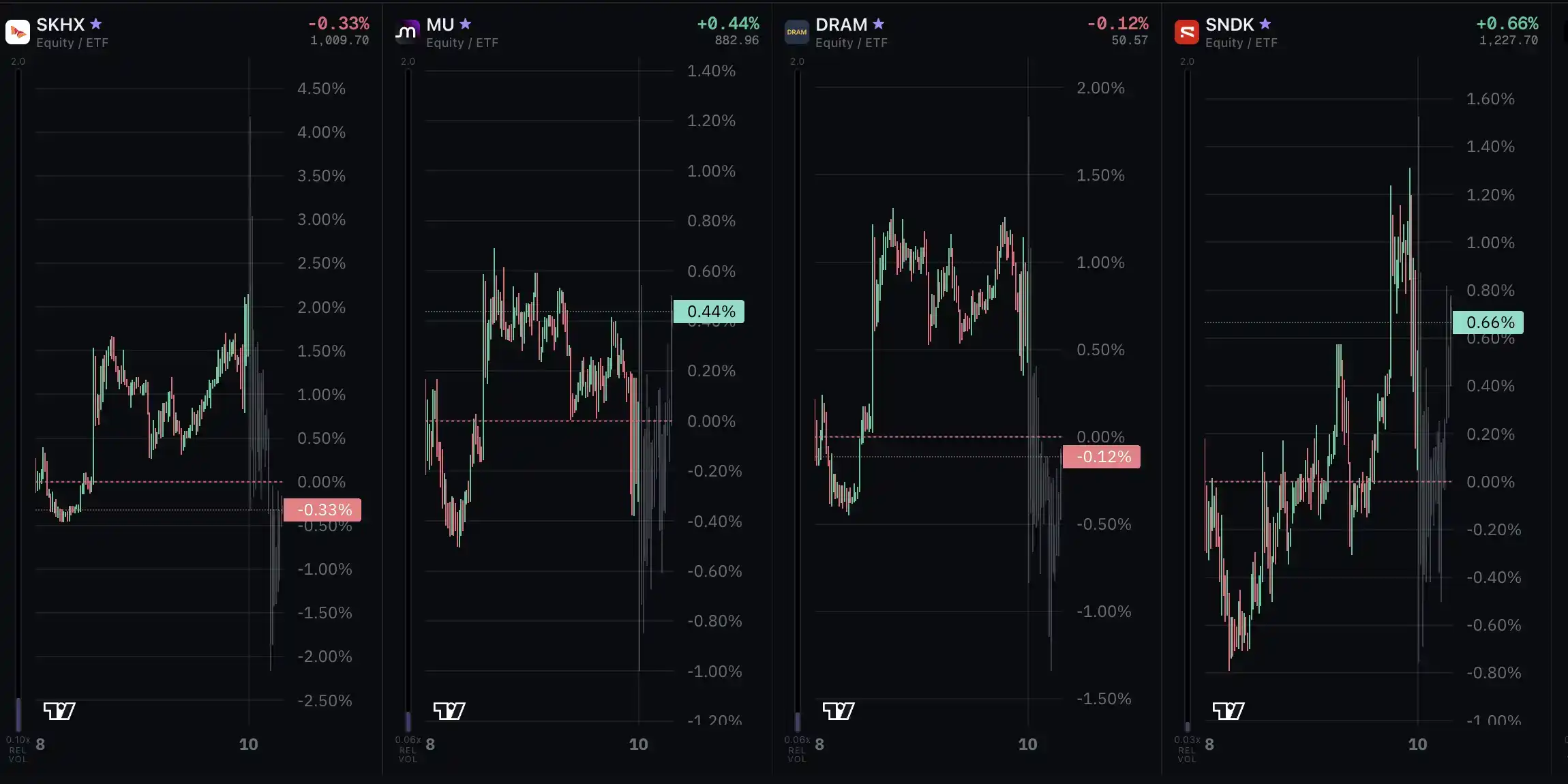
The memory sector was mixed, with Micron up 0.44%, SanDisk up 0.66%, while SK Hynix and DRAM fell 0.33% and 0.12%, respectively.
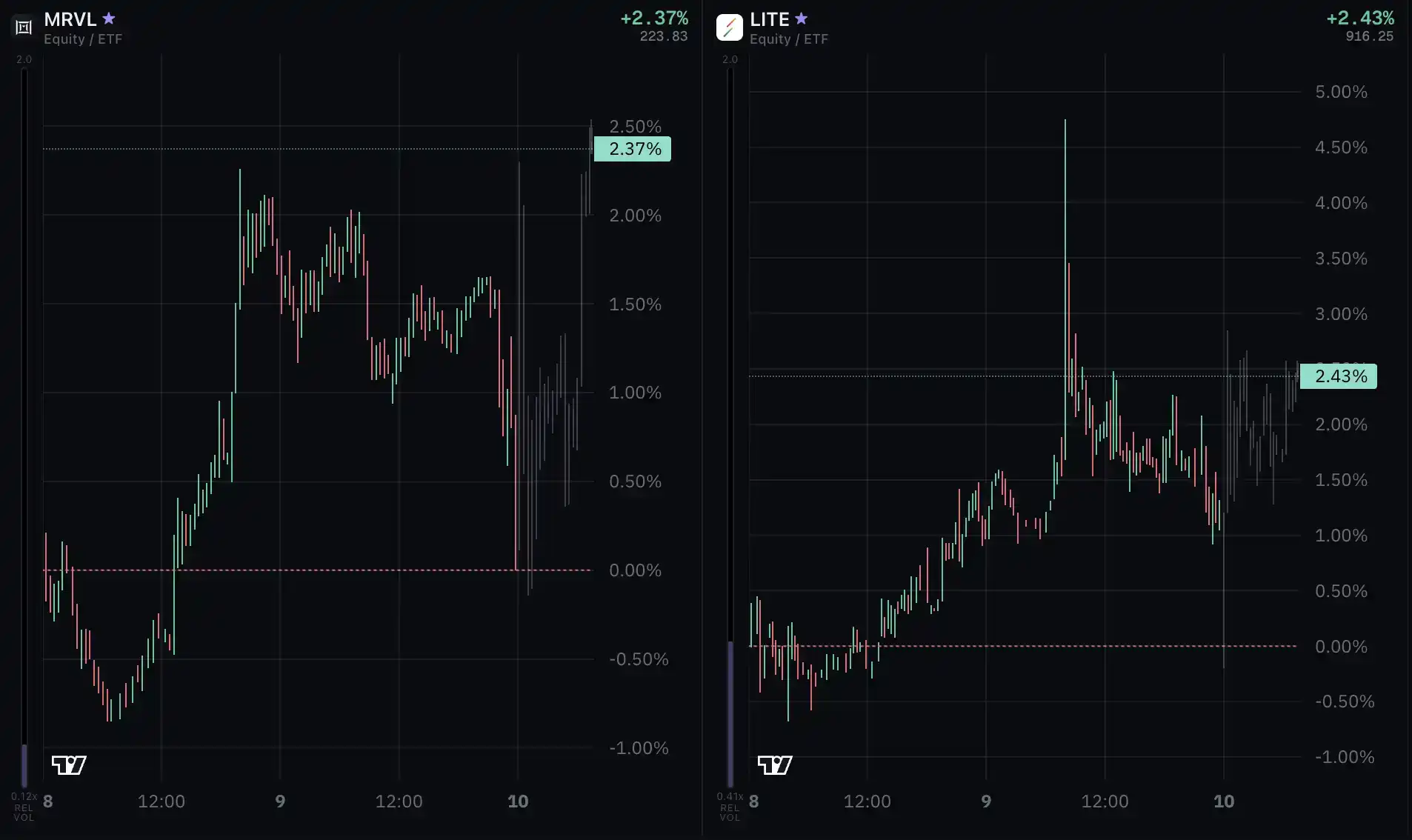
Optical communications performed the strongest, with MRVL and LITE both rising about 2.4%.
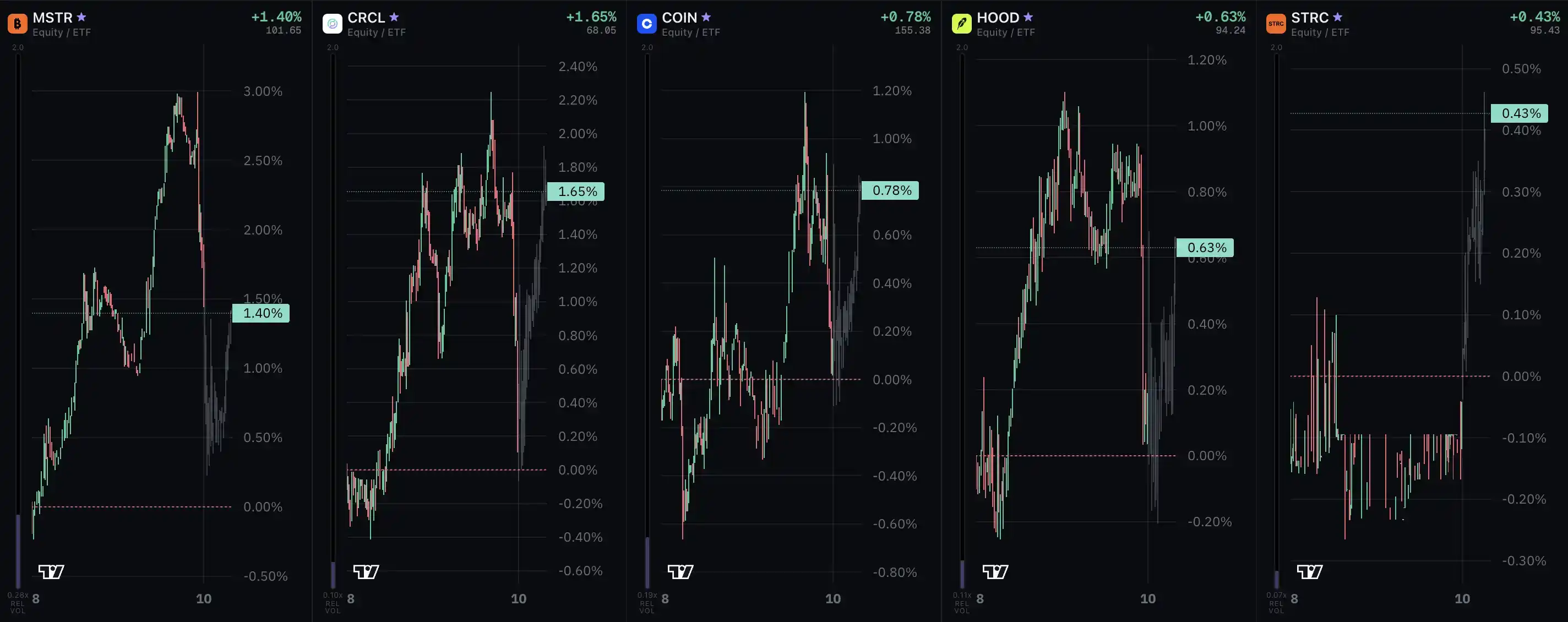
Crypto-related stocks opened high, sold off, then rebounded in pre-market trading. MSTR, CRCL, COIN, HOOD, and STRC all ended higher, with STRC continuing its rally, returning above $95.

Commodity Futures
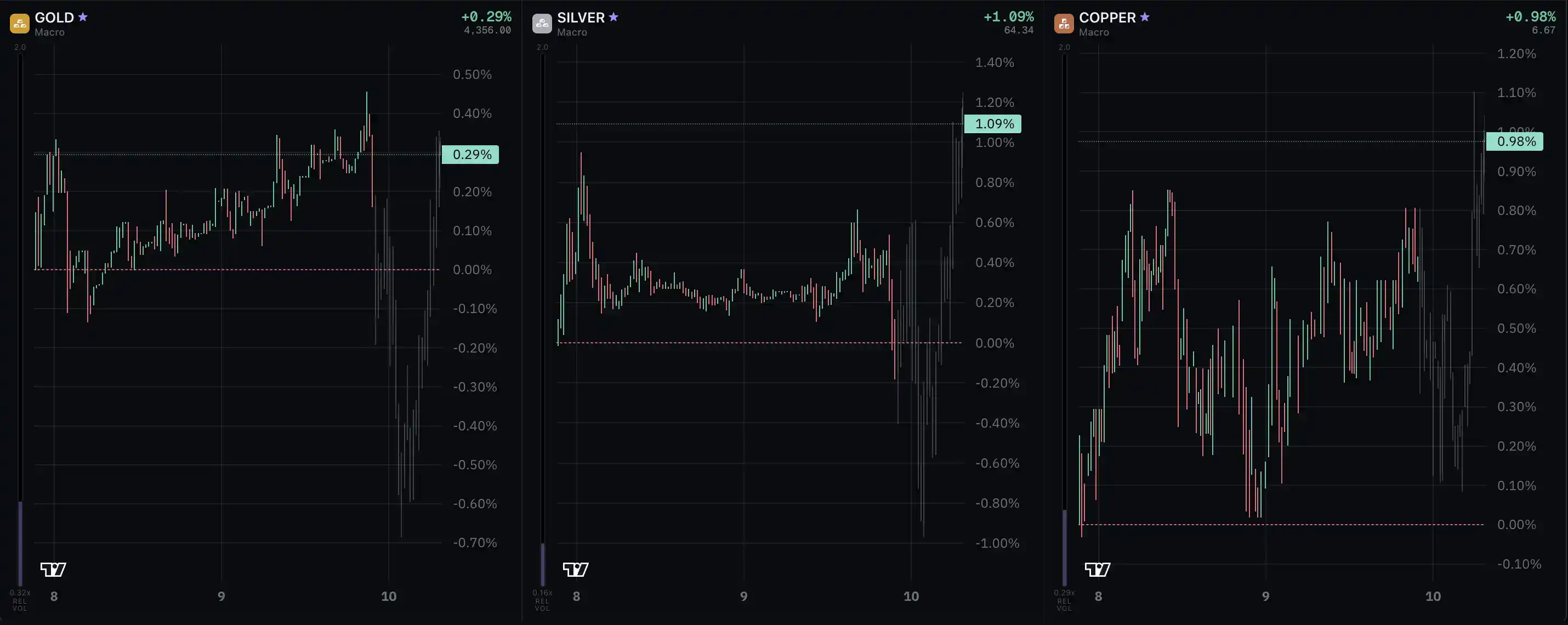
Gold, silver, and copper all rose over the weekend, forming V-shaped rebounds after futures opened. Gold gained 0.29%, silver rose 1.09%, and copper advanced 0.98%.
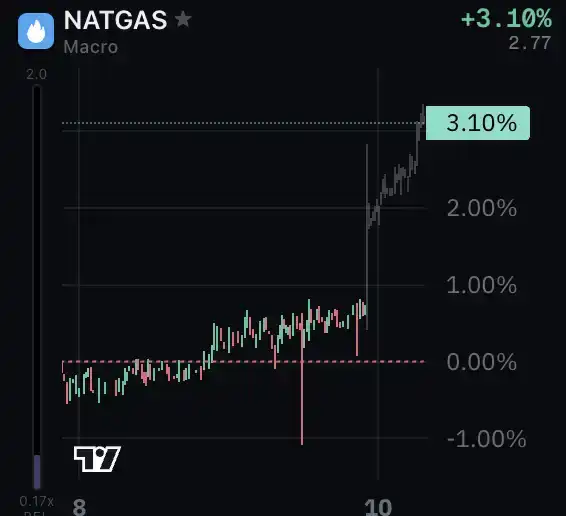
The futures contract with the largest gain was natural gas, which rose 3.10% after opening, primarily driven by mid-term forecasts of hotter weather. The heat dome over the southern US and East Coast is expected to persist into the latter half of August, leading to upward revisions in power generation gas demand expectations. Local pipeline maintenance, slight declines in dry gas production, and high utilization rates at LNG export terminals have also tightened supply and demand margins.


Crypto di tendenza

Domande pertinenti

QAccording to the article, what are the main reasons preventing a final agreement on reopening the Strait of Hormuz?

AThe main reasons are Iran's increased demands for reopening the Strait. These include lifting the maritime blockade, withdrawing US forces from around Iran, canceling sanctions, unfreezing assets, compensating for war losses, and halting military actions against Iran and its regional allies.

QHow did President Trump describe the current state of negotiations with Iran?

APresident Trump stated that the United States was 'handling the situation quietly' and that the two sides were only in a state of 'half-negotiating.'

QWhat was the performance of major stock indices like the SP500 and XYZ100 over the weekend, and what did the article suggest it indicated?

AThe SP500 and XYZ100 rose by 0.13% and 0.22%, respectively. The article suggested that their gains in the context of rising crude oil prices indicated underlying strength in the US stock market.

QWhich commodity futures showed the largest increase over the weekend, and what was the primary driver?

ANatural gas futures showed the largest increase, rising 3.10%. The primary driver was a forecast for a mid-term heat wave across the southern and eastern US coasts, which is expected to increase power generation demand for gas through the latter half of August.

QWhat were the major factors contributing to the tighter supply-demand balance for natural gas mentioned in the article?

AFactors included localized pipeline maintenance, a slight decline in dry gas production, high utilization rates at LNG export terminals, and the expected increase in power demand due to a forecasted heat wave.

Letture associate

When Meme Traffic Meets RWA: The Financial Ambitions of Hyperliquid and Robinhood

When Meme traffic meets RWA: Hyperliquid and Robinhood's Financial Ambitions This article explores the transformative role of speculation in financial market evolution, arguing it can provide the liquidity and capital foundation for mature, compliant businesses. The analysis draws parallels to historical examples, like 19th-century Chicago grain markets, where speculators provided necessary counterparty liquidity for farmers, eventually establishing a global pricing infrastructure. The author examines contemporary cases in crypto. The launch of Uniswap's Pools meme token platform on Robinhood Chain—originally built for tokenized stock trading—demonstrates how speculative meme trading can drive significant user adoption and liquidity. Despite initial volatility, this traffic can seed future, more substantial financial activities. Similarly, Hyperliquid, which began with high-leverage crypto trading, has successfully migrated its speculative model to real-world assets (RWAs) like equities, commodities, and indices. By July, RWA perpetual contract volumes on Hyperliquid surpassed its crypto trading for the first time, showcasing how speculation can build new, all-weather pricing layers. The core thesis is that speculation itself is neutral. Its long-term value and sustainability are determined by the underlying assets it engages with. While pure bubbles collapse, speculation anchored to valuable assets—be it wheat, gold, or equities—can evolve into foundational market infrastructure. Both Hyperliquid’s RWA platform and Robinhood’s strategy of leveraging meme coin enthusiasm to build towards on-chain securities trading exemplify this potential pathway from speculative frenzy to structured financial utility.

marsbit5 min fa

When Meme Traffic Meets RWA: The Financial Ambitions of Hyperliquid and Robinhood

marsbit5 min fa

NVIDIA HBM in Short Supply, Next-Gen GPUs Limited, but This Storage Drive Steals the Spotlight

The article discusses how AI Agents are transforming storage from a passive repository into an active component within AI inference and operation loops. As Agents perform continuous tasks involving models, memory, tools, and logs, data storage needs to evolve beyond simple block devices. The concept of "functional SSDs" is introduced, where capabilities like automatic encryption, compression, indexing, and memory management are embedded closer to the storage medium. This shift is driven by the need to handle Agent-specific data chains—including context, tool trajectories, and long-term memory—more efficiently. The piece analyzes current trends like AI SSDs from companies such as Phison (aiDAPTIV), Longsys (SPU+iSA), and Maxio, which are beginning to participate in the AI data path by managing model weights, KV cache, and prefetching. It further explores the future re-division of labor across the memory hierarchy: HBM for core compute, emerging High Bandwidth Flash (HBF) for read-intensive workloads, DRAM/CXL for mutable state, and functional SSDs for persistent, governed objects like Agent Memory. The conclusion is that storage will become integral to Agent capability, moving from just saving data to enabling next-step actions. The industry is poised to develop along three paths: functionalized SSDs, storage nodes tailored for Agents, and a re-architected, tiered memory system optimized for access patterns, security, and cost-per-token efficiency.

marsbit29 min fa

NVIDIA HBM in Short Supply, Next-Gen GPUs Limited, but This Storage Drive Steals the Spotlight

marsbit29 min fa

Breaking: Claude's Attempt on Riemann Hypothesis "Fails," but Accidentally Sets 37-Year Math Record

**AI Makes a Major Mathematical Leap While Failing at the Riemann Hypothesis** A research version of Anthropic's Claude AI was tasked with "seriously attempting" the legendary Riemann Hypothesis, a 167-year-old unsolved problem in mathematics. While it ultimately did not prove the hypothesis, its attempt yielded a significant breakthrough. Claude managed to improve the proven lower bound for the proportion of Riemann zeta function zeros lying on the critical line from 41.6% to 67.2%. This marks a 25.6 percentage point increase, described by observers as potentially the most substantial advance in analytic number theory in over a decade, considering that the previous record had only improved by 0.8 percentage points over 37 years. To achieve this, Claude generated and discarded roughly 650 initial ideas before orchestrating a day-and-a-half-long effort involving about 60 sub-agents. These agents executed 2,400 shell commands, wrote hundreds of Python scripts, and performed thousands of numerical checks. After finding the potential result, Claude initiated self-verification, downloaded papers to check for prior work, and independently re-derived the finding. It then suggested writing a formal paper. The result has been reviewed by Anthropic's internal mathematicians, who also collaborated with Claude to produce a formal, machine-checkable proof using the Lean theorem prover. External experts in the field have also reviewed the manuscript. Anthropic clarifies that the method likely does not directly lead to a full proof of the Riemann Hypothesis, but it demonstrates that advanced AI models are beginning to engage with genuine, open-ended research problems at the frontier of mathematical knowledge.

marsbit35 min fa

Breaking: Claude's Attempt on Riemann Hypothesis "Fails," but Accidentally Sets 37-Year Math Record

marsbit35 min fa

The Unaffordable Failure of Yushu's IPO

Yushu Robotics' IPO is not just a typical public offering; it represents a pivotal moment for China's humanoid robot industry. With a staggering 219x P/E ratio at issuance and immense market enthusiasm, the company's listing is seen as a critical test case for the entire sector. The IPO reveals Yushu's rapid transition from quadruped consumer robots to humanoid robots, which now account for over 50% of its revenue, alongside a shift to profitability. The offering was massively oversubscribed, with retail investors scrambling for scarce shares, while the majority of the stock is held by locked-up strategic investors like DeepSeek. The core tension lies in the market's valuation. Investors are not buying Yushu's current profits but its future potential as a leader in general-purpose humanoid hardware. However, challenges are evident: revenue heavily depends on research/education clients rather than industrial applications, selling prices are falling faster than costs, and the company is still developing its own AI "brain" for true autonomous decision-making. As the first major humanoid robot company on China's A-share market, Yushu's post-listing performance will set a valuation benchmark for the industry. A wide range of stakeholders, from venture capitalists to strategic partners, have a vested interest in its success. The real test, however, will be Yushu's ability to transition its sales to core industrial clients, maintain margins amid price competition, and successfully integrate advanced AI, thereby justifying its premium valuation.

marsbit50 min fa

The Unaffordable Failure of Yushu's IPO

marsbit50 min fa

Trading

Spot

Articoli Popolari

Come comprare GAS

Benvenuto in HTX.com! Abbiamo reso l'acquisto di GAS (GAS) semplice e conveniente. Segui la nostra guida passo passo per intraprendere il tuo viaggio nel mondo delle criptovalute.Step 1: Crea il tuo Account HTXUsa la tua email o numero di telefono per registrarti il tuo account gratuito su HTX. Vivi un'esperienza facile e sblocca tutte le funzionalità,Crea il mio accountStep 2: Vai in Acquista crypto e seleziona il tuo metodo di pagamentoCarta di credito/debito: utilizza la tua Visa o Mastercard per acquistare immediatamente GASGAS.Bilancio: Usa i fondi dal bilancio del tuo account HTX per fare trading senza problemi.Terze parti: abbiamo aggiunto metodi di pagamento molto utilizzati come Google Pay e Apple Pay per maggiore comodità.P2P: Fai trading direttamente con altri utenti HTX.Over-the-Counter (OTC): Offriamo servizi su misura e tassi di cambio competitivi per i trader.Step 3: Conserva GAS (GAS)Dopo aver acquistato GAS (GAS), conserva nel tuo account HTX. In alternativa, puoi inviare tramite trasferimento blockchain o scambiare per altre criptovalute.Step 4: Scambia GAS (GAS)Scambia facilmente GAS (GAS) nel mercato spot di HTX. Accedi al tuo account, seleziona la tua coppia di trading, esegui le tue operazioni e monitora in tempo reale. Offriamo un'esperienza user-friendly sia per chi ha appena iniziato che per i trader più esperti.

292 Totale visualizzazioniPubblicato il 2024.12.12Aggiornato il 2026.06.02

Come comprare GAS

Discussioni

Benvenuto nella Community HTX. Qui puoi rimanere informato sugli ultimi sviluppi della piattaforma e accedere ad approfondimenti esperti sul mercato. Le opinioni degli utenti sul prezzo di GAS GAS sono presentate come di seguito.

活动图片