Indiana Advances Bitcoin Rights Law as U.S. States Deepen Crypto Integration

bitcoinistPubblicato 2026-02-26Pubblicato ultima volta 2026-02-26

Introduzione

Indiana lawmakers have passed House Bill 1042, known as the Bitcoin Rights Bill, which now awaits the governor's signature. If enacted, the law would allow state-managed investment funds—including retirement plans for public employees and education savings programs—to offer cryptocurrency ETFs as voluntary investment options. It also establishes legal protections for individuals using or holding digital assets, including the right to accept crypto payments and use self-custodied wallets, while prohibiting public agencies from restricting lawful crypto activities. The bill aligns with a broader trend of U.S. states integrating digital assets into public financial systems and is set to take effect in July 2026.

Indiana is moving closer to formally embedding crypto into its public financial system after lawmakers approved House Bill 1042, commonly referred to as the Bitcoin Rights Bill. The legislation has cleared both legislative chambers and now awaits the signature of Governor Mike Braun.

Related Reading: Binance Faces US Senate Inquiry Tied To $1.7 Billion In Sanctions-Related Transactions

If enacted, the law would allow certain public investment programs to provide exposure to crypto through regulated ETFs and establish legal protections for individuals who use or hold digital assets. The measure reflects a broader shift among U.S. states as they explore how crypto fits within traditional finance.
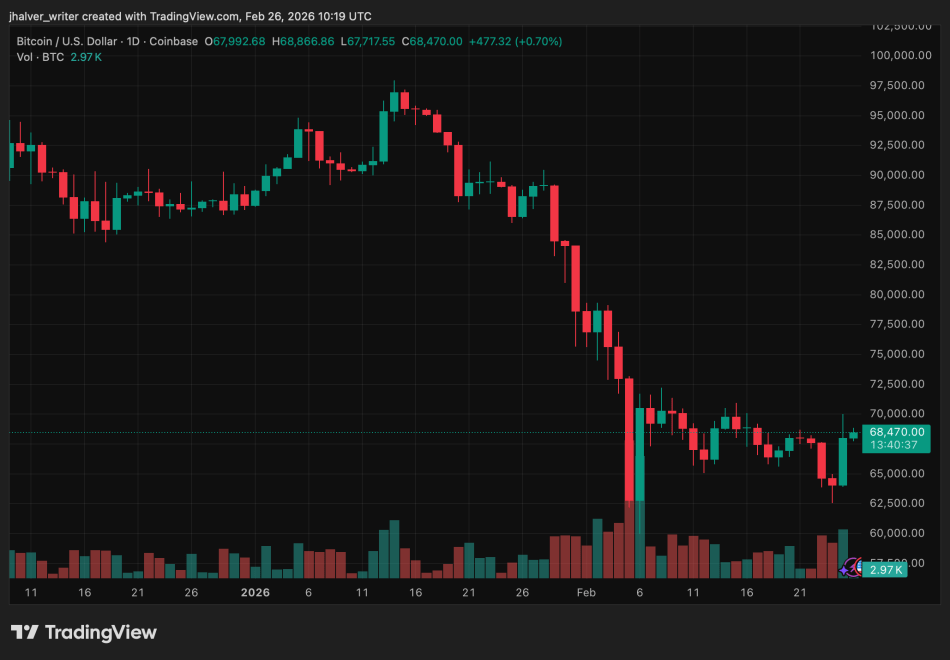
BTC's price trends to the downside with some sideways action on low timeframes as seen on the daily chart. Source: BTCUSD on Tradingview

Public Funds and Retirement Plans Open to Crypto ETFs

HB 1042 permits state-managed investment funds to include cryptocurrency ETFs as investment options rather than allowing direct token purchases. The approach aims to provide exposure through regulated financial products while maintaining oversight mechanisms.

Under the bill, several state-administered programs must offer self-directed brokerage accounts containing at least one digital asset investment option. These include retirement plans for teachers, public employees, and legislators, as well as the Hoosier START 529 education savings program.

Participation would remain voluntary, meaning individuals could choose whether to allocate funds toward crypto-related investments. Before rollout, the state must establish approved investment structures designed to manage compliance and risk oversight.

The legislation also allows eligible investment funds from outside Indiana to allocate assets into crypto ETFs under the state’s framework, potentially expanding institutional participation beyond state borders.

Legal Protections for Digital Asset Users

Beyond access to investment, the bill introduces protections for cryptocurrency users. Public agencies, with limited exceptions, would be restricted from banning or limiting lawful digital asset activities.

Residents would retain the right to accept crypto payments for legal goods and services and to store assets in self-custodied or hardware wallets. The proposal also prevents the state from imposing special taxes on crypto transactions and requires taxation rules to align with those applied to other financial activities.

Supporters argue that these provisions provide legal clarity for individuals and businesses operating in the digital asset space, while critics continue to highlight concerns about market volatility and retirement risk exposure.

Part of a Broader U.S. Policy Shift

Indiana’s move comes amid growing institutional interest in cryptos, following the expansion of crypto ETFs and evolving federal policy discussions on retirement portfolio diversification. Other states are considering similar measures, signaling a gradual shift toward incorporating digital assets into public finance structures.

HB 1042, introduced by State Representative Kyle Pierce, completed the legislative process after the House approved Senate amendments. If Governor Braun signs the bill, the law is scheduled to take effect on July 1, 2026, triggering implementation by state agencies and retirement administrators.

Related Reading: Netherlands To Amend Controversial 36% Tax On Unrealized Crypto, Stock Gains

As more states evaluate crypto-focused legislation, Indiana’s decision could serve as another trigger to the continued adoption of crypto in other states’ financial systems.

Cover image from ChatGPT, BTCUSD chart on Tradingview

Domande pertinenti

QWhat is the main purpose of Indiana's House Bill 1042, also known as the Bitcoin Rights Bill?

AThe main purpose is to allow certain public investment programs to provide exposure to cryptocurrency through regulated ETFs and to establish legal protections for individuals who use or hold digital assets.

QWhich specific state-administered programs must offer a digital asset investment option under this bill?

AThe programs include retirement plans for teachers, public employees, and legislators, as well as the Hoosier START 529 education savings program.

QWhat are some of the key legal protections for cryptocurrency users provided by this legislation?

AThe bill prevents public agencies from banning lawful digital asset activities, allows residents to accept crypto payments and use self-custodied wallets, and prohibits special taxes on crypto transactions, requiring taxation to align with other financial activities.

QHow does the bill propose to provide crypto exposure to public funds without allowing direct token purchases?

AIt permits state-managed investment funds to include cryptocurrency ETFs as investment options, providing exposure through these regulated financial products.

QWhen is the Indiana Bitcoin Rights Bill scheduled to take effect if signed by the governor?

AThe law is scheduled to take effect on July 1, 2026, if signed by Governor Mike Braun.

Letture associate

Within Strategy's Framework, STRC's Dividend Yield Remains at 12% as Share Price Stays Below Par Value

Michael Saylor, Executive Chairman of Strategy (MSTR), confirmed that the dividend rate for its STRC perpetual preferred shares will remain at 12.00% through August 2026. The rate has increased from 9% at its July 2025 launch to the current high via a "ratchet" mechanism, which permanently raises the rate by 0.5% whenever the share price falls below $95. This mechanism is intended to push the price back toward its $100 par value and support Strategy's "at-the-market" (ATM) program for issuing new shares to fund Bitcoin purchases. However, the mechanism has not worked as intended. STRC shares closed at $89.46 on July 31, remaining about 10-11% below par value despite the record-high dividend. Competition from rival Strive's higher-yielding SATA securities has pressured demand. The persistent discount has forced Strategy to suspend new STRC issuances via its ATM program, limiting this funding channel for Bitcoin acquisitions. STRC's struggles reflect Bitcoin's own volatility, as the preferred shares historically move in tandem. Analysts have warned the ratchet structure carries long-term, one-way risk. A law firm is investigating Strategy's ability to maintain dividend payments if Bitcoin's price stays low. Retail investors own roughly 83% of outstanding STRC shares, a group seen as prone to panic selling during downturns. In response, Strategy has established financial reserves, including a liquidity cushion covering about 26 months of dividend/interest obligations, and a $2 billion share buyback program alongside a Bitcoin monetization framework, though the company emphasized it is not obligated to sell any Bitcoin.

cryptonews.ru18 min fa

Within Strategy's Framework, STRC's Dividend Yield Remains at 12% as Share Price Stays Below Par Value

cryptonews.ru18 min fa

Analyst: Bitcoin's Price Will Drop to $60k in August, Then Rebound to $70k

Financial analyst Andrey Poroshin has provided a new forecast for Bitcoin's price dynamics in August. Poroshin, an analyst at the Bitbanker exchange, expects the cryptocurrency market to experience a downturn this month, with prices retesting the $60,000 level due to a lack of supportive macroeconomic catalysts. He noted that the recent US Federal Reserve decision to hold interest rates did not significantly impact the market, while inflation remains above the 2% target. Poroshin stated that Bitcoin is ending July under pressure from moderate volatility and a lack of new macroeconomic stimuli, leading to continued market caution. According to his base scenario, Bitcoin will drop to a range of $60,000 to $62,000 before recovering to $70,000. He pointed out that even $70,000 remains below the cost of mining in the US, which has prompted some miners to shift towards AI data center operations. Poroshin cited the winding down of BitMEX's operations as a potential catalyst for a price rebound, suggesting the exit of weaker players often coincides with market reversals and reduced short-term selling pressure. He believes Bitcoin is currently less susceptible to geopolitical shocks, such as the Iran-US conflict, and does not expect significant market changes in August related to the pending CLARITY Act. Looking ahead, Poroshin forecasts that September will bring more active price fluctuations driven by potential Fed rate decisions and possible discussions or approval of the CLARITY Act.

cryptonews.ru18 min fa

Analyst: Bitcoin's Price Will Drop to $60k in August, Then Rebound to $70k

cryptonews.ru18 min fa

Trading

Spot
活动图片





