In the Last 2 Minutes Before SK Hynix Market Open, TradeXYZ Achieved Price Accuracy Within 0.13%

marsbitPubblicato 2026-06-08Pubblicato ultima volta 2026-06-08

Introduzione

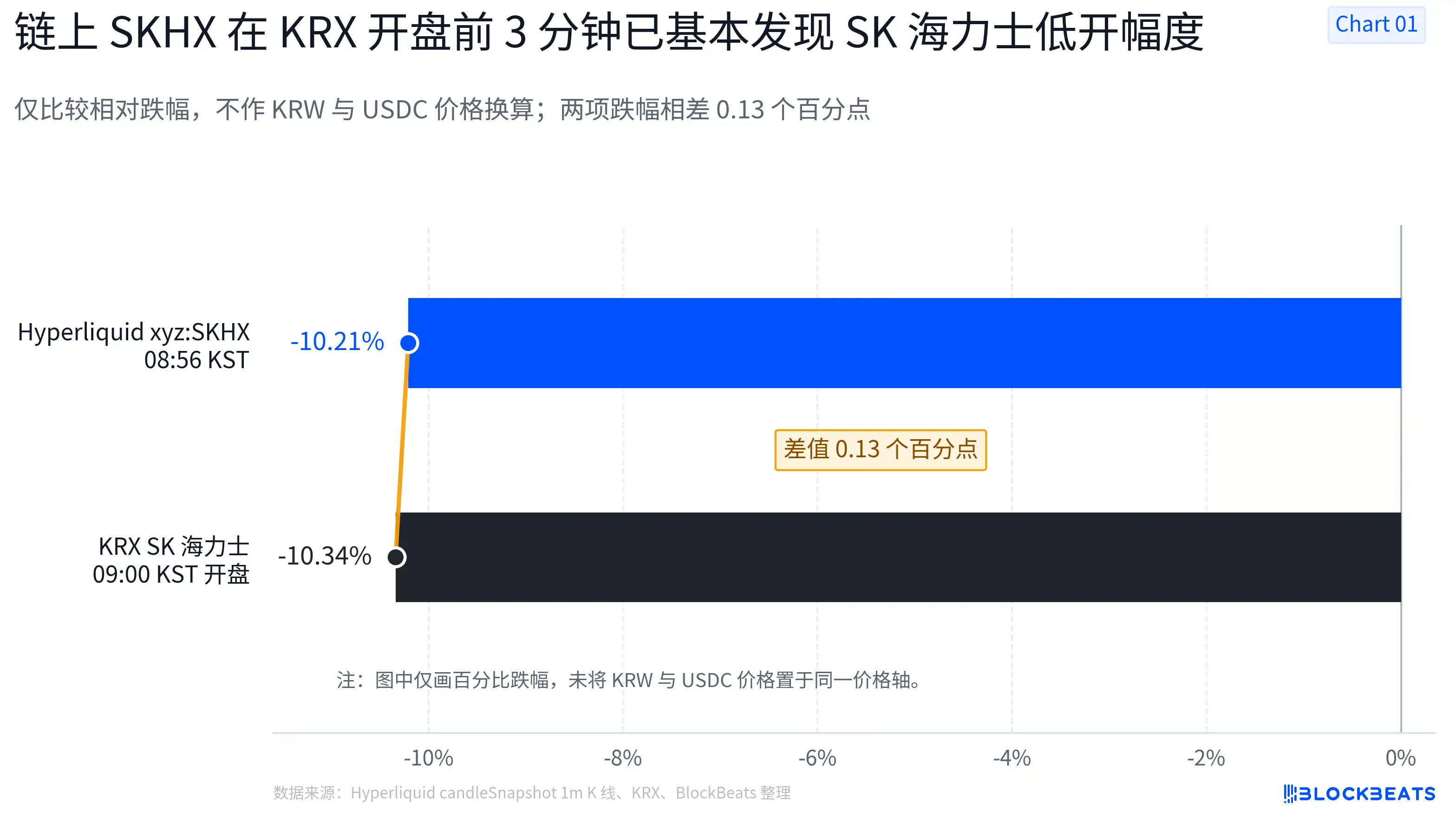
Traditionally, asset price discovery halts when markets close. However, decentralized exchanges like Hyperliquid, enabling 24/7 trading of Real-World Asset (RWA) perpetuals, are changing this. A case study involving SK Hynix stock on Hyperliquid's xyz:SKHX market demonstrates this shift during a weekend when the Korean Exchange (KRX) was closed. While the KRX closed at 2,070,000 KRW on June 5th, active trading continued on-chain. By 08:56 KST on Monday, June 8th, just before the KRX open, the chain price had fallen to 1200.0 USDC, implying a -10.21% drop. Three minutes later, the KRX opened at 1,856,000 KRW, an actual drop of -10.34%. The on-chain price had predicted the opening decline with remarkable accuracy, missing by only 0.13 percentage points. In the final two minutes before the open (08:58-08:59 KST), the on-chain market saw a significant volume spike and a +2.31% price rebound. This wasn't a prediction error but likely the market front-running the expected post-open bounce. Indeed, after opening at its low, the KRX price rebounded approximately +2.64% by 09:03 KST. This event illustrates how 24/7 on-chain markets can act as a leading price discovery venue, not only anticipating opening prices but also trading the immediate post-open dynamics before traditional markets even begin.

In the past, the closure of traditional financial markets typically meant a suspension of price discovery. Assets such as stocks, commodities, and ETFs would enter a silent state after Friday's close, and investors had to wait until the next trading day's opening to see the real impact of events reflected in prices.

However, the on-chain derivatives market, spearheaded by Hyperliquid, is changing this structure.

With Hyperliquid HIP-3 allowing external builders to deploy RWA perpetual contracts for stocks, commodities, indices, and more, certain traditional assets, represented by the XYZ market, can now achieve 24/7 continuous trading on-chain. When traditional markets are closed, the on-chain market does not halt matching; instead, it can become a front-running venue for risk expression and price discovery.

The recent weekend price action of the Korean chipmaker SK Hynix (SK Hynix) on-chain provides a clear observation sample. Hyperliquid xyz:SKHX was not just experiencing sporadic trades during the KRX closure. According to 1m K-line data from candleSnapshot, substantial volume exchanges between longs and shorts occurred over the weekend.

By June 8th, Monday, just before the official KRX market open, the on-chain market had already charted a complete weekend price path.

Accuracy Within 0.13%: SK Hynix's Weekend Price Discovery

On June 5th, SK Hynix's stock on KRX closed at 2,070,000 KRW. Subsequently, the Korean stock market entered its weekend closure.

According to 1-minute K-line data from Hyperliquid, its base price on-chain remained at 1336.5 USDC after Friday's close. On Monday morning, just before the KRX open, significant price fluctuations occurred on-chain:

· Monday 08:56 KST (Korean Standard Time): xyz:SKHX dropped to a low of 1200.0 USDC, corresponding to a decline of -10.21%.

Three minutes later, the traditional world's KRX officially opened, with the real-world data as follows:

· Monday KRX Official Opening: 1,856,000 KRW, corresponding to a decline of -10.34%.

The difference between the two was only 0.13 percentage points.

This means that just 3 minutes before the KRX official open, the funds in the on-chain market had almost completely discovered the extent of SK Hynix's lower open on Monday. It didn't vaguely express the direction of "will fall," but precisely priced the decline around 10%, aligning closely with the actual opening result.
A Critical Reversal: Not a Failed Prediction, But Front-Running the Post-Open Trend

The market then entered a second phase of change, concentrated in the final 120 seconds before the open.

During the period from 08:58 to 08:59 KST, xyz:SKHX experienced unusual volume surges:

· 08:58: Minute trading volume rose to 708.132, placing it at the 99.85th percentile of the entire weekend's minute-by-minute volume;

· 08:59: Volume remained high at 665.584 (99.82nd percentile), and the price rebounded from 1201.1 USDC to 1228.8 USDC, a +2.31% bounce within two minutes.

If looking only at the final price at 08:59, the on-chain price was about 2 percentage points higher than the subsequent actual KRX opening price. However, this does not indicate a failure of on-chain price discovery. A more reasonable explanation is that the on-chain market had already front-run the low-price buying that would occur immediately after the stock's opening.

Looking at the actual post-open movement on KRX:

· KRX opened and probed a low of 1,855,000 KRW;

· 09:03 KST: The stock price had already recovered to 1,904,000 KRW, rebounding approximately +2.64%.


Domande pertinenti

QWhat is the main structural change that Hyperliquid and its HIP-3 proposal are enabling in the financial markets, as described in the article?

AThey are enabling a shift from traditional markets that pause price discovery during off-hours to a 24/7 continuous trading environment for traditional assets like stocks, commodities, and indices through on-chain perpetual contracts. This allows the on-chain market to become a venue for risk expression and price discovery while traditional exchanges are closed.

QBased on the SK Hynix example, how accurate was the price discovery on the Hyperliquid xyz:SKHX market just before the KRX opened?

AThe price discovery was extremely accurate. At 08:56 KST, the on-chain price implied a -10.21% drop. Three minutes later, the actual KRX opening price showed a -10.34% drop. The difference between the on-chain predicted drop and the real opening drop was only 0.13 percentage points.

QWhat happened in the last two minutes before the KRX opening, and how does the article interpret this activity?

AIn the final two minutes (08:58-08:59 KST), the xyz:SKHX market saw unusually high volume and a price rebound of +2.31%. The article interprets this not as a prediction failure, but as the on-chain market already beginning to trade the expected post-open bounce and low-price buying activity that would occur on the traditional exchange.

QWhat evidence does the article provide to show that the on-chain market for SK Hynix was active and not just seeing sporadic trades over the weekend?

AThe article cites candleSnapshot 1m K-line data, stating that "多空双方在周末完成了较大规模的筹码交换," which translates to long and short positions completing a relatively large-scale exchange of chips (trading volume) over the weekend. This indicates substantive trading activity, not just零星交易 (sporadic trades).

QAccording to the article, what was the subsequent price action on the KRX for SK Hynix after its opening, and how did it relate to the final on-chain price movement?

AAfter opening at the low of 1,855,000 KRW, the KRX price of SK Hynix rebounded to 1,904,000 KRW by 09:03 KST, a bounce of approximately +2.64%. This real-world bounce closely matched the +2.31% rebound that had already occurred on the chain in the two minutes before the KRX opened, supporting the interpretation that the on-chain market was front-running the traditional market's immediate post-open movement.

Letture associate

From South Korea to the United States: Blue-Collar Jobs Are Becoming Increasingly Popular, Thanks to AI

AI is reshaping the labor market's value proposition. The traditional four-year college degree is losing its appeal as a guaranteed career path, while skilled blue-collar trades like electricians, welders, and plumbers are experiencing historic demand and wage premiums. This shift is driven by dual pressures: AI's displacement of certain white-collar roles and a booming need for physical infrastructure and data center construction. Data confirms the trend. In the U.S., vocational school revenue surged, and a significant portion of recent layoffs are AI-related. Surveys show a majority of Gen Z adults plan to pursue blue-collar work, citing better job security against AI automation. Vocational education interest has exploded recently. Experts cite a psychological shift as younger generations seek tangible, AI-resistant careers and avoid high student debt. In many cases, salaries for skilled trades now match or exceed those requiring a bachelor's degree. In South Korea, semiconductor vocational high schools boast near-total employment, with graduates securing high-paying roles at companies like Samsung. The shortage is structural, exacerbated by a retiring baby boomer workforce and massive infrastructure projects. Companies like JPMorgan Chase, Meta, and Lowe's are investing heavily in training programs. However, overcoming historical stigma and a "perception gap" around trade careers remains a key challenge to closing the talent gap.

marsbit42 min fa

From South Korea to the United States: Blue-Collar Jobs Are Becoming Increasingly Popular, Thanks to AI

marsbit42 min fa

Qualcomm: AI Hype Subsides, When Will Smartphones Emerge from the Gloom?

Qualcomm reported its Q3 FY2026 results (ending June 2026), with revenue of $9.95B, down 4% YoY but above expectations. Gross margin declined to 53.1%, pressured by rising costs across manufacturing and memory. Key business segments showed mixed performance: Handset revenue fell 19.6% YoY to $5.09B, dragged by an 11% decline in non-Apple Android shipments and weaker high-end mix. Conversely, Automotive revenue surged 61% to $1.59B, and IoT grew 9% to $1.83B. Core operating profit dropped 41% YoY due to margin compression and higher expenses. Management's Q4 FY2026 guidance projects revenue of $9.7B-$10.5B, in line with consensus, but Non-GAAP EPS guidance of $2.05-$2.25 fell short of expectations. Amidst persistent weakness in its core handset market, Qualcomm is pursuing growth in AI, focusing on Edge AI (smartphones, PCs, automotive) and Data Center AI. Its data center strategy includes four pillars: AI accelerators (e.g., AI200), commercial CPUs (Dragonfly C1000), custom silicon, and connectivity solutions. While these initiatives initially boosted its stock, concerns over AI capital expenditure sustainability have since erased those gains. The company targets $5B in data center revenue for FY2027 and $15B for FY2029. The report concludes that with the traditional handset business still under pressure, the data center opportunity is currently viewed as a longer-term option, and a more conservative valuation based on core operations may be warranted until AI contributions materialize.

marsbit46 min fa

Qualcomm: AI Hype Subsides, When Will Smartphones Emerge from the Gloom?

marsbit46 min fa

From TPU to Self-Evolving Agents: How Jeff Dean Predicts the Next Step in AI

At the 2026 YC Startup School, Jeff Dean outlined his vision for AI's next phase, shifting focus from simply scaling models to building intelligent, autonomous systems. He believes AI's progress is no longer just about creating smarter models, but about integrating them into systems capable of long-term, iterative work, automated experimentation, and continuous learning. This evolution moves the competition from "who has the bigger model" to "who can best organize intelligence." Dean suggests AI capabilities are now comparable to a junior engineer, enabling the automation of complex workflows. However, the true challenge and opportunity lie in managing these AI "workers" at scale. He emphasizes the importance of **context engineering**—structuring tools, memory, and feedback loops—over raw model power. For startups, this means building deep expertise in niche domains where general models currently fail (near 0-1% success rates), leveraging proprietary data, specialized tools, and domain-specific evaluators. A recurring theme is re-examining fundamental constraints. Dean's past work, like moving Google's search index to memory or creating the TPU, stemmed from questioning outdated assumptions about hardware and cost. He sees similar inflection points today, particularly in **specialized inference hardware** to drastically reduce latency and energy consumption for real-time Agent operation. Notably, he points out that in modern AI systems, the dominant cost is often not computation but **data movement**. Reliable, long-running Agents require robust system design, borrowing concepts from distributed computing like checkpointing, state management, and parallel exploration to handle failures and maintain progress over days or weeks. As AI automates execution, the scarcest human skills will shift to **defining clear specifications**, **judging what problems are worth solving** (taste), and designing effective feedback loops. Ultimately, Dean's framework prioritizes understanding the problem deeply, identifying the true bottlenecks, and systematically building closed-loop systems where AI can not only perform tasks but also improve AI itself.

marsbit46 min fa

From TPU to Self-Evolving Agents: How Jeff Dean Predicts the Next Step in AI

marsbit46 min fa

Trading

Spot
活动图片




