In the Last 2 Minutes Before SK Hynix Market Open, TradeXYZ Achieved Price Accuracy Within 0.13%

marsbitPubblicato 2026-06-08Pubblicato ultima volta 2026-06-08

Introduzione

Traditionally, asset price discovery halts when markets close. However, decentralized exchanges like Hyperliquid, enabling 24/7 trading of Real-World Asset (RWA) perpetuals, are changing this. A case study involving SK Hynix stock on Hyperliquid's xyz:SKHX market demonstrates this shift during a weekend when the Korean Exchange (KRX) was closed. While the KRX closed at 2,070,000 KRW on June 5th, active trading continued on-chain. By 08:56 KST on Monday, June 8th, just before the KRX open, the chain price had fallen to 1200.0 USDC, implying a -10.21% drop. Three minutes later, the KRX opened at 1,856,000 KRW, an actual drop of -10.34%. The on-chain price had predicted the opening decline with remarkable accuracy, missing by only 0.13 percentage points. In the final two minutes before the open (08:58-08:59 KST), the on-chain market saw a significant volume spike and a +2.31% price rebound. This wasn't a prediction error but likely the market front-running the expected post-open bounce. Indeed, after opening at its low, the KRX price rebounded approximately +2.64% by 09:03 KST. This event illustrates how 24/7 on-chain markets can act as a leading price discovery venue, not only anticipating opening prices but also trading the immediate post-open dynamics before traditional markets even begin.

In the past, the closure of traditional financial markets typically meant a suspension of price discovery. Assets such as stocks, commodities, and ETFs would enter a silent state after Friday's close, and investors had to wait until the next trading day's opening to see the real impact of events reflected in prices.

However, the on-chain derivatives market, spearheaded by Hyperliquid, is changing this structure.

With Hyperliquid HIP-3 allowing external builders to deploy RWA perpetual contracts for stocks, commodities, indices, and more, certain traditional assets, represented by the XYZ market, can now achieve 24/7 continuous trading on-chain. When traditional markets are closed, the on-chain market does not halt matching; instead, it can become a front-running venue for risk expression and price discovery.

The recent weekend price action of the Korean chipmaker SK Hynix (SK Hynix) on-chain provides a clear observation sample. Hyperliquid xyz:SKHX was not just experiencing sporadic trades during the KRX closure. According to 1m K-line data from candleSnapshot, substantial volume exchanges between longs and shorts occurred over the weekend.

By June 8th, Monday, just before the official KRX market open, the on-chain market had already charted a complete weekend price path.

Accuracy Within 0.13%: SK Hynix's Weekend Price Discovery

On June 5th, SK Hynix's stock on KRX closed at 2,070,000 KRW. Subsequently, the Korean stock market entered its weekend closure.

According to 1-minute K-line data from Hyperliquid, its base price on-chain remained at 1336.5 USDC after Friday's close. On Monday morning, just before the KRX open, significant price fluctuations occurred on-chain:

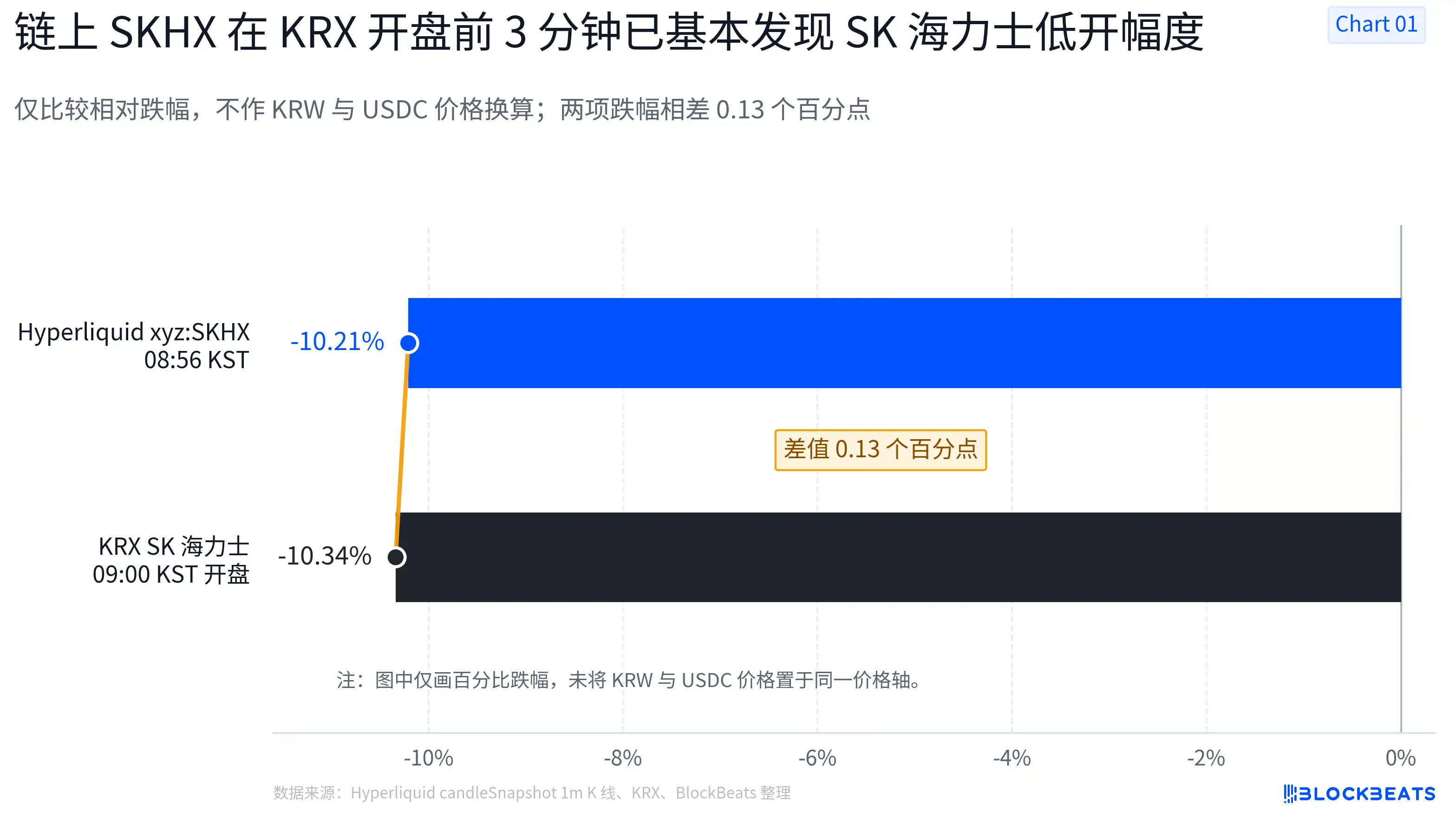
· Monday 08:56 KST (Korean Standard Time): xyz:SKHX dropped to a low of 1200.0 USDC, corresponding to a decline of -10.21%.

Three minutes later, the traditional world's KRX officially opened, with the real-world data as follows:

· Monday KRX Official Opening: 1,856,000 KRW, corresponding to a decline of -10.34%.

The difference between the two was only 0.13 percentage points.

This means that just 3 minutes before the KRX official open, the funds in the on-chain market had almost completely discovered the extent of SK Hynix's lower open on Monday. It didn't vaguely express the direction of "will fall," but precisely priced the decline around 10%, aligning closely with the actual opening result.
A Critical Reversal: Not a Failed Prediction, But Front-Running the Post-Open Trend

The market then entered a second phase of change, concentrated in the final 120 seconds before the open.

During the period from 08:58 to 08:59 KST, xyz:SKHX experienced unusual volume surges:

· 08:58: Minute trading volume rose to 708.132, placing it at the 99.85th percentile of the entire weekend's minute-by-minute volume;

· 08:59: Volume remained high at 665.584 (99.82nd percentile), and the price rebounded from 1201.1 USDC to 1228.8 USDC, a +2.31% bounce within two minutes.

If looking only at the final price at 08:59, the on-chain price was about 2 percentage points higher than the subsequent actual KRX opening price. However, this does not indicate a failure of on-chain price discovery. A more reasonable explanation is that the on-chain market had already front-run the low-price buying that would occur immediately after the stock's opening.

Looking at the actual post-open movement on KRX:

· KRX opened and probed a low of 1,855,000 KRW;

· 09:03 KST: The stock price had already recovered to 1,904,000 KRW, rebounding approximately +2.64%.


Domande pertinenti

QWhat is the main structural change that Hyperliquid and its HIP-3 proposal are enabling in the financial markets, as described in the article?

AThey are enabling a shift from traditional markets that pause price discovery during off-hours to a 24/7 continuous trading environment for traditional assets like stocks, commodities, and indices through on-chain perpetual contracts. This allows the on-chain market to become a venue for risk expression and price discovery while traditional exchanges are closed.

QBased on the SK Hynix example, how accurate was the price discovery on the Hyperliquid xyz:SKHX market just before the KRX opened?

AThe price discovery was extremely accurate. At 08:56 KST, the on-chain price implied a -10.21% drop. Three minutes later, the actual KRX opening price showed a -10.34% drop. The difference between the on-chain predicted drop and the real opening drop was only 0.13 percentage points.

QWhat happened in the last two minutes before the KRX opening, and how does the article interpret this activity?

AIn the final two minutes (08:58-08:59 KST), the xyz:SKHX market saw unusually high volume and a price rebound of +2.31%. The article interprets this not as a prediction failure, but as the on-chain market already beginning to trade the expected post-open bounce and low-price buying activity that would occur on the traditional exchange.

QWhat evidence does the article provide to show that the on-chain market for SK Hynix was active and not just seeing sporadic trades over the weekend?

AThe article cites candleSnapshot 1m K-line data, stating that "多空双方在周末完成了较大规模的筹码交换," which translates to long and short positions completing a relatively large-scale exchange of chips (trading volume) over the weekend. This indicates substantive trading activity, not just零星交易 (sporadic trades).

QAccording to the article, what was the subsequent price action on the KRX for SK Hynix after its opening, and how did it relate to the final on-chain price movement?

AAfter opening at the low of 1,855,000 KRW, the KRX price of SK Hynix rebounded to 1,904,000 KRW by 09:03 KST, a bounce of approximately +2.64%. This real-world bounce closely matched the +2.31% rebound that had already occurred on the chain in the two minutes before the KRX opened, supporting the interpretation that the on-chain market was front-running the traditional market's immediate post-open movement.

Letture associate

Bitcoin Mining Farms Are Becoming AI Factories

Bitcoin mines are transforming into AI factories. This shift is driven by the convergence of three key assets from the previous crypto cycle: infrastructure, talent, and capital. Crypto mining companies like Crusoe, CoreWeave, and Bitdeer are repurposing their core competency—securing power, land, and grid connections in remote locations—to build data centers for AI clients. These firms are signing multi-billion dollar, long-term contracts with companies like Anthropic, AWS, and Microsoft, as AI's demand for reliable, high-capacity compute surpasses the profitability of Bitcoin mining. Simultaneously, crypto entrepreneurs and engineers are applying their skills to new AI ventures. Examples include OpenSea's co-founder launching OpenRouter (an AI model aggregator), and former Coinbase engineers building Fal.ai (a generative media infrastructure platform). Their experience in building scalable, global software networks translates effectively to the AI space. Furthermore, capital accumulated during the crypto boom is now fueling AI. Figures like Jed McCaleb (co-founder of Ripple) funded Voltage Park, a large-scale GPU cloud provider. Notably, some crypto investments, like FTX's early bets on Anthropic and Cursor, have generated astronomical paper returns, demonstrating how high-risk crypto capital flowed into AI before it became mainstream. The transition is not just about repurposing hardware, but about redirecting critical resources—power infrastructure, distributed systems expertise, and venture funding—to the next technological frontier: artificial intelligence.

链捕手1 h fa

Bitcoin Mining Farms Are Becoming AI Factories

链捕手1 h fa

Morpho Launches Fixed-Rate Product Midnight: Lenders and Borrowers Set Their Own Rates, Ending the Era of Interest Rate Models

Morpho Launches Fixed-Rate Product Midnight: Lenders and Borrowers Set Their Own Rates, Ending the Era of Algorithmic Interest Models On-chain lending has grown to $60 billion but remains minuscule compared to traditional finance's $200 trillion annual credit volume. Morpho identifies the lack of fixed rates and maturity dates as key bottlenecks. Institutions need predictability, not the passive floating rates set by algorithmic models. Midnight allows lenders and borrowers to directly quote rates, set terms, and become price makers, not takers. Fixed-rate lending is now viable due to cheaper, faster blockchains and the entry of institutions demanding control and certainty over returns, costs, and duration. Morpho Blue previously gave users control over risk; Midnight adds control over interest rates. Past attempts at on-chain fixed-rate lending failed primarily because they were built on top of floating-rate pools (creating unpredictability) or lacked sufficient active participants. Midnight avoids these pitfalls as a standalone primitive with fixed rates at its core, built upon Morpho Blue's existing large and active user base. Midnight offers distinct value: institutions gain predictable term structures and full control; fintech companies can offer tailored fixed-rate products; lenders/borrowers achieve predictability and efficiency; and curators can now differentiate by configuring both risk and interest rates. Morpho Midnight is not a replacement for Morpho Blue. The Morpho network will now feature two complementary market structures: floating-rate/open-term (Blue) for flexibility and fixed-rate/fixed-term (Midnight) for predictability. Liquidity can flow between them. The launch will be gradual, prioritizing security. Initially, it will support direct lending on Base network with one trading pair (cbBTC/USDC) and limited maturity dates. Advanced features like auto-rollovers will be introduced later.

marsbit1 h fa

Morpho Launches Fixed-Rate Product Midnight: Lenders and Borrowers Set Their Own Rates, Ending the Era of Interest Rate Models

marsbit1 h fa

Trading

Spot
活动图片