In the AI Era, How Do GitHub Stars Become Developers' 'Proof of Execution'?

比推Pubblicato 2026-03-10Pubblicato ultima volta 2026-03-10

Introduzione

"The article argues that GitHub has evolved from a code hosting platform into an 'execution stock exchange' in the AI era, where stars serve as verifiable proof of attention and execution. Key metrics like stars, forks, issues, and pull requests are framed as forms of developer capital: stars represent public confidence, forks indicate real investment of time, issues drive progress, and PRs enable compounding collaboration. The author highlights real-time data from fast-growing AI-related repositories, such as openclaw and paperclip, to demonstrate how GitHub signals market trends. The platform is presented as a transparent, actionable market for developer attention, where users can build a quantifiable 'social capital ledger' by tracking and investing in promising projects early."

Author: AttentionVC

Compiled by: Deep Tide TechFlow

Original title: In the Era of Universal AI, the Star on GitHub Is the New Social Capital


Deep Tide Introduction: AttentionVC posted a widely noticed long tweet, with the core argument being: GitHub is no longer just a code hosting platform; it is the 'execution exchange' of the AI era.

Star count is a verifiable attention signal, Fork is real investment, and PR is compound collaboration. They tracked over 4,600 code repositories and 474 developers, 71% of which are AI-related.

This tweet itself is also a promotion for their product GitHubVC, but the observation of GitHub as a 'developer social capital ledger' is indeed interesting.

Full text as follows:

You released something amazing. A feature that improves workflow efficiency by 10 times. The code is so clean it's heartbreaking. Yet... your repo only has 10 stars. Maybe 100 if you're lucky.

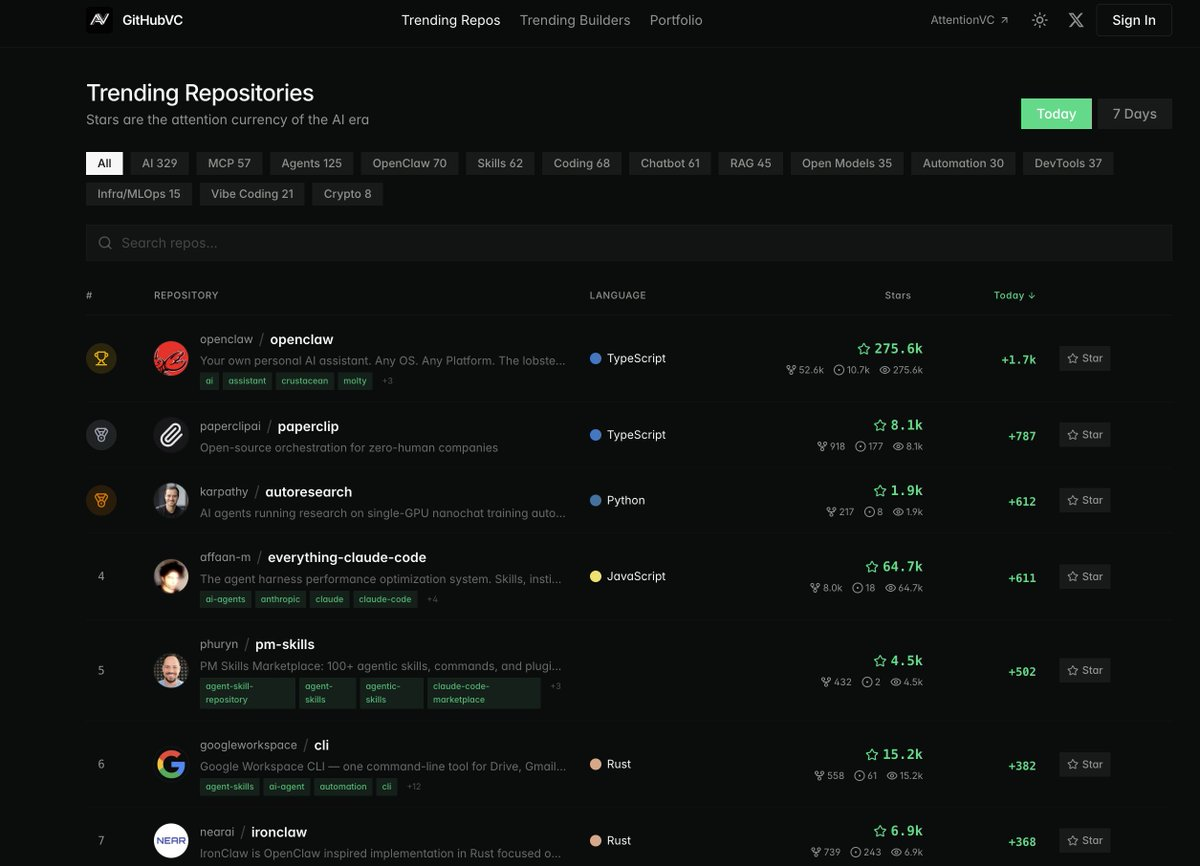
Meanwhile, @openclaw just surpassed 275,000 stars, with a daily increase of 2,870 stars, overtaking many long-standing top projects and securing one of the highest star counts on GitHub.
That moment wasn't luck. It proved something irreversible:

GitHub has evolved. It is no longer just 'code hosting.' It is the execution exchange of the AI era, and execution signals are the scarcest, most verifiable form of attention.

On X, You Express; On GitHub, You Execute

X gives you emotion, virality, reach. GitHub gives you proof. A viral tweet dies in 48 hours. A steep star growth curve lives forever—founders track it, investors do due diligence, and Agents will soon rank by it.

As you read this:

  • paperclipai/paperclip grows by +1,191 stars daily

  • Google Workspace CLI, launched just days ago, already has 15,000 stars, growing by +935 daily

  • OpenAI Symphony reached 8,400 stars, growing by +834 daily

These are not vanity metrics—they are real-time market signals, indicating where developer attention is flowing.

No matter how killer your feature is, it's useless if no one sees the signal.

Star = Vote, Fork = Commitment, Issue = Conversation, PR = Delivery

These are no longer just mechanisms. They are the atomic units of developer capital:

  • Star → Public deposits of confidence

  • Fork → I'm betting real time and energy on you

  • Issue → Conversations that actually move things forward

  • PR → Collaborations that compound into production

Junk traffic bounces off. Only real developer attention compounds here.

We are currently tracking over 4,600 code repositories and 474 developers. 71% of them are AI-related. The frontier is being built here—the signals are all public, if you know where to look.

Currently Fastest-Growing Repos (Real-Time Data)

  • openclaw/openclaw — 275k stars (today +2,870)

  • paperclipai/paperclip — 7.7k stars (today +1,191)

  • googleworkspace/cli — 15k stars (today +935)

  • openai/symphony — 8.4k stars (today +834)

  • everything-claude-code — 64k stars (today +802)

Full list:

https://github.attentionvc.ai/trending/repos

Your Personal Attention Portfolio, Now Quantifiable

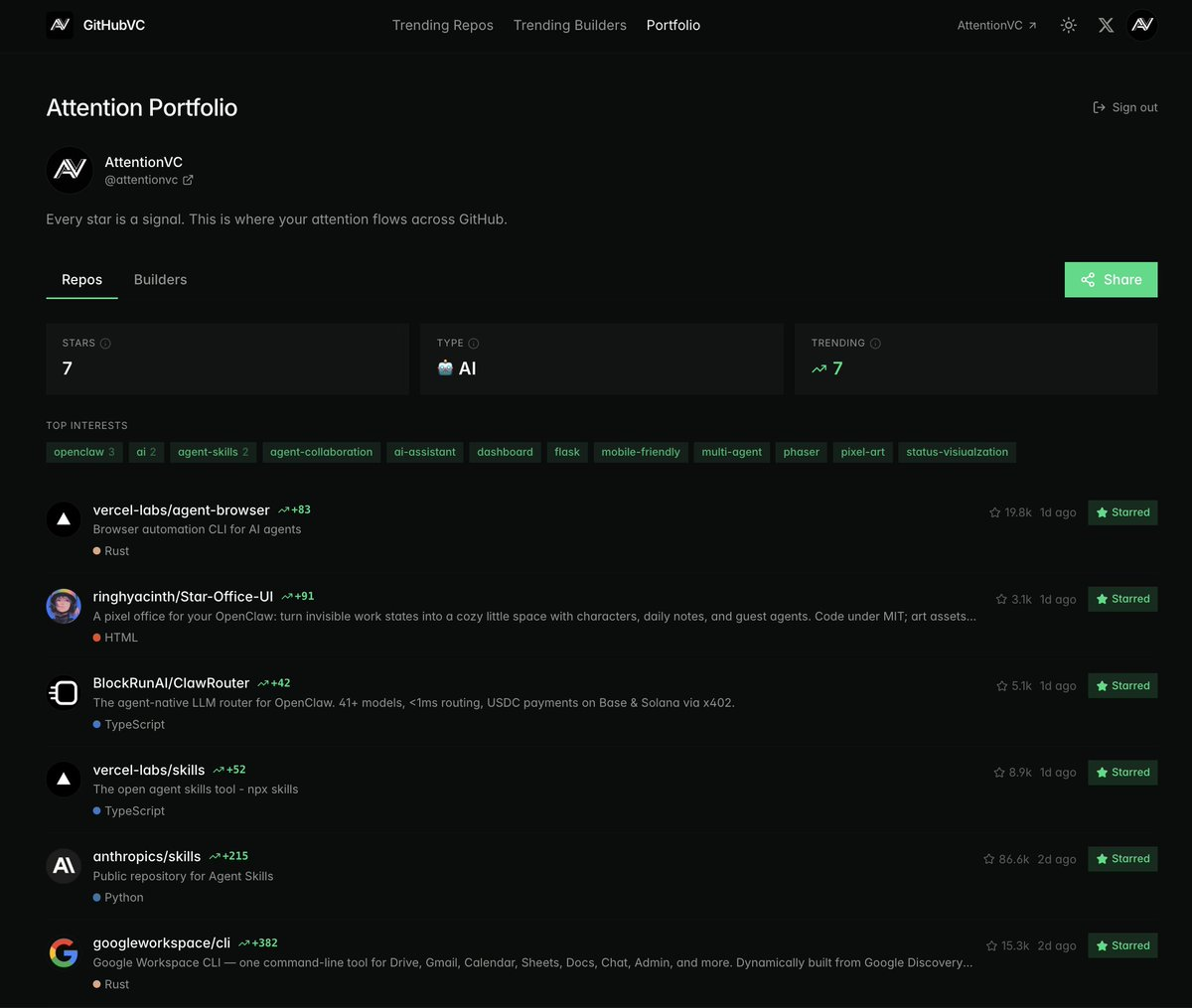
Log in with your GitHub account. See a repo you believe in? Star it directly in GitHubVC. Then watch in real time:

Does your bet appear on the daily fastest-growing list? Did your early star follow the curve from 200 → 20k → 200k?

This is the missing闭环: You're not just consuming signals—you're creating them and tracking them. Your star becomes a verifiable bet with public ROI.

Every Developer Gets a Dynamic Social Layer

GitHubVC turns your GitHub identity into something far more powerful—your personal capability network.

You start building:

  • A curated portfolio of repos, recording where you placed attention early

  • A visible trust trail: which developers you believed in at 200 stars, who grew to 200k

  • An influence score that rises whenever a repo you starred explodes

This isn't about having more followers. It's about having a trust trail—a permanent record of who believed in whom first.

Your GitHub is no longer a static profile. It becomes your public, verifiable social capital ledger in the developer economy.
GitHub Is Now a Real-Time Market for Developer Attention

In the real world, judging execution is slow, subjective, private. On GitHubVC, it's instant, public, actionable.

The era of treating GitHub attention as serious capital has arrived.

Stop wondering why your killer product remains unseen. Come build your portfolio. Place your attention bets on the next 200k-star repo. Leave a trust trail that compounds forever.


Twitter: https://twitter.com/BitpushNewsCN

BitPush TG Discussion Group: https://t.me/BitPushCommunity

BitPush TG Subscription: https://t.me/bitpush

Original link: https://www.bitpush.news/articles/7618433

Domande pertinenti

QWhat is the core argument of the article regarding GitHub in the AI era?

AThe core argument is that GitHub has evolved beyond a code hosting platform into an 'execution stock exchange' for the AI era, where stars serve as a verifiable signal of developer attention and execution capability.

QAccording to the article, what do the different GitHub actions (Star, Fork, Issue, PR) represent?

AStar represents a public vote of confidence; Fork represents investing real time and effort; Issue represents dialogue that drives progress; and PR represents collaborative work that compounds into the production environment.

QWhat percentage of the 4600+ repositories and 474 developers tracked by GitHubVC are AI-related?

A71% of the tracked repositories and developers are AI-related.

QWhich repository had the highest number of stars and the highest daily growth according to the real-time data mentioned?

AThe openclaw/openclaw repository had the highest number of stars at 275,000 and the highest daily growth with an increase of 2,870 stars.

QHow does GitHubVC enhance a developer's GitHub profile according to the article?

AGitHubVC transforms a developer's GitHub profile into a dynamic social capital ledger, allowing them to build a curated portfolio of repos, a visible trust trail of early support for successful projects, and an influence score that increases when their starred repos gain popularity.

Letture associate

$292 Million KelpDAO Cross-Chain Bridge Hack: Who Should Foot the Bill?

On April 18, 2026, an attacker stole 116,500 rsETH (worth ~$292M) from KelpDAO’s cross-chain bridge in 46 minutes—the largest DeFi exploit of 2026. The stolen assets were deposited into Aave V3 as collateral, causing $177–200M in bad debt and triggering a cascade of losses across nine DeFi protocols. Aave’s TVL dropped by ~$6B overnight. This legal analysis argues that KelpDAO and LayerZero Labs share concurrent liability, with fault apportioned 60%/40%. KelpDAO negligently configured its bridge with a 1-of-1 decentralized verifier network (DVN)—a single point of failure—despite LayerZero’s explicit recommendation of a 2-of-3 setup. LayerZero, which operated the compromised DVN, failed to secure its RPC infrastructure against a known poisoning attack vector. Both protocols’ terms of service cap liability at $200 (KelpDAO) or $50 (LayerZero), but these limits are likely unenforceable due to unconscionability, gross negligence exceptions, and potential securities law invalidation (if rsETH is deemed a security under the Howey test). Aave’s governance also faces fiduciary duty claims for raising rsETH’s loan-to-value ratio to 93%—far above competitors’ 72–75%—without adequately assessing bridge risks, amplifying the systemic fallout. Practical recovery targets include LayerZero Labs (a registered Canadian entity), KelpDAO’s founders, auditors, and identifiable Aave governance delegates. The incident underscores escalating legal risks for DeFi protocols, infrastructure providers, and governance participants.

marsbit47 min fa

$292 Million KelpDAO Cross-Chain Bridge Hack: Who Should Foot the Bill?

marsbit47 min fa

Insider Trading in War: 5 People Involved, the Highest Earner Was Arrested

On April 24, the U.S. Department of Justice arrested U.S. Army Special Forces Staff Sergeant Gannon Ken Van Dyke for insider trading related to the capture of Venezuelan President Nicolás Maduro on January 3. Van Dyke allegedly profited over $400,000 by placing bets on a prediction market, Polymarket, using insider knowledge of the covert operation. According to the indictment, Van Dyke registered an account (0x31a5) on December 26 and made a series of bets predicting Maduro’s capture and U.S. military involvement in Venezuela. He withdrew most of his funds on the day of the operation and attempted to obscure his tracks by transferring assets through crypto and brokerage accounts. This case marks the first time the DOJ has prosecuted insider trading on Polymarket. PolyBeats had previously identified five suspicious accounts, including Van Dyke’s—the highest earner—in January. The other accounts, with profits ranging from $34,000 to $145,000, remain under unofficial scrutiny but have not been charged. Their lower profits, indirect access to information, and unclear legal boundaries may complicate prosecution. Polymarket has since strengthened its market integrity rules, explicitly prohibiting trading based on confidential or insider information. Van Dyke’s arrest, nearly four months after his trades, signals increased regulatory attention and the persistent traceability of blockchain-based transactions.

marsbit49 min fa

Insider Trading in War: 5 People Involved, the Highest Earner Was Arrested

marsbit49 min fa

Bitwise: Bullish on Bitcoin's Performance in the Second Half of the Year, AI and Regulation Will Spark a New Altcoin Season

Bitwise CIO Matt Hougan and Research Lead Ryan Rasmussen express strong bullish sentiment on Bitcoin's long-term prospects, suggesting that its $1 million price target may be too conservative. They argue Bitcoin serves a dual role: as digital gold and a potential global settlement asset, especially amid declining trust in traditional monetary systems. Despite a weak Q1 2026 where nearly all crypto assets and prices saw double-digit declines, the analysts remain optimistic due to strong forward-looking catalysts, including institutional adoption via Bitcoin ETFs from major firms like Morgan Stanley and Goldman Sachs. Geopolitical instability, such as Iran’s mention of using Bitcoin for international payments, increases the value of Bitcoin’s “out-of-the-money call option” as a non-political, global settlement currency. This enhances its appeal beyond a mere store of value. . Additionally, Hougan highlights that a clearer regulatory token framework under current SEC leadership, combined with AI efficiency gains and high-performance blockchains, could fuel a new “altseason” by late 2026. This may lead to a wave of legitimate, value-capturing token projects, unlike the earlier ICO boom. . Bitwise also announced an Avalanche ETF, citing its unique architecture and rapid growth in real-world asset (RWA) tokenization, which has surged 10x to nearly $30 billion in two years. The firm believes Layer 1 blockchains are still early in their growth cycle, with significant potential ahead.

marsbit1 h fa

Bitwise: Bullish on Bitcoin's Performance in the Second Half of the Year, AI and Regulation Will Spark a New Altcoin Season

marsbit1 h fa

Trading

Spot
Futures

Articoli Popolari

Come comprare ERA

Benvenuto in HTX.com! Abbiamo reso l'acquisto di Caldera (ERA) semplice e conveniente. Segui la nostra guida passo passo per intraprendere il tuo viaggio nel mondo delle criptovalute.Step 1: Crea il tuo Account HTXUsa la tua email o numero di telefono per registrarti il tuo account gratuito su HTX. Vivi un'esperienza facile e sblocca tutte le funzionalità,Crea il mio accountStep 2: Vai in Acquista crypto e seleziona il tuo metodo di pagamentoCarta di credito/debito: utilizza la tua Visa o Mastercard per acquistare immediatamente CalderaERA.Bilancio: Usa i fondi dal bilancio del tuo account HTX per fare trading senza problemi.Terze parti: abbiamo aggiunto metodi di pagamento molto utilizzati come Google Pay e Apple Pay per maggiore comodità.P2P: Fai trading direttamente con altri utenti HTX.Over-the-Counter (OTC): Offriamo servizi su misura e tassi di cambio competitivi per i trader.Step 3: Conserva Caldera (ERA)Dopo aver acquistato Caldera (ERA), conserva nel tuo account HTX. In alternativa, puoi inviare tramite trasferimento blockchain o scambiare per altre criptovalute.Step 4: Scambia Caldera (ERA)Scambia facilmente Caldera (ERA) nel mercato spot di HTX. Accedi al tuo account, seleziona la tua coppia di trading, esegui le tue operazioni e monitora in tempo reale. Offriamo un'esperienza user-friendly sia per chi ha appena iniziato che per i trader più esperti.

314 Totale visualizzazioniPubblicato il 2025.07.17Aggiornato il 2025.07.17

Come comprare ERA

Discussioni

Benvenuto nella Community HTX. Qui puoi rimanere informato sugli ultimi sviluppi della piattaforma e accedere ad approfondimenti esperti sul mercato. Le opinioni degli utenti sul prezzo di ERA ERA sono presentate come di seguito.

活动图片













