In Just 70 Days, Polymarket Easily Rakes in Tens of Millions in Fees

marsbitPubblicato 2026-03-16Pubblicato ultima volta 2026-03-16

Introduzione

Polymarket, a prediction market platform, has generated over $11.2 million in fees in just 70 days since introducing transaction fees on January 6. Initially applied only to "15-minute crypto up/down" markets, the fee structure charges more when odds are near 50% (up to 1.56%) and less when they approach 0% or 100%. By March 6, fees were expanded to all crypto-related markets. Conservative estimates now project annualized revenue of around $58.4 million. However, weekly fee income has shown consistent growth—rising from $560,000 to $1.84 million in recent weeks—driven by both increased trading volume and the expansion of fee-eligible markets. If fees were extended to all markets, current trading activity suggests Polymarket could achieve approximately $360 million in annual revenue. The platform has also distributed $13.41 million in liquidity provider subsidies, which are likely to be offset by fee revenue this month. Polymarket’s revenue potential hinges on continued trading volume growth and further expansion of fee-based markets, positioning it as a highly profitable model within the crypto industry.

Original | Odaily Planet Daily (@OdailyChina)

Author | Azuma (@azuma_eth)

On January 6th of this year, Polymarket officially ended its "zero-fee" model and began trialing transaction fees starting with the "15-minute cryptocurrency up/down" markets. The specific fee rate varies with the real-time odds of the market—the closer the odds are to 0% or 100%, the lower the fee; conversely, the closer the odds are to 50%, the higher the fee, up to a maximum of 1.56%.

Then, on January 28th, about three weeks after fees were introduced, we published an article titled "Data Estimates Polymarket's Annual Revenue Could Easily Exceed $100 Million, Assuming...". The article provided a static estimate based on Polymarket's trading volume and transaction activity structure at the time: in the most conservative scenario, if the scope of fee-charging markets remained unchanged, Polymarket was projected to generate approximately $38 million in annual revenue; in the most aggressive scenario, if Polymarket extended fees to all markets, it was projected to earn $418 million in annual fee revenue.

When we last estimated Polymarket's revenue, we were hampered by the short observation period and limited calculable samples. Now, nearly two months later, we have used richer data to re-estimate Polymarket's revenue expectations. The results show that the so-called "conservative" estimate was indeed too conservative, and the "aggressive" expectation is not overly exaggerated.

Changes in Revenue Data

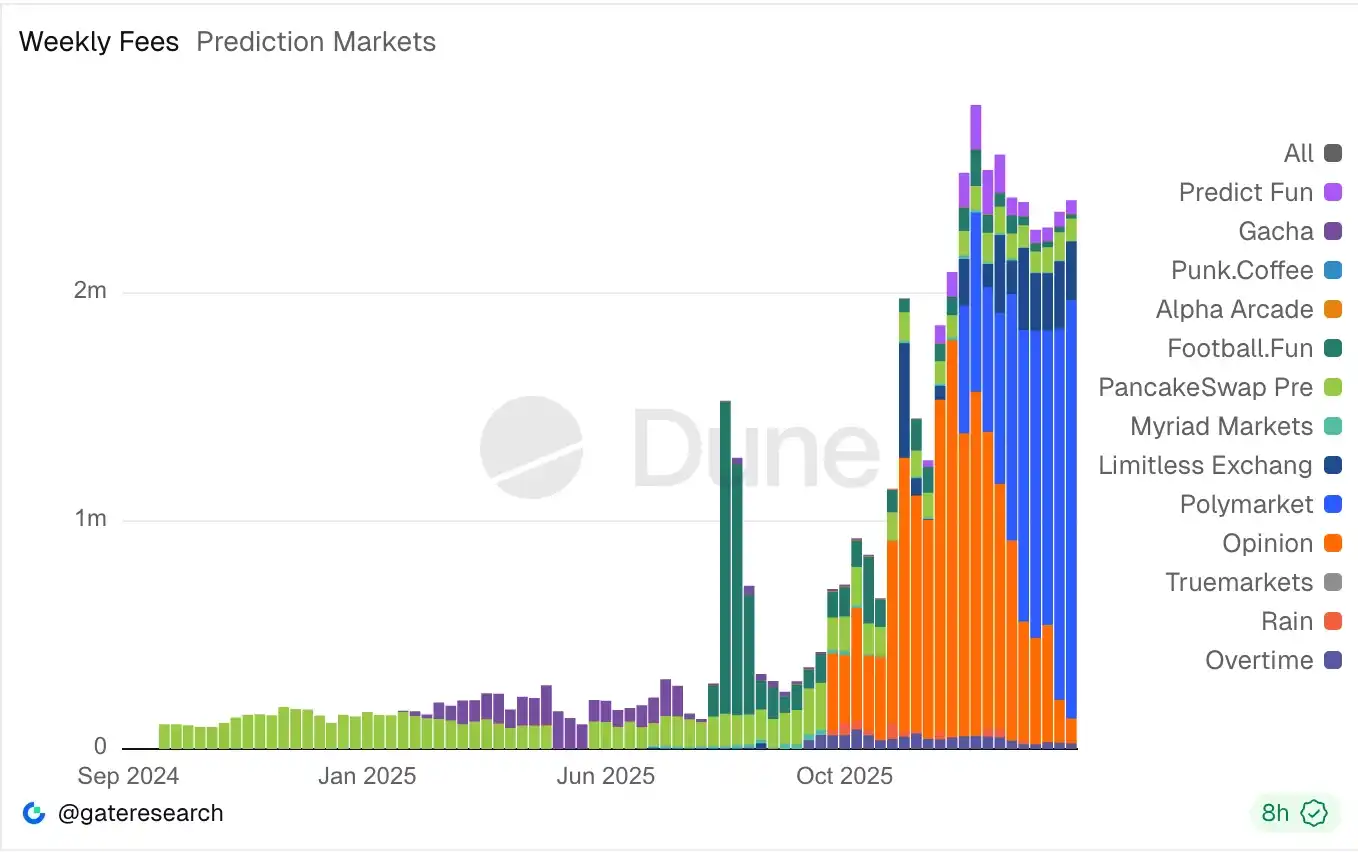
According to data compiled by Gate Research on Dune, since transaction fees were introduced on January 6th, Polymarket has accumulated over $11.2 million in fee revenue.

Using the most conservative method for another static estimate, assuming the trading volume and transaction activity structure of the relevant markets remain unchanged, Polymarket is projected to generate approximately $58.4 million in annual revenue.
However, this estimation method does not accurately reflect Polymarket's revenue-generating capability.

The reason is that Polymarket's revenue data is visibly growing—over the past 10 weeks, the platform's weekly fee revenue has been $560,000, $786,000, $633,000, $749,000, $1.08 million, $1.28 million, $1.35 million, $1.29 million, $1.63 million, $1.84 million... showing almost weekly significant growth.

Reasons for Revenue Growth

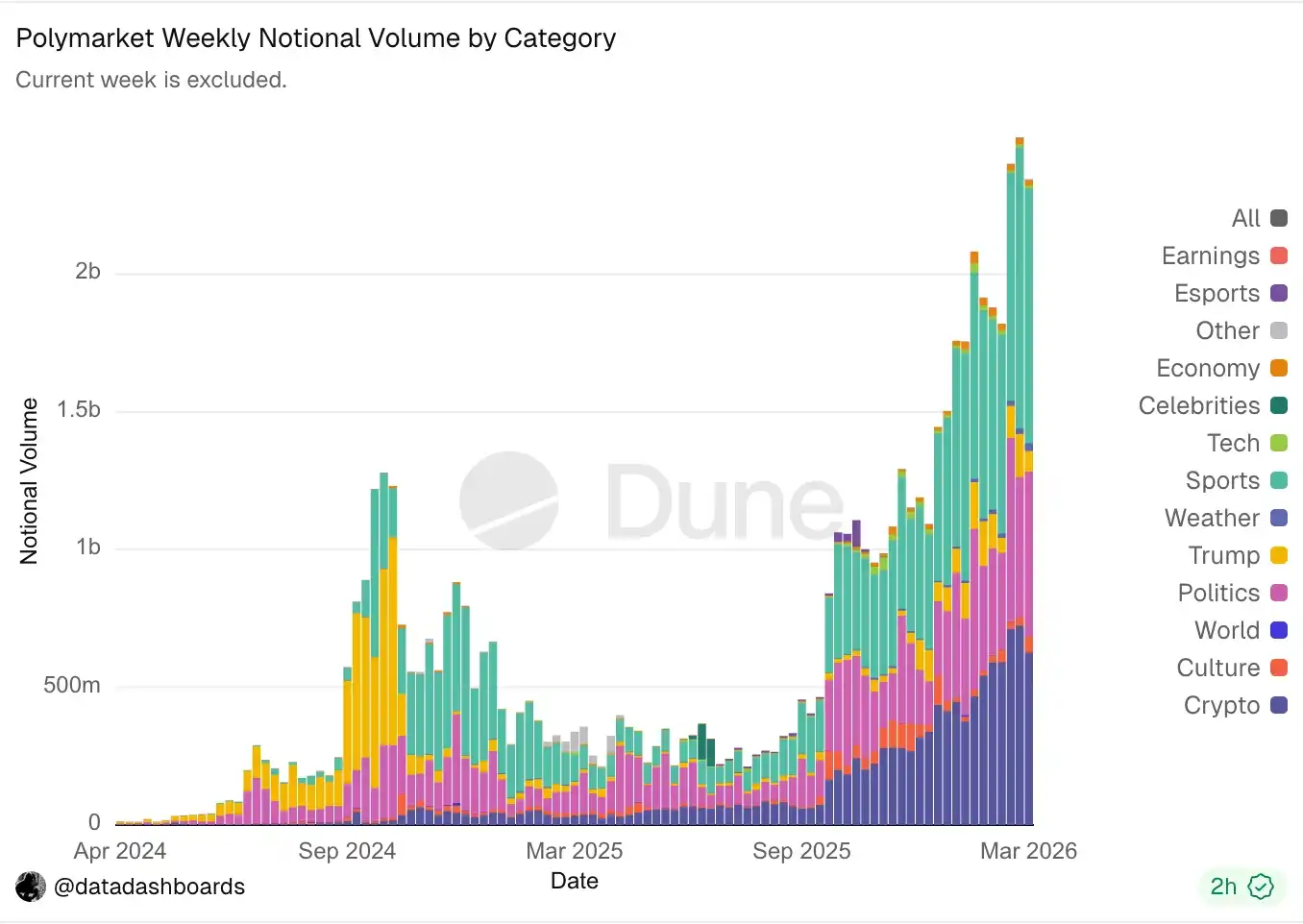
There are two reasons for the growth in Polymarket's fee revenue. First, Polymarket has expanded the scope of fee-charging markets; second, Polymarket's overall trading volume and the trading volume of fee-charging markets are continuously increasing.

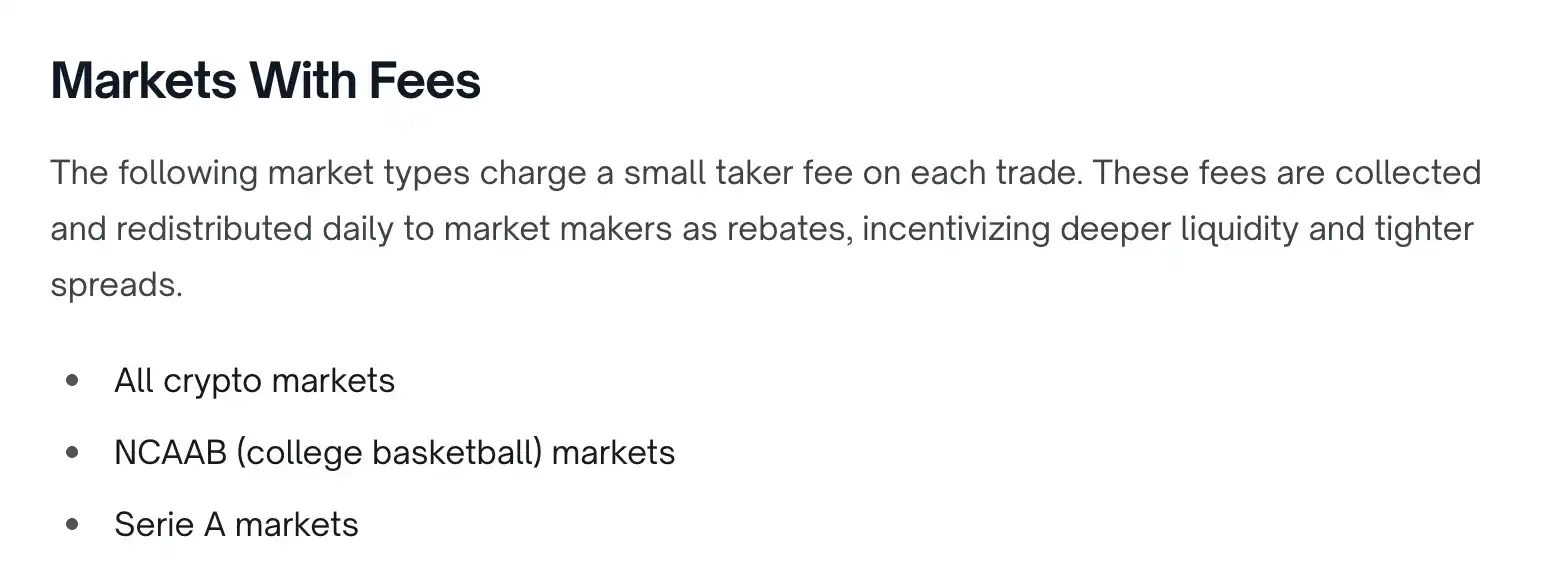
Regarding the scope of fee-charging markets, Polymarket extended the fee mechanism to all cryptocurrency-related markets on March 6th. Additionally, even earlier, it had trialed fee collection in sports markets like NCAA and Serie A. However, the former (cryptocurrency-related markets) currently remains the primary source of fee revenue.
Regarding trading volume, the data dashboard compiled by Data Dashboards on Dune shows that Polymarket's weekly overall trading volume and cryptocurrency market volume (the bottom purple bars) are consistently growing.
Future Revenue Projections

When we last projected Polymarket's revenue, we had to manually extract the trading volume proportion of "15-minute cryptocurrency up/down" related markets within all cryptocurrency-related markets. But now, since Polymarket extended fees to all cryptocurrency-related markets on March 6th, this estimation is much more straightforward. As for NCAA and Serie A, perhaps because the former hasn't entered the "March Madness" official stage yet, and the latter has relatively low attention in American culture, the trading volume scale of these markets is significantly smaller compared to cryptocurrencies, so they are temporarily ignored here.

Taking the only full week after March 6th (March 9-15) data, the trading volume of cryptocurrency-related events accounted for 26.7% of Polymarket's total platform trading volume this week. In the same week, Polymarket's fee revenue was approximately $1.84 million. Based on this ratio for推算, under the current trading volume level and transaction structure, if Polymarket introduces a similar fee model across all markets, it is projected to bring in $360 million in annual revenue for the platform.

The Money Printer is Already Running

It is worth mentioning that, as a key measure for Polymarket to enhance liquidity, the platform has so far distributed a total of $13.41 million in subsidies to liquidity providers (LPs). In contrast, if the data for the remaining ten-plus days of March continues the performance of the first half, the fee revenue earned by Polymarket within this month could cover the total expenditure on liquidity subsidies.

Polymarket has largely proven the revenue-generating capability of this new业态 of prediction markets. Future revenue growth will primarily depend on two variables—how much more trading volume can grow, and whether fees can be further extended to more markets.

If these two variables continue to trend upward, prediction markets might become the simplest and most direct "money printer" in the cryptocurrency industry.


Domande pertinenti

QWhen did Polymarket start charging transaction fees, and what was the initial market targeted?

APolymarket started charging transaction fees on January 6, beginning with the '15-minute cryptocurrency up/down' markets.

QWhat is the highest possible transaction fee rate on Polymarket, and when does it apply?

AThe highest possible transaction fee rate on Polymarket is 1.56%, which applies when the odds are closest to 50%.

QHow much fee revenue has Polymarket accumulated since it began charging fees, according to the article?

APolymarket has accumulated over $11.2 million in fee revenue since it began charging fees.

QWhat was the estimated annual fee revenue for Polymarket under the most conservative static estimate mentioned in the article?

AThe most conservative static estimate mentioned in the article projected an annual fee revenue of approximately $58.4 million.

QWhat are the two main reasons cited for the growth in Polymarket's fee income?

AThe two main reasons are the expansion of fee-charging markets to all crypto-related markets and the continuous growth in overall trading volume, particularly in crypto markets.

Letture associate

In Jinjiang, Fujian, a Storage Super Unicorn Lies Quiet

In Fujian's Jinjiang, a city known for sportswear, lies a quiet semiconductor giant: Fujian Jinhua Integrated Circuit Co. (JHICC). Once a promising domestic DRAM manufacturer alongside Yangtze Memory and ChangXin Memory Technologies (CXMT), its journey was derailed in 2018 when the U.S. placed it on an Entity List and filed criminal charges for alleged trade secret theft. This halted production for years. A turning point came in February 2024 when a U.S. federal court found JHICC not guilty. However, it had lost crucial time. While CXMT soared to become a top-valued A-share company in 2024, JHICC, with an estimated valuation of 80 billion RMB, was just restarting. Its current output is primarily customized DDR4 chips, not the advanced DDR5/HBM demanded for AI, but it still benefits from the broader memory chip upcycle. JHICC's story is tied to Chen Zhengkun, a veteran engineer who left Micron to lead the venture. Founded in 2016 with state-backed funding, JHICC partnered with Taiwan's UMC to develop DRAM technology. Rapid progress was cut short by the U.S. actions, which Micron initiated, partly due to its heavy reliance on the Chinese market. Post-sanctions, Chen's team worked to rebuild the production line with reduced reliance on U.S. technology. According to its records, JHICC achieved small-scale production and revenue growth under immense pressure. It now focuses on the stable "niche" DRAM market (e.g., TVs, routers) with a monthly capacity of ~40,000 wafers, aiming for 60,000 by 2026. It holds over 1,000 patents but remains on the Entity List. For Jinjiang, investing in JHICC was a bold industrial leap. The local government provided unwavering financial and logistical support during the crisis, helping the company survive. JHICC has become the anchor for a growing local semiconductor cluster. Though its scale lags behind domestic peers, JHICC's persistence symbolizes a hard-won foothold in a global market long dominated by Samsung, SK Hynix, and Micron. Having missed one boom, it seeks a place in the new AI-driven memory supercycle.

marsbit20 min fa

In Jinjiang, Fujian, a Storage Super Unicorn Lies Quiet

marsbit20 min fa

Must-Watch Events Next Week|CLARITY Act Could Face Senate Vote; SpaceX, Circle to Report Earnings (8.3-8.9)

**Summary: Key Events and Developments to Watch (August 3-9)** The upcoming week is marked by significant financial disclosures, key legislative deadlines, and notable product updates. **Major Financial Events:** Several companies are scheduled to release their Q2 2026 earnings. American Bitcoin (ABTC) will report on August 3, followed by SpaceX and Hut 8 Mining Corp. on August 4, and Circle on August 5. Notably, a significant portion of SpaceX shares (up to 12% of total shares) will be unlocked on August 6 following their earnings release. **Key Legislative Deadline:** The U.S. Senate faces an August 7 deadline to secure 60 votes for the CLARITY Act, a bipartisan bill aiming to establish a federal regulatory framework for cryptocurrencies. The Senate may hold a full vote on the bill during the week. **Economic Data:** The U.S. July Non-Farm Payrolls report will be released on August 7, providing crucial labor market data. **Technology & Product Updates:** * **Shutdowns:** DeFi portfolio tracker Zapper and wallet app Ctrl Wallet will cease operations on August 3. * **Upgrades:** LayerZero will deprecate its v1 relayers on August 3. XRP Ledger's new version 3.3.0, featuring five new functions, is expected next week. * **AI:** Elon Musk announced that the advanced Grok 4.6 AI model is set for release around August 7. * **Bitcoin:** The BIP-110 forced signaling for a potential Bitcoin network change is scheduled to begin around August 8. **Other Notable Events:** Chinese robotics firm Unitree Tech has set its preliminary price inquiry for its IPO for August 5. South Korean exchange Upbit will delist AQT and AERGO tokens on August 3.

marsbit2 h fa

Must-Watch Events Next Week|CLARITY Act Could Face Senate Vote; SpaceX, Circle to Report Earnings (8.3-8.9)

marsbit2 h fa

Trading

Spot
活动图片




