In a Losing Bear Market, Who Is Quietly Making a Fortune?

Odaily星球日报Pubblicato 2026-04-10Pubblicato ultima volta 2026-04-10

Introduzione

Amid a prolonged bear market where most crypto participants are losing money, a few projects continue to generate significant revenue. A closer look at Defillama’s revenue rankings reveals that profitable projects share simple and clear revenue models, primarily falling into two categories: spread income and transaction fees. Spread-based revenue models involve acting as capital intermediaries—absorbing funds at lower costs and deploying them at higher yields. Examples include stablecoin issuers like Tether and Circle, which earn from interest on reserve assets like U.S. Treasuries; lending protocols such as Aave, which profit from the spread between borrowing and deposit rates; and liquid staking services like Lido, which retain a portion of staking rewards as fees. Transaction fee models generate revenue by taxing activities like trading, token creation, or other on-chain actions. Platforms such as Hyperliquid and EdgeX (perpetual trading), Polymarket (event prediction), pump.fun and GMGN (meme trading), Aerodrome and Jupiter (spot trading), as well as Phantom (via swap fees) and NFT marketplaces like Courtyard and Fragment, all rely heavily on transaction fees. Notable exceptions include Grayscale (traditional asset management fees), Chainlink (oracle data service fees), and Titan Builder (which profited unusually from a large MEV capture incident). The key insight is that sustainable profitability in a bear market comes from straightforward revenue models combined with...

Original | Odaily Planet Daily (@OdailyChina)

Author | Azuma (@azuma_eth)

The market remains sluggish, with funds performing poorly, protocols shutting down, major holders staying silent, and retail investors bleeding... It seems like everyone from top to bottom in the industry is losing money. However, even in such a cold market environment, a very few projects are still running their money-printing machines at full throttle.

The latest example is Polymarket, which has fully opened its fee gates. Since recently broadening its fee scope and revising its fee formula (recommended reading: "Hardcore Analysis of Polymarket's Fee Formula: How Did Extreme Rates of 90+% Emerge?"), Polymarket's revenue-generating capacity has significantly surged; as of publication, Polymarket's total fee income has exceeded $24 million, with a single-day record of $1.5 million in revenue on April 2.
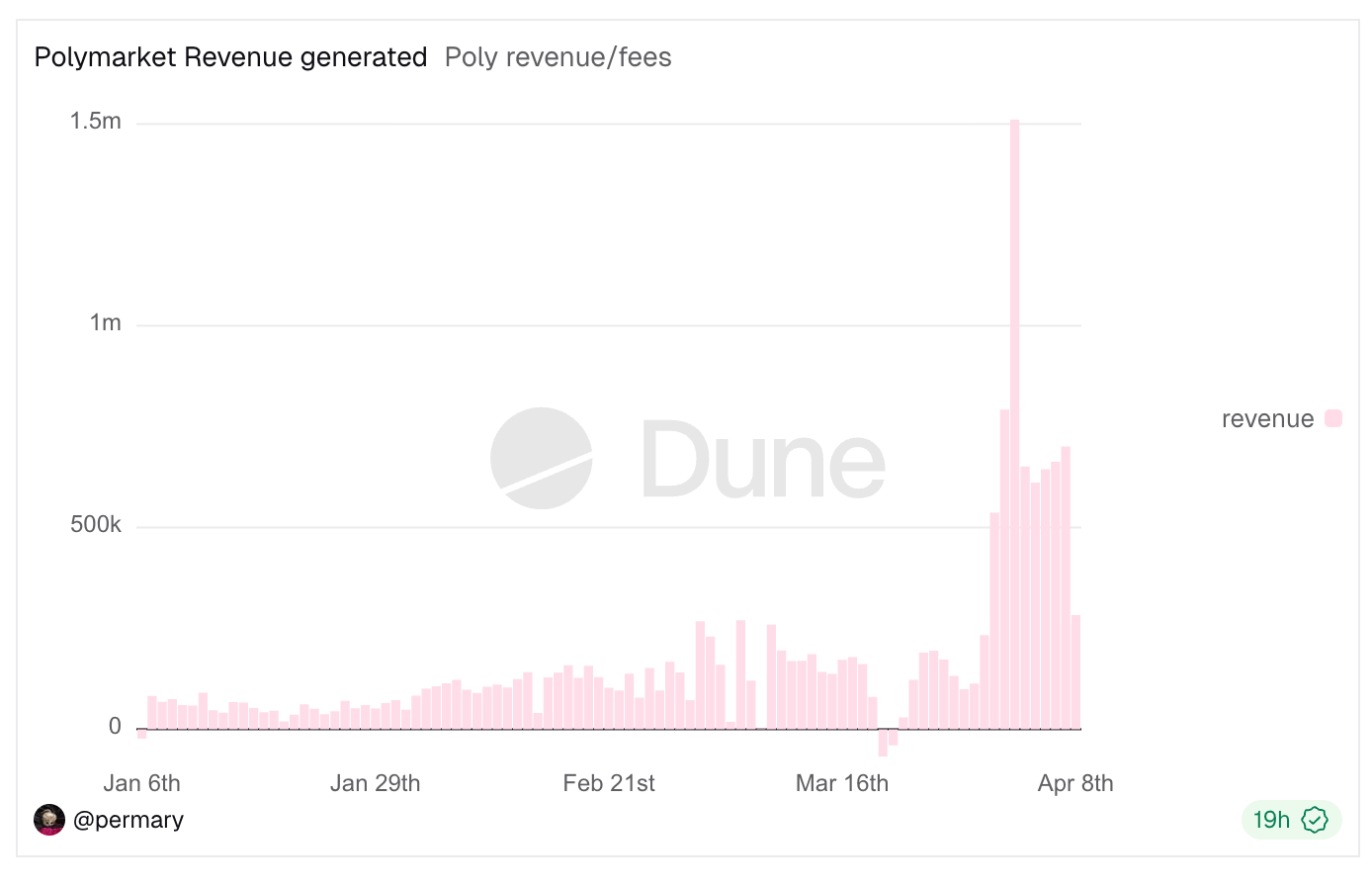
Taking this opportunity, I browsed the revenue rankings on Defillama to see which businesses are still consistently making money during the bear market, and the results were quite surprising: The core businesses and revenue sources of the listed projects are quite clear, even "simple."
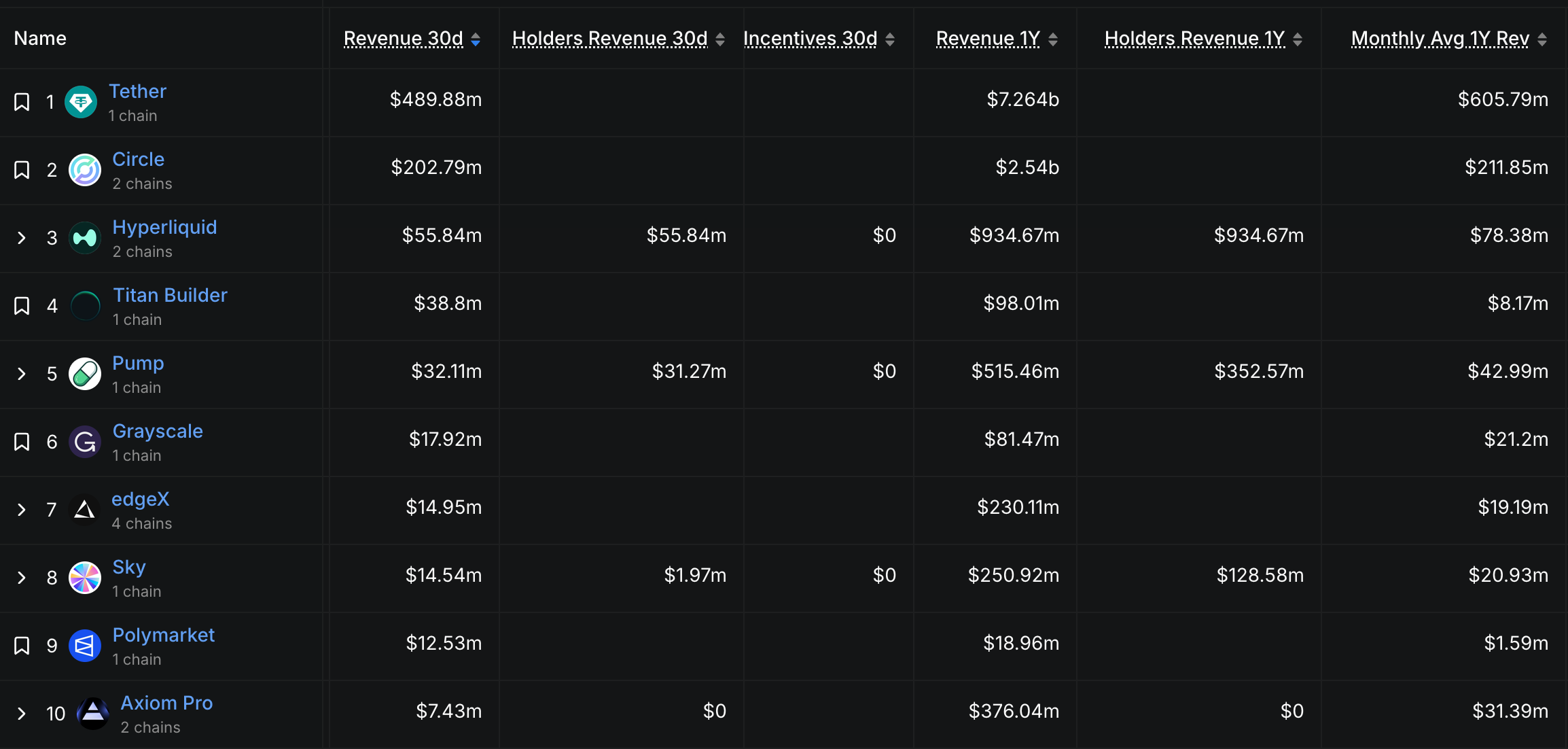
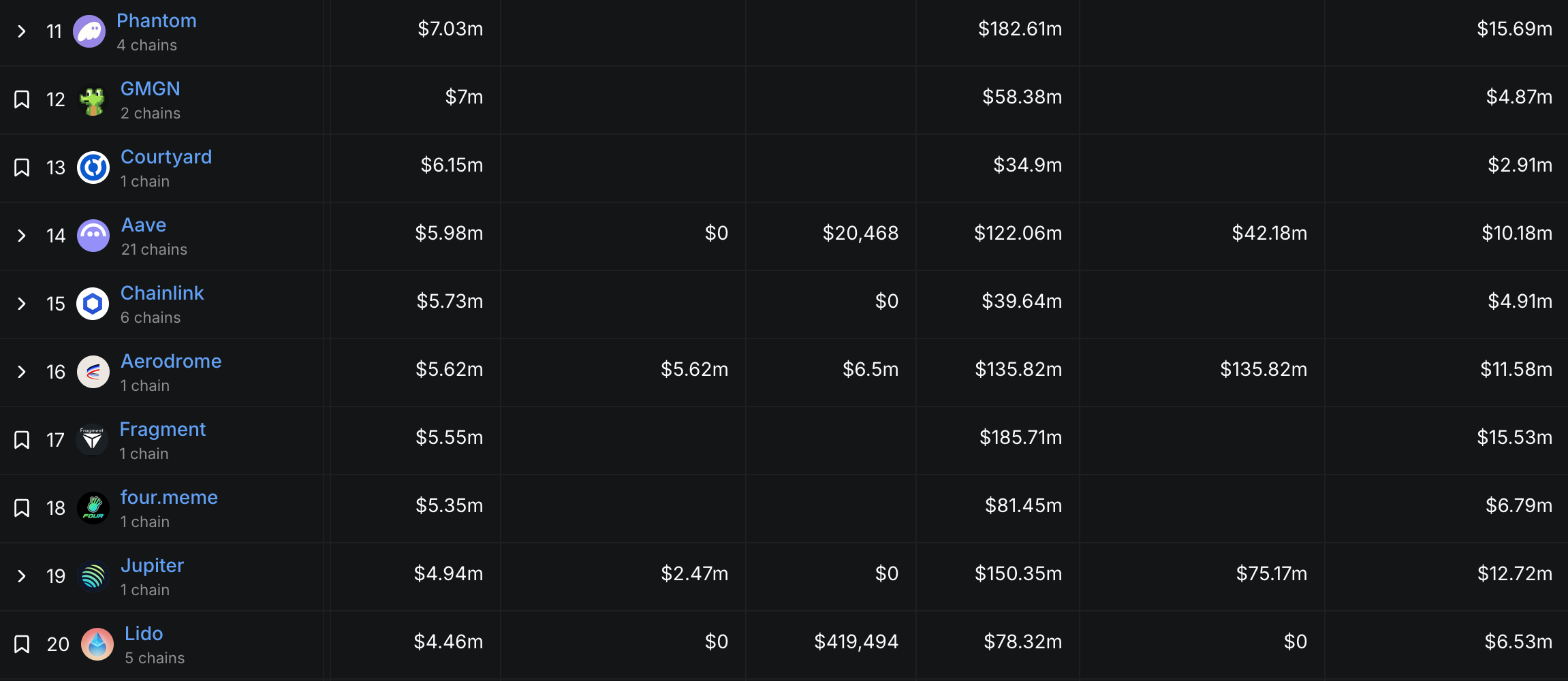
As shown above, I believe most players deeply involved in the crypto market could guess most of these names even without looking at the answers, and probably know exactly what they do. But when these names are neatly listed together, I suddenly realized that the main revenue sources of these profitable businesses are highly convergent, and can essentially be summarized into two broad categories: first, interest spreads, and second, transaction taxes (fees).

First, interest spreads: This is essentially acting as a "capital intermediary." The core logic is to absorb funds at relatively low costs and deploy them at relatively high returns, using time to gradually accumulate the difference between returns and costs — the profit of such businesses depends on the scale and duration of capital沉淀; the larger the scale and the longer the time, the higher the profit.

Tether, Circle, and other stablecoin issuers fall into this category. Their main income comes from the interest generated by deploying reserve funds into assets like U.S. Treasury bonds, while their costs mainly involve subsidies paid to partners and users. The difference between the two is the profit. Lending protocols like Aave also belong here, with the spread being the difference between the relatively higher borrowing rates and the relatively lower deposit rates. Liquid staking services (LST) like Lido are no exception; they withhold a certain percentage from ETH's native staking rewards as a service fee, which is also a form of interest spread.

Second, transaction taxes: This type of business is easier to understand. Whenever transaction-related activities (including token creation) occur, the business entity can "tax" the activity in the form of fees — the profit of such businesses depends on the transaction size per activity and the frequency of activities; the larger the size and the higher the frequency, the greater the profit.

Whether it's Hyperliquid and EdgeX focusing on contract trading, Polymarket focusing on event trading, pump.fun, GMGN, Axiom, and four.meme focusing on Meme trading, Aerodrome, Jupiter, and Phantom (whose main revenue comes from Swap fees on the wallet frontend) focusing on spot trading, or Courtyard and Fragment focusing on NFT trading (it's quite a surprise that this category even made the list), their primary revenue source is transaction taxes.

The only few special cases in the rankings are Grayscale, Chanilink, and Titan Builder. Grayscale is somewhat out of place here; its core revenue comes from ETF and fund management fees, essentially a traditional asset management business focused on the cryptocurrency market. Chanilink is definitely worth mentioning; its main revenue comes from data service fees paid by projects calling its oracle, making it more like a To B on-chain SaaS business. But as you can see, the Matthew effect in this path is more pronounced than in other sectors. Titan Builder is purely a sporadic phenomenon; it is a block-building service provider, not normally a particularly profitable business. The reason it made the list is because Titan Builder took the largest piece of the pie in last month's massive AAVE transaction sandwiching incident (details in "50 Million USDT for 35,000 AAVE: How Did the Disaster Happen?").
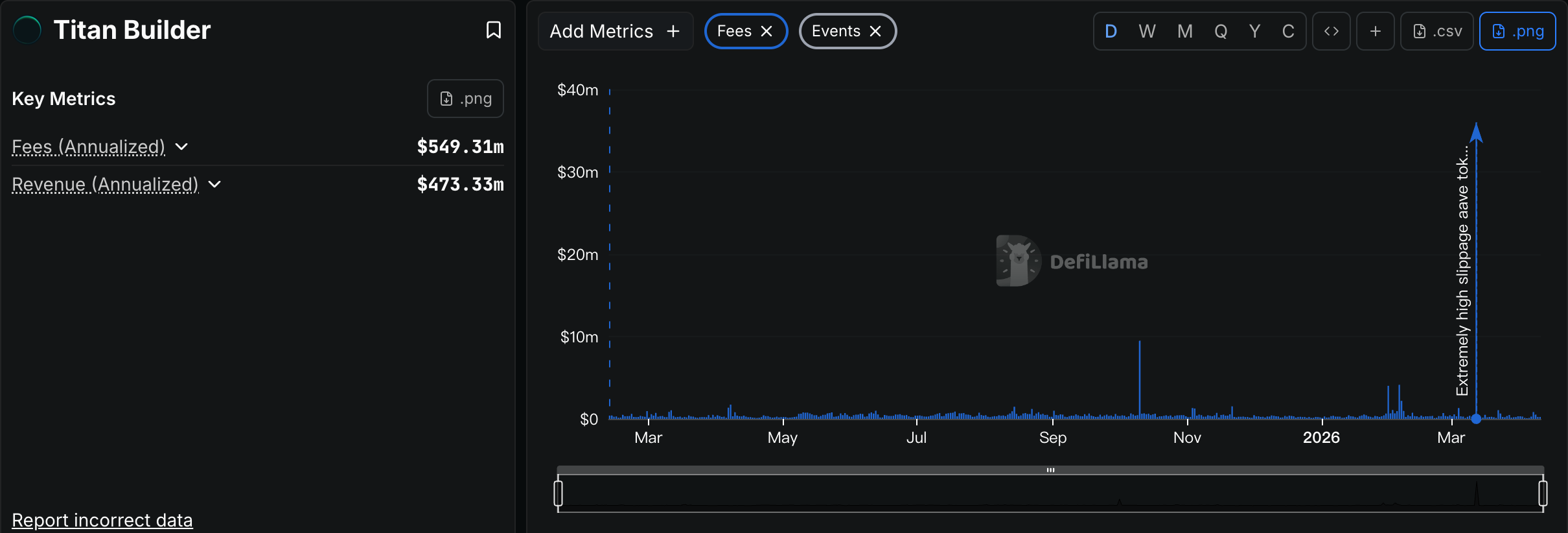
Odaily Note: See what it means to not open for business for three years, but eat for three years when you do.

So the conclusion is clear. Projects that continue to make money during the bear market are not those pursuing complex mechanisms and high-risk opportunities, but those that can operate consistently with simple, clear revenue models. In the still volatile cryptocurrency market, simpler revenue models have demonstrated greater resilience and better withstand the test of market fluctuations.

However, a simpler revenue model absolutely does not mean these businesses are "easier to run." On the contrary, behind the simple revenue models often lie more complex product services and meticulous operational management. This is where the leading players on the list have truly "differentiated" themselves through intense competition. From interaction design, to liquidity accumulation, to risk management, to user communication and feedback... To stand out in the fierce competition of the存量 market, one must invest more effort into product and service.

The crypto winter is not over yet. The projects that can truly survive and even profit are often those that flexibly combine simple revenue models with complex product services. Perhaps, this is the long-term code to navigate through bull and bear markets.


Domande pertinenti

QWhat are the two main categories of revenue sources for profitable projects in the crypto bear market, as mentioned in the article?

AThe two main categories are spread (acting as a capital intermediary) and transaction tax (fees).

QWhich project set a single-day revenue record of $1.5 million on April 2nd, according to the article?

APolymarket set a single-day revenue record of $1.5 million on April 2nd.

QWhat is the core revenue source for stablecoin issuers like Tether and Circle, as explained in the article?

ATheir core revenue comes from the interest earned by deploying reserve funds into assets like U.S. Treasury bonds, minus the costs of subsidies to partners and users.

QName one project whose primary revenue comes from data service fees paid for oracle services, as highlighted in the article.

AChanilink's primary revenue comes from data service fees paid by projects for using its oracle services.

QWhat does the article suggest is the 'long-term password' to survive and profit through market cycles in crypto?

AThe 'long-term password' is combining simple revenue models with complex product services and sophisticated operational management.

Letture associate

Gensyn AI: Don't Let AI Repeat the Mistakes of the Internet

In recent months, the rapid growth of the AI industry has attracted significant talent from the crypto sector. A persistent question among researchers intersecting both fields is whether blockchain can become a foundational part of AI infrastructure. While many previous AI and Crypto projects focused on application layers (like AI Agents, on-chain reasoning, data markets, and compute rentals), few achieved viable commercial models. Gensyn differentiates itself by targeting the most critical and expensive layer of AI: model training. Gensyn aims to organize globally distributed GPU resources into an open AI training network. Developers can submit training tasks, nodes provide computational power, and the network verifies results while distributing incentives. The core issue addressed is not decentralization for its own sake, but the increasing centralization of compute power among tech giants. In the era of large models, access to GPUs (like the H100) has become a decisive bottleneck, dictating the pace of AI development. Major AI companies are heavily dependent on large cloud providers for compute resources. Gensyn's approach is significant for several reasons: 1) It operates at the core infrastructure layer (model training), the most resource-intensive and technically demanding part of the AI value chain. 2) It proposes a more open, collaborative model for compute, potentially increasing resource utilization by dynamically pooling idle GPUs, similar to early cloud computing logic. 3) Its technical moat lies in solving complex challenges like verifying training results, ensuring node honesty, and maintaining reliability in a distributed environment—making it more of a deep-tech infrastructure company. 4) It targets a validated, high-growth market with genuine demand, rather than pursuing blockchain integration without purpose. Ultimately, the boundaries between Crypto and AI are blurring. AI requires global resource coordination, incentive mechanisms, and collaborative systems—areas where crypto-native solutions excel. Gensyn represents a step toward making advanced training capabilities more accessible and collaborative, moving beyond a niche controlled by a few giants. If successful, it could evolve into a fundamental piece of AI infrastructure, where the most enduring value in the AI era is often created.

marsbit11 h fa

Gensyn AI: Don't Let AI Repeat the Mistakes of the Internet

marsbit11 h fa

Why is China's AI Developing So Fast? The Answer Lies Inside the Labs

A US researcher's visit to China's top AI labs reveals distinct cultural and organizational factors driving China's rapid AI development. While talent, data, and compute are similar to the West, Chinese labs excel through a pragmatic, execution-focused culture: less emphasis on individual stardom and conceptual debate, and more on teamwork, engineering optimization, and mastering the full tech stack. A key advantage is the integration of young students and researchers who approach model-building with fresh perspectives and low ego, prioritizing collective progress over personal credit. This contrasts with the US culture of self-promotion and "star scientist" narratives. Chinese labs also exhibit a strong "build, don't buy" mentality, preferring to develop core capabilities—like data pipelines and environments—in-house rather than relying on external services. The ecosystem feels more collaborative than tribal, with mutual respect among labs. While government support exists, its scale is unclear, and technical decisions appear driven by labs, not state mandates. Chinese companies across sectors, from platforms to consumer tech, are building their own foundational models to control their tech destiny, reflecting a broader cultural drive for technological sovereignty. Demand for AI is emerging, with spending patterns potentially mirroring cloud infrastructure more than traditional SaaS. Despite challenges like a less mature data industry and GPU shortages, Chinese labs are propelled by vast talent, rapid iteration, and deep integration with the open-source community. The competition is evolving beyond a pure model race into a contest of organizational execution, developer ecosystems, and industrial pragmatism.

marsbit13 h fa

Why is China's AI Developing So Fast? The Answer Lies Inside the Labs

marsbit13 h fa

3 Years, 5 Times: The Rebirth of a Century-Old Glass Factory

Corning, a 175-year-old glass company, is experiencing a dramatic revival as a key player in AI infrastructure, driven by surging demand for high-performance optical fiber in data centers. AI data centers require vastly more fiber than traditional ones—5 to 10 times as much per rack—to handle high-speed data transmission between GPUs. This structural demand shift, coupled with supply constraints from the lengthy expansion cycle for fiber preforms, has created a significant supply-demand gap. Nvidia has invested in Corning, along with Lumentum and Coherent, in a $4.5 billion total commitment to secure the optical supply chain for AI. Corning's competitive edge lies in its expertise in producing ultra-low-loss, high-density, and bend-resistant specialty fiber, which is critical for 800G+ and future 1.6T data rates. Its deep involvement in co-packaged optics (CPO) with partners like Nvidia further solidifies its position. While not the largest fiber manufacturer globally, Corning's revenue from enterprise/data center clients now exceeds 40% of its optical communications sales, and it has secured multi-year supply agreements with major hyperscalers including Meta and Nvidia. Financially, Corning's optical communications revenue has surged, doubling from $1.3 billion in 2023 to over $3 billion in 2025. Its stock price has risen nearly 6-fold since late 2023. Key future catalysts include the rollout of Nvidia's CPO products and the scale of undisclosed customer agreements. However, risks include high current valuations and potential disruption from next-generation technologies like hollow-core fiber. The company's long-term bet on light over electricity, maintained even through the telecom bubble crash, is now being validated by the AI boom.

marsbit13 h fa

3 Years, 5 Times: The Rebirth of a Century-Old Glass Factory

marsbit13 h fa

Trading

Spot
Futures
活动图片




