Original | Odaily Planet Daily (@OdailyChina)
Author | Azuma (@azuma_eth)

The market remains sluggish, with funds performing poorly, protocols shutting down, major holders staying silent, and retail investors bleeding... It seems like everyone from top to bottom in the industry is losing money. However, even in such a cold market environment, a very few projects are still running their money-printing machines at full throttle.
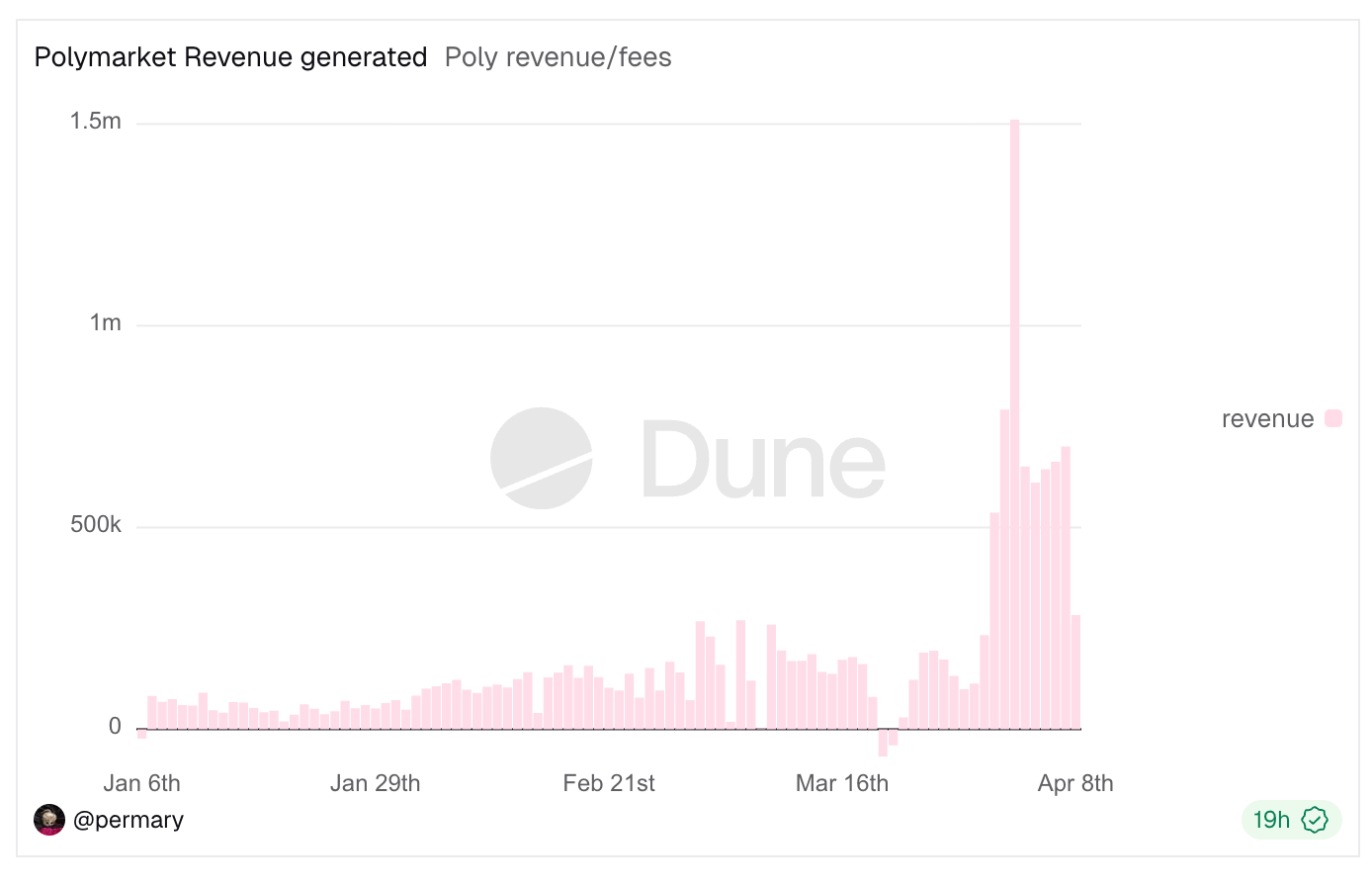
The latest example is Polymarket, which has fully opened its fee gates. Since recently broadening its fee scope and revising its fee formula (recommended reading: "Hardcore Analysis of Polymarket's Fee Formula: How Did Extreme Rates of 90+% Emerge?"), Polymarket's revenue-generating capacity has significantly surged; as of publication, Polymarket's total fee income has exceeded $24 million, with a single-day record of $1.5 million in revenue on April 2.
Taking this opportunity, I browsed the revenue rankings on Defillama to see which businesses are still consistently making money during the bear market, and the results were quite surprising: The core businesses and revenue sources of the listed projects are quite clear, even "simple."
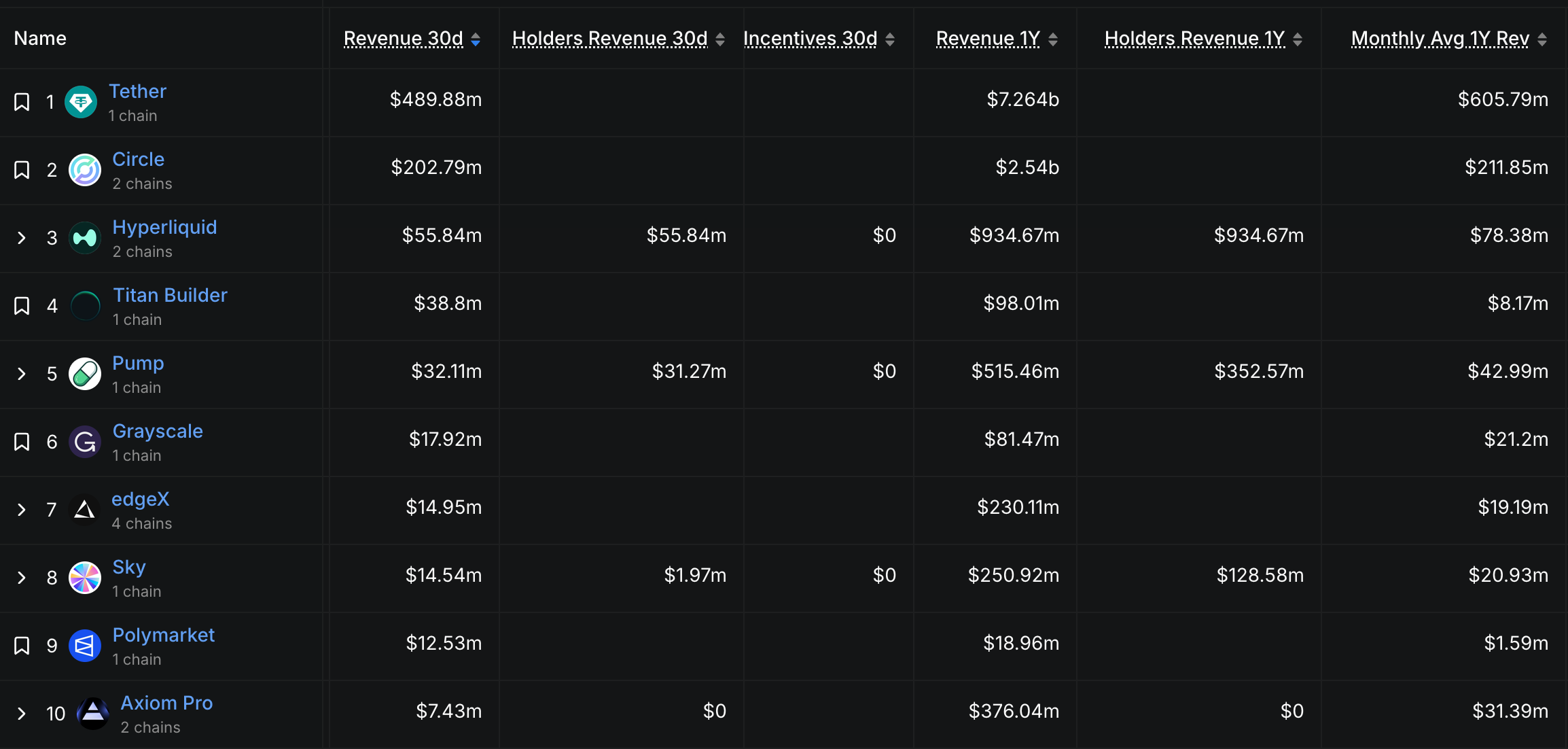
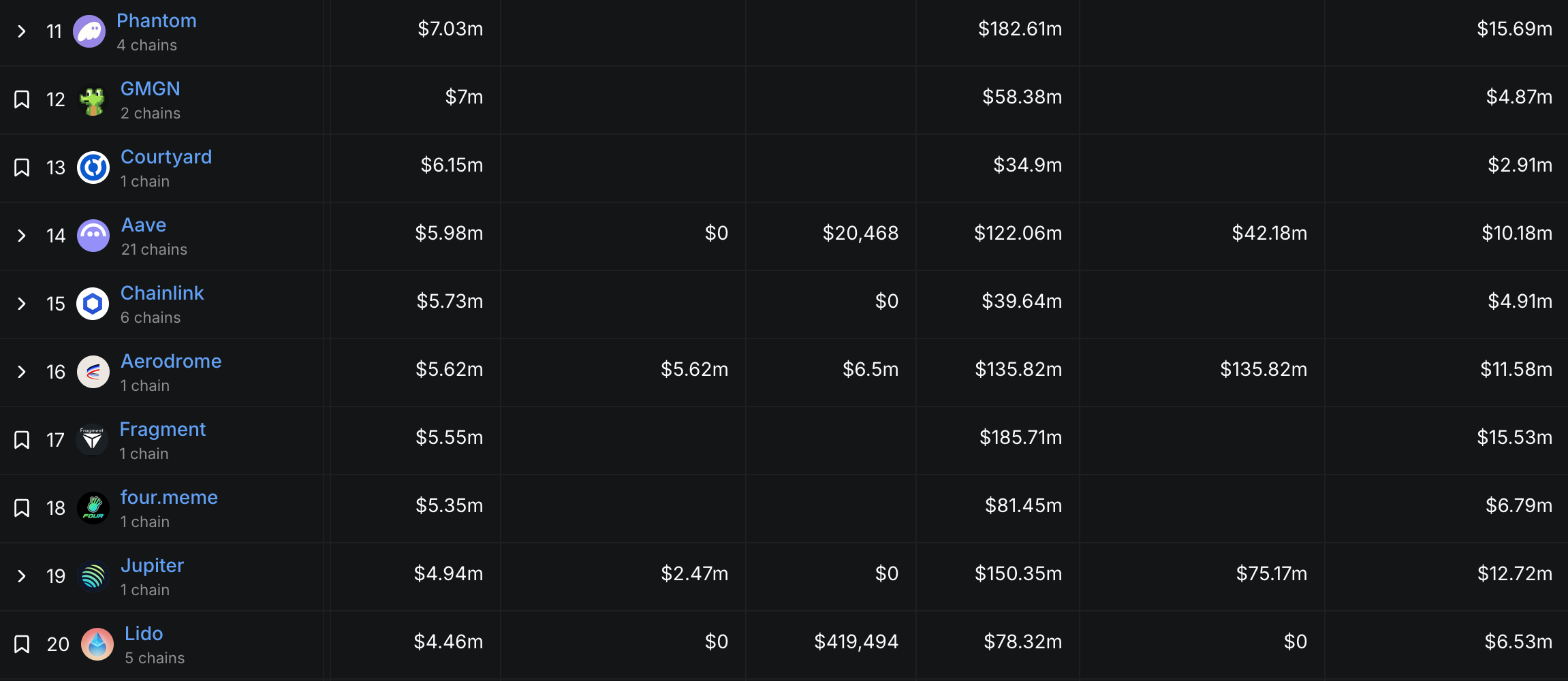
As shown above, I believe most players deeply involved in the crypto market could guess most of these names even without looking at the answers, and probably know exactly what they do. But when these names are neatly listed together, I suddenly realized that the main revenue sources of these profitable businesses are highly convergent, and can essentially be summarized into two broad categories: first, interest spreads, and second, transaction taxes (fees).
First, interest spreads: This is essentially acting as a "capital intermediary." The core logic is to absorb funds at relatively low costs and deploy them at relatively high returns, using time to gradually accumulate the difference between returns and costs — the profit of such businesses depends on the scale and duration of capital沉淀; the larger the scale and the longer the time, the higher the profit.
Tether, Circle, and other stablecoin issuers fall into this category. Their main income comes from the interest generated by deploying reserve funds into assets like U.S. Treasury bonds, while their costs mainly involve subsidies paid to partners and users. The difference between the two is the profit. Lending protocols like Aave also belong here, with the spread being the difference between the relatively higher borrowing rates and the relatively lower deposit rates. Liquid staking services (LST) like Lido are no exception; they withhold a certain percentage from ETH's native staking rewards as a service fee, which is also a form of interest spread.
Second, transaction taxes: This type of business is easier to understand. Whenever transaction-related activities (including token creation) occur, the business entity can "tax" the activity in the form of fees — the profit of such businesses depends on the transaction size per activity and the frequency of activities; the larger the size and the higher the frequency, the greater the profit.
Whether it's Hyperliquid and EdgeX focusing on contract trading, Polymarket focusing on event trading, pump.fun, GMGN, Axiom, and four.meme focusing on Meme trading, Aerodrome, Jupiter, and Phantom (whose main revenue comes from Swap fees on the wallet frontend) focusing on spot trading, or Courtyard and Fragment focusing on NFT trading (it's quite a surprise that this category even made the list), their primary revenue source is transaction taxes.
The only few special cases in the rankings are Grayscale, Chanilink, and Titan Builder. Grayscale is somewhat out of place here; its core revenue comes from ETF and fund management fees, essentially a traditional asset management business focused on the cryptocurrency market. Chanilink is definitely worth mentioning; its main revenue comes from data service fees paid by projects calling its oracle, making it more like a To B on-chain SaaS business. But as you can see, the Matthew effect in this path is more pronounced than in other sectors. Titan Builder is purely a sporadic phenomenon; it is a block-building service provider, not normally a particularly profitable business. The reason it made the list is because Titan Builder took the largest piece of the pie in last month's massive AAVE transaction sandwiching incident (details in "50 Million USDT for 35,000 AAVE: How Did the Disaster Happen?").
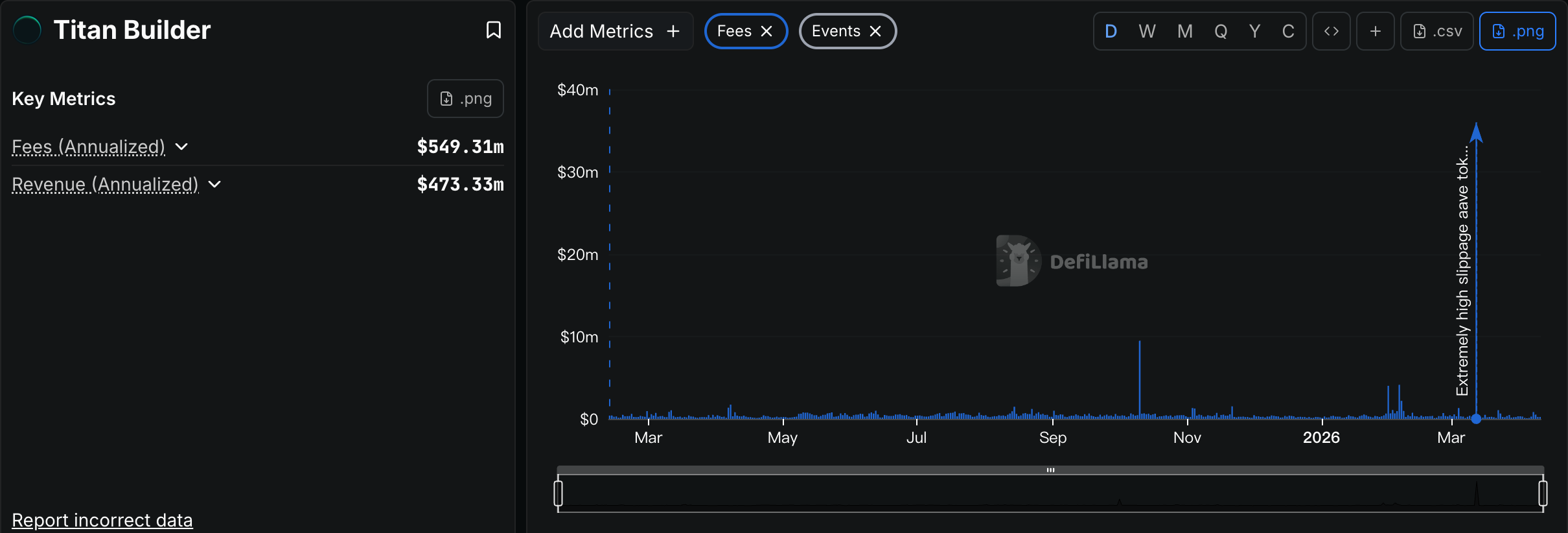
Odaily Note: See what it means to not open for business for three years, but eat for three years when you do.
So the conclusion is clear. Projects that continue to make money during the bear market are not those pursuing complex mechanisms and high-risk opportunities, but those that can operate consistently with simple, clear revenue models. In the still volatile cryptocurrency market, simpler revenue models have demonstrated greater resilience and better withstand the test of market fluctuations.
However, a simpler revenue model absolutely does not mean these businesses are "easier to run." On the contrary, behind the simple revenue models often lie more complex product services and meticulous operational management. This is where the leading players on the list have truly "differentiated" themselves through intense competition. From interaction design, to liquidity accumulation, to risk management, to user communication and feedback... To stand out in the fierce competition of the存量 market, one must invest more effort into product and service.
The crypto winter is not over yet. The projects that can truly survive and even profit are often those that flexibly combine simple revenue models with complex product services. Perhaps, this is the long-term code to navigate through bull and bear markets.