Illegal Miners Threatened with Criminal Punishment. What to Prepare For

RBK-cryptoPubblicato 2025-12-09Pubblicato ultima volta 2025-12-09

Introduzione

Russian authorities plan to introduce both administrative and criminal liability for illegal cryptocurrency mining, as announced by Deputy Prime Minister Alexander Novak. The government aims to regulate the digital currency market and establish penalties for mining violations. Legal experts suggest that criminal charges should be reserved for cases involving significant public danger, such as large-scale damage to energy infrastructure or threats to grid stability, rather than duplicating existing laws. They argue that administrative fines are sufficient for minor offenses like small-scale home mining. The distinction between criminal and administrative liability will likely be based on the scale of damage and the amount of illicit income generated. A previous legislative draft proposed substantial fines for unregistered mining, but it was criticized for lacking proportionality. Amendments to both the Administrative and Criminal Codes are expected by 2026 to address these issues. Despite mining being legalized in Russia in 2024, an estimated 70% of miners remain unregistered due to challenges in legalizing previously imported equipment.

As stated by Deputy Prime Minister Alexander Novak at the meeting of the Council for Strategic Development and National Projects on December 8, the government plans to establish both administrative and criminal liability for violations related to cryptocurrency mining.

"We will legislatively regulate the issue of digital currency circulation, as well as establish administrative liability for violations of digital currency mining legislation and criminal liability for illegal mining," Novak said.

Lawyers explained to "RBC-Crypto" where the line between administrative and criminal liability might lie and what could influence the assessment of the severity of the crime.

"Eliminating the Gap"

Criminal liability for mining could make sense if it applies to socially dangerous consequences from illegal mining, rather than duplicating existing offenses, says Yuri Brisov, partner at Digital & Analogue Partners. He explained that criminal liability is considered justified when substantial harm to protected public relations can be caused or there is no other way to effectively stop the violation. Also, creating a separate offense is necessary to eliminate a gap.

Currently, Russian law has liability for electricity theft (Art. 158 of the Criminal Code), damage to power supply (Art. 165 of the Criminal Code), illegal entrepreneurship (if the activity is systematic and large-scale), and illegal miners are also usually subject to norms on tax evasion and violation of power grid operation rules, the lawyer said.

According to him, the problem is that these norms cover only specific aspects of illegal mining. If the new criminal article is targeted, for example, "illegal mining resulting in damage to energy infrastructure on a large scale" — this is not duplication, but gap elimination, the expert noted. He added that if the article is general ("mining without permission"), it will become redundant because the same thing is already addressed by administrative measures.

For comparison, the US does not have a separate criminal article for mining, but it has effective existing norms: energy theft, damage to public utilities, and collectively, these norms are sufficient for courts to effectively prosecute illegal mining, Brisov explained. A similar situation, he said, exists in Germany, France, and in general, the dominant approach in Europe is that there is no need to single out mining as a separate criminal offense if the basic norms work.

When the Damage is Too Great

In Russia, criminal liability for illegal mining could be justified when damage is caused to the energy system (or a threat to its stability is recorded) on a large scale, Brisov believes. According to him, this does not duplicate theft because damage can occur without theft, and it does not duplicate administrative liability because the latter is powerless against major violations.

"Large underground farms can create emergency loads on power grids, disable facilities, cause multi-million dollar damage, and administrative fines are clearly insufficient for such violations, as the public danger and potential damage are too great. At the same time, for 'home mining,' where the maximum risk is blowing the fuses in the house, fines are quite sufficient," the lawyer says.

Search for Justice

The line between criminal and administrative liability will most likely be determined by the amount of damage caused and the illegally obtained income, that is, by the volume of mined cryptocurrency, believes Denis Polyakov, head of the "Digital Economy" practice at the GMT Legal law firm.

The lawyer suggested that the draft law from the Ministry of Digital Development, which appeared this summer, will form the basis for defining the offenses. Polyakov recalled that the ministry proposed introducing administrative liability for illegal mining, illegal activities of mining infrastructure operators (MIO), and failure to submit reports to the Federal Tax Service on mined digital currency.

"The violation itself regarding 'illegal mining' consists of mining cryptocurrency on the territory of Russia without being included in the register. That is, to recognize a violation, it is sufficient to prove that a person is engaged in mining and is not included in the register," Polyakov explained.

According to him, the Ministry of Digital Development's draft law proposed the following fine amounts: from 200 to 400 thousand rubles for individual entrepreneurs and from 1 to 2 million rubles for legal entities. However, these fines were subsequently removed from the draft law, and one of the reasons was that the document proposed only administrative liability, the expert said.

"Effectively, this would mean that any violations, whether illegal mining with 3 ASICs (devices for cryptocurrency mining) or mining with 1000 ASICs, would be subject to the same measures of liability, which is not fair," Polyakov said.

According to him, simultaneous amendments to both the Administrative Code (KoAP) and the Criminal Code (UK) are expected in 2026. These changes should take into account the specifics of possible violations and their consequences, the lawyer says.

Other Proposals

Novak instructed to work on strengthening liability for illegal mining back in mid-July. Among the violations mentioned at the time were illegal connection to power grids, electricity theft, and violation of the mining ban.

In October, the State Duma proposed finalizing the Administrative Code regarding non-compliance with current requirements for cryptocurrency mining, and making electricity theft for mining a separate criminal offense. The latter initiative suggests that electricity theft for cryptocurrency mining is defined as an aggravating circumstance.

Mining was legalized in Russia in 2024, after which the industry began to "whiten," but the share of illegal business remains high — according to expert estimates, only about 30% of miners are officially registered. Industry participants cite the lack of a mechanism for legalizing equipment that was previously imported through gray schemes as the main reason preventing many miners from "coming out of the shadows," and call for this problem to be solved.

Arkham Announced "De-anonymization" of ZCash. Which Transactions Are Tracked

Tether Invested in Humanoid Robots. When Will They Be Launched

Only 7 Native Tokens Remain in the Green Since the Start of the Year. And It's Not Bitcoin

Letture associate

When Hyperliquid Takes Away Solana's "Internet Capital Markets" Script

The article discusses how Solana's vision of becoming the "Internet Capital Markets" is being challenged, primarily by the rise of Hyperliquid. While Solana positioned itself as a high-performance blockchain for tokenizing all global assets, its native token SOL has significantly underperformed, and its core narrative faces pressure. Hyperliquid, initially a perpetual contracts platform, has evolved into a specialized Layer 1 financial network. Its focused, trading-optimized design is attracting users and capital, suggesting a vertical L1 may be better suited for a core capital market than a general-purpose chain like Solana. This external competition was compounded by an internal $200M+ exploit on Solana's key derivatives protocol, Drift, creating a strategic vacuum. In response, Solana founder Anatoly Yakovenko heavily promoted the Phoenix protocol as a decentralized, composable alternative. However, Phoenix's trading volume remains far behind leading platforms. Solana supporters also launched critiques against Hyperliquid's decentralization, citing its limited validators and closed-source code. Critics countered that Solana's own decentralization metrics have weakened, and the foundation's overt backing of Phoenix caused friction with other ecosystem builders. The piece concludes that Solana risks losing the "Internet Capital Markets" race if it cannot regain dominance in derivatives, potentially remaining a meme coin hub rather than achieving its grand ambition of hosting all global assets.

marsbit1 h fa

When Hyperliquid Takes Away Solana's "Internet Capital Markets" Script

marsbit1 h fa

Trump Signs Executive Order, Kraken, Coinbase and Others May Gain Access to Fed Payment Channels

President Trump has signed an executive order, "Incorporating Financial Technology Innovation into the Regulatory Framework," pressuring the Federal Reserve to reassess its rules on granting non-bank financial companies—including crypto and fintech firms—access to its payment systems, specifically master accounts that connect to the Fedwire settlement system. Currently, such accounts are primarily reserved for depository institutions. The order mandates a review to determine if broader access is permissible and to establish an application process. This move, supported by figures like Senator Cynthia Lummis, aims to reduce barriers to innovation and lower public payment costs by fostering fairer competition. It does not grant immediate access but could pave the way for companies like Kraken, Coinbase, Ripple, and Circle to reduce reliance on intermediary banks, lowering costs and speeding up settlements. A key precedent is the Kansas City Fed granting Kraken's parent company a restricted master account in March, offering limited payment services without interest or credit privileges. This model is seen as a potential template for allowing controlled access while mitigating systemic risk. Other firms like Anchorage, Paxos, and BitGo, which hold specialized banking charters, are also well-positioned to apply. The banking industry, represented by the American Bankers Association, opposes easing access, arguing any institution handling bank-like payments must meet the same stringent regulatory, consumer protection, and risk-management standards as traditional banks. Their core concerns include potential systemic risks, compliance gaps in areas like anti-money laundering, and the diversion of liquidity from the traditional banking system. The outcome of the Fed's review will be crucial in determining whether and how crypto and fintech firms can integrate more directly into the core U.S. financial infrastructure, balancing innovation with financial stability.

marsbit1 h fa

Trump Signs Executive Order, Kraken, Coinbase and Others May Gain Access to Fed Payment Channels

marsbit1 h fa

The First Large-Scale Strike in the AI Era Comes from the Factories That Build AI

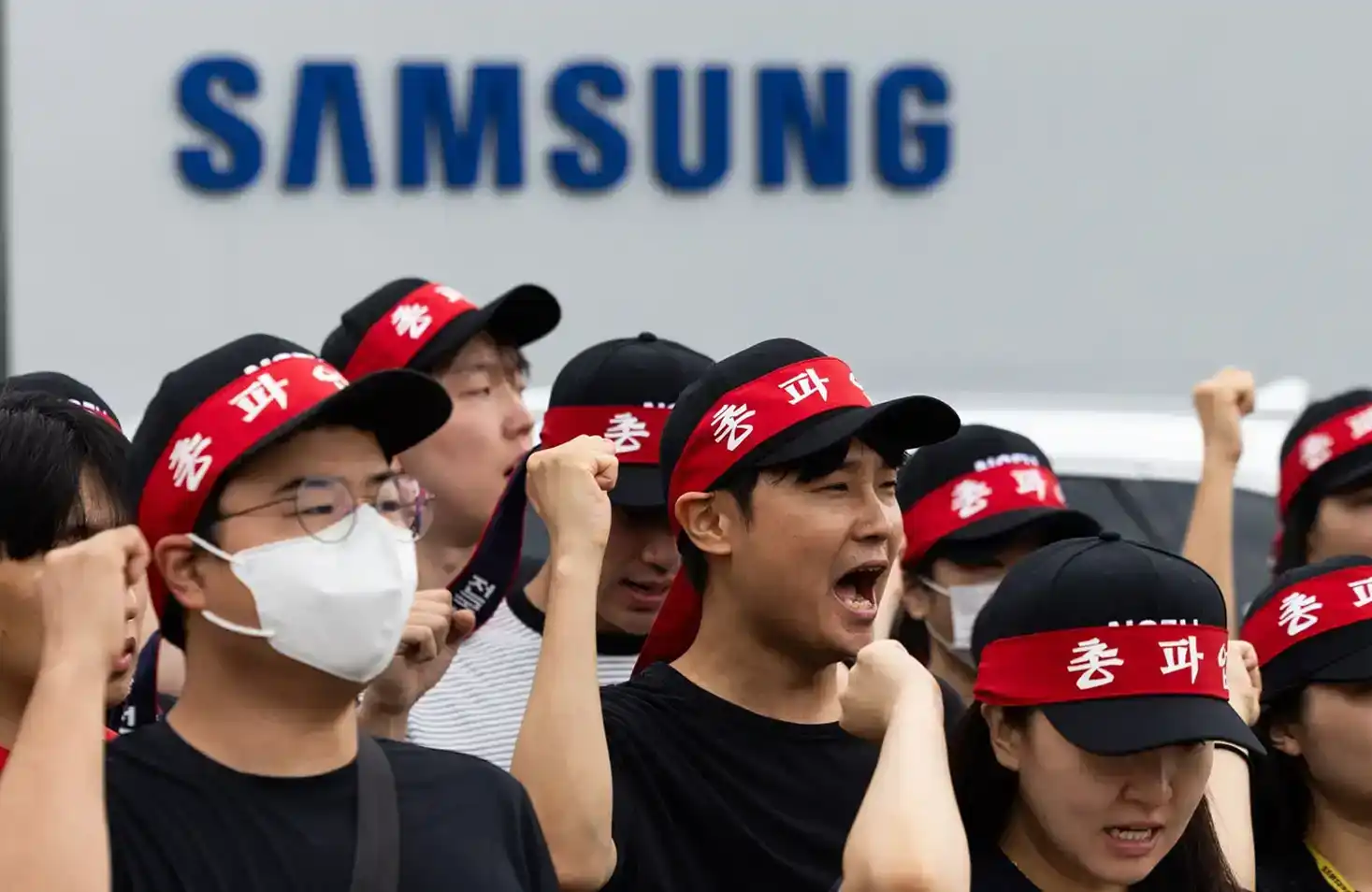
The article describes a potential large-scale strike at Samsung Electronics, narrowly averted in May 2026 after a temporary agreement. The strike, planned by the company's union, would have been the first major labor action in the AI era targeting a core AI supply chain player. Samsung, alongside SK Hynix, produces roughly two-thirds of the world's memory chips, critical components for AI training and data centers like HBM. An 18-day strike could have disrupted global supply, affecting prices and production for tech companies and cloud providers. For South Korea, where semiconductors constitute about 35% of exports and Samsung represents a quarter of the stock market's value, such an action threatens national economic stability. The union's demands include a 7% base wage increase and, crucially, a clear, substantial profit-sharing model. They want 15% of annual operating profit as an employee bonus pool and the removal of the existing cap (about 50% of annual salary). This frustration is amplified by seeing rival SK Hynix successfully negotiate a deal granting employees 10% of operating profit as bonuses, with reports suggesting some workers could receive bonuses equivalent to hundreds of thousands of dollars. The conflict stems from deeper issues in South Korea's chaebol (conglomerate) system, where rapid national industrialization often prioritized corporate growth over labor rights. Samsung long maintained a "no union" policy until a 2020 apology from its leader. The article argues this strike highlights a fundamental tension in the AI age: as technology advances and corporate profits soar—often driven by AI—the workers who build the infrastructure are demanding a fair share and dignity, rejecting the notion that they are mere expendable components in a machine that "must not stop." The piece concludes that the true test of the AI era isn't just computational power, but whether the people who build the future can secure a stable and valued place within it.

marsbit2 h fa

The First Large-Scale Strike in the AI Era Comes from the Factories That Build AI

marsbit2 h fa

Ripple’s Fed Master Account Bid Gains Momentum After Trump Order

President Donald Trump has signed an executive order directing financial regulators and the Federal Reserve to review expanding fintech and crypto firms' access to core payment infrastructure. This order significantly advances the industry's push for direct Fed connectivity, a central issue for Ripple. The company has been seeking a Federal Reserve master account as part of its strategy for its RLUSD stablecoin, which would allow it to hold reserves directly with the central bank and access its payment rails. The order, titled "Integrating Financial Technology Innovation into Regulatory Frameworks," mandates a Fed review within 120 days on allowing access for entities like uninsured depository institutions and non-bank financial companies, including those in digital assets. This creates a formal policy timeline for resolving whether crypto payment firms must rely on traditional bank intermediaries. Ripple's application for a national bank charter and a master account is part of this broader landscape. The issue gained precedent when Kraken Financial received a limited-purpose master account, while Custodia Bank's application was denied after a legal battle. The Fed has also proposed a more restricted "payment account" option. Trump's order does not guarantee approval for Ripple but forces a high-level examination of the regulatory barriers, bringing the company's long-running effort to the forefront of Washington's financial policy agenda.

bitcoinist2 h fa

Ripple’s Fed Master Account Bid Gains Momentum After Trump Order

bitcoinist2 h fa

Trading

Spot
Futures
活动图片