If U.S. Treasury Yields Soar Above 5%, Will Bitcoin Fall Below $50,000?

marsbitPubblicato 2026-03-25Pubblicato ultima volta 2026-03-25

Introduzione

An article explores the potential impact of rising U.S. Treasury yields above 5% on Bitcoin's price, suggesting it could fall below $50,000. The analysis is prompted by the recent U.S.-Israel conflict with Iran, which has driven oil prices higher and fueled inflation fears, pushing bond yields up. Historically, prolonged oil-related conflicts lead to sustained yield increases and pressure on risk assets like stocks. Given Bitcoin's high correlation with the S&P 500, similar downward pressure is expected. Technical analysis indicates a bearish flag pattern for Bitcoin, with a break below it potentially leading to a drop to $50,000 or lower. Prediction markets also show a high probability of Bitcoin falling below $55,000 in 2026. However, BitMEX co-founder Arthur Hayes notes that prolonged conflict might force the Fed to print more money, which could ultimately benefit Bitcoin.

Written by: Cointelegraph

Compiled by: AiddiaoJP, Foresight News

During the war between the U.S. and Iran, Bitcoin has been one of the strongest performing assets. However, as the bond market shows signs of being 'out of control,' Bitcoin's upward momentum is beginning to show signs of exhaustion.

Key Points:

  • If the U.S.-Iran war prolongs, the benchmark U.S. Treasury yield could rise by 200 basis points.
  • Historical experience suggests that oil-related conflicts tend to push up inflation and suppress risk appetite. Based on this, it is speculated that Bitcoin's price could fall below $50,000 in 2026.

Oil Supply Shock Could Push U.S. Treasury Yields Above 5%

Since the U.S. and Israel launched attacks on Iran on February 28, the benchmark 10-year U.S. Treasury yield has climbed to about 4.42%, hitting a nine-month high.
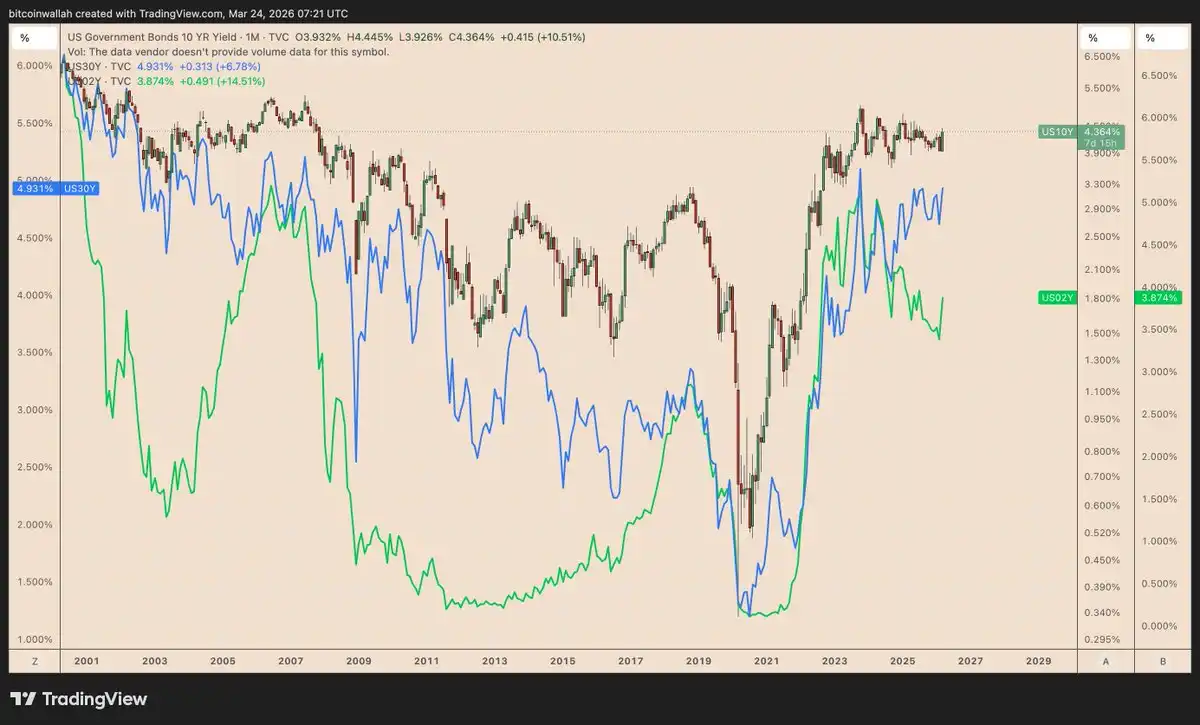
Monthly performance of U.S. 2-year, 10-year, and 30-year Treasury yields. Source: TradingView

Among them, the 30-year Treasury yield rose to about 4.97%, and the 2-year Treasury yield also increased to the range of 3.95% to 3.98%.

Affected by the war, oil prices have surged, exacerbating market concerns about rising inflation, thereby pushing Treasury yields higher. Against this backdrop, the market widely expects no rate cuts within 2026.

U.S. President Donald Trump announced a five-day suspension of operations, temporarily alleviating immediate concerns about strikes on Iranian energy facilities. However, as Iran denies any negotiations and cross-border attacks continue as of Tuesday, the conflict situation remains effectively uncontrolled.
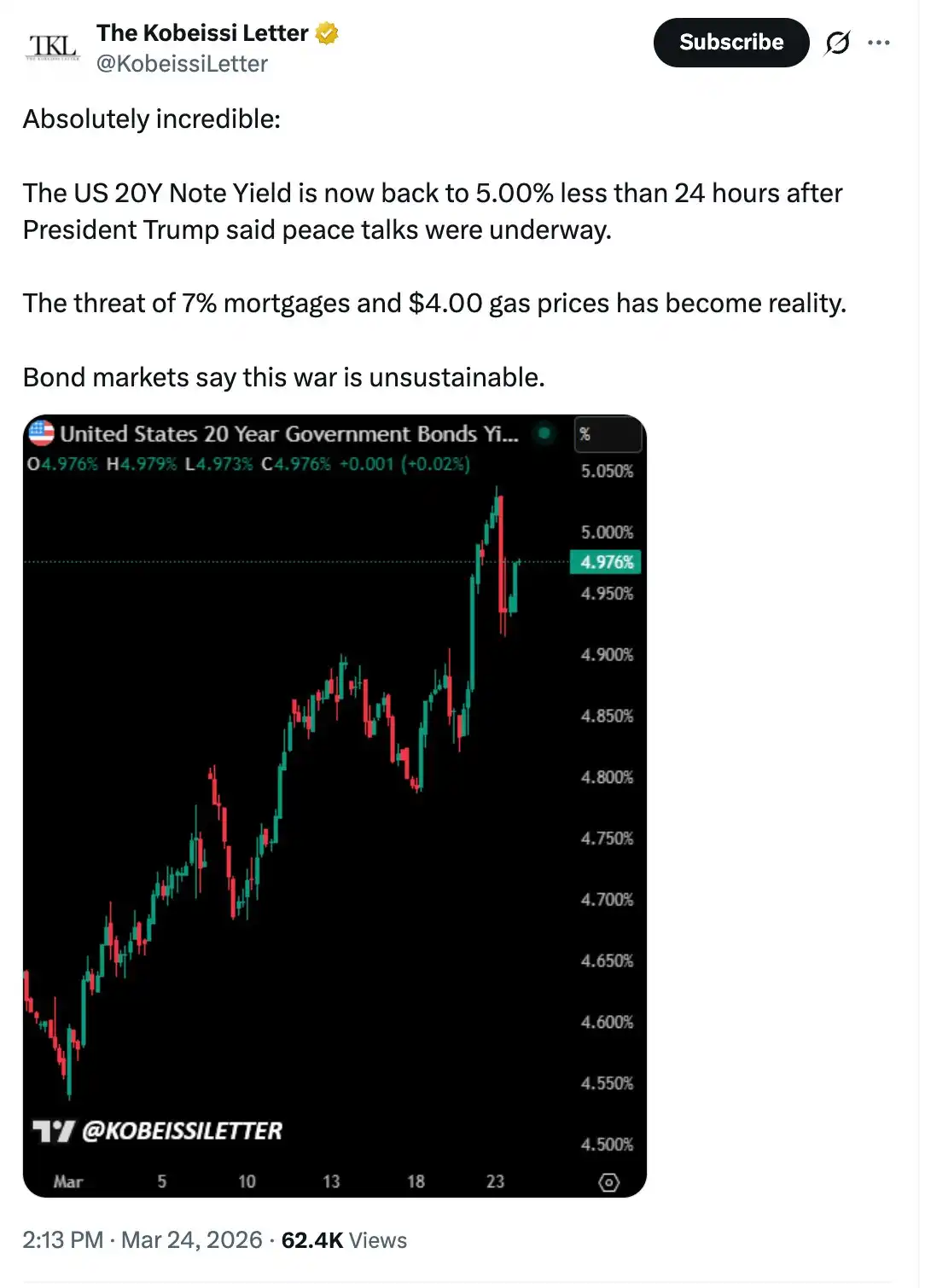
Source: X

Market observers have expressed concerns, believing that U.S. Treasury yields face further upside risks. Technical analysts further pointed out that if the 10-year Treasury yield breaks through the current symmetrical triangle pattern, it could rise by 200 basis points to 6.4%.
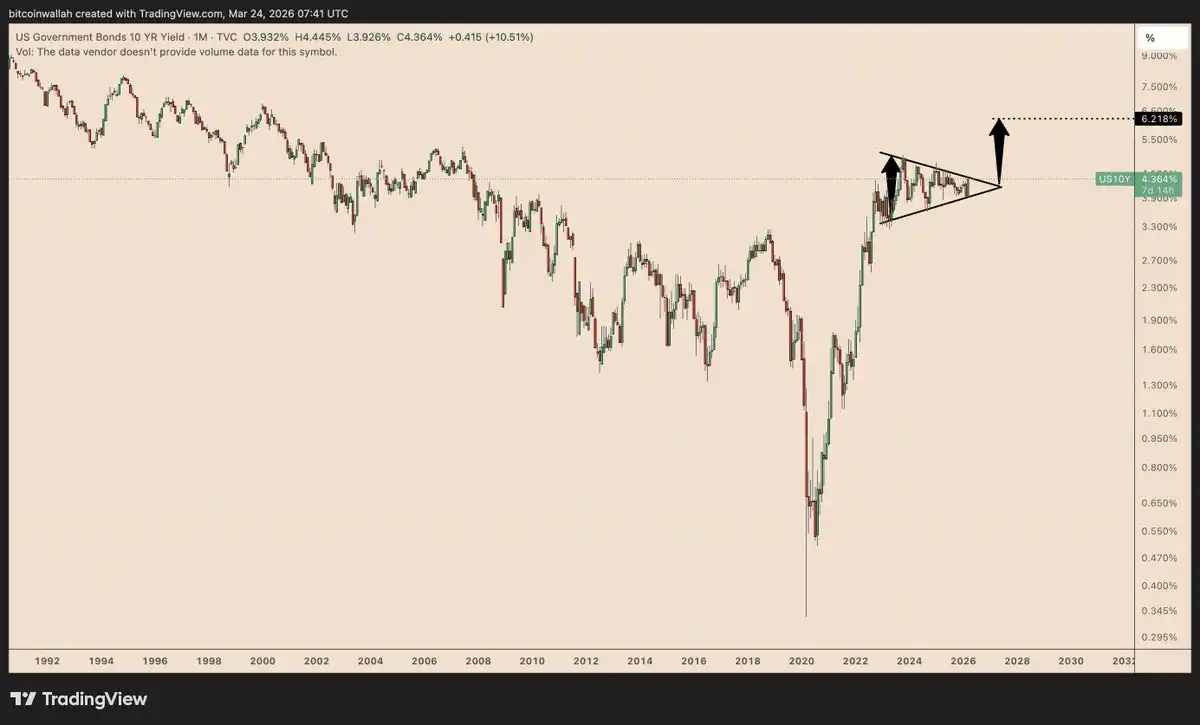
Monthly chart of U.S. 10-year Treasury yield. Source: TradingView

Rising yields increase the opportunity cost of holding risk assets such as stocks and Bitcoin. If Bitcoin continues to exhibit risk asset attributes, a break above 5% in the 10-year Treasury yield could trigger selling pressure in the Bitcoin market.

Historical Cases of Oil-Related Shocks

Historically, short-term oil-related conflicts typically cause sharp but brief fluctuations in Treasury yields and stock markets, while long-term supply shocks can push yields up persistently and suppress stock markets continuously.

During the 1973 Yom Kippur War and the Arab oil embargo, Treasury yields initially rose slightly, then climbed significantly as inflation intensified, with the S&P 500 index falling about 41% to 48% during the 'stagflation' phase.
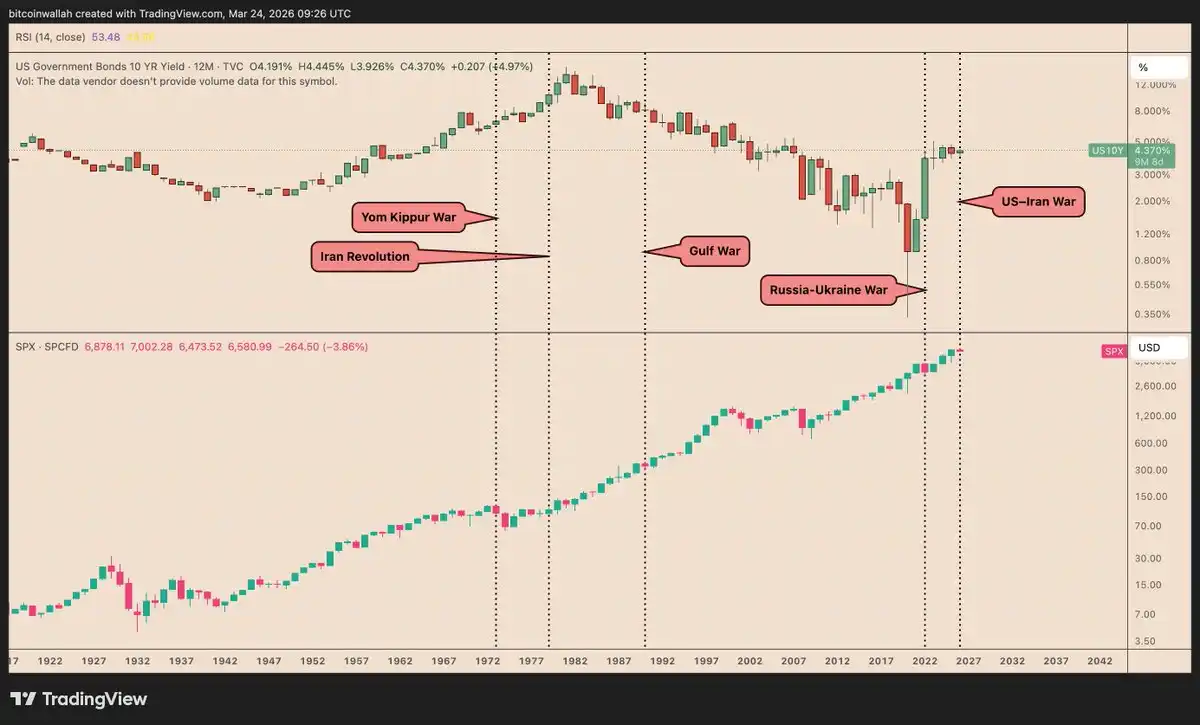
Annual chart of U.S. 10-year Treasury yield and S&P 500 index. Source: TradingView

During the 1979 Iranian Revolution, the bond market reaction was more intense, with the 10-year Treasury yield rising about 150 to 200 basis points in the following year, while the stock market correction was relatively moderate.

During the 1990-1991 Gulf War, the 10-year Treasury yield rose about 50 to 70 basis points, and the S&P 500 index fell about 16% to 20%, rebounding after the conflict was brought under control.

After the outbreak of the Russia-Ukraine conflict in 2022, there was also a rise in Treasury yields and a short-term drop of 5% to 10% in the S&P 500 index.

The current conflict between the U.S., Israel, and Iran seems to be in the early stages of these historical patterns. If the conflict escalates further and oil prices remain high, Treasury yields could rise further, and risk assets may face a new round of downward pressure.

Bitcoin still maintains a high correlation with the S&P 500 index. Therefore, unless the conflict situation eases quickly, Bitcoin's price is likely to face greater downward pressure.

To What Level Could Bitcoin's Price Drop?

From a technical analysis perspective, if Bitcoin's price breaks below the current bear flag pattern, it could further drop to $50,000 or even lower in the coming months.
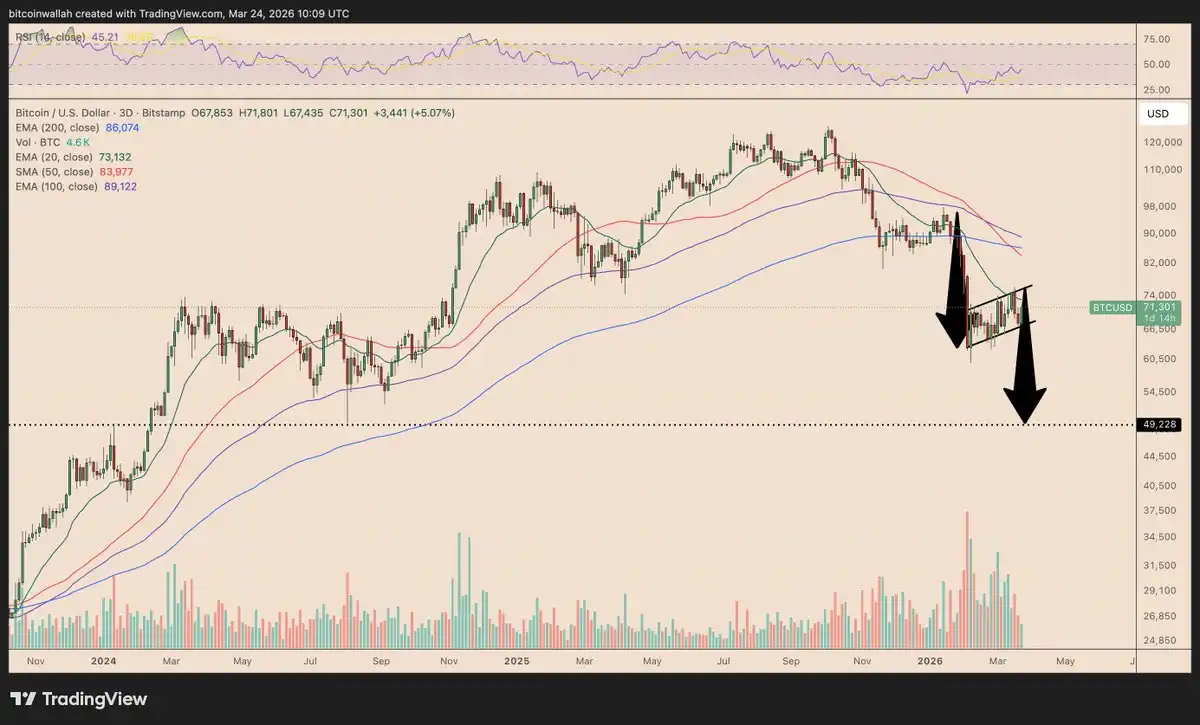
Bitcoin/USD three-day price chart. Source: TradingView

This technical expectation is largely consistent with trading data from prediction markets. Currently, traders estimate a 70% probability that Bitcoin will fall below $55,000 in 2026, and a 46% probability it will fall below $45,000.

BitMEX co-founder Arthur Hayes stated that if the U.S.-Iran war prolongs, it could force the Federal Reserve to adopt loose monetary policies, which would be a positive factor for Bitcoin.

He noted: 'The longer the conflict lasts, the more likely the Fed is to print money to support the U.S. war machine.' He further added:

'When central banks start printing money, I will choose to buy Bitcoin.'

Crypto di tendenza

Domande pertinenti

QWhat is the main concern regarding US Treasury yields and Bitcoin's price according to the article?

AThe article suggests that if the US 10-year Treasury yield rises above 5%, it could trigger selling pressure in the Bitcoin market, potentially causing its price to fall below $50,000.

QHow have oil-related conflicts historically impacted Treasury yields and risk assets like stocks?

AHistorically, short-term oil-related conflicts caused sharp but brief volatility in yields and stocks, while prolonged supply shocks led to sustained yield increases and prolonged stock market declines, as seen during the 1973 Yom Kippur War and the 1979 Iranian Revolution.

QWhat technical pattern does the article mention for Bitcoin's price, and what is the predicted downside target?

AThe article mentions a bearish flag pattern for Bitcoin's price. If this pattern breaks down, the price could decline to $50,000 or lower in the coming months.

QAccording to market traders, what is the probability of Bitcoin falling below $55,000 and $45,000 in 2026?

ATraders estimate a 70% probability of Bitcoin falling below $55,000 and a 46% probability of it dropping below $45,000 in 2026.

QWhat contrasting view does BitMEX co-founder Arthur Hayes present regarding the impact of prolonged US-Iran war on Bitcoin?

AArthur Hayes argues that a prolonged US-Iran war could force the Federal Reserve to adopt loose monetary policy and print money, which would ultimately be bullish for Bitcoin as he states, 'When central banks start printing money, I will choose to buy Bitcoin.'

Letture associate

The Verdict in Choi Tae-won's Divorce Case: Revealing the Inheritance Undercurrent Behind SK Hynix's Trillion-Won Empire

SK Group Chairman Chey Tae-won's high-profile divorce case, involving a record 1.38 trillion won settlement, has drawn attention to the succession plans for Korea's second-largest conglomerate, especially its crown jewel, SK hynix. Unlike traditional chaebol scripts centered on the eldest son, Chey's three children from his marriage to former President Roh Tae-woo's daughter, Roh Soh-yeong, are carving distinct, non-traditional paths. Eldest daughter Chey Yun-jung (b. 1989) is seen as the most evident successor. With a scientific and consulting background, she holds executive roles at SK bioscience and SK Inc.'s growth support department, focusing on future strategy and biopharma. Her marriage is to an AI infrastructure entrepreneur, not a traditional business alliance. Second daughter Chey Min-jung (b. 1991) took a unique route, voluntarily serving as a South Korean naval officer, including an anti-piracy deployment. She later worked on policy and strategy for SK hynix in Washington D.C. before co-founding an AI-driven healthcare startup. She married a former U.S. Marine Corps officer, connecting her to U.S. defense and policy circles—networks crucial for a global semiconductor giant. The only son, Chey In-geun (b. 1995), who studied physics like his father, worked briefly at SK E&S before joining McKinsey. Despite fitting the traditional "heir" profile as the eldest son, he remains silent and holds no public position or shares in SK, suggesting the old succession playbook is obsolete. As SK hynix's valuation soars, becoming a geopolitical asset in the AI era, the heirs' legitimacy is no longer automatic. They must prove themselves in fields like AI biotech, global policy, and strategic consulting. Their marriages also reflect new elite networks in tech and defense, not old political alliances. Their inheritance is the complex challenge of navigating a globalized, tech-driven world, not just a corporate throne.

marsbit7 h fa

The Verdict in Choi Tae-won's Divorce Case: Revealing the Inheritance Undercurrent Behind SK Hynix's Trillion-Won Empire

marsbit7 h fa

From OpenSea to OpenRouter: Is Alex Atallah Repeating His 'Exit at the Peak' Playbook?

From OpenSea to OpenRouter: Is Alex Atallah Repeating His "Exit at the Peak" Playbook? According to the Wall Street Journal, payments giant Stripe is in talks to acquire the AI model aggregation platform OpenRouter in a potential deal valuing the company near $100 billion. This would mark founder Alex Atallah's second creation of a company reaching a $100 billion valuation, following his co-founding of NFT marketplace OpenSea. OpenRouter, founded just over three years ago, has grown rapidly by acting as a unified gateway for developers to access over 400 AI models. It currently has about 10 million users and processes over 200 trillion tokens monthly. While the platform's annualized revenue is around $50 million, its valuation has skyrocketed from $1.3 billion in March 2026. The potential acquisition by Stripe, a company OpenRouter's founder once likened it to, represents a major expansion into AI infrastructure for the payments leader. This move echoes Atallah's previous timing with OpenSea, where he departed before the NFT market's significant downturn. For OpenRouter, selling now may be strategic. Despite its scale, its business model—charging a 5-5.5% fee on AI inference calls—faces pressure from competition, open-source models, and potential price wars among model providers, limiting its profitability narrative for an IPO. A key asset for potential acquirers like Stripe is OpenRouter's vast repository of real-world AI usage data, which offers unique insights into model performance and developer preferences that are difficult to replicate. Whether this potential deal signifies a new valuation benchmark for AI infrastructure or another market peak signal remains to be seen.

链捕手7 h fa

From OpenSea to OpenRouter: Is Alex Atallah Repeating His 'Exit at the Peak' Playbook?

链捕手7 h fa

Trading

Spot

Articoli Popolari

Come comprare WAR

Benvenuto in HTX.com! Abbiamo reso l'acquisto di WAR (WAR) semplice e conveniente. Segui la nostra guida passo passo per intraprendere il tuo viaggio nel mondo delle criptovalute.Step 1: Crea il tuo Account HTXUsa la tua email o numero di telefono per registrarti il tuo account gratuito su HTX. Vivi un'esperienza facile e sblocca tutte le funzionalità,Crea il mio accountStep 2: Vai in Acquista crypto e seleziona il tuo metodo di pagamentoCarta di credito/debito: utilizza la tua Visa o Mastercard per acquistare immediatamente WARWAR.Bilancio: Usa i fondi dal bilancio del tuo account HTX per fare trading senza problemi.Terze parti: abbiamo aggiunto metodi di pagamento molto utilizzati come Google Pay e Apple Pay per maggiore comodità.P2P: Fai trading direttamente con altri utenti HTX.Over-the-Counter (OTC): Offriamo servizi su misura e tassi di cambio competitivi per i trader.Step 3: Conserva WAR (WAR)Dopo aver acquistato WAR (WAR), conserva nel tuo account HTX. In alternativa, puoi inviare tramite trasferimento blockchain o scambiare per altre criptovalute.Step 4: Scambia WAR (WAR)Scambia facilmente WAR (WAR) nel mercato spot di HTX. Accedi al tuo account, seleziona la tua coppia di trading, esegui le tue operazioni e monitora in tempo reale. Offriamo un'esperienza user-friendly sia per chi ha appena iniziato che per i trader più esperti.

234 Totale visualizzazioniPubblicato il 2024.12.11Aggiornato il 2026.06.02

Come comprare WAR

Discussioni

Benvenuto nella Community HTX. Qui puoi rimanere informato sugli ultimi sviluppi della piattaforma e accedere ad approfondimenti esperti sul mercato. Le opinioni degli utenti sul prezzo di WAR WAR sono presentate come di seguito.

活动图片