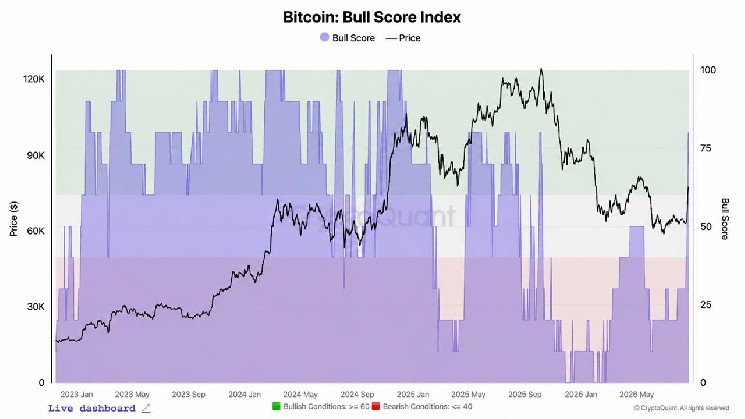
If MSCI Removes MSTR, Will the Stock Price Actually Fall? Historical Backtesting Reveals a Surprising Answer

marsbitPubblicato 2025-12-15Pubblicato ultima volta 2025-12-15

Introduzione

The article examines whether MSCI's potential removal of MicroStrategy (MSTR) from its index would actually cause a significant drop in its share price, based on historical backtesting. MSCI index changes can trigger forced selling by passive funds, reducing liquidity and investor confidence. However, historical data from the November 2025 MSCI rebalancing shows that most of the price decline for removed stocks occurred during the pre-announcement anticipation phase (average drop of 24.5%), not after the official announcement (average drop of only 0.7%) or on the effective date. Some stocks even rebounded after removal. MSTR has already fallen 51% from its October high, suggesting the market may have already priced in the risk of removal. Additionally, Nasdaq 100's recent decision to retain MSTR indicates strong fundamentals and liquidity. The core driver of MSTR’s price remains Bitcoin’s performance. If MSCI retains MSTR on January 15, it could be a positive surprise. The current setup may present an asymmetric risk-reward opportunity for MSTR.

The discussion about whether MSCI should remove MicroStrategy from its index has become a Sword of Damocles hanging over the company.

The market seems to be waiting for the official announcement on January 15th to deliver the final verdict on $MSTR.

How influential is MSCI really? If removed, will MicroStrategy's stock actually fall? I backtested historical data, and the answer is surprising.

Let's state the conclusion first: even if MSCI removes MSTR, it's highly likely that MSTR won't experience a significant drop because of it.

I. Why We Care About MSCI

First, we need to understand why MSCI's decision is so important.

The MSCI index is not just a simple list of stocks; it's the benchmark for trillions of dollars in global asset allocation.

1⃣ Forced Buying and Selling by Passive Funds:

Globally, trillions of dollars in ETFs (like iShares, Vanguard) and index funds strictly track the MSCI USA Index.

Once MSCI announces the removal of a stock, these funds must unconditionally sell that stock on the effective date (usually at the market close on the last day of the month), regardless of cost.

2⃣ A Double Blow to Liquidity and Attention:

Removal typically means the company is kicked out of the "core asset" club. Many actively managed funds, constrained by risk control rules (e.g., only allowed to invest in major index constituents), are also forced to follow suit and reduce their positions. This leads to decreased stock liquidity and a lower valuation benchmark.

II. Echoes from History: The Big Drop Often Happens *Before* the Announcement

However, based on my backtest of data from the last MSCI index review, the decline often doesn't begin on the day of the index adjustment.

The rule in financial markets is: the price always moves ahead of the news.

The most recent MSCI index adjustment occurred this November, removing companies like Whirlpool, Sensata, and ZoomInfo.

The timeline for an MSCI index adjustment is as follows:

November 5th: Announcement of the changes

November 25th: Changes become effective

Through calculation, I found that the maximum decline for the removed stocks did not occur *after* the removal took effect, but rather during the anticipation phase *before* the announcement.

The data is shown in the chart below
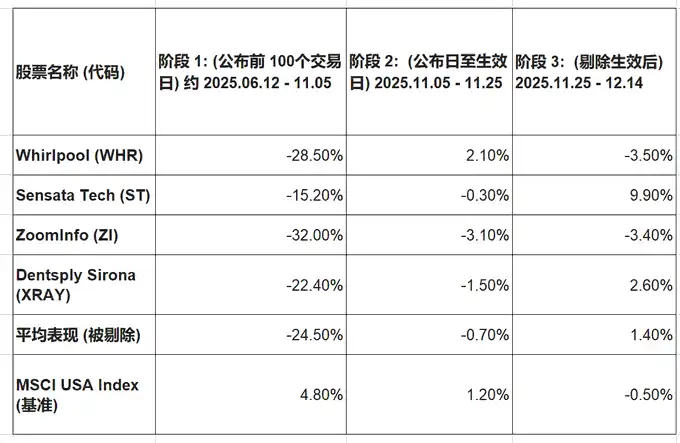
Phase 1 (Panic Brewing Period, 100 days before announcement):

During this period, stocks that were eventually removed fell by an average of 24.5%. The market anticipated the removal outcome in advance through deteriorating fundamentals and shrinking market capitalization.

Smart money had already front-run the move.

Phase 2 (Bad News Realization Period, Announcement day to Effective day):

When MSCI officially announced the removal list, stock performance was反而 stable, with an average decline of only 0.7%.甚至, individual stocks like Whirlpool (WHR)反而 saw a 2.1% rebound after the announcement.

Phase 3 (Post-Effect Recovery Period):

After the official removal took effect, some oversold individual stocks (like Sensata) even recorded gains of nearly 10%.

Overall, the average decline was 24.5% *before* the announcement, and 0.7% *after* the announcement.

Back to our protagonist 【MSTR】

MSCI announced in October that it was considering removing stocks of MSTR's type from the index.

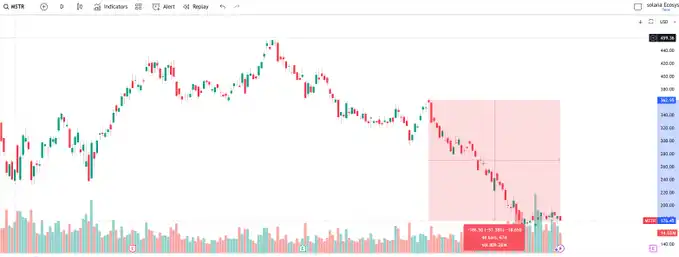
And MSTR's stock price has fallen 51% from its October high, far exceeding the decline in BTC over the same period.

Just like other companies removed from the MSCI index, the market has already started front-running the passive funds *before* MSCI's decision.
III. The Signal from the Nasdaq 100

When analyzing whether MicroStrategy will truly be removed by MSCI,

we cannot ignore a key leading indicator: the Nasdaq 100 index.

Although the Nasdaq 100 and MSCI USA indices have different construction rules, their core logic is highly overlapping: both place extreme importance on market capitalization and liquidity.

This past Friday, the Nasdaq 100 index announced it would retain MicroStrategy's constituent status.
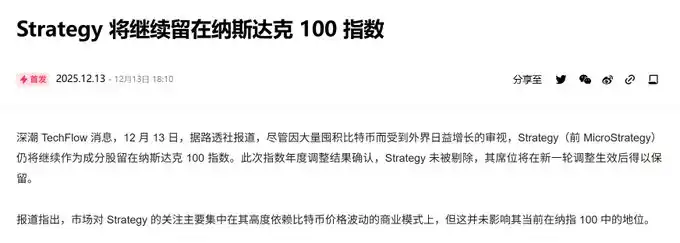
This means that, from an index compilation perspective, MicroStrategy's average daily trading volume and free-float market capitalization still meet the stringent standards for being among the top 100 largest non-financial technology companies in the US.

Since MicroStrategy managed to hold its ground in the Nasdaq 100, it indicates that its fundamentals and liquidity have not deteriorated to an irreparable point.

Although MSCI has its own qualitative industry classification considerations, in terms of hard metrics, MicroStrategy still possesses strong competitiveness.

Conclusion

MSCI potentially removing MSTR from its index is definitely a significant negative.

But negatives are often提前 priced in by the market. According to historical backtesting, the impact on the stock price after the negative news materializes is反而 not significant.

The core variable真正 affecting MSTR's direction right now is still the trend of BTC.

甚至, because MSCI's potential removal of MSTR is still only in the discussion phase, if the announcement on January 15th next year ends up retaining MSTR's constituent status, that would be a major positive. Retention = big rise! Removal = small fall. I believe MSTR presents an opportunity for asymmetric returns in the period ahead.


Domande pertinenti

QWhat is the main conclusion of the article regarding MSTR's stock price if it is removed from the MSCI index?

AThe main conclusion is that even if MSCI removes MSTR from its index, MSTR's stock price is unlikely to fall significantly, as the negative impact has likely already been priced in by the market.

QAccording to the historical backtest, when did the largest average price drop occur for stocks removed from the MSCI index?

AThe largest average price drop of 24.5% occurred during the 'panic fermentation phase,' which is the 100 days before the official announcement of the removal.

QWhat is the significance of the Nasdaq 100 index's recent decision regarding MSTR?

AThe Nasdaq 100 index's decision to retain MSTR as a component is a key leading indicator, suggesting that MSTR's average trading volume and free-float market cap still meet the stringent standards for a top-100 non-financial tech company, which could influence MSCI's decision.

QWhat does the article identify as the core variable that will truly influence MSTR's future price movement?

AThe article identifies the price movement of Bitcoin (BTC) as the core variable that will truly influence MSTR's future price direction.

QWhat potential asymmetric opportunity does the article suggest exists for MSTR?

AThe article suggests an asymmetric opportunity exists because if MSCI announces on January 15th that it will retain MSTR, it would be a major positive catalyst causing the stock to rise significantly, whereas a removal is expected to have only a minor negative impact, creating a favorable risk-reward scenario.

Letture associate

Google and Amazon Simultaneously Invest Heavily in a Competitor: The Most Absurd Business Logic of the AI Era Is Becoming Reality

In a span of four days, Amazon announced an additional $25 billion investment, and Google pledged up to $40 billion—both direct competitors pouring over $65 billion into the same AI startup, Anthropic. Rather than a typical venture capital move, this signals the latest escalation in the cloud wars. The core of the deal is not equity but compute pre-orders: Anthropic must spend the majority of these funds on AWS and Google Cloud services and chips, effectively locking in massive future compute consumption. This reflects a shift in cloud market dynamics—enterprises now choose cloud providers based on which hosts the best AI models, not just price or stability. With OpenAI deeply tied to Microsoft, Anthropic’s Claude has become the only viable strategic asset for Google and Amazon to remain competitive. Anthropic’s annualized revenue has surged to $30 billion, and it is expanding into verticals like biotech, positioning itself as a cross-industry AI infrastructure layer. However, this funding comes with constraints: Anthropic’s independence is challenged as it balances two rival investors, its safety-first narrative faces pressure from regulatory scrutiny, and its path to IPO introduces new financial pressures. Globally, this accelerates a "tri-polar" closed-loop structure in AI infrastructure, with Microsoft-OpenAI, Google-Anthropic, and Amazon-Anthropic forming exclusive model-cloud alliances. In contrast, China’s landscape differs—investments like Alibaba and Tencent backing open-source model firm DeepSeek reflect a more decoupled approach, though closed-source models from major cloud providers still dominate. The $65 billion bet is ultimately about securing a seat at the table in an AI-defined future—where missing the model layer means losing the cloud war.

marsbit5 h fa

Google and Amazon Simultaneously Invest Heavily in a Competitor: The Most Absurd Business Logic of the AI Era Is Becoming Reality

marsbit5 h fa

Computing Power Constrained, Why Did DeepSeek-V4 Open Source?

DeepSeek-V4 has been released as a preview open-source model, featuring 1 million tokens of context length as a baseline capability—previously a premium feature locked behind enterprise paywalls by major overseas AI firms. The official announcement, however, openly acknowledges computational constraints, particularly limited service throughput for the high-end DeepSeek-V4-Pro version due to restricted high-end computing power. Rather than competing on pure scale, DeepSeek adopts a pragmatic approach that balances algorithmic innovation with hardware realities in China’s AI ecosystem. The V4-Pro model uses a highly sparse architecture with 1.6T total parameters but only activates 49B during inference. It performs strongly in agentic coding, knowledge-intensive tasks, and STEM reasoning, competing closely with top-tier closed models like Gemini Pro 3.1 and Claude Opus 4.6 in certain scenarios. A key strategic product is the Flash edition, with 284B total parameters but only 13B activated—making it cost-effective and accessible for mid- and low-tier hardware, including domestic AI chips from Huawei (Ascend), Cambricon, and Hygon. This design supports broader adoption across developers and SMEs while stimulating China's domestic semiconductor ecosystem. Despite facing talent outflow and intense competition in user traffic—with rivals like Doubao and Qianwen leading in monthly active users—DeepSeek has maintained technical momentum. The release also comes amid reports of a new funding round targeting a valuation exceeding $10 billion, potentially setting a new record in China’s LLM sector. Ultimately, DeepSeek-V4 represents a shift toward open yet realistic infrastructure development in the constrained compute landscape of Chinese AI, emphasizing engineering efficiency and domestic hardware compatibility over pure model scale.

marsbit5 h fa

Computing Power Constrained, Why Did DeepSeek-V4 Open Source?

marsbit5 h fa

Trading

Spot
Futures

Articoli Popolari

Cosa è WL

I. Introduzione al ProgettoWorldLand è una L2 o side chain di Ethereum, progettata come una soluzione dal basso verso l'alto per migliorare l'ecosistema di Ethereum.II. Informazioni sul Token1) Informazioni di BaseNome del token: WL (WorldLand)III. Link CorrelatiSito web:https://worldland.foundation/Esploratori:https://bscscan.com/address/0x8aaB31fbc69C92fa53f600910Cf0f215531F8239Social:https://x.com/WorldLand_space Nota: L'introduzione al progetto proviene dai materiali pubblicati o forniti dal team ufficiale del progetto, che sono solo a scopo di riferimento e non costituiscono consulenza per gli investimenti. HTX non si assume alcuna responsabilità per eventuali perdite dirette o indirette risultanti.

294 Totale visualizzazioniPubblicato il 2026.03.28Aggiornato il 2026.03.28

Cosa è WL

Come comprare WL

Benvenuto in HTX.com! Abbiamo reso l'acquisto di WorldLand (WL) semplice e conveniente. Segui la nostra guida passo passo per intraprendere il tuo viaggio nel mondo delle criptovalute.Step 1: Crea il tuo Account HTXUsa la tua email o numero di telefono per registrarti il tuo account gratuito su HTX. Vivi un'esperienza facile e sblocca tutte le funzionalità,Crea il mio accountStep 2: Vai in Acquista crypto e seleziona il tuo metodo di pagamentoCarta di credito/debito: utilizza la tua Visa o Mastercard per acquistare immediatamente WorldLandWL.Bilancio: Usa i fondi dal bilancio del tuo account HTX per fare trading senza problemi.Terze parti: abbiamo aggiunto metodi di pagamento molto utilizzati come Google Pay e Apple Pay per maggiore comodità.P2P: Fai trading direttamente con altri utenti HTX.Over-the-Counter (OTC): Offriamo servizi su misura e tassi di cambio competitivi per i trader.Step 3: Conserva WorldLand (WL)Dopo aver acquistato WorldLand (WL), conserva nel tuo account HTX. In alternativa, puoi inviare tramite trasferimento blockchain o scambiare per altre criptovalute.Step 4: Scambia WorldLand (WL)Scambia facilmente WorldLand (WL) nel mercato spot di HTX. Accedi al tuo account, seleziona la tua coppia di trading, esegui le tue operazioni e monitora in tempo reale. Offriamo un'esperienza user-friendly sia per chi ha appena iniziato che per i trader più esperti.

219 Totale visualizzazioniPubblicato il 2026.03.28Aggiornato il 2026.03.28

Come comprare WL

Come comprare BASED

Benvenuto in HTX.com! Abbiamo reso l'acquisto di Based (BASED) semplice e conveniente. Segui la nostra guida passo passo per intraprendere il tuo viaggio nel mondo delle criptovalute.Step 1: Crea il tuo Account HTXUsa la tua email o numero di telefono per registrarti il tuo account gratuito su HTX. Vivi un'esperienza facile e sblocca tutte le funzionalità,Crea il mio accountStep 2: Vai in Acquista crypto e seleziona il tuo metodo di pagamentoCarta di credito/debito: utilizza la tua Visa o Mastercard per acquistare immediatamente BasedBASED.Bilancio: Usa i fondi dal bilancio del tuo account HTX per fare trading senza problemi.Terze parti: abbiamo aggiunto metodi di pagamento molto utilizzati come Google Pay e Apple Pay per maggiore comodità.P2P: Fai trading direttamente con altri utenti HTX.Over-the-Counter (OTC): Offriamo servizi su misura e tassi di cambio competitivi per i trader.Step 3: Conserva Based (BASED)Dopo aver acquistato Based (BASED), conserva nel tuo account HTX. In alternativa, puoi inviare tramite trasferimento blockchain o scambiare per altre criptovalute.Step 4: Scambia Based (BASED)Scambia facilmente Based (BASED) nel mercato spot di HTX. Accedi al tuo account, seleziona la tua coppia di trading, esegui le tue operazioni e monitora in tempo reale. Offriamo un'esperienza user-friendly sia per chi ha appena iniziato che per i trader più esperti.

456 Totale visualizzazioniPubblicato il 2026.03.30Aggiornato il 2026.03.30

Come comprare BASED

Discussioni

Benvenuto nella Community HTX. Qui puoi rimanere informato sugli ultimi sviluppi della piattaforma e accedere ad approfondimenti esperti sul mercato. Le opinioni degli utenti sul prezzo di A A sono presentate come di seguito.

活动图片