Identity, Recourse, Attribution: Decoding the Three Breakthrough Points of the Next-Generation AI Agent Economy

深潮Pubblicato 2025-12-22Pubblicato ultima volta 2025-12-22

Introduzione

Identity, Recourse, Attribution: Decoding the Three Breakthrough Points of the Next-Generation AI Agent Economy As AI agents begin to handle transactions, new standards like OpenAI's ACP and Google's AP2 are emerging to facilitate payments, while protocols like x402 enable machine-to-machine micropayments. However, these systems lack the trust infrastructure—identity verification, fraud detection, and dispute resolution—that underpins traditional commerce. This creates a critical gap: while blockchain enables fast, irreversible settlements, agents operate without mechanisms for recourse when errors occur. The solution requires building new layers for the agent economy: a "Know Your Agent" (KYA) identity system to establish persistent, verifiable credentials; a recourse mechanism to handle disputes and provide insurance-like protection; and an attribution layer to track influence on purchasing decisions. Established players like card networks and AI labs are unlikely to lead this effort due to misaligned incentives, creating opportunities for startups. The development of agent commerce will unfold in three stages: as an interface (current stage), executing under human supervision (where trust layers become critical), and fully autonomous transactions. Startups that build identity, recourse, and attribution infrastructure will enable the transition to an economy where agents transact freely and securely at scale.

Written by: Decentralised.co

Compiled by: AididaoJP, Foresight News

In the article "Internet Pricing," we once argued: when metered payments are frictionless, machines will automatically pay. Humans have not fully embraced micropayments because monitoring the metering process consumes energy and mental effort. But machines are different; they only see 1s and 0s. Mental capacity or task switching does not affect their execution ability. If breaking down to sub-cent levels makes the process more efficient, they will do it, unlike humans.

We ended the last article with a question: what happens when an agent messes up? It doesn't matter if the agent's intent is correct. The key point is, it's impossible to supervise the agent step by step.

This leaves us in a dilemma: the new technology fails to inherit a major advantage of the old infrastructure, such as the ability to reverse payments when things go wrong. This is precisely the issue this article will explore. We will discuss what is needed for agents to achieve autonomy, who is building the foundation for this, and why new startups are emerging at the intersection of blockchain payment channels and autonomous agents.

Emerging Standards

Any commercial activity involves three parties: the buyer, the seller, and the intermediary that enables the transaction. The intermediary can be a platform or marketplace like Amazon, or a card network like Visa that processes payments.
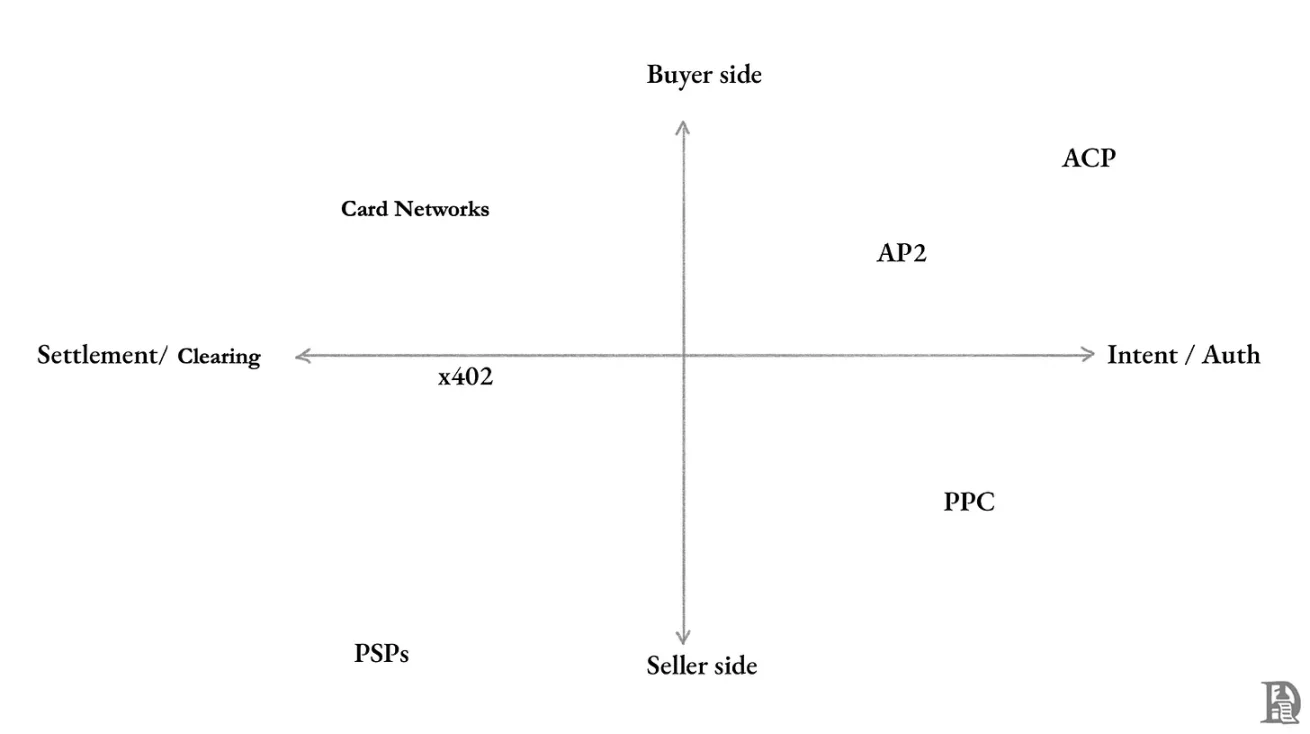
Buyer

Consumer applications are typically responsible for handling funds or transactions and take a cut. But what happens when the consumer is an AI acting on our behalf? Several emerging standards are currently seeking answers.

ChatGPT has 700 million active users, all trying to obtain information or services through AI. Although we are not yet directly buying and selling goods through agent interfaces, it is common to use it to "discover" goods. Whether buying running shoes or finding a hotel in El Calafate, I use AI for price comparison. It would be much more convenient to be able to purchase directly within the same interface. This is precisely the purpose of OpenAI's collaboration with Stripe to launch the Autonomous Commercial Protocol (ACP).
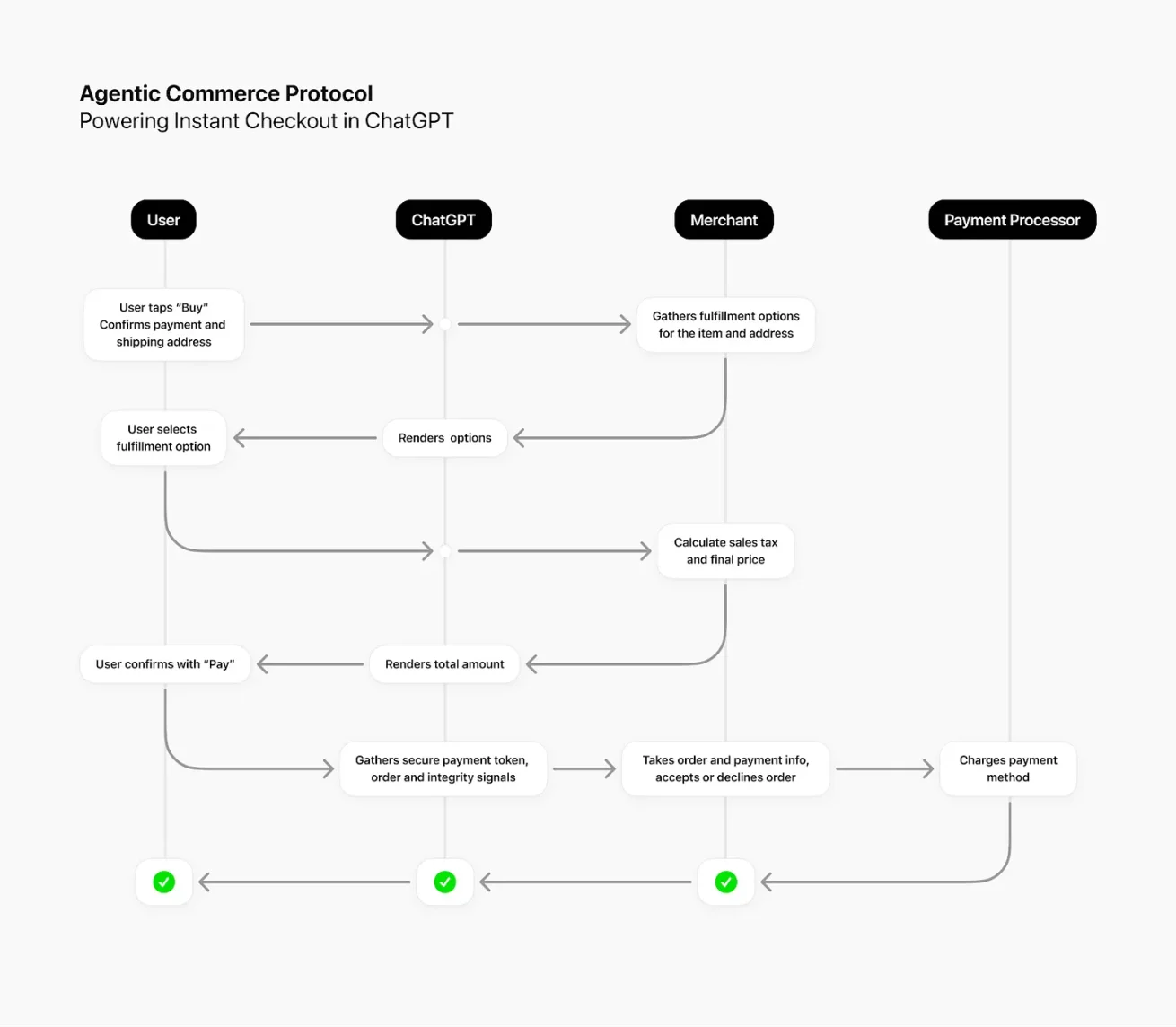
Source: OpenAI

This is currently the most direct way for agents to handle funds: the user is in control throughout. After the user places an order, ChatGPT sends the necessary information to the merchant's backend via ACP. The merchant then decides to accept or reject the order, processes the payment through their existing payment service provider, and handles shipping and customer service as usual.

Think of ACP commerce like this: you authorize an intern with a fixed budget, but you have the final say on which product/service to choose, from which merchant, and complete the payment.

OpenAI and Stripe have ACP, while Google has introduced the Agent Payment Protocol (AP2). Before diving into AP2, let's take a step back. Google wants to solve the "interoperability" problem. Currently, AI agents operate in silos: Gemini doesn't talk to Claude, and ChatGPT doesn't know what's happening in Perplexity.

Ideally, when tasks become complex and require collaboration, we want these agents to communicate using a common language. To this end, Google developed A2A (Agent-to-Agent Protocol), allowing different agents to communicate and coordinate.

But being able to talk is not enough. Agents also need to be able to use tools, access APIs, and services. The Model Context Protocol (MCP) allows agents to use tools like Google Calendar, Notion, Figma, etc.
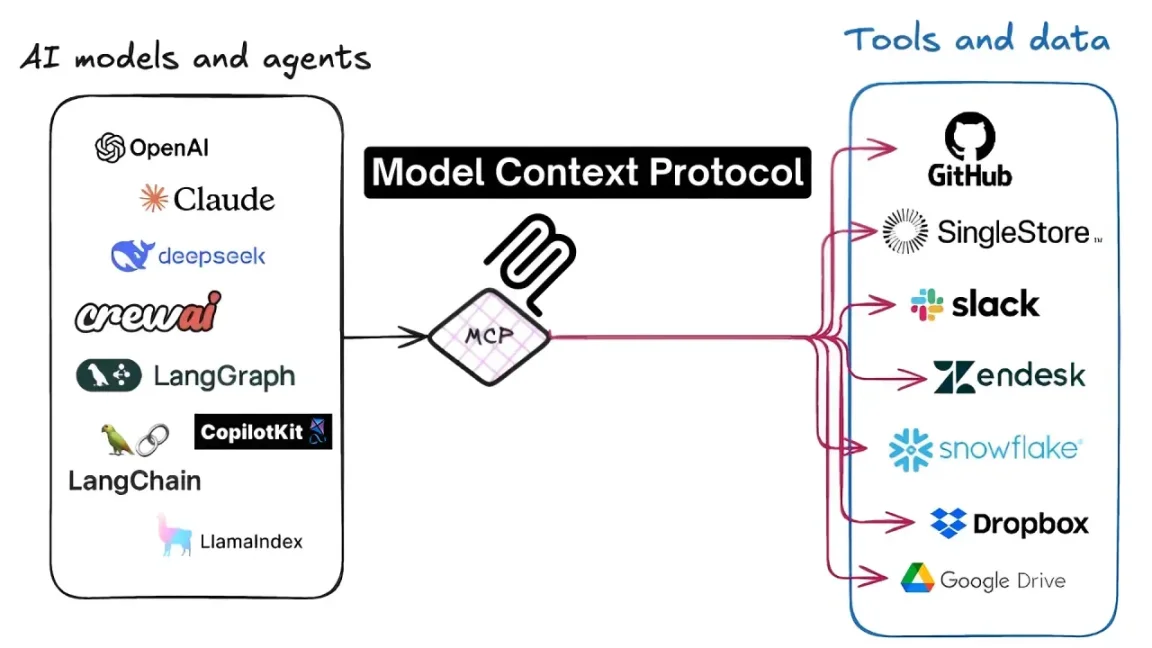
Source: Level Up Coding

MCP defines a universal language. As long as they all "speak" MCP, agents can use any tool without additional custom code. The protocol was created by Anthropic, but the specification is open and is being rapidly adopted by various companies. An MCP server is essentially a translation layer placed in front of a company's existing API, exposing the service in a standardized format to any MCP-compatible agent.

Back to AP2, it can be simply understood as: MCP gives agents the ability to obtain data, files, and tools; A2A gives them a voice to talk to each other; and AP2 gives them a wallet, allowing them to spend money safely.

All these protocols place the user at the control center, with agents having limited spending permissions. This solves the distribution and process problems, but none have yet solved: what to do when the agent makes a mistake?

Seller

The story isn't just happening on the buyer's side. New standards are also emerging on the seller's side, focusing on how machines pay for access to APIs, data, and content.

Currently, the most talked about is the x402 standard, an open protocol developed by Coinbase. It revives the HTTP status code 402—"Payment Required"—which was defined as early as 1997 but never used. x402 brings this status code back to life by combining it with stablecoin payments, making micropayments economically viable to settle.

x402 turns HTTP requests into paid requests. Whenever payment is required, the server makes the request. Since the agent has a preset budget, it pays the server and obtains the data within the same flow. This makes "pay-per-request" or "pay-per-call" feasible in machine-to-machine transactions.

With x402, agents can pay precisely for what they need at the moment. For example, spending 2 cents to read a paid article, or paying a fraction of a cent for an API call. Transactions settle on-chain in seconds, without the need to establish long-term relationships.
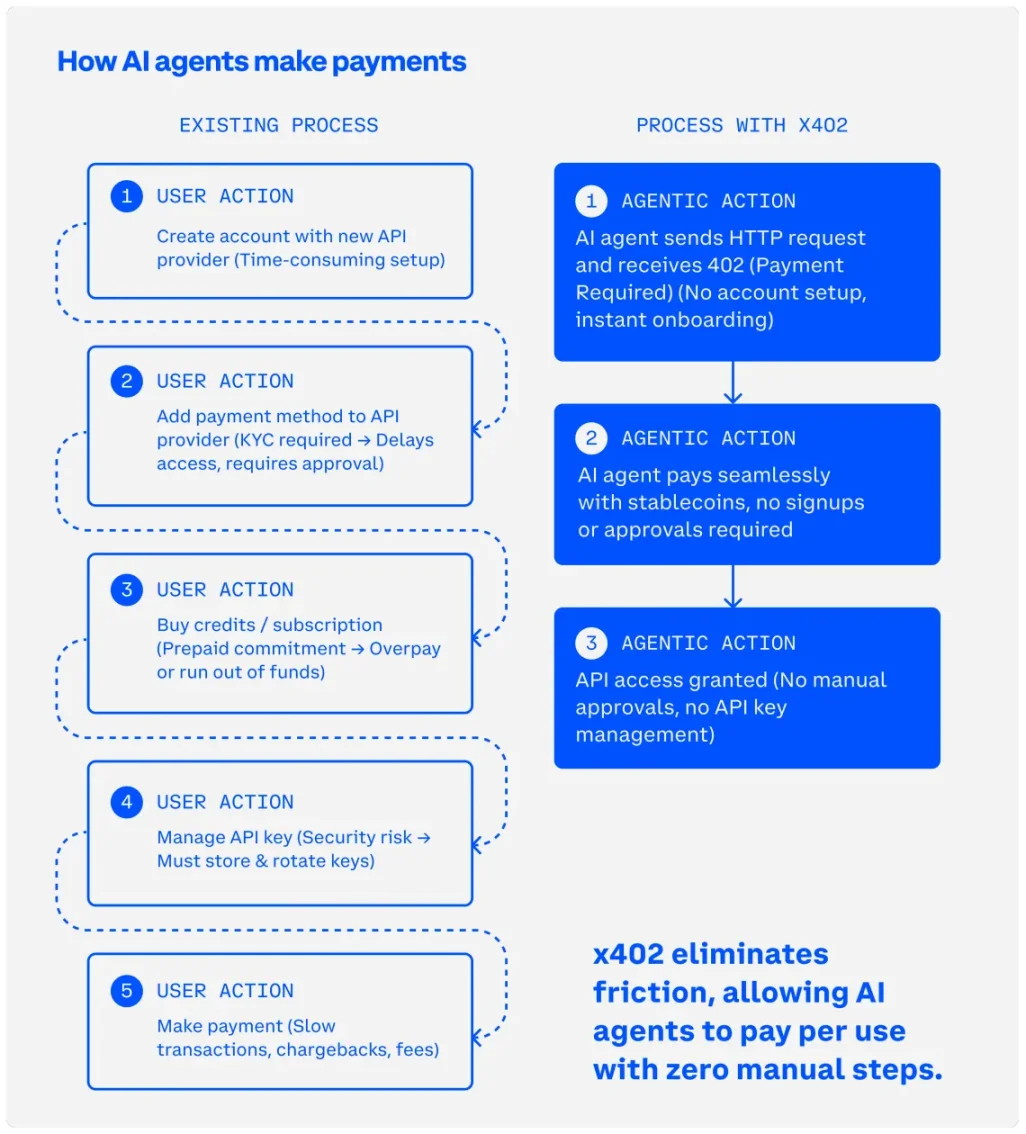
Source: Coinbase's x402 Paper

Cloudflare has borrowed this concept to build a more specific "Pay for Crawl" system. It also uses HTTP 402 underneath, but the key is Cloudflare's market dominance, with 20% of global web traffic passing through its network, giving it significant influence.

"Pay for Crawl" leverages Cloudflare's edge network to require payment before providing content to AI crawlers. This turns access to content into enforced metering. Publishers are facing plummeting traffic because people no longer click through to websites from search engines but instead read AI-generated summaries. Through this system, publishers can charge AI labs directly each time a crawler accesses their content.

Card networks are also trying to extend existing payment channels to handle agent transactions. Visa has launched an MCP server and an Agent Acceptance Toolkit. Mastercard has a project called "Agent Payments." Both are in early pilot stages, but they are important because Visa and Mastercard already have global distribution networks, issuer relationships, and extensive merchant acceptance networks. The basic idea is: register the agent, set spending controls, and allow the agent to initiate transactions on the existing human credit card payment network.

An Urgent Need to Fill the Trust Gap

All the above standards assume that payments will proceed smoothly and the results will meet expectations. ACP and AP2 involve humans at the checkout stage, providing some security. The x402 variants handle machine-to-machine data access, where risks are typically lower. Card networks extend their familiar protection mechanisms, but at the cost of slow settlement and high fees.

Achieving large-scale micropayments requires speed as the primary goal. Card payment networks take days to settle, and merchants pay a few percent of the transaction amount in fees. Cryptocurrency channels settle in seconds, costing less than a cent. But this efficiency comes with irreversibility; cryptocurrency payments cannot be reversed once completed.

Traditional commerce has built an entire infrastructure around "things that can go wrong." When something goes wrong with a credit card purchase, you have a process to follow: contact the bank, initiate a dispute, the card network investigates and temporarily withholds funds, and finally rules for a refund or supports the merchant. In 2025, there were 261 million disputed transactions, totaling $34 billion.

However, agents running on stablecoin channels have none of these protections.

The problem becomes more complex when agents start collaborating. When hundreds or thousands of multi-agent workflows intertwine, clarifying responsibility can become a nightmare.

Card networks will not take on this risk, at least not under their current profit model. Visa and Mastercard's agent projects still charge standard interchange fees, and settlement still takes days. They could move to instant stablecoin settlement, but that would mean abandoning the dispute handling system that forms the basis of their fees.

The dispute resolution mechanism in traditional finance was not inherent. The first credit card (Diners Club) appeared around 1950, but consumers waited another 24 years to gain the right to dispute transactions. The modern infrastructure we take for granted today was built gradually as problems emerged.

Autonomous agent commerce does not have this much time to waste. API requests already account for 60% of the dynamic HTTP traffic handled by Cloudflare. Bots and automated traffic already account for nearly half of web traffic. ChatGPT's 700 million users can already checkout directly on Etsy through ACP, and Shopify integration is coming soon. The transaction volume already exists, users have the potential need to handle tasks through agents, and it's only a matter of time before agents are used for commercial activities.

Therefore, we face a choice: do we let traditional financial infrastructure continue its slow settlement, or do we consciously build trust infrastructure to match fast blockchain settlement? The former will limit the potential of agents, while the latter is an opportunity and an inevitable extension of the development of autonomous agent commerce.

So, how exactly should it be done?

Unsurprisingly, this involves both pre-transaction and post-transaction parts.
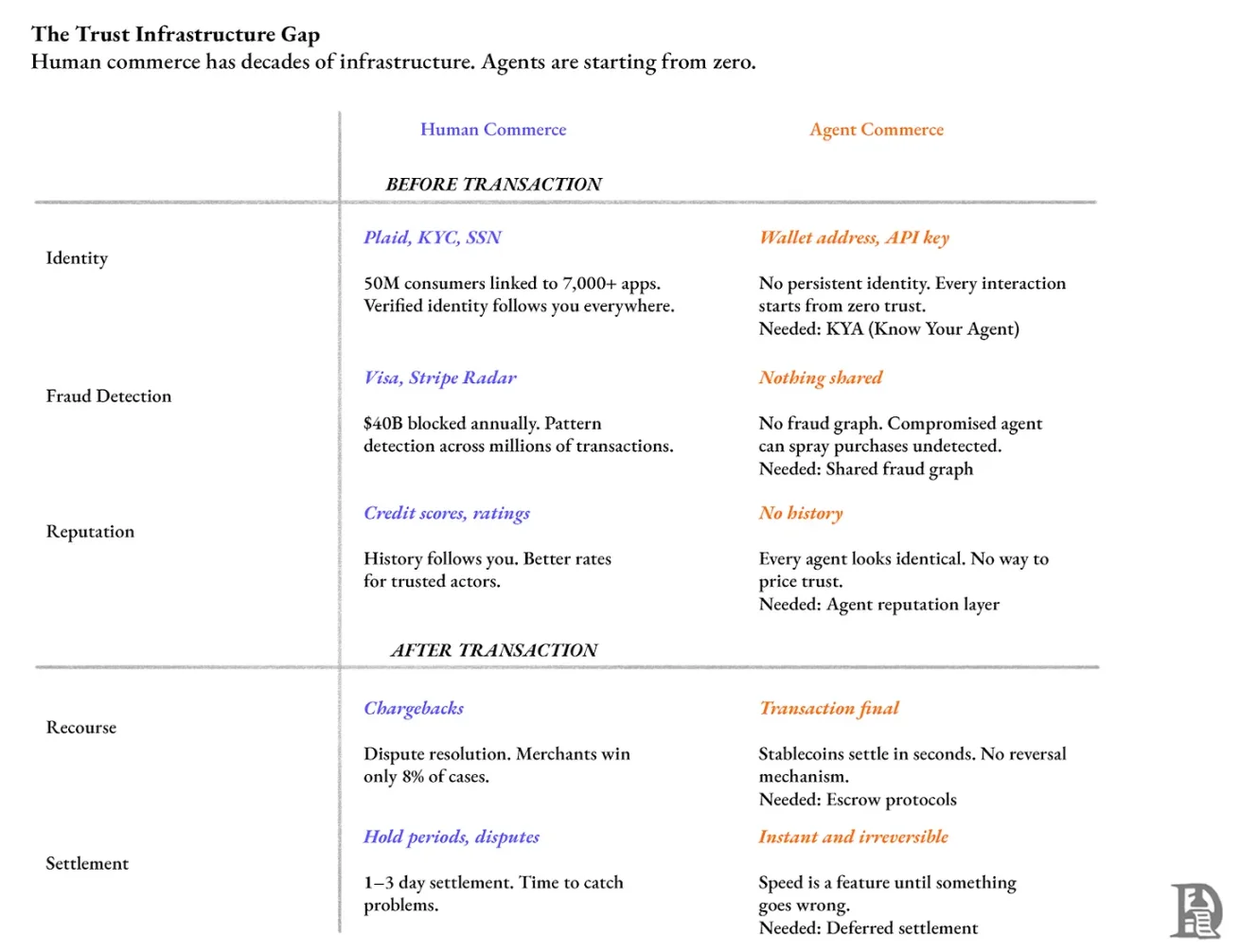
Pre-Transaction: Should the agent transaction be allowed?

This depends on three points: identifying the counterparty, fraud detection, and using reputation scores to determine pricing and access permissions.

In the US, Plaid connects nearly half of all bank accounts, processing millions of account verifications daily. When you verify your identity on Venmo, you are using Plaid.

Currently, any agent interacting with APIs, scraping web pages, or initiating payments lacks equivalent identity verification. The server sees only a vague ID (like a wallet address or API key), not knowing who the caller is. Without a universal identity across services, there is no way to accumulate reputation, and every interaction starts from "zero trust."

In 2024, US adults lost approximately $47 billion due to identity fraud.

We need a "Know Your Agent" (KYA) layer, similar to how Plaid provides identity infrastructure for fintech. It should issue persistent and revocable credentials, binding the agent to the human or organization behind it.

Card networks spent decades building systems that can identify suspicious patterns from millions of transactions. They understand normal human consumption behavior and can flag anomalies in real-time. If an agent is compromised and makes unauthorized purchases from multiple merchants, there is currently no shared fraud graph to detect it.

Visa claims that after investing $11 billion in security between 2019-24, its systems prevented $40 billion in fraud attempts. Stripe processes over $1.4 trillion in payments annually and uses this to train its Radar anti-fraud system. During Black Friday and Cyber Monday 2024, Radar prevented 20.9 million fraudulent transactions worth $917 million.

Agent transactions currently lack such a fraud detection layer. When an agent makes an x402 payment, there is no shared system to flag abnormal behavior, such as a surge in spending or abnormal frequency.

Without persistent identity and reputation, every agent interaction starts from zero. Reputation is deeply embedded in human commerce: the ads you see are based on browsing history, your Uber rating affects driver acceptance, and your credit score follows you to every financial institution. The same should be true for agents.

Post-Transaction: What to do if something goes wrong?

Chargebacks are how card networks handle disputes: after a customer disputes a transaction through their bank, funds are withdrawn from the merchant. But this is also often abused. In 2023, chargebacks cost merchants approximately $117.47 billion in losses. For every $1 lost to a chargeback, merchants typically bear an additional $3.75-$4.61 in other costs (including fees, loss of goods, and administrative overhead).
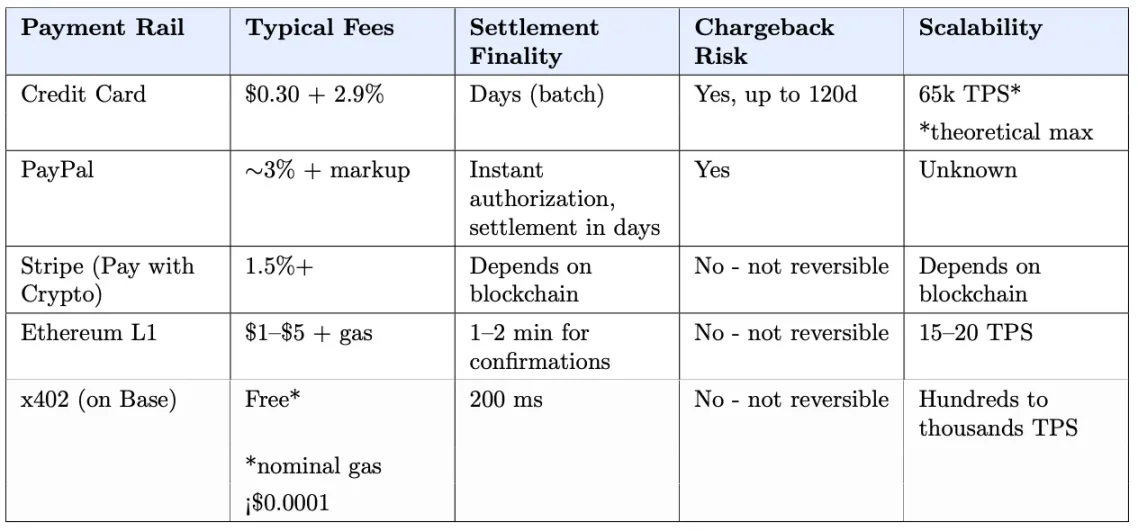
Source: Coinbase's x402 Paper

Merchants win only 8.1% of disputes they actively contest. 84% of customers believe it is easier to initiate a chargeback directly with their bank than to seek a refund from the merchant.

Agent-initiated stablecoin transactions settle in seconds and are currently irreversible. Cloudflare has proposed a delayed settlement extension to x402, allowing a "waiting period" to be set before funds are finally transferred.

Developers are already building prototypes of this infrastructure. At the ETHGlobal Buenos Aires hackathon, a team created Private-Escrow x402. Their escrow scheme is: the buyer pre-funds a smart contract, and when paying, signs a "payment intent" off-chain. A coordinator batches hundreds of such signatures into a single settlement transaction, reducing Gas fees by 28 times.

But this is just a basic component; it still needs to be productized.

Who will build all this?

This reminds me of the era when telecom operators dominated the industry. They owned the billing relationship for every mobile user but missed out on the value created by smartphones. App distribution and mobile advertising created hundreds of billions of dollars in revenue, which could have been captured by the operators.

Card networks now face a similar situation. What Visa and Mastercard built over decades is precisely the trust infrastructure lacking in the autonomous agent economy. But their business model relies entirely on interchange fees, and these fees exist precisely because they control the payment channels. They spent huge sums maintaining this facility, funded by a few percent of the transaction volume. Providing consumer protection for stablecoin transactions would mean subsidizing a competitor's payment channel with their own revenue.

If the card networks don't do it, the next candidates are AI labs like OpenAI, Google, and Anthropic. They all want their agents to be widely used. But operating a centralized identity registry means they must take responsibility when agents misbehave. They don't want to become the arbitration court for your "wrong hotel booking."

They would prefer a third party to build the identity and recourse infrastructure for them to plug into directly, just like they plug into payments or search engines today.

Cloudflare is in a unique position. They already handle massive web traffic, already run bot detection, and their "AI Audit" tool allows publishers to track crawler access. The technical leap from "identifying bots" to "verifying agent identity and reputation" is not huge.

But Cloudflare has always positioned itself as neutral infrastructure. Once it starts issuing trust scores or adjudicating disputes, it becomes more like a regulatory body—that's a different business and implies different responsibilities.

Three Entry Points for Startups

You can't beat OpenAI on model quality, nor can you surpass Cloudflare on traffic. You have to find parts of the tech stack that their business models (at least currently) don't allow them to touch, but where value still exists. I see three entry points: Identity, Recourse, and Attribution.

Agent Identity is the most straightforward. The registry model is proven. Although Plaid is a classic case, it's apt: they did identity verification for bank accounts. A startup could do the same for agents: issue credentials, accumulate reputation, and allow merchants to check reputation scores before accepting payment. Its moat comes from network effects: once enough merchants check through your registry, agents will be forced to maintain a good reputation record.

Recourse Mechanism is harder because it requires taking on risk. Think of it as insurance: charge a small fee per transaction and cover the loss when things go wrong. Scale is key. Card interchange rates are 1.5%-3%, which includes the cost of dispute handling. Stablecoin channel costs are much lower, so a recourse layer could provide comparable protection at a 0.5% fee and still be profitable.

Attribution Mechanism is the most forward-looking but will inevitably emerge. When agents start influencing purchasing decisions, brands will pay to influence the recommended content. Auction mechanisms can be designed. But it has a "cold start" problem, requiring brands, agents, and merchants to participate in a market together for it to work, unlike the first two entry points.

The importance of these three entry points changes with the stage of agent economic development:

  • Identity becomes critical when agents no longer require human approval for each transaction.

  • Recourse is essential when agents start handling real money.

  • Attribution will only start when the volume of transactions between agents is sufficient to support an advertising market.

This leads to the actual development trajectory:
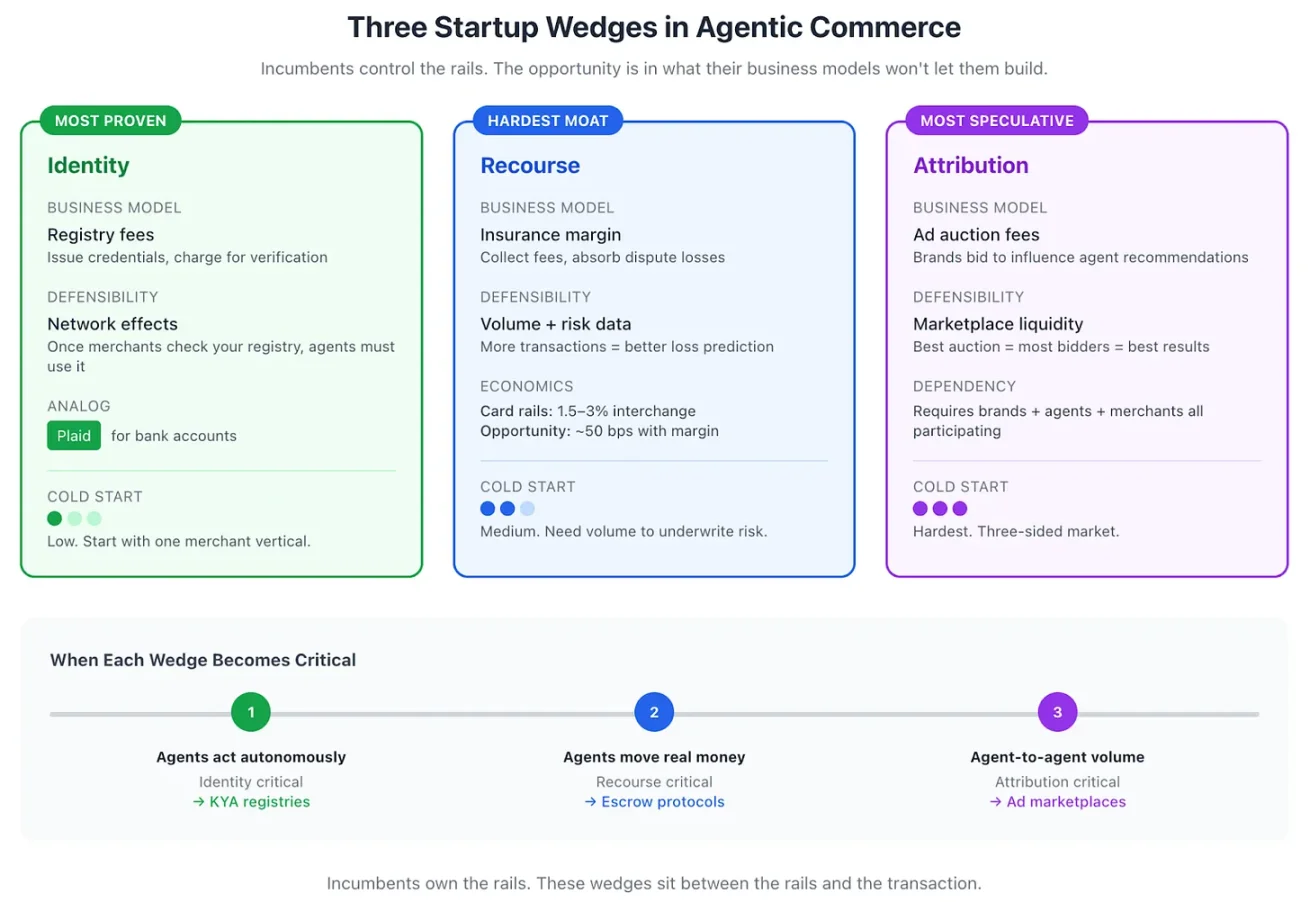
Source—Chart generated using Claude

Startups Will Build Part of the Agent Economy Infrastructure

The development of agents can be divided into three stages:

  • As an interaction interface

  • Executing under human supervision

  • Autonomously transacting with each other
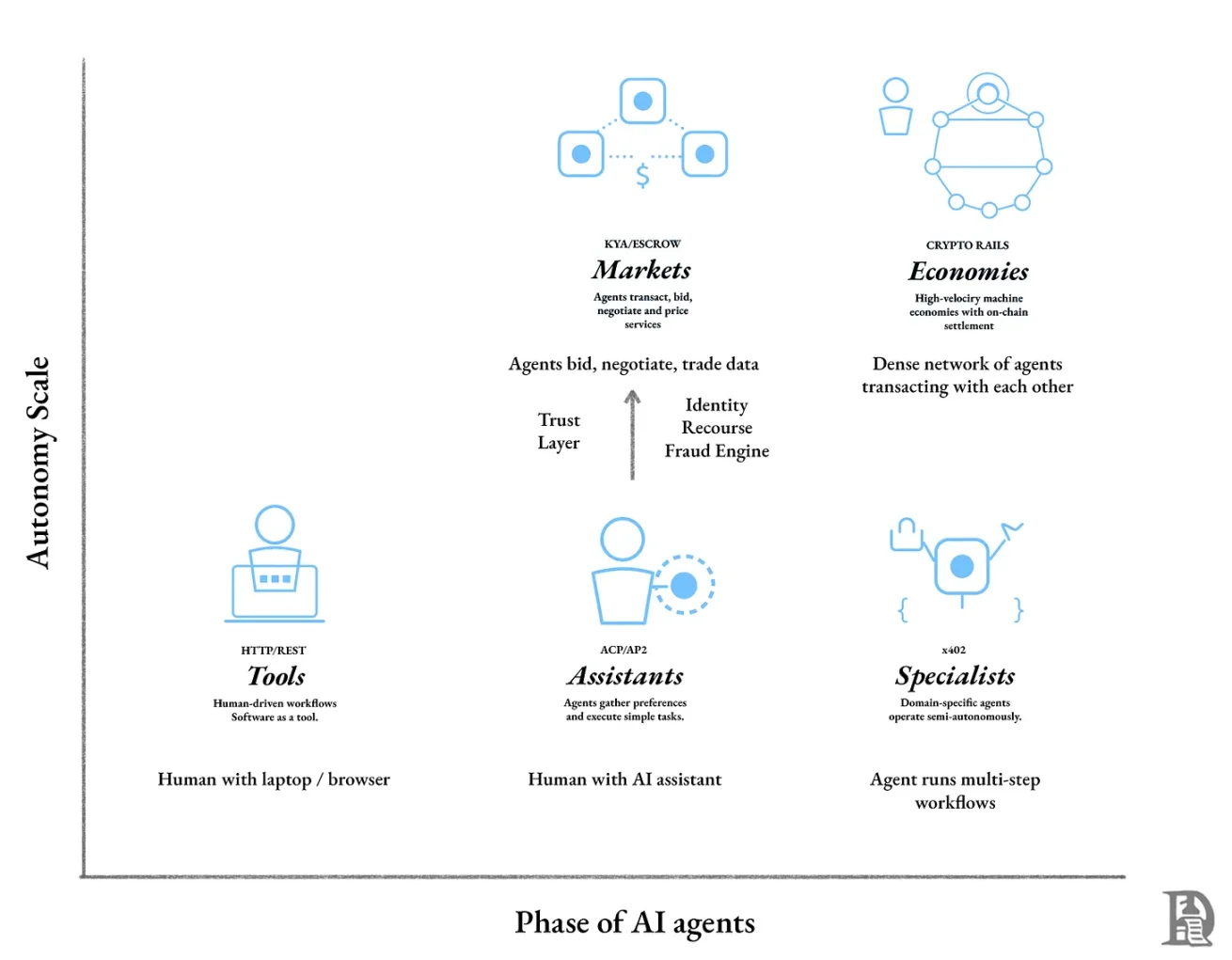
We are in the first stage. ChatGPT's Etsy checkout integration is a good example: we browse products in the chat interface (though not exclusively), the agent recommends options, but the human makes the final decision. Trust is entirely borrowed from existing facilities.

This stage belongs to the existing giants because it's a distribution game for争夺 the user entry point. Value accumulates with the players who own the interface where purchase decisions are made.

The second stage is marked by agents gaining more autonomy. Agents no longer just suggest itineraries but directly book flights, rent cars, and reserve hotels. We give goals or constraints, the agent executes, and we accept the results.

At this point, the trust layer becomes indispensable. Without a recourse mechanism, users will not authorize agents; without identity verification, merchants will not accept agent payments.

This is precisely the opportunity for startups. Existing giants may lack sufficient incentive to build trust facilities for stablecoin channels because they already have huge growth potential in the current stage (which they still dominate). OpenAI's revenue this year reached $13 billion. In comparison, Tether's profit in the first ten months of 2025 alone was $10 billion, with even higher annual profit expected.

The identity, recourse, and attribution layers will be built by new companies dedicated to solving the specific problems at the boundary of agent capabilities and user authorization.

The third stage is autonomous agent commerce. Your agent no longer needs to ask for routine decisions; it can negotiate with other agents, bid for computing resources, participate in advertising auctions, and continuously settle thousands of small transactions. Stablecoins, due to the volume, speed, and granularity required for machine-to-machine transactions, will become the default settlement layer.

The competitive focus at this stage will no longer be the best model or the fastest blockchain, but who builds the most trusted infrastructure: the "passport" for agents, the "court" for adjudicating disputes, the "credit system" that allows transactions beyond balances. These institutions for software services will determine which agents can participate in the economy and under what conditions.

Conclusion

We have laid the pipes for agents to "spend money," but we haven't built the mechanisms to verify "whether they should spend." HTTP 402 slept for thirty years and finally woke up because micropayments became feasible. The technical problems are solved. But the trust facilities that underpin human commerce, such as identity verification, fraud detection, and dispute resolution, still lack their agent counterparts. We solved the easy part. It will take time for agents to do business with each other with confidence.


Domande pertinenti

QWhat are the three key areas (breakthrough points) for the next-generation AI agent economy as discussed in the article?

AThe three key breakthrough points are Identity, Recourse, and Attribution.

QWhich protocol, developed by Coinbase, revives the HTTP 402 status code to enable machine-to-machine micropayments?

AThe protocol is called x402.

QWhat is the main limitation of using stablecoin channels for AI agent payments that creates a 'trust gap'?

AThe main limitation is that stablecoin payments are fast and irreversible, offering no built-in consumer protections like chargebacks or dispute resolution when transactions go wrong.

QAccording to the article, what are the three potential entry points for startups to build infrastructure for the agent economy?

AThe three potential entry points for startups are building solutions for Agent Identity, Recourse mechanisms, and Attribution systems.

QWhat is the role of the Model Context Protocol (MCP) in the AI agent ecosystem?

AThe Model Context Protocol (MCP) provides a common language that allows AI agents to use various tools and access APIs (like Google Calendar, Notion, Figma) in a standardized format, without needing custom code for each service.

Letture associate

TechFlow Intelligence Bureau: KelpDAO Attack Causes Nearly $300 Million Loss, Triggers Aave Withdrawal Wave, RAVE Crashes 95% in a Single Day

China's AI firm DeepSeek is seeking external funding for the first time, with a valuation exceeding $10 billion, signaling intensifying competition and high R&D costs in the domestic large model sector. Meanwhile, OpenAI CEO Sam Altman faces scrutiny over potential conflicts of interest between his personal investments and OpenAI’s business ahead of a possible IPO. In Web3, KelpDAO suffered a $294 million attack due to forged cross-chain messages on LayerZero, leading to massive withdrawals from Aave and a resulting 18% drop in AAVE tokens. Separately, RAVE cryptocurrency collapsed by 95% in a single day amid suspected insider manipulation. Geopolitically, Iran is now demanding Bitcoin payments for transit through the Strait of Hormuz, reflecting both internal governmental discord and the growing adoption of crypto in tense regions. In semiconductors, Nvidia CEO Jensen Huang showed rare public frustration over questions regarding chip sales to China, while the industry faces renewed price hikes. Tesla continues expanding its Robotaxi service, and a Chinese humanoid robot outperformed humans in a half-marathon, marking a milestone in robotics. Despite Middle East tensions and market uncertainties, U.S. stocks continue to rise, prompting discussions about market optimism versus risk blindness. Overall, today’s developments highlight systemic vulnerabilities—in tech, finance, and geopolitics—while also showcasing innovation in crises.

marsbit5 h fa

TechFlow Intelligence Bureau: KelpDAO Attack Causes Nearly $300 Million Loss, Triggers Aave Withdrawal Wave, RAVE Crashes 95% in a Single Day

marsbit5 h fa

Trading

Spot
Futures

Articoli Popolari

Cosa è GROK AI

Grok AI: Rivoluzionare la Tecnologia Conversazionale nell'Era Web3 Introduzione Nel panorama in rapida evoluzione dell'intelligenza artificiale, Grok AI si distingue come un progetto notevole che collega i domini della tecnologia avanzata e dell'interazione con l'utente. Sviluppato da xAI, un'azienda guidata dal rinomato imprenditore Elon Musk, Grok AI cerca di ridefinire il modo in cui interagiamo con l'intelligenza artificiale. Mentre il movimento Web3 continua a prosperare, Grok AI mira a sfruttare il potere dell'IA conversazionale per rispondere a query complesse, offrendo agli utenti un'esperienza che è non solo informativa ma anche divertente. Cos'è Grok AI? Grok AI è un sofisticato chatbot di intelligenza artificiale conversazionale progettato per interagire dinamicamente con gli utenti. A differenza di molti sistemi di intelligenza artificiale tradizionali, Grok AI abbraccia un'ampia gamma di domande, comprese quelle tipicamente considerate inappropriate o al di fuori delle risposte standard. Gli obiettivi principali del progetto includono: Ragionamento Affidabile: Grok AI enfatizza il ragionamento di buon senso per fornire risposte logiche basate sulla comprensione contestuale. Supervisione Scalabile: L'integrazione dell'assistenza degli strumenti garantisce che le interazioni degli utenti siano sia monitorate che ottimizzate per la qualità. Verifica Formale: La sicurezza è fondamentale; Grok AI incorpora metodi di verifica formale per migliorare l'affidabilità delle sue uscite. Comprensione del Lungo Contesto: Il modello di IA eccelle nel trattenere e richiamare una vasta storia di conversazione, facilitando discussioni significative e consapevoli del contesto. Robustezza Adversariale: Concentrandosi sul miglioramento delle sue difese contro input manipolati o malevoli, Grok AI mira a mantenere l'integrità delle interazioni degli utenti. In sostanza, Grok AI non è solo un dispositivo di recupero informazioni; è un partner conversazionale immersivo che incoraggia un dialogo dinamico. Creatore di Grok AI Il cervello dietro Grok AI non è altri che Elon Musk, un individuo sinonimo di innovazione in vari campi, tra cui automotive, viaggi spaziali e tecnologia. Sotto l'egida di xAI, un'azienda focalizzata sull'avanzamento della tecnologia AI in modi benefici, la visione di Musk mira a rimodellare la comprensione delle interazioni con l'IA. La leadership e l'etica fondamentale sono profondamente influenzate dall'impegno di Musk nel superare i confini tecnologici. Investitori di Grok AI Sebbene i dettagli specifici riguardanti gli investitori che sostengono Grok AI rimangano limitati, è pubblicamente riconosciuto che xAI, l'incubatore del progetto, è fondato e supportato principalmente dallo stesso Elon Musk. Le precedenti imprese e partecipazioni di Musk forniscono un robusto sostegno, rafforzando ulteriormente la credibilità e il potenziale di crescita di Grok AI. Tuttavia, al momento, le informazioni riguardanti ulteriori fondazioni di investimento o organizzazioni che supportano Grok AI non sono facilmente accessibili, segnando un'area per potenziali esplorazioni future. Come Funziona Grok AI? Le meccaniche operative di Grok AI sono innovative quanto il suo framework concettuale. Il progetto integra diverse tecnologie all'avanguardia che facilitano le sue funzionalità uniche: Infrastruttura Robusta: Grok AI è costruito utilizzando Kubernetes per l'orchestrazione dei container, Rust per prestazioni e sicurezza, e JAX per il calcolo numerico ad alte prestazioni. Questo trio garantisce che il chatbot operi in modo efficiente, si scaldi efficacemente e serva gli utenti prontamente. Accesso alla Conoscenza in Tempo Reale: Una delle caratteristiche distintive di Grok AI è la sua capacità di attingere a dati in tempo reale attraverso la piattaforma X—precedentemente nota come Twitter. Questa capacità consente all'IA di accedere alle informazioni più recenti, permettendole di fornire risposte e raccomandazioni tempestive che altri modelli di IA potrebbero perdere. Due Modalità di Interazione: Grok AI offre agli utenti la scelta tra “Modalità Divertente” e “Modalità Normale”. La Modalità Divertente consente uno stile di interazione più giocoso e umoristico, mentre la Modalità Normale si concentra sulla fornitura di risposte precise e accurate. Questa versatilità garantisce un'esperienza su misura che soddisfa varie preferenze degli utenti. In sostanza, Grok AI sposa prestazioni con coinvolgimento, creando un'esperienza che è sia arricchente che divertente. Cronologia di Grok AI Il viaggio di Grok AI è segnato da traguardi fondamentali che riflettono le sue fasi di sviluppo e distribuzione: Sviluppo Iniziale: La fase fondamentale di Grok AI si è svolta in circa due mesi, durante i quali sono stati condotti l'addestramento iniziale e il perfezionamento del modello. Rilascio Beta di Grok-2: In un significativo avanzamento, è stata annunciata la beta di Grok-2. Questo rilascio ha introdotto due versioni del chatbot—Grok-2 e Grok-2 mini—ognuna dotata delle capacità per chattare, programmare e ragionare. Accesso Pubblico: Dopo lo sviluppo beta, Grok AI è diventato disponibile per gli utenti della piattaforma X. Coloro che hanno account verificati tramite un numero di telefono e attivi per almeno sette giorni possono accedere a una versione limitata, rendendo la tecnologia disponibile a un pubblico più ampio. Questa cronologia racchiude la crescita sistematica di Grok AI dall'inizio all'impegno pubblico, enfatizzando il suo impegno per il miglioramento continuo e l'interazione con gli utenti. Caratteristiche Chiave di Grok AI Grok AI comprende diverse caratteristiche chiave che contribuiscono alla sua identità innovativa: Integrazione della Conoscenza in Tempo Reale: L'accesso a informazioni attuali e rilevanti differenzia Grok AI da molti modelli statici, consentendo un'esperienza utente coinvolgente e accurata. Stili di Interazione Versatili: Offrendo modalità di interazione distinte, Grok AI soddisfa varie preferenze degli utenti, invitando alla creatività e alla personalizzazione nella conversazione con l'IA. Avanzata Struttura Tecnologica: L'utilizzo di Kubernetes, Rust e JAX fornisce al progetto un solido framework per garantire affidabilità e prestazioni ottimali. Considerazione del Discorso Etico: L'inclusione di una funzione di generazione di immagini mette in mostra lo spirito innovativo del progetto. Tuttavia, solleva anche considerazioni etiche riguardanti il copyright e la rappresentazione rispettosa di figure riconoscibili—una discussione in corso all'interno della comunità AI. Conclusione Come entità pionieristica nel campo dell'IA conversazionale, Grok AI incarna il potenziale per esperienze utente trasformative nell'era digitale. Sviluppato da xAI e guidato dall'approccio visionario di Elon Musk, Grok AI integra conoscenze in tempo reale con capacità di interazione avanzate. Si sforza di spingere i confini di ciò che l'intelligenza artificiale può realizzare, mantenendo un focus su considerazioni etiche e sicurezza degli utenti. Grok AI non solo incarna il progresso tecnologico, ma rappresenta anche un nuovo paradigma conversazionale nel panorama Web3, promettendo di coinvolgere gli utenti con sia conoscenze esperte che interazioni giocose. Man mano che il progetto continua a evolversi, si erge come testimonianza di ciò che l'incrocio tra tecnologia, creatività e interazione simile a quella umana può realizzare.

349 Totale visualizzazioniPubblicato il 2024.12.26Aggiornato il 2024.12.26

Cosa è GROK AI

Cosa è ERC AI

Euruka Tech: Una Panoramica di $erc ai e delle sue Ambizioni in Web3 Introduzione Nel panorama in rapida evoluzione della tecnologia blockchain e delle applicazioni decentralizzate, nuovi progetti emergono frequentemente, ciascuno con obiettivi e metodologie uniche. Uno di questi progetti è Euruka Tech, che opera nel vasto dominio delle criptovalute e del Web3. L'obiettivo principale di Euruka Tech, in particolare del suo token $erc ai, è presentare soluzioni innovative progettate per sfruttare le crescenti capacità della tecnologia decentralizzata. Questo articolo si propone di fornire una panoramica completa di Euruka Tech, un'esplorazione dei suoi obiettivi, della funzionalità, dell'identità del suo creatore, dei potenziali investitori e della sua importanza nel contesto più ampio del Web3. Cos'è Euruka Tech, $erc ai? Euruka Tech è caratterizzato come un progetto che sfrutta gli strumenti e le funzionalità offerte dall'ambiente Web3, concentrandosi sull'integrazione dell'intelligenza artificiale nelle sue operazioni. Sebbene i dettagli specifici sul framework del progetto siano piuttosto sfuggenti, è progettato per migliorare l'engagement degli utenti e automatizzare i processi nello spazio crypto. Il progetto mira a creare un ecosistema decentralizzato che non solo faciliti le transazioni, ma incorpori anche funzionalità predittive attraverso l'intelligenza artificiale, da cui il nome del suo token, $erc ai. L'obiettivo è fornire una piattaforma intuitiva che faciliti interazioni più intelligenti e un'elaborazione delle transazioni più efficiente all'interno della crescente sfera del Web3. Chi è il Creatore di Euruka Tech, $erc ai? Attualmente, le informazioni riguardanti il creatore o il team fondatore di Euruka Tech rimangono non specificate e piuttosto opache. Questa assenza di dati solleva preoccupazioni, poiché la conoscenza del background del team è spesso essenziale per stabilire credibilità nel settore blockchain. Pertanto, abbiamo classificato queste informazioni come sconosciute fino a quando dettagli concreti non saranno resi disponibili nel dominio pubblico. Chi sono gli Investitori di Euruka Tech, $erc ai? Allo stesso modo, l'identificazione degli investitori o delle organizzazioni di supporto per il progetto Euruka Tech non è prontamente fornita attraverso la ricerca disponibile. Un aspetto cruciale per i potenziali stakeholder o utenti che considerano di impegnarsi con Euruka Tech è la garanzia che deriva da partnership finanziarie consolidate o dal supporto di società di investimento rispettabili. Senza divulgazioni sulle affiliazioni di investimento, è difficile trarre conclusioni complete sulla sicurezza finanziaria o sulla longevità del progetto. In linea con le informazioni trovate, anche questa sezione rimane allo stato di sconosciuto. Come funziona Euruka Tech, $erc ai? Nonostante la mancanza di specifiche tecniche dettagliate per Euruka Tech, è essenziale considerare le sue ambizioni innovative. Il progetto cerca di sfruttare la potenza computazionale dell'intelligenza artificiale per automatizzare e migliorare l'esperienza dell'utente all'interno dell'ambiente delle criptovalute. Integrando l'IA con la tecnologia blockchain, Euruka Tech mira a fornire funzionalità come operazioni automatizzate, valutazioni del rischio e interfacce utente personalizzate. L'essenza innovativa di Euruka Tech risiede nel suo obiettivo di creare una connessione fluida tra gli utenti e le vaste possibilità presentate dalle reti decentralizzate. Attraverso l'utilizzo di algoritmi di apprendimento automatico e IA, mira a ridurre le sfide degli utenti alle prime armi e semplificare le esperienze transazionali all'interno del framework Web3. Questa simbiosi tra IA e blockchain sottolinea l'importanza del token $erc ai, fungendo da ponte tra le interfacce utente tradizionali e le avanzate capacità delle tecnologie decentralizzate. Cronologia di Euruka Tech, $erc ai Sfortunatamente, a causa delle limitate informazioni disponibili riguardo a Euruka Tech, non siamo in grado di presentare una cronologia dettagliata dei principali sviluppi o traguardi nel percorso del progetto. Questa cronologia, tipicamente preziosa per tracciare l'evoluzione di un progetto e comprendere la sua traiettoria di crescita, non è attualmente disponibile. Man mano che le informazioni su eventi notevoli, partnership o aggiunte funzionali diventano evidenti, gli aggiornamenti miglioreranno sicuramente la visibilità di Euruka Tech nella sfera crypto. Chiarimento su Altri Progetti “Eureka” È importante sottolineare che più progetti e aziende condividono una nomenclatura simile con “Eureka.” La ricerca ha identificato iniziative come un agente IA della NVIDIA Research, che si concentra sull'insegnamento ai robot di compiti complessi utilizzando metodi generativi, così come Eureka Labs ed Eureka AI, che migliorano l'esperienza utente nell'istruzione e nell'analisi del servizio clienti, rispettivamente. Tuttavia, questi progetti sono distinti da Euruka Tech e non dovrebbero essere confusi con i suoi obiettivi o funzionalità. Conclusione Euruka Tech, insieme al suo token $erc ai, rappresenta un attore promettente ma attualmente oscuro nel panorama del Web3. Sebbene i dettagli sul suo creatore e sugli investitori rimangano non divulgati, l'ambizione centrale di combinare intelligenza artificiale e tecnologia blockchain si erge come un punto focale di interesse. Gli approcci unici del progetto nel promuovere l'engagement degli utenti attraverso l'automazione avanzata potrebbero distinguerlo mentre l'ecosistema Web3 progredisce. Con l'evoluzione continua del mercato crypto, gli stakeholder dovrebbero tenere d'occhio gli sviluppi riguardanti Euruka Tech, poiché lo sviluppo di innovazioni documentate, partnership o una roadmap definita potrebbe presentare opportunità significative nel prossimo futuro. Così com'è, attendiamo ulteriori approfondimenti sostanziali che potrebbero svelare il potenziale di Euruka Tech e la sua posizione nel competitivo panorama crypto.

356 Totale visualizzazioniPubblicato il 2025.01.02Aggiornato il 2025.01.02

Cosa è ERC AI

Cosa è DUOLINGO AI

DUOLINGO AI: Integrare l'apprendimento delle lingue con Web3 e innovazione AI In un'era in cui la tecnologia rimodella l'istruzione, l'integrazione dell'intelligenza artificiale (AI) e delle reti blockchain annuncia una nuova frontiera per l'apprendimento delle lingue. Entra in scena DUOLINGO AI e la sua criptovaluta associata, $DUOLINGO AI. Questo progetto aspira a fondere la potenza educativa delle principali piattaforme di apprendimento delle lingue con i benefici della tecnologia decentralizzata Web3. Questo articolo esplora gli aspetti chiave di DUOLINGO AI, esaminando i suoi obiettivi, il framework tecnologico, lo sviluppo storico e il potenziale futuro, mantenendo chiarezza tra la risorsa educativa originale e questa iniziativa indipendente di criptovaluta. Panoramica di DUOLINGO AI Alla sua base, DUOLINGO AI cerca di stabilire un ambiente decentralizzato in cui gli studenti possono guadagnare ricompense crittografiche per il raggiungimento di traguardi educativi nella competenza linguistica. Applicando smart contracts, il progetto mira ad automatizzare i processi di verifica delle competenze e le allocazioni di token, aderendo ai principi di Web3 che enfatizzano la trasparenza e la proprietà da parte degli utenti. Il modello si discosta dagli approcci tradizionali all'acquisizione linguistica, facendo forte affidamento su una struttura di governance guidata dalla comunità, che consente ai detentori di token di suggerire miglioramenti ai contenuti dei corsi e alle distribuzioni delle ricompense. Alcuni degli obiettivi notevoli di DUOLINGO AI includono: Apprendimento Gamificato: Il progetto integra traguardi blockchain e token non fungibili (NFT) per rappresentare i livelli di competenza linguistica, promuovendo la motivazione attraverso ricompense digitali coinvolgenti. Creazione di Contenuti Decentralizzati: Apre opportunità per educatori e appassionati di lingue di contribuire con i propri corsi, facilitando un modello di condivisione dei ricavi che beneficia tutti i collaboratori. Personalizzazione Guidata dall'AI: Utilizzando modelli avanzati di machine learning, DUOLINGO AI personalizza le lezioni per adattarsi ai progressi individuali, simile alle funzionalità adattive presenti nelle piattaforme consolidate. Creatori del Progetto e Governance A partire da aprile 2025, il team dietro $DUOLINGO AI rimane pseudonimo, una pratica comune nel panorama decentralizzato delle criptovalute. Questa anonimato è inteso a promuovere la crescita collettiva e il coinvolgimento degli stakeholder piuttosto che concentrarsi su sviluppatori individuali. Lo smart contract distribuito sulla blockchain di Solana annota l'indirizzo del wallet dello sviluppatore, che segna l'impegno verso la trasparenza riguardo alle transazioni, nonostante l'identità dei creatori sia sconosciuta. Secondo la sua roadmap, DUOLINGO AI mira a evolversi in un'Organizzazione Autonoma Decentralizzata (DAO). Questa struttura di governance consente ai detentori di token di votare su questioni critiche come l'implementazione di funzionalità e le allocazioni del tesoro. Questo modello si allinea con l'etica dell'empowerment della comunità presente in varie applicazioni decentralizzate, enfatizzando l'importanza del processo decisionale collettivo. Investitori e Partnership Strategiche Attualmente, non ci sono investitori istituzionali o capitalisti di rischio identificabili pubblicamente legati a $DUOLINGO AI. Invece, la liquidità del progetto proviene principalmente da scambi decentralizzati (DEX), segnando un netto contrasto con le strategie di finanziamento delle aziende tradizionali di tecnologia educativa. Questo modello di base indica un approccio guidato dalla comunità, riflettendo l'impegno del progetto verso la decentralizzazione. Nel suo whitepaper, DUOLINGO AI menziona la formazione di collaborazioni con “piattaforme educative blockchain” non specificate, mirate ad arricchire la sua offerta di corsi. Sebbene partnership specifiche non siano ancora state divulgate, questi sforzi collaborativi suggeriscono una strategia per mescolare innovazione blockchain con iniziative educative, ampliando l'accesso e il coinvolgimento degli utenti attraverso diverse vie di apprendimento. Architettura Tecnologica Integrazione AI DUOLINGO AI incorpora due componenti principali guidate dall'AI per migliorare la sua offerta educativa: Motore di Apprendimento Adattivo: Questo sofisticato motore apprende dalle interazioni degli utenti, simile ai modelli proprietari delle principali piattaforme educative. Regola dinamicamente la difficoltà delle lezioni per affrontare le sfide specifiche degli studenti, rinforzando le aree deboli attraverso esercizi mirati. Agenti Conversazionali: Utilizzando chatbot alimentati da GPT-4, DUOLINGO AI offre una piattaforma per gli utenti per impegnarsi in conversazioni simulate, promuovendo un'esperienza di apprendimento linguistico più interattiva e pratica. Infrastruttura Blockchain Costruito sulla blockchain di Solana, $DUOLINGO AI utilizza un framework tecnologico completo che include: Smart Contracts per la Verifica delle Competenze: Questa funzionalità assegna automaticamente token agli utenti che superano con successo i test di competenza, rinforzando la struttura di incentivi per risultati di apprendimento genuini. Badge NFT: Questi token digitali significano vari traguardi che gli studenti raggiungono, come completare una sezione del loro corso o padroneggiare competenze specifiche, consentendo loro di scambiare o mostrare digitalmente i loro successi. Governance DAO: I membri della comunità dotati di token possono partecipare alla governance votando su proposte chiave, facilitando una cultura partecipativa che incoraggia l'innovazione nell'offerta di corsi e nelle funzionalità della piattaforma. Cronologia Storica 2022–2023: Concettualizzazione I lavori per DUOLINGO AI iniziano con la creazione di un whitepaper, evidenziando la sinergia tra i progressi dell'AI nell'apprendimento delle lingue e il potenziale decentralizzato della tecnologia blockchain. 2024: Lancio Beta Un lancio beta limitato introduce offerte in lingue popolari, premiando i primi utenti con incentivi in token come parte della strategia di coinvolgimento della comunità del progetto. 2025: Transizione DAO Ad aprile, avviene un lancio completo della mainnet con la circolazione di token, stimolando discussioni nella comunità riguardo a possibili espansioni nelle lingue asiatiche e ad altri sviluppi dei corsi. Sfide e Direzioni Future Ostacoli Tecnici Nonostante i suoi obiettivi ambiziosi, DUOLINGO AI affronta sfide significative. La scalabilità rimane una preoccupazione costante, in particolare nel bilanciare i costi associati all'elaborazione dell'AI e nel mantenere una rete decentralizzata reattiva. Inoltre, garantire la creazione e la moderazione di contenuti di qualità in un'offerta decentralizzata presenta complessità nel mantenere standard educativi. Opportunità Strategiche Guardando al futuro, DUOLINGO AI ha il potenziale per sfruttare partnership di micro-credentialing con istituzioni accademiche, fornendo validazioni verificate dalla blockchain delle competenze linguistiche. Inoltre, l'espansione cross-chain potrebbe consentire al progetto di attingere a basi utenti più ampie e a ulteriori ecosistemi blockchain, migliorando la sua interoperabilità e portata. Conclusione DUOLINGO AI rappresenta una fusione innovativa di intelligenza artificiale e tecnologia blockchain, presentando un'alternativa focalizzata sulla comunità ai sistemi tradizionali di apprendimento delle lingue. Sebbene il suo sviluppo pseudonimo e il modello economico emergente comportino alcuni rischi, l'impegno del progetto verso l'apprendimento gamificato, l'istruzione personalizzata e la governance decentralizzata illumina un percorso per la tecnologia educativa nel regno di Web3. Man mano che l'AI continua a progredire e l'ecosistema blockchain evolve, iniziative come DUOLINGO AI potrebbero ridefinire il modo in cui gli utenti interagiscono con l'istruzione linguistica, potenziando le comunità e premiando il coinvolgimento attraverso meccanismi di apprendimento innovativi.

329 Totale visualizzazioniPubblicato il 2025.04.11Aggiornato il 2025.04.11

Cosa è DUOLINGO AI

Discussioni

Benvenuto nella Community HTX. Qui puoi rimanere informato sugli ultimi sviluppi della piattaforma e accedere ad approfondimenti esperti sul mercato. Le opinioni degli utenti sul prezzo di AI AI sono presentate come di seguito.

活动图片