IBIT ranking 6th in 2025 ETF flows despite negative returns is ‘a really good sign’

cointelegraphPubblicato 2025-12-20Pubblicato ultima volta 2025-12-20

Introduzione

Despite posting negative returns for the year, BlackRock’s iShares Bitcoin Trust (IBIT) ranked sixth in 2025 ETF net inflows with approximately $25 billion. This performance, noted by Bloomberg analyst Eric Balchunas as a "really good sign," highlights strong investor commitment amid a down market. In contrast, many top-performing equity and bond ETFs saw double-digit gains. Balchunas suggested that such inflows during a weak period indicate long-term confidence rather than short-term speculation. Meanwhile, sustained institutional buying via ETFs hasn't significantly boosted Bitcoin’s price, which he attributes to profit-taking and mature market behavior. BlackRock executives defended IBIT's outflows as normal for ETF liquidity management.

BlackRock’s spot Bitcoin ETF, iShares Bitcoin Trust (IBIT, has ranked sixth in net inflows despite being the only fund in the top cohort posting a negative return for the year.

Data shared by Bloomberg ETF analyst Eric Balchunas shows IBIT pulling in roughly $25 billion in year-to-date inflows, even as its annual performance sits in the red. By comparison, several traditional equity and bond ETFs ahead of IBIT on the leaderboard posted double-digit gains, while gold-backed ETF GLD, which is up more than 60% on the year, attracted less capital than IBIT.

Balchunas described the result as a “really good sign” over the long term, arguing that the flows reveal more about investor behavior than short-term price action.

“If you can do $25 billion in a bad year, imagine the flow potential in a good year,” he wrote, pointing to what he called a “HODL clinic” from older, long-term investors.
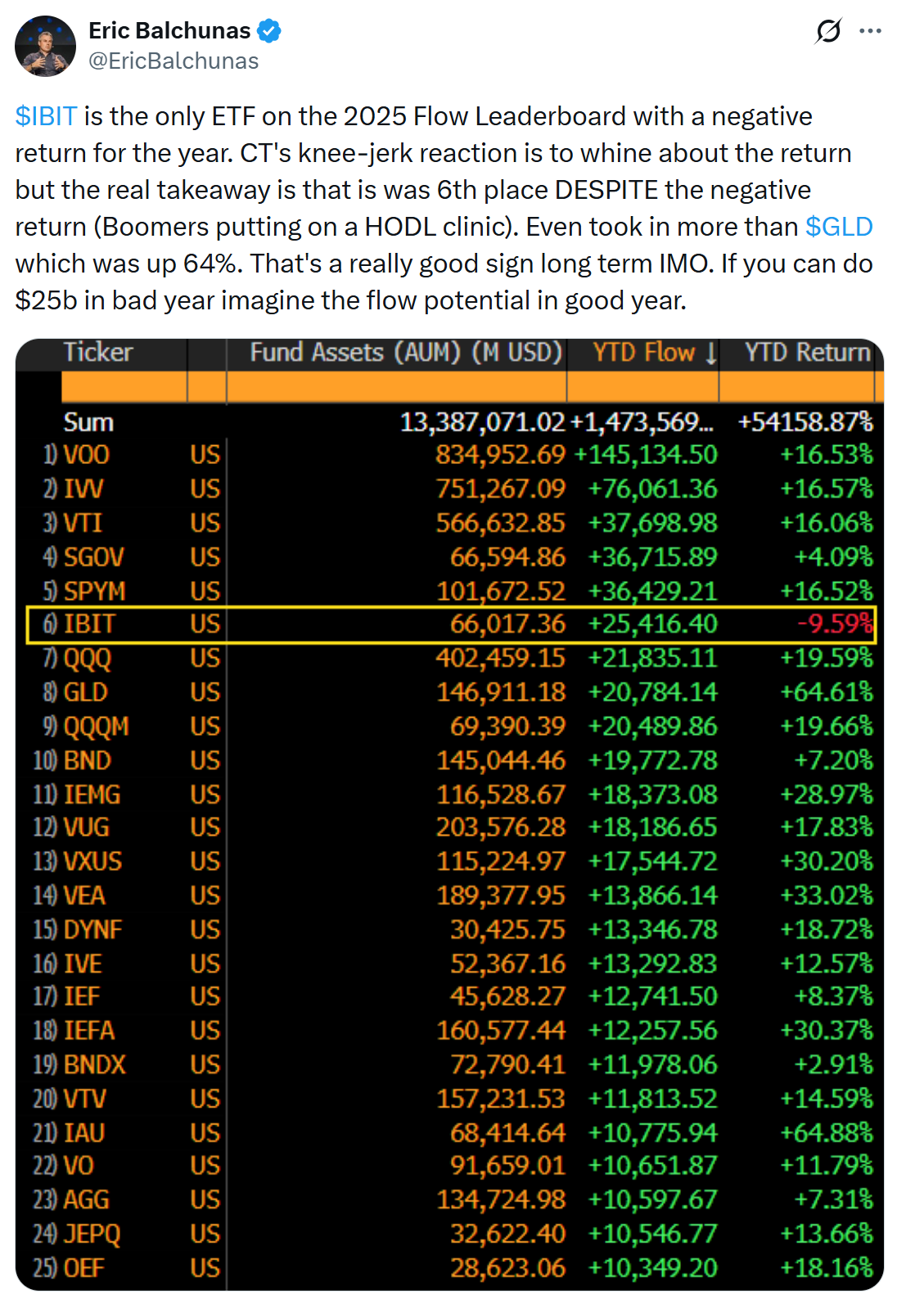
IBIT sees net inflows but negative returns. Source: Eric Balchunas

Related: BlackRock IBIT Bitcoin ETF achieves $70B AUM record

Why heavy ETF buying isn’t pushing Bitcoin higher?

Meanwhile, one crypto market participant questioned why sustained institutional buying through ETFs has not translated into stronger price performance.

In response, Balchunas suggested the market may be behaving more like a mature asset class, where early holders take profits and deploy income strategies, such as selling call options, rather than chasing immediate upside. He also noted Bitcoin had risen more than 120% the previous year, tempering expectations for continuous gains.

On Friday, US spot Bitcoin (BTC) ETFs saw $158 million in net outflows, with Fidelity’s FBTC the only fund to post inflows. Meanwhile, spot Ether (ETH) ETFs recorded $75.9 million in outflows, extending their losing streak to seven consecutive days.

Related: BlackRock's most profitable ETF is now a 'hair away' from $100B

BlackRock defends IBIT after outflows

BlackRock’s spot Bitcoin ETF faced heavy pressure in November, with its flagship IBIT fund recording about $2.34 billion in net outflows, including two large withdrawal days mid-month. Despite the pullback, BlackRock executives downplayed concerns.

Speaking at Blockchain Conference 2025 in São Paulo, BlackRock business development director Cristiano Castro said the firm’s Bitcoin ETFs have become one of its largest revenue drivers. He argued that ETFs are designed to facilitate capital allocation and cash-flow management, making periods of compression and outflows normal.

Magazine: 2026 is the year of pragmatic privacy in crypto — Canton, Zcash and more

Domande pertinenti

QWhat is the ranking of BlackRock's iShares Bitcoin Trust (IBIT) in 2025 ETF net inflows, and what is unique about its performance?

AIBIT ranked 6th in 2025 ETF net inflows, pulling in roughly $25 billion. It is unique because it was the only fund in the top cohort to post a negative return for the year.

QAccording to Eric Balchunas, why is IBIT's performance considered a 'really good sign'?

AHe argues that the substantial inflows during a period of negative returns reveal strong long-term investor behavior and commitment (a 'HODL clinic'), suggesting even greater flow potential during a good year, rather than being solely focused on short-term price action.

QWhat reason did Eric Balchunas suggest for why sustained institutional ETF buying hasn't pushed Bitcoin's price significantly higher?

AHe suggested the market may be maturing, with early holders taking profits and deploying income strategies like selling call options, rather than chasing immediate upside. He also noted that Bitcoin had risen over 120% the previous year, tempering expectations for continuous gains.

QHow did BlackRock executives respond to the significant net outflows from IBIT in November?

ABlackRock executives downplayed concerns. Director Cristiano Castro stated that Bitcoin ETFs have become one of the firm's largest revenue drivers and argued that ETFs are designed for capital allocation and cash-flow management, making periods of outflows normal.

QHow did the net flows for US spot Bitcoin and Ether ETFs perform on the Friday mentioned in the article?

AUS spot Bitcoin ETFs saw $158 million in net outflows, with only Fidelity's FBTC posting inflows. Spot Ether ETFs recorded $75.9 million in outflows, extending their losing streak to seven consecutive days.

Letture associate

Worried about AI's Self-Evolution, Anthropic Intends to Stop Training?

In early 2026, Anthropic signaled a significant shift in its public narrative regarding AI development timelines and safety. In June, its Anthropic Institute published a detailed article, "When AI builds itself," presenting internal data suggesting accelerating AI self-improvement. Key figures included over 80% of merged code being written by Claude and a 52x speedup in certain optimization tasks. The article outlined three future scenarios, with the most speculative being full recursive self-improvement (RSI), where AI autonomously builds better successors. Anthropic stated RSI is "possible" and may arrive faster than most institutions are prepared for. This narrative pivot followed a series of strategic moves. In January, CEO Dario Amodei wrote about a powerful self-improvement feedback loop. In February, Anthropic revised its Responsible Scaling Policy, removing a core commitment to pause training if capabilities outstripped safety controls, citing the risk of falling behind competitors. This change coincided with reported pressure from the US Department of Defense. By May, Anthropic's valuation had soared to $965 billion. Anthropic's stance was mirrored by other industry leaders. DeepMind CEO Demis Hassabis adjusted his AGI timeline to "by 2029" and admitted to using provocative language like "foothills of the singularity" to create urgency. OpenAI also released a model claiming a key role in its own creation process. The article's carefully calibrated tone—presenting dramatic data alongside qualifying footnotes—exemplifies a balancing act between signaling technological acceleration and managing commercial, regulatory, and safety imperatives. External experts offered contrasting interpretations of the same data, from warnings of catastrophic risk akin to Chernobyl to skepticism that current automation merely handles "grunt work," not genius. The coordinated narrative shift among top labs highlights the complex interplay between perceived technical inflection points and strategic communication aimed at investors, regulators, and the public.

marsbit3 min fa

Worried about AI's Self-Evolution, Anthropic Intends to Stop Training?

marsbit3 min fa

The Macroeconomic Underpinnings of Africa's Payment Market Landscape

The African payments market, characterized by the world's highest mobile money penetration and fastest-growing cryptocurrency adoption, is not a coincidence but a macroeconomic necessity driven by deep structural factors. Two key drivers create this landscape: (1) Africa's heavy reliance on commodity exports, trade, and remittances, generating massive cross-border settlement and remittance demand; and (2) chronically underdeveloped financial infrastructure, exacerbated by international bank de-risking, foreign exchange mismanagement, and persistent inflation. This vacuum has allowed mobile money and crypto to thrive. Mobile money platforms replace banks for domestic payments, while cryptocurrencies serve as a store of value against local currency depreciation and a low-cost medium for cross-border exchange. A crucial division lies along the Sahara Desert. North Africa is integrated into the oil-anchored MENA framework, while Sub-Saharan Africa (SSA), plagued by dollar shortages and fragmented currencies, has become a natural, massive market for mobile money and crypto. Nigeria, Kenya, and South Africa are global leaders in adoption. The SSA economy is deeply dollarized due to currency instability, yet suffers from a severe "dollar shortage" caused by trade deficits and limited export capacity. This creates parallel forex markets and high remittance costs. Cryptocurrencies, particularly stablecoins, fill this gap by providing access to dollar liquidity, cheaper cross-border transfers, and an inflation-resistant store of value, primarily driven by retail users for small-value transactions. While regional initiatives like PAPSS aim to reduce dollar dependence, the fundamental constraints of commodity reliance, trade imbalances, and shallow financial markets persist. Therefore, mobile money and cryptocurrencies are not niche trends but essential financial infrastructure filling a structural void, and they are likely to remain central to Africa's economic landscape for the foreseeable future.

链捕手13 min fa

The Macroeconomic Underpinnings of Africa's Payment Market Landscape

链捕手13 min fa

Is the Sharp Decline Over? Let the Data Speak

**Has the Sharp Decline Ended? Let Data Speak** Bitcoin's recent significant drop has placed short sellers in a precarious position. Three concurrent pressures—sustained outflows from ETFs, miners offloading coins to exchanges, and short-term holders capitulating—pushed the price near $63k. The asset fell 13% this week and 21% this month, roughly halving from its all-time high. A critical data point is the extremely crowded short positioning, with a short-to-long ratio reaching 8:1, representing nearly $100 billion in short interest overhead. This creates conditions for a potential short squeeze if selling pressure merely pauses, similar to the event in November 2022 which triggered a 24% rally. The selling pressures are real: spot Bitcoin ETFs have seen a record $5.4 billion outflow over 20 days. Short-term holders moved 53k loss-held BTC to exchanges in a day, and miners sent 24k BTC to Binance, a six-month high. Capital is also rotating towards AI and tech stocks like SpaceX, with $400 billion invested in AI infrastructure recently. However, on-chain data shows accumulation by long-term holders, who added 200k BTC in a month, and institutions/miners have absorbed 1.24 million BTC since 2023. This indicates strong buying beneath the surface. Key levels to watch are the $67k-$70k zone (2021 high & 2024 breakout point). A swift recovery above it suggests a leverage washout; failure could test $60k-$55k. The direction also hinges on ETF flow reversal. Currently, the S&P 500 hits new highs driven by AI, while Bitcoin and DeFi (TVL down from $173b to $73.9b) lag. The most probable path is a grinding basing process between $60k-$58k with continued ETF outflows. A less likely but explosive scenario involves a sudden flow reversal, a surge above $70k triggering a short squeeze, and a rally back above $76k. The immediate trigger depends on when the relentless selling pauses. A final cautionary note questions Bitcoin's correlation: if the high-flying U.S. stock market corrects, will Bitcoin once again miss the rally but not the decline?

foresightnews_api28 min fa

Is the Sharp Decline Over? Let the Data Speak

foresightnews_api28 min fa

Trading

Spot
Futures

Articoli Popolari

Come comprare BILL

Benvenuto in HTX.com! Abbiamo reso l'acquisto di Billions Network (BILL) semplice e conveniente. Segui la nostra guida passo passo per intraprendere il tuo viaggio nel mondo delle criptovalute.Step 1: Crea il tuo Account HTXUsa la tua email o numero di telefono per registrarti il tuo account gratuito su HTX. Vivi un'esperienza facile e sblocca tutte le funzionalità,Crea il mio accountStep 2: Vai in Acquista crypto e seleziona il tuo metodo di pagamentoCarta di credito/debito: utilizza la tua Visa o Mastercard per acquistare immediatamente Billions NetworkBILL.Bilancio: Usa i fondi dal bilancio del tuo account HTX per fare trading senza problemi.Terze parti: abbiamo aggiunto metodi di pagamento molto utilizzati come Google Pay e Apple Pay per maggiore comodità.P2P: Fai trading direttamente con altri utenti HTX.Over-the-Counter (OTC): Offriamo servizi su misura e tassi di cambio competitivi per i trader.Step 3: Conserva Billions Network (BILL)Dopo aver acquistato Billions Network (BILL), conserva nel tuo account HTX. In alternativa, puoi inviare tramite trasferimento blockchain o scambiare per altre criptovalute.Step 4: Scambia Billions Network (BILL)Scambia facilmente Billions Network (BILL) nel mercato spot di HTX. Accedi al tuo account, seleziona la tua coppia di trading, esegui le tue operazioni e monitora in tempo reale. Offriamo un'esperienza user-friendly sia per chi ha appena iniziato che per i trader più esperti.

201 Totale visualizzazioniPubblicato il 2026.05.07Aggiornato il 2026.06.02

Come comprare BILL

Cosa è ATWO

I. Introduzione al ProgettoArena Two è una piattaforma interattiva decentralizzata che consente ai fan di svolgere un ruolo attivo e tokenizzato nei risultati degli eventi in tempo reale. A differenza dei modelli di trasmissione tradizionali che riducono i fan a spettatori passivi, Arena Two sfrutta la tecnologia blockchain per consentire ai fan di votare direttamente in tempo reale e influenzare i risultati sul campo.II. Informazioni sul TokenNome del token: ATWO(Arena Two)III. Link CorrelatiSito web:https://arenatwo.com/Esploratori:https://basescan.org/token/0x499D35eBE6cEe9B2Ac35Fd003fcBbeeB9CFc7B32Twitter:https://x.com/arenatwoXNota: L'introduzione al progetto proviene dai materiali pubblicati o forniti dal team ufficiale del progetto, che è solo a scopo di riferimento e non costituisce consulenza sugli investimenti. HTX non si assume responsabilità per eventuali perdite dirette o indirette derivanti.

141 Totale visualizzazioniPubblicato il 2026.05.18Aggiornato il 2026.06.02

Cosa è ATWO

Come comprare ATWO

Benvenuto in HTX.com! Abbiamo reso l'acquisto di Arena Two (ATWO) semplice e conveniente. Segui la nostra guida passo passo per intraprendere il tuo viaggio nel mondo delle criptovalute.Step 1: Crea il tuo Account HTXUsa la tua email o numero di telefono per registrarti il tuo account gratuito su HTX. Vivi un'esperienza facile e sblocca tutte le funzionalità,Crea il mio accountStep 2: Vai in Acquista crypto e seleziona il tuo metodo di pagamentoCarta di credito/debito: utilizza la tua Visa o Mastercard per acquistare immediatamente Arena TwoATWO.Bilancio: Usa i fondi dal bilancio del tuo account HTX per fare trading senza problemi.Terze parti: abbiamo aggiunto metodi di pagamento molto utilizzati come Google Pay e Apple Pay per maggiore comodità.P2P: Fai trading direttamente con altri utenti HTX.Over-the-Counter (OTC): Offriamo servizi su misura e tassi di cambio competitivi per i trader.Step 3: Conserva Arena Two (ATWO)Dopo aver acquistato Arena Two (ATWO), conserva nel tuo account HTX. In alternativa, puoi inviare tramite trasferimento blockchain o scambiare per altre criptovalute.Step 4: Scambia Arena Two (ATWO)Scambia facilmente Arena Two (ATWO) nel mercato spot di HTX. Accedi al tuo account, seleziona la tua coppia di trading, esegui le tue operazioni e monitora in tempo reale. Offriamo un'esperienza user-friendly sia per chi ha appena iniziato che per i trader più esperti.

78 Totale visualizzazioniPubblicato il 2026.05.18Aggiornato il 2026.06.02

Come comprare ATWO

Discussioni

Benvenuto nella Community HTX. Qui puoi rimanere informato sugli ultimi sviluppi della piattaforma e accedere ad approfondimenti esperti sul mercato. Le opinioni degli utenti sul prezzo di A A sono presentate come di seguito.

活动图片