IBIT ranking 6th in 2025 ETF flows despite negative returns is ‘a really good sign’

cointelegraphPubblicato 2025-12-20Pubblicato ultima volta 2025-12-20

Introduzione

Despite posting negative returns for the year, BlackRock’s iShares Bitcoin Trust (IBIT) ranked sixth in 2025 ETF net inflows with approximately $25 billion. This performance, noted by Bloomberg analyst Eric Balchunas as a "really good sign," highlights strong investor commitment amid a down market. In contrast, many top-performing equity and bond ETFs saw double-digit gains. Balchunas suggested that such inflows during a weak period indicate long-term confidence rather than short-term speculation. Meanwhile, sustained institutional buying via ETFs hasn't significantly boosted Bitcoin’s price, which he attributes to profit-taking and mature market behavior. BlackRock executives defended IBIT's outflows as normal for ETF liquidity management.

BlackRock’s spot Bitcoin ETF, iShares Bitcoin Trust (IBIT, has ranked sixth in net inflows despite being the only fund in the top cohort posting a negative return for the year.

Data shared by Bloomberg ETF analyst Eric Balchunas shows IBIT pulling in roughly $25 billion in year-to-date inflows, even as its annual performance sits in the red. By comparison, several traditional equity and bond ETFs ahead of IBIT on the leaderboard posted double-digit gains, while gold-backed ETF GLD, which is up more than 60% on the year, attracted less capital than IBIT.

Balchunas described the result as a “really good sign” over the long term, arguing that the flows reveal more about investor behavior than short-term price action.

“If you can do $25 billion in a bad year, imagine the flow potential in a good year,” he wrote, pointing to what he called a “HODL clinic” from older, long-term investors.
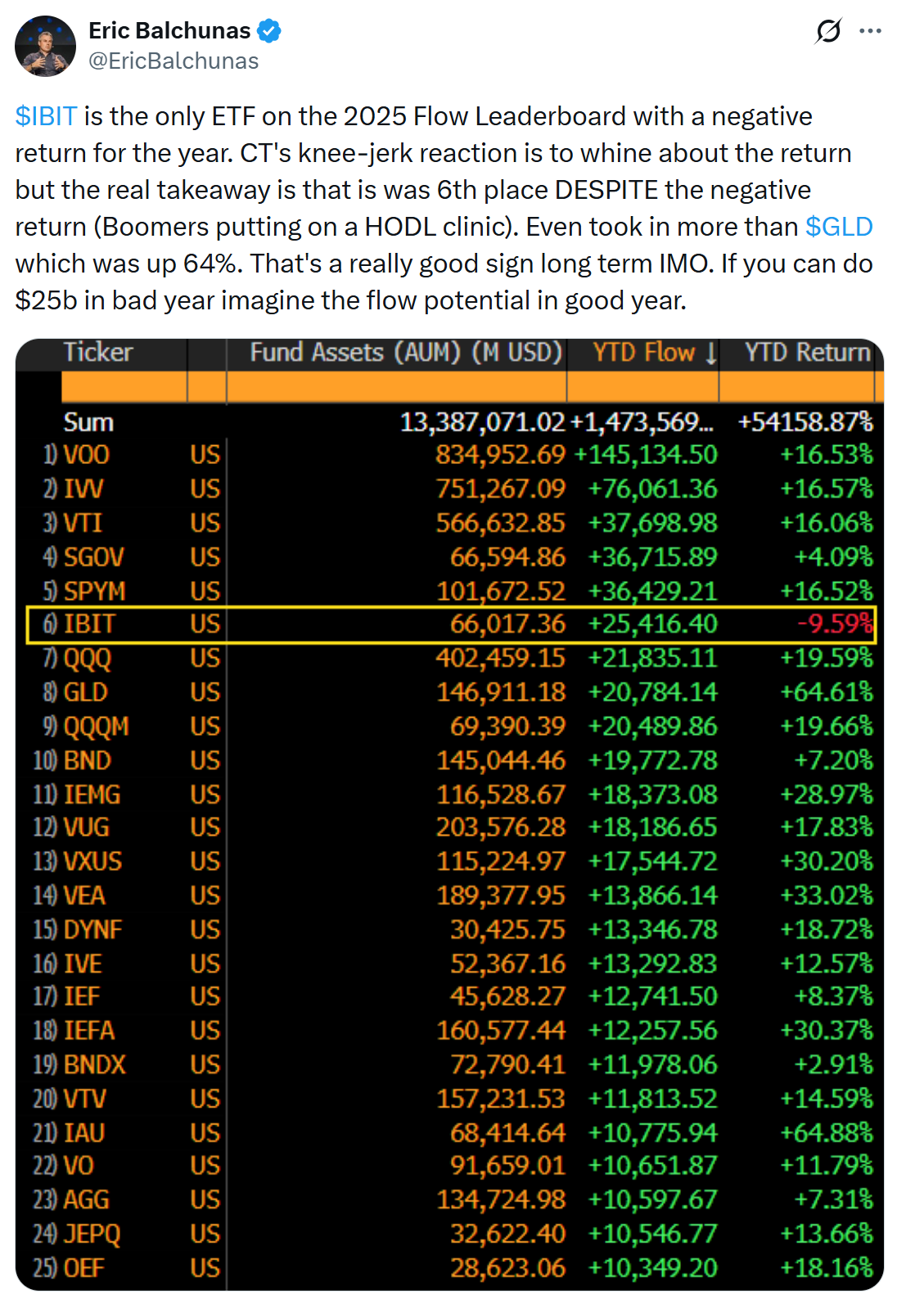
IBIT sees net inflows but negative returns. Source: Eric Balchunas

Related: BlackRock IBIT Bitcoin ETF achieves $70B AUM record

Why heavy ETF buying isn’t pushing Bitcoin higher?

Meanwhile, one crypto market participant questioned why sustained institutional buying through ETFs has not translated into stronger price performance.

In response, Balchunas suggested the market may be behaving more like a mature asset class, where early holders take profits and deploy income strategies, such as selling call options, rather than chasing immediate upside. He also noted Bitcoin had risen more than 120% the previous year, tempering expectations for continuous gains.

On Friday, US spot Bitcoin (BTC) ETFs saw $158 million in net outflows, with Fidelity’s FBTC the only fund to post inflows. Meanwhile, spot Ether (ETH) ETFs recorded $75.9 million in outflows, extending their losing streak to seven consecutive days.

Related: BlackRock's most profitable ETF is now a 'hair away' from $100B

BlackRock defends IBIT after outflows

BlackRock’s spot Bitcoin ETF faced heavy pressure in November, with its flagship IBIT fund recording about $2.34 billion in net outflows, including two large withdrawal days mid-month. Despite the pullback, BlackRock executives downplayed concerns.

Speaking at Blockchain Conference 2025 in São Paulo, BlackRock business development director Cristiano Castro said the firm’s Bitcoin ETFs have become one of its largest revenue drivers. He argued that ETFs are designed to facilitate capital allocation and cash-flow management, making periods of compression and outflows normal.

Magazine: 2026 is the year of pragmatic privacy in crypto — Canton, Zcash and more

Domande pertinenti

QWhat is the ranking of BlackRock's iShares Bitcoin Trust (IBIT) in 2025 ETF net inflows, and what is unique about its performance?

AIBIT ranked 6th in 2025 ETF net inflows, pulling in roughly $25 billion. It is unique because it was the only fund in the top cohort to post a negative return for the year.

QAccording to Eric Balchunas, why is IBIT's performance considered a 'really good sign'?

AHe argues that the substantial inflows during a period of negative returns reveal strong long-term investor behavior and commitment (a 'HODL clinic'), suggesting even greater flow potential during a good year, rather than being solely focused on short-term price action.

QWhat reason did Eric Balchunas suggest for why sustained institutional ETF buying hasn't pushed Bitcoin's price significantly higher?

AHe suggested the market may be maturing, with early holders taking profits and deploying income strategies like selling call options, rather than chasing immediate upside. He also noted that Bitcoin had risen over 120% the previous year, tempering expectations for continuous gains.

QHow did BlackRock executives respond to the significant net outflows from IBIT in November?

ABlackRock executives downplayed concerns. Director Cristiano Castro stated that Bitcoin ETFs have become one of the firm's largest revenue drivers and argued that ETFs are designed for capital allocation and cash-flow management, making periods of outflows normal.

QHow did the net flows for US spot Bitcoin and Ether ETFs perform on the Friday mentioned in the article?

AUS spot Bitcoin ETFs saw $158 million in net outflows, with only Fidelity's FBTC posting inflows. Spot Ether ETFs recorded $75.9 million in outflows, extending their losing streak to seven consecutive days.

Letture associate

Arthur Hayes' New Article: It's 'No-Trade Zone' Time

Arthur Hayes argues that the current market is in a "no-trade zone," a period of high uncertainty created by two converging forces: the deflationary shock from AI and the inflationary shock from geopolitics. AI agents are rapidly displacing knowledge workers, eroding their incomes and creditworthiness, which will eventually trigger a deflationary financial crisis in consumer credit-dependent Western economies. Simultaneously, the war in the Middle East, particularly the potential disruption to shipping through the Strait of Hormuz, threatens global energy supplies and could force nations to abandon the dollar system. Hayes outlines three main scenarios: 1) A return to normalcy, where the deflationary AI shock remains the primary concern; 2) The "Tehran Toll Booth," where Iran controls the Strait and demands payment in gold or yuan, accelerating the end of dollar hegemony; and 3) "Empire Strikes Back," where the US destroys Iran's capabilities but risks a catastrophic regional war that sends commodity prices soaring. In all but the most extreme scenarios, Hayes posits that the key driver for Bitcoin's price will be the *quantity* of money, not its price (interest rates). He expects that governments, forced to fund wars and stockpile resources, will have to print money, expanding the money supply. This would be bullish for fixed-supply assets like Bitcoin, even if it occurs alongside rising rates. However, he cautions that until this liquidity is explicitly unleashed (e.g., when bond market volatility spikes), the risk/reward for new long positions is poor. His current strategy is to wait for a clear signal of monetary expansion before deploying capital, preferring to hold gold and select crypto assets in the meantime.

marsbit40 min fa

Arthur Hayes' New Article: It's 'No-Trade Zone' Time

marsbit40 min fa

a16z Founder: In the Agent Era, What Truly Matters Has Changed

Marc Andreessen, co-founder of a16z, argues that the current AI boom is not an overnight success but the culmination of 80 years of research, now delivering practical results. He emphasizes that this era is defined by the convergence of four key capabilities: large language models (LLMs), reasoning, coding, and agents capable of recursive self-improvement. Andreessen describes the agent architecture—combining an LLM with a shell, file system, markdown, and cron/loop—as a fundamental shift beyond chatbots. This structure leverages existing software components, allowing agents to maintain state, introspect, and extend their own functionality. He predicts a move away from traditional GUI and browser-based interactions toward an "agent-first" world where software is primarily operated by bots, not humans, with people simply stating their goals. He draws parallels to the 2000 internet bubble but notes key differences: current AI infrastructure investments are led by cash-rich giants and quickly monetized. He highlights that scaling constraints involve not just GPUs but the entire chip ecosystem. Open source and edge inference are crucial for democratizing knowledge and enabling low-latency, cost-effective applications on local hardware. Finally, Andreessen identifies significant non-technical challenges: potential short-term cybersecurity crises, the need for "proof of human" identity solutions, financial infrastructure for agents, and institutional resistance from sectors like education and healthcare. He cautions that societal adoption will be slower than technological change.

marsbit51 min fa

a16z Founder: In the Agent Era, What Truly Matters Has Changed

marsbit51 min fa

Trading

Spot
Futures

Articoli Popolari

Come comprare FRAX

Benvenuto in HTX.com! Abbiamo reso l'acquisto di FRAX (FRAX) semplice e conveniente. Segui la nostra guida passo passo per intraprendere il tuo viaggio nel mondo delle criptovalute.Step 1: Crea il tuo Account HTXUsa la tua email o numero di telefono per registrarti il tuo account gratuito su HTX. Vivi un'esperienza facile e sblocca tutte le funzionalità,Crea il mio accountStep 2: Vai in Acquista crypto e seleziona il tuo metodo di pagamentoCarta di credito/debito: utilizza la tua Visa o Mastercard per acquistare immediatamente FRAXFRAX.Bilancio: Usa i fondi dal bilancio del tuo account HTX per fare trading senza problemi.Terze parti: abbiamo aggiunto metodi di pagamento molto utilizzati come Google Pay e Apple Pay per maggiore comodità.P2P: Fai trading direttamente con altri utenti HTX.Over-the-Counter (OTC): Offriamo servizi su misura e tassi di cambio competitivi per i trader.Step 3: Conserva FRAX (FRAX)Dopo aver acquistato FRAX (FRAX), conserva nel tuo account HTX. In alternativa, puoi inviare tramite trasferimento blockchain o scambiare per altre criptovalute.Step 4: Scambia FRAX (FRAX)Scambia facilmente FRAX (FRAX) nel mercato spot di HTX. Accedi al tuo account, seleziona la tua coppia di trading, esegui le tue operazioni e monitora in tempo reale. Offriamo un'esperienza user-friendly sia per chi ha appena iniziato che per i trader più esperti.

572 Totale visualizzazioniPubblicato il 2026.03.03Aggiornato il 2026.03.03

Come comprare FRAX

Cosa è MANTRA

I. Introduzione al ProgettoMANTRA è una Blockchain Layer 1 con priorità sulla Sicurezza, capace di aderire e far rispettare i requisiti normativi del mondo reale. Costruita per Istituzioni e Sviluppatori, MANTRA offre una Blockchain senza permessi per applicazioni con permessi.Caratteristiche principali: * Costruita utilizzando Cosmos SDK, compatibile con IBC, con supporto per CosmWasm * Sicura tramite un set di validatori PoS sovrano * Scalabile fino a 10k TPS * Moduli, SDK e API integrati per creare, scambiare e gestire RWAs conformi alle normative * Esperienza utente migliorata per integrare utenti e istituzioni non native in Web3.1) Informazioni di baseNome: MANTRA (OM)III. Link correlatiWhitepaper:https://docs.mantrachain.io/Sito ufficiale:https://www.mantrachain.io/Esploratori:https://mintscan.io/mantraSocial Media:https://x.com/MANTRA_ChainNota: L'introduzione al progetto proviene dai materiali pubblicati o forniti dal team ufficiale del progetto, che è solo a scopo di riferimento e non costituisce consulenza per gli investimenti. HTX non si assume responsabilità per eventuali perdite dirette o indirette risultanti.

478 Totale visualizzazioniPubblicato il 2026.03.04Aggiornato il 2026.03.04

Cosa è MANTRA

Come comprare MANTRA

Benvenuto in HTX.com! Abbiamo reso l'acquisto di Mantra (MANTRA) semplice e conveniente. Segui la nostra guida passo passo per intraprendere il tuo viaggio nel mondo delle criptovalute.Step 1: Crea il tuo Account HTXUsa la tua email o numero di telefono per registrarti il tuo account gratuito su HTX. Vivi un'esperienza facile e sblocca tutte le funzionalità,Crea il mio accountStep 2: Vai in Acquista crypto e seleziona il tuo metodo di pagamentoCarta di credito/debito: utilizza la tua Visa o Mastercard per acquistare immediatamente MantraMANTRA.Bilancio: Usa i fondi dal bilancio del tuo account HTX per fare trading senza problemi.Terze parti: abbiamo aggiunto metodi di pagamento molto utilizzati come Google Pay e Apple Pay per maggiore comodità.P2P: Fai trading direttamente con altri utenti HTX.Over-the-Counter (OTC): Offriamo servizi su misura e tassi di cambio competitivi per i trader.Step 3: Conserva Mantra (MANTRA)Dopo aver acquistato Mantra (MANTRA), conserva nel tuo account HTX. In alternativa, puoi inviare tramite trasferimento blockchain o scambiare per altre criptovalute.Step 4: Scambia Mantra (MANTRA)Scambia facilmente Mantra (MANTRA) nel mercato spot di HTX. Accedi al tuo account, seleziona la tua coppia di trading, esegui le tue operazioni e monitora in tempo reale. Offriamo un'esperienza user-friendly sia per chi ha appena iniziato che per i trader più esperti.

193 Totale visualizzazioniPubblicato il 2026.03.04Aggiornato il 2026.03.04

Come comprare MANTRA

Discussioni

Benvenuto nella Community HTX. Qui puoi rimanere informato sugli ultimi sviluppi della piattaforma e accedere ad approfondimenti esperti sul mercato. Le opinioni degli utenti sul prezzo di A A sono presentate come di seguito.

活动图片