I Built a Bitcoin Buying System: $64,000, The Lower the Score, The More I Buy

marsbitPubblicato 2026-07-27Pubblicato ultima volta 2026-07-27

Introduzione

Australian trader Jake Pahor shares his personal Bitcoin investment system. After losing money on altcoins in the last cycle, he now holds 100% Bitcoin, viewing it as the benchmark for the crypto asset class. His strategy centers on a dynamic dollar-cost averaging plan driven by the CSH Risk Score (a proprietary metric). He buys only when the score is between 10 and 30, purchasing more when the score is lower. Exit rules are also predefined. Currently, the CSH score is 25.6, indicating an "early cycle" phase, so his regular buying continues while larger purchases await a drop below 20. He emphasizes that a robust system, written calmly in advance, is crucial for withstanding market emotions. He also monitors key metrics like Bitcoin dominance and the TOTAL3/BTC ratio, noting that altcoin season hasn't begun yet based on historical patterns. The article's core message is that the right answer to "Should I buy now?" is not a specific recommendation but a personalized system that fits one's life and risk tolerance.

Author: Jake Pahor

Compiled by: Deep Tide TechFlow

Deep Tide Guide: Australian trader Jake Pahor publicly discloses his real portfolio: 100% Bitcoin, zero altcoins. This isn't blind faith; it's the choice of an ordinary person with a full-time job and a family to care for, made after heavy losses in the last cycle—complex strategies have a time cost, and Bitcoin beat nearly every altcoin he held last cycle. He uses a CSH scoring system for dynamic dollar-cost averaging (DCA), buying more when the score is lower, with exit plans also hardcoded. The value of this system isn't in copying it, but in letting you see clearly: the only thing that can withstand market sentiment at 11 PM is the rules you wrote down during calm times.

Every SMSF (self-managed super fund) consultation ends the same way.

We finish the paperwork. Trust deeds, bank accounts, custody, audit trails. All the things that keep you out of trouble. Then there's a pause. I know exactly what's coming next.

"So. Should I buy now? Should I wait? What should I even buy?"

I can't answer. Not unwilling. Unable. The person asking might be 42 with twenty years left, or 68 with three. They might sleep soundly through a 30% drawdown or panic at 10%. No one can answer this for someone else. Anyone who gives an answer is just guessing.

But by now, hundreds have asked me this, and it's why Tom and I built CSH. So this week I'm giving the only honest answer: how my own money actually works, and the system that drives it. Not for you to copy. For you to see what a system looks like, and then build your own.

Everything below runs on the free tier of the app.

CSH Risk Dashboard

CSH Score: 25.6/100 — Early Cycle (Stable, +0.7 this week). In the bottom 22% of all readings since 2011, has remained in the 20-30 range for 52 consecutive days.

Key Metrics:

BTC: $64,492 / A$91,717 (7-day: essentially flat)

BTC Dominance: 59.2%

ETH/BTC: 0.029

TOTAL3/BTC (Altcoin market cap priced in Bitcoin): 0.37 — Previous cycle bottoms have probed around 0.25

Fear & Greed Index: 26 - Fear

Total Market Cap: $2.27 Trillion

Review: Last issue, I said three things must happen before this bear market ends. None of them have happened. A week later, still zero for three. The only notable change: BTC climbed back above the 200-week moving average (~$63,300). A necessary condition, far from sufficient.

Jake's Take: Two weeks of sideways chopping between roughly $62k and $66k, with the score stuck in the 20s the entire time. Boring price action, noisy macro. My plan didn't change this week. That is the plan.
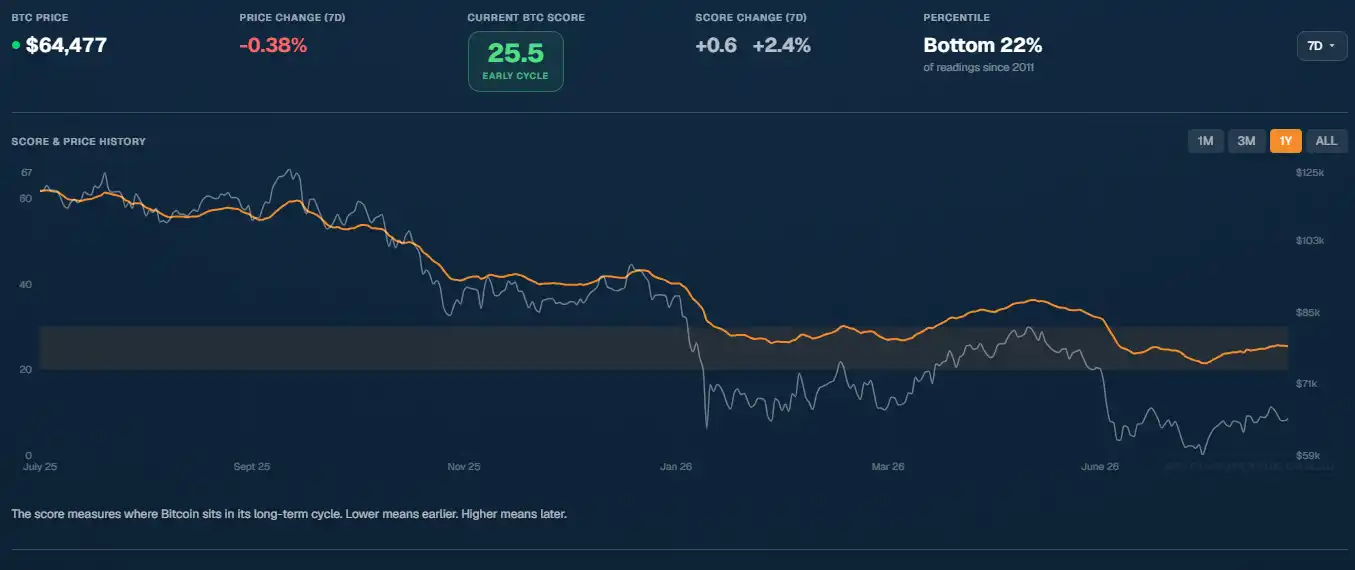
Image: CSH Risk Score Dashboard, score 25.6/100, in Early Cycle, has remained in the 20-30 range for 52 consecutive days. Source: Crypto Super Hub

How I Invest My Own Money

No headline this week. The question above is more important than any news cycle, so here's my answer, three rules.

Rule One: Benchmark against two things. I track my portfolio in two currencies: USD and Bitcoin. The second number keeps me honest. If your altcoin doubles but Bitcoin triples, you lost. You just didn't notice because you were only watching the dollar number. Fifteen years in, BTC is still the benchmark for the entire asset class. If I'm going to hold anything else, it's because I genuinely believe it will outperform Bitcoin. Otherwise, why hold it?

Rule Two: Core first, know your limits. Right now, I'm 100% Bitcoin. Zero altcoins. This isn't forever, it just fits my life. I have a family, a full-time job at an exchange, and I'm building CSH on the side. Altcoin rotation is a job for people with time. I know because I tried it last cycle, holding a bunch of alts with no plan, and got smashed, while Bitcoin quietly outperformed almost everything I held. The lesson wasn't that alts are bad. It's that my portfolio has to fit my real life. Start with BTC as your core. Add complexity only when you have the time and skill to take it on.

Rule Three: Let the system do the buying. My money runs a dynamic DCA through the CSH score. Buying on schedule, but only when the score is within my 10 to 30 range. The sizing is dynamic: the lower the score, the bigger the buy. Score 30 gets a modest allocation. Score 15 gets several times more. Every decision was made months ago, in the calm. The market can't renegotiate with me at 11 PM.

The same mechanism runs in reverse. My plan sells dynamically in tranches above an exit range. Last cycle, writing down the exit rules was the difference between realizing cycle gains and riding the rollercoaster back down. Bitcoin has followed a rhythm very close to four years its entire life. I'm not going to wing it against that.

Where am I this week? Score 25.6, scheduled buying running within the range, bigger buys still waiting for a sub-20 score that hasn't appeared yet. Two weeks of deliberately taking no new action. Inaction is a position, and right now it's my position.

Jake's Workbench

Big update this week: A full revamp of my Plans feature. Email alerts are live. You can set portfolio targets and watch them fill. Order history is two clicks away, and the portfolio view now shows your average buy price next to the live score. It's becoming the screen I check, not price.

This is my own plan, screenshotted directly from the app:
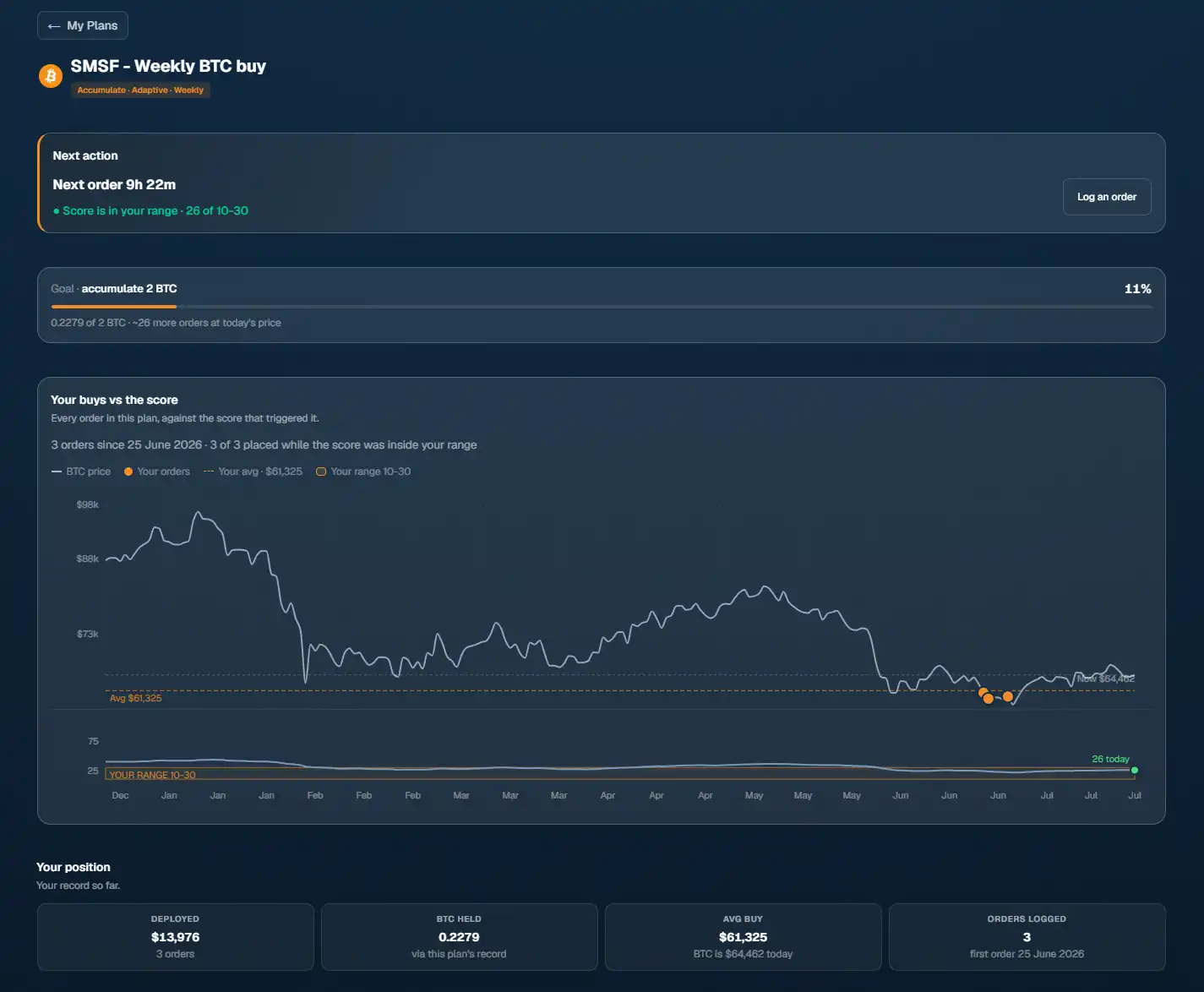
Image: The author's own DCA plan, having bought 0.2279 BTC since late June at an average price of A$87,755, targeting 2 BTC. Source: Crypto Super Hub

Three orders logged since late June, 0.2279 BTC bought towards a 2 BTC target, average buy price A$87,755. A quick note before anyone misreads this screen: this plan only tracks the portion I've bought since the feature went live a few weeks ago. It's a slice of my holdings, not the whole thing. But this is the system from the section above, running publicly, with the log accumulating from here.

Next for Workbench: CSV upload and exchange sync, to make order logging simpler.

Altseason talk is back. My feed is full of rotation calls. My watched metric says not yet: the altcoin market cap priced in BTC is at 0.37. Every cycle bottom sees it probe the 0.25 area before alts start running. Dominance is still rising, ETH/BTC is still flat. So: If someone pitches you an altcoin rotation this week, ask what benchmark they're using.
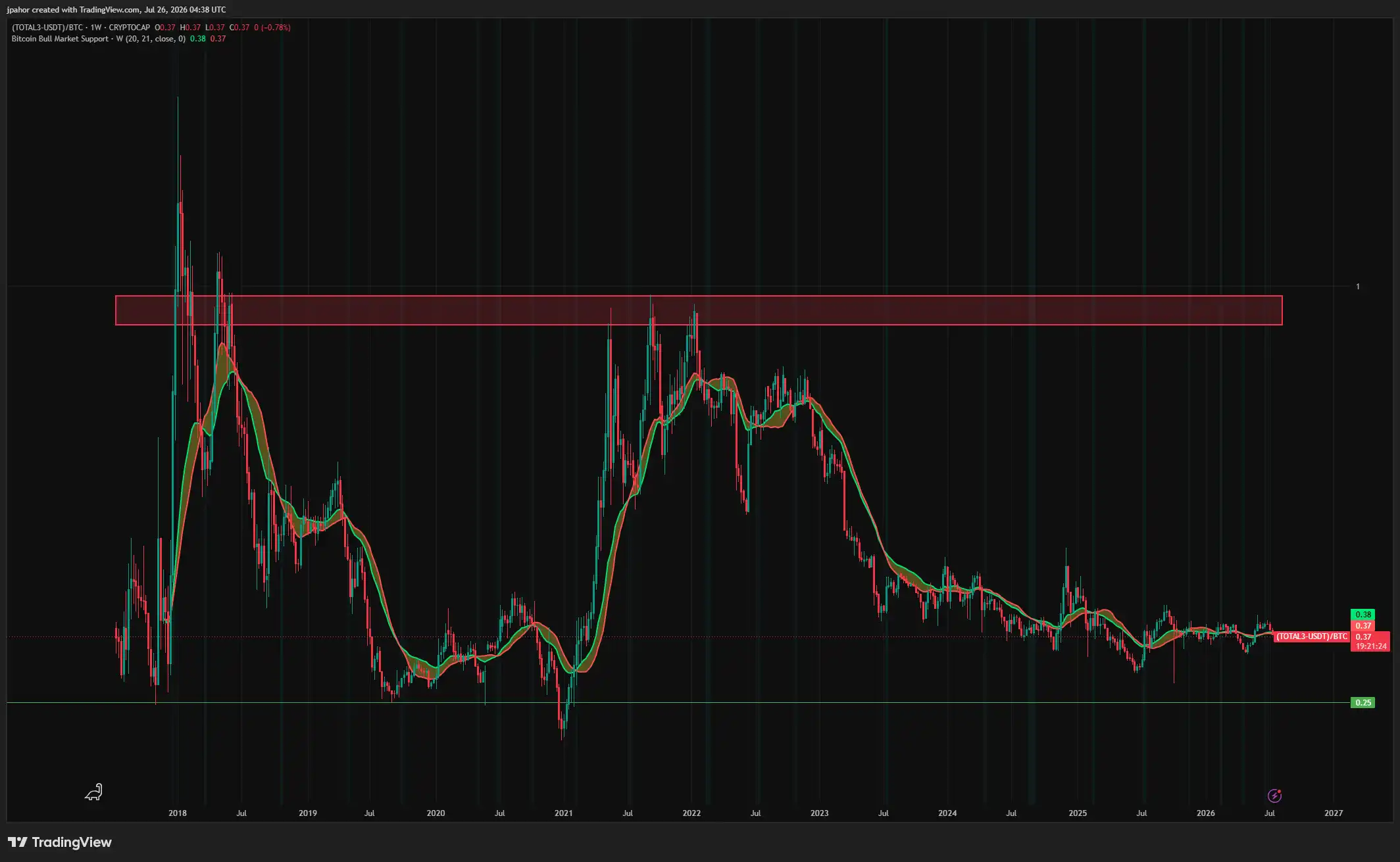
Image: (TOTAL3 - USDT)/BTC chart, altcoin market cap priced in Bitcoin at 0.37, previous cycle bottoms probed around 0.25. Source: Trading View

The Fed meets Wednesday (US time). ~85% probability of rates on hold, but whispers of a hike are getting louder. So: Unless your plan hinges on next month's rate, this is noise. My plan doesn't.

Visa launches a stablecoin platform, letting banks issue their own stablecoins without building the infrastructure. So: This is what bear markets are for. While nobody's watching, infrastructure gets built.

Morgan Stanley enables BTC, ETH, and SOL spot trading for E*TRADE clients. So: Millions of ordinary brokerage accounts are now one click away from Bitcoin. The next wave of buyers isn't coming from Crypto Twitter. They're coming from the screens they already use.

Watching Next Week

FOMC decision, 4 AM Thursday (AEST). Hold is largely priced in, so the reaction will depend on the wording. Expect two-way chop. Chop is not a signal.

The 200-week MA, ~$63,300. BTC is sitting almost exactly on it. A weekly close above or below this line is something the whole market watches.

Sub-20 score. Still zero days below 20 this cycle. This is the trigger my larger buys are waiting for. If it arrives, you'll hear it here first.

One question spawned an entire company: "Should I buy now?" The honest answer was never a date or a coin. It was a system that fits your life, matches your nerves, and is written down before the market gets loud.

Mine is above. If you want to build your own, the score and plan builder are free.

I'm curious: Reply directly with a number—the percentage of Bitcoin in your portfolio right now. I'll share the stats next week.

See you next week.

Thanks for reading. Share this with someone who'd find it valuable.

Crypto di tendenza

Domande pertinenti

QWhat is the core principle behind Jake Pahor's Bitcoin buying system?

AThe core principle is a dynamic dollar-cost averaging system based on the CSH (Crypto Super Hub) risk score. He buys more Bitcoin when the CSH score is lower (within his predetermined buy zone of 10-30). The system automates decisions to remove emotional bias, with buying and selling rules written in advance.

QWhat percentage of Jake Pahor's crypto portfolio is currently in Bitcoin, and why has he chosen this allocation?

AHe is currently 100% allocated to Bitcoin with zero altcoins. He chose this because it aligns with his life situation (having a family, a full-time job, and building CSH). His past experience trying to actively trade altcoins without a plan resulted in losses, while Bitcoin outperformed most of his holdings. He believes starting with Bitcoin as a core is crucial before adding complexity if one has the time and skill.

QAccording to the article, what key market condition has NOT yet been met for the author to confirm the bear market is over?

AThe key condition not yet met is the CSH risk score dropping below 20. The author states this cycle has had zero days below a score of 20, and a score below 20 is the trigger for his larger buy orders. He also mentions that the altcoin market cap denominated in Bitcoin (TOTAL3/BTC) has not yet bottomed around 0.25, which historically precedes altcoin seasons.

QWhat are the two benchmarks Jake Pahor uses to track his investment performance?

AHe tracks his investment performance against two benchmarks: 1) The US Dollar (fiat currency value), and 2) Bitcoin itself. Tracking against Bitcoin keeps him honest about relative performance, ensuring that if an altcoin gains value in USD but underperforms Bitcoin, he recognizes it as an opportunity cost loss.

QWhat is the significance of the "TOTAL3/BTC" chart mentioned and shown in the article?

AThe TOTAL3/BTC chart shows the total market capitalization of all cryptocurrencies (excluding Bitcoin and Ethereum) denominated in Bitcoin. The author points out that its current value of 0.37 has not yet reached the approximate 0.25 level seen near the bottom of previous cycles. This metric is used to gauge whether altcoins are undervalued relative to Bitcoin and to identify potential turning points for an 'altcoin season.'

Letture associate

Qualcomm Chip Price Hike Deals a Blow to Android Phones

Qualcomm has officially announced a new round of price increases for its entire chip portfolio, effective September 1. The hikes, reaching up to 18% for the flagship Snapdragon 8 Elite Gen 6 Pro, follow similar moves by MediaTek, intensifying cost pressures on the already strained smartphone industry. CEO Cristiano Amon confirmed the plan, citing the need to offset rising industry-wide costs and restore declining profit margins. Qualcomm's Q3 FY2026 results showed a 25% drop in net profit, with mobile revenue plunging 20% year-over-year, hitting its lowest level since 2021. The surge in AI computing demand has led memory manufacturers to prioritize HBM production, creating a shortage in general-purpose DRAM and NAND Flash chips. Their prices soared by 93%-98% and 55%-60% respectively in Q1 2026, causing the memory cost share in smartphones to jump from 10%-15% to over 30%. Coupled with the soaring cost of advanced nodes like TSMC's 2nm and packaging, overall chip costs have reached historic highs. These upstream pressures are forcing downstream smartphone brands like Xiaomi, OPPO, and vivo to cut orders for mid-to-low-end models by up to 20% and use cost-saving measures like older chipsets. Reportedly, the Snapdragon 8E5 will be repurposed as a "long-lasting" chip for sub-brand phones in H2 2026. Amid this cost crisis, the Android market remains sluggish. Q2 2026 smartphone shipments in China fell 4.3% year-over-year, marking five consecutive quarters of decline. Major Android brands saw market share drop, while Huawei and Apple, with their in-house chip advantages, gained share. Qualcomm is diversifying into automotive and IoT sectors to reduce reliance on smartphones, but these new segments cannot yet fill the mobile revenue gap. Industry observers warn that the full impact of component cost hikes will hit in the second half of 2026, likely leading to higher-than-expected price increases for Android flagships and a further contraction in the Chinese smartphone market.

marsbit1 h fa

Qualcomm Chip Price Hike Deals a Blow to Android Phones

marsbit1 h fa

Trading

Spot

Articoli Popolari

Cosa è BITCOIN

Comprendere HarryPotterObamaSonic10Inu (ERC-20) e la sua posizione nel mondo delle criptovalute Negli ultimi anni, il mercato delle criptovalute ha assistito a un aumento della popolarità delle meme coin, catturando l'interesse non solo dei trader, ma anche di coloro che cercano coinvolgimento comunitario e valore di intrattenimento. Tra questi token unici c'è HarryPotterObamaSonic10Inu (ERC-20), un progetto intrigante che mescola riferimenti culturali nel tessuto delle criptovalute. Questo articolo esplora gli aspetti chiave di HarryPotterObamaSonic10Inu, analizzando i suoi meccanismi, l'etica guidata dalla comunità e il suo coinvolgimento con il panorama crittografico più ampio. Che cos'è HarryPotterObamaSonic10Inu (ERC-20)? Come suggerisce il suo nome, HarryPotterObamaSonic10Inu è una meme coin costruita sulla blockchain di Ethereum, classificata secondo lo standard ERC-20. A differenza delle criptovalute tradizionali che possono enfatizzare l'utilità pratica o il potenziale investimento, questo token prospera grazie al valore di intrattenimento e alla forza della sua comunità. Il progetto mira a creare un ambiente in cui gli utenti coinvolti possono riunirsi, condividere idee e partecipare ad attività ispirate a diversi fenomeni culturali. Una caratteristica notevole di HarryPotterObamaSonic10Inu è la zero tassa sulle transazioni. Questo elemento allettante tende a incoraggiare il trading e il coinvolgimento della comunità, privo di costi aggiuntivi che possono scoraggiare i trader di piccole dimensioni. L'offerta totale della moneta è fissata a un miliardo di token, un numero che segna la sua intenzione di mantenere una circolazione sostanziale all'interno della comunità. Creatore di HarryPotterObamaSonic10Inu (ERC-20) Le origini di HarryPotterObamaSonic10Inu sono avvolte in un certo mistero; i dettagli sul creatore rimangono sconosciuti. Lo sviluppo di questo token non presenta un team identificabile o un piano esplicito, cosa non rara nel settore delle meme coin. Invece, il progetto è emerso organicamente, con il suo progresso fortemente dipendente dall'entusiasmo e dalla partecipazione della sua comunità. Investitori di HarryPotterObamaSonic10Inu (ERC-20) Per quanto riguarda investimenti esterni e finanziamenti, HarryPotterObamaSonic10Inu rimane ambiguo. Il token non elenca alcuna fondazione di investimento conosciuta o un sostegno organizzativo significativo. Invece, la linfa vitale del progetto è la sua comunità di base, che informa la sua crescita e sostenibilità attraverso azioni collettive e coinvolgimento nello spazio crittografico. Come funziona HarryPotterObamaSonic10Inu (ERC-20)? In quanto meme coin, HarryPotterObamaSonic10Inu opera principalmente al di fuori delle strutture tradizionali che governano spesso il valore degli asset. Ci sono diversi aspetti distintivi che definiscono il funzionamento del progetto: Transazioni senza tasse: Senza costi fiscali sulle transazioni, gli utenti possono comprare e vendere liberamente il token senza preoccuparsi di costi nascosti. Coinvolgimento della comunità: Il progetto prospera sull'interazione della comunità, sfruttando le piattaforme social per creare entusiasmo e facilitare il coinvolgimento. Discussioni, condivisione di contenuti e coinvolgimento sono elementi cruciali che aiutano ad espandere la sua portata e a favorire la lealtà tra i sostenitori. Nessuna utilità pratica: Va notato che HarryPotterObamaSonic10Inu non offre un'utilità concreta all'interno dell'ecosistema finanziario. Piuttosto, è classificato come un token principalmente per attività di intrattenimento e comunitarie. Riferimento culturale: Il token incorpora astutamente elementi della cultura pop per attirare interesse, collegandosi a appassionati di meme e seguaci delle criptovalute. HarryPotterObamaSonic10Inu esemplifica come le meme coin operino in modo diverso rispetto ai progetti di criptovalute più tradizionali, entrando nel mercato come costrutti sociali innovativi piuttosto che come asset utilitari. Cronologia di HarryPotterObamaSonic10Inu (ERC-20) La storia di HarryPotterObamaSonic10Inu è segnata da diversi traguardi notevoli: Creazione: Il token è emerso da un meme virale, catturando l'immaginazione di molti appassionati di criptovalute. Le date di creazione specifiche non sono disponibili, sottolineando la sua crescita organica. Inserimento negli scambi: HarryPotterObamaSonic10Inu ha fatto il suo ingresso in vari scambi, consentendo un accesso e un trading più facili da parte della comunità. Iniziative di coinvolgimento della comunità: Attività in corso volte a migliorare l'interazione della comunità, comprese gare, campagne sui social media e generazione di contenuti da parte di fan e sostenitori. Piani di espansione futura: La tabella di marcia del progetto include il lancio di una collezione NFT, merchandising e un sito di eCommerce relativo ai suoi temi culturali, coinvolgendo ulteriormente la comunità e cercando di aggiungere più dimensioni al suo ecosistema. Punti chiave su HarryPotterObamaSonic10Inu (ERC-20) Natura guidata dalla comunità: Il progetto dà priorità al contributo collettivo e alla creatività, garantendo che il coinvolgimento degli utenti sia al centro del suo sviluppo. Classificazione come meme coin: Rappresenta l'epitome delle criptovalute basate sull'intrattenimento, distinguendosi dai veicoli d'investimento tradizionali. Nessuna affiliazione diretta con Bitcoin: Nonostante la somiglianza nel nome del ticker, HarryPotterObamaSonic10Inu è distintivo e non ha alcuna relazione con Bitcoin o altre criptovalute consolidate. Focus sulla collaborazione: HarryPotterObamaSonic10Inu è progettato per creare uno spazio per la collaborazione e la condivisione di storie tra i suoi detentori, fornendo un canale per la creatività e il legame comunitario. Prospettive future: L'ambizione di espandersi oltre il suo presupposto iniziale verso NFT e merchandising delinea un percorso per il progetto per potenzialmente entrare in strade più mainstream all'interno della cultura digitale. Poiché le meme coin continuano a catturare l'immaginazione della comunità crittografica, HarryPotterObamaSonic10Inu (ERC-20) si distingue per i suoi legami culturali e il suo approccio centrato sulla comunità. Anche se potrebbe non adattarsi al modello tipico di un token orientato all'utilità, la sua essenza risiede nella gioia e nella camaraderia coltivate tra i suoi sostenitori, evidenziando la natura in evoluzione delle criptovalute in un'epoca sempre più digitale. Con la continuazione dello sviluppo del progetto, sarà importante osservare come le dinamiche della comunità influenzano la sua traiettoria nel panorama in continuo cambiamento della tecnologia blockchain.

1.9k Totale visualizzazioniPubblicato il 2024.04.01Aggiornato il 2024.12.03

Cosa è BITCOIN

Come comprare BTC

Benvenuto in HTX.com! Abbiamo reso l'acquisto di Bitcoin (BTC) semplice e conveniente. Segui la nostra guida passo passo per intraprendere il tuo viaggio nel mondo delle criptovalute.Step 1: Crea il tuo Account HTXUsa la tua email o numero di telefono per registrarti il tuo account gratuito su HTX. Vivi un'esperienza facile e sblocca tutte le funzionalità,Crea il mio accountStep 2: Vai in Acquista crypto e seleziona il tuo metodo di pagamentoCarta di credito/debito: utilizza la tua Visa o Mastercard per acquistare immediatamente BitcoinBTC.Bilancio: Usa i fondi dal bilancio del tuo account HTX per fare trading senza problemi.Terze parti: abbiamo aggiunto metodi di pagamento molto utilizzati come Google Pay e Apple Pay per maggiore comodità.P2P: Fai trading direttamente con altri utenti HTX.Over-the-Counter (OTC): Offriamo servizi su misura e tassi di cambio competitivi per i trader.Step 3: Conserva Bitcoin (BTC)Dopo aver acquistato Bitcoin (BTC), conserva nel tuo account HTX. In alternativa, puoi inviare tramite trasferimento blockchain o scambiare per altre criptovalute.Step 4: Scambia Bitcoin (BTC)Scambia facilmente Bitcoin (BTC) nel mercato spot di HTX. Accedi al tuo account, seleziona la tua coppia di trading, esegui le tue operazioni e monitora in tempo reale. Offriamo un'esperienza user-friendly sia per chi ha appena iniziato che per i trader più esperti.

4.3k Totale visualizzazioniPubblicato il 2024.12.12Aggiornato il 2026.06.02

Come comprare BTC

Cosa è $BITCOIN

ORO DIGITALE ($BITCOIN): Un'Analisi Completa Introduzione all'ORO DIGITALE ($BITCOIN) L'ORO DIGITALE ($BITCOIN) è un progetto basato su blockchain che opera sulla rete Solana, con l'obiettivo di combinare le caratteristiche dei metalli preziosi tradizionali con l'innovazione delle tecnologie decentralizzate. Sebbene condivida un nome con Bitcoin, spesso definito “oro digitale” a causa della sua percezione come riserva di valore, l'ORO DIGITALE è un token separato progettato per creare un ecosistema unico all'interno del panorama Web3. Il suo obiettivo è posizionarsi come un asset digitale alternativo valido, anche se i dettagli riguardanti le sue applicazioni e funzionalità sono ancora in fase di sviluppo. Cos'è l'ORO DIGITALE ($BITCOIN)? L'ORO DIGITALE ($BITCOIN) è un token di criptovaluta esplicitamente progettato per l'uso sulla blockchain di Solana. A differenza di Bitcoin, che fornisce un ruolo di stoccaggio di valore ampiamente riconosciuto, questo token sembra concentrarsi su applicazioni e caratteristiche più ampie. Aspetti notevoli includono: Infrastruttura Blockchain: Il token è costruito sulla blockchain di Solana, nota per la sua capacità di gestire transazioni ad alta velocità e a basso costo. Dinamiche di Offerta: L'ORO DIGITALE ha un'offerta massima fissata a 100 quadrilioni di token (100P $BITCOIN), sebbene i dettagli riguardanti la sua offerta circolante siano attualmente non divulgati. Utilità: Sebbene le funzionalità precise non siano esplicitamente delineate, ci sono indicazioni che il token potrebbe essere utilizzato per varie applicazioni, potenzialmente coinvolgendo applicazioni decentralizzate (dApp) o strategie di tokenizzazione degli asset. Chi è il Creatore dell'ORO DIGITALE ($BITCOIN)? Attualmente, l'identità dei creatori e del team di sviluppo dietro l'ORO DIGITALE ($BITCOIN) rimane sconosciuta. Questa situazione è tipica tra molti progetti innovativi nel settore blockchain, in particolare quelli allineati con la finanza decentralizzata e i fenomeni delle meme coin. Sebbene tale anonimato possa favorire una cultura guidata dalla comunità, intensifica le preoccupazioni riguardo alla governance e alla responsabilità. Chi sono gli Investitori dell'ORO DIGITALE ($BITCOIN)? Le informazioni disponibili indicano che l'ORO DIGITALE ($BITCOIN) non ha alcun sostenitore istituzionale noto o investimenti di venture capital prominenti. Il progetto sembra operare su un modello peer-to-peer incentrato sul supporto e sull'adozione della comunità piuttosto che su percorsi di finanziamento tradizionali. La sua attività e liquidità si trovano principalmente su exchange decentralizzati (DEX), come PumpSwap, piuttosto che su piattaforme di trading centralizzate consolidate, evidenziando ulteriormente il suo approccio di base. Come Funziona l'ORO DIGITALE ($BITCOIN) Le meccaniche operative dell'ORO DIGITALE ($BITCOIN) possono essere elaborate in base al suo design blockchain e alle caratteristiche della rete: Meccanismo di Consenso: Sfruttando il proof-of-history (PoH) unico di Solana combinato con un modello di proof-of-stake (PoS), il progetto garantisce una validazione efficiente delle transazioni contribuendo all'alta performance della rete. Tokenomics: Sebbene meccanismi deflazionistici specifici non siano stati dettagliati ampiamente, l'ampia offerta massima di token implica che potrebbe soddisfare microtransazioni o casi d'uso di nicchia che devono ancora essere definiti. Interoperabilità: Esiste il potenziale per l'integrazione con l'ecosistema più ampio di Solana, inclusi vari piattaforme di finanza decentralizzata (DeFi). Tuttavia, i dettagli riguardanti integrazioni specifiche rimangono non specificati. Cronologia degli Eventi Chiave Ecco una cronologia che evidenzia traguardi significativi riguardanti l'ORO DIGITALE ($BITCOIN): 2023: Il dispiegamento iniziale del token avviene sulla blockchain di Solana, contrassegnato dal suo indirizzo di contratto. 2024: L'ORO DIGITALE guadagna visibilità poiché diventa disponibile per il trading su exchange decentralizzati come PumpSwap, consentendo agli utenti di scambiarlo contro SOL. 2025: Il progetto assiste a un'attività di trading sporadica e a un potenziale interesse per impegni guidati dalla comunità, sebbene non siano state documentate partnership significative o avanzamenti tecnici fino ad ora. Analisi Critica Punti di Forza Scalabilità: L'infrastruttura sottostante di Solana supporta alti volumi di transazioni, il che potrebbe migliorare l'utilità di $BITCOIN in vari scenari di transazione. Accessibilità: Il potenziale basso prezzo di trading per token potrebbe attrarre investitori al dettaglio, facilitando una partecipazione più ampia grazie a opportunità di proprietà frazionata. Rischi Mancanza di Trasparenza: L'assenza di sostenitori, sviluppatori o di un processo di audit pubblicamente noti potrebbe generare scetticismo riguardo alla sostenibilità e all'affidabilità del progetto. Volatilità del Mercato: L'attività di trading è fortemente dipendente dal comportamento speculativo, il che può comportare una significativa volatilità dei prezzi e incertezze per gli investitori. Conclusione L'ORO DIGITALE ($BITCOIN) emerge come un progetto intrigante ma ambiguo all'interno dell'evolvente ecosistema di Solana. Sebbene tenti di sfruttare la narrativa dell'“oro digitale”, la sua partenza dal ruolo consolidato di Bitcoin come riserva di valore sottolinea la necessità di una chiara differenziazione della sua utilità e struttura di governance. L'accettazione e l'adozione future dipenderanno probabilmente dall'affrontare l'attuale opacità e dalla definizione più esplicita delle sue strategie operative ed economiche. Nota: Questo rapporto comprende informazioni sintetizzate disponibili a ottobre 2023, e potrebbero essersi verificati sviluppi oltre il periodo di ricerca.

196 Totale visualizzazioniPubblicato il 2025.05.13Aggiornato il 2025.05.13

Cosa è $BITCOIN

Discussioni

Benvenuto nella Community HTX. Qui puoi rimanere informato sugli ultimi sviluppi della piattaforma e accedere ad approfondimenti esperti sul mercato. Le opinioni degli utenti sul prezzo di BTC BTC sono presentate come di seguito.

活动图片