Hyperliquid Team Plans Expansion Into Prediction Markets as HYPE Pumps 20%

bitcoinistPubblicato 2026-02-03Pubblicato ultima volta 2026-02-03

Introduzione

Hyperliquid, a leading decentralized derivatives exchange, has announced its expansion into prediction markets, causing its HYPE token to surge 20%. This move aims to bridge traditional trading with event wagering, enhancing capital efficiency. The article also highlights a parallel trend in high-conviction trading culture, exemplified by the meme token Maxi Doge ($MAXI), which targets active "degen" traders with features like trading competitions and staking rewards. The project has reportedly raised over $4.5M in its presale, with significant whale accumulation noted, indicating strong early interest.

The decentralized derivatives landscape isn’t just shifting; it’s mutating. Hyperliquid, currently the heavyweight champion of on-chain perps, has signaled a direct expansion into prediction markets.

The market’s reaction was immediate and violent: the HYPE token surged 20% following the revelation, proving there is an immense appetite for infrastructure that bridges traditional trading with event wagering.
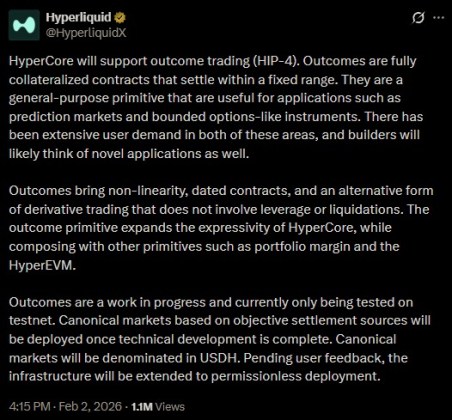
Why does this matter? Liquidity consolidation. Until now, prediction markets like Polymarket lived in silos, isolated from high-frequency perp trading. Hyperliquid’s integration hints at a future where capital efficiency rules supreme—traders can hedge election outcomes and leverage long ETH positions from a single collateral pool.

That 20% surge wasn’t just speculation. It was a rapid repricing of the protocol’s total addressable market.

But look closer at the liquidity flowing into high-performance chains. There is a secondary trend brewing: a resurgence of ‘high-conviction’ trading culture.

The traders on Hyperliquid aren’t passive allocators; they’re hunting volatility, leverage, and competition. That specific mindset is exactly what’s now fueling Maxi Doge ($MAXI), a project built for the ‘degen’ trader who treats markets like a contact sport.

Buy $MAXI today.

Maxi Doge Targets the ‘Leverage King’ Demographic

While Hyperliquid builds the plumbing for risk, Maxi Doge captures the culture of the risk-taker. Forget the passive ‘hold and hope’ mechanics of yesterday’s meme coins. Maxi Doge positions itself as a 240-lb canine juggernaut, embodying the ‘1000x energy’ of the current bull cycle. Its ethos: ‘Never skip leg-day, never skip a pump’, resonates with retail traders who know the market is a grind requiring serious conviction.
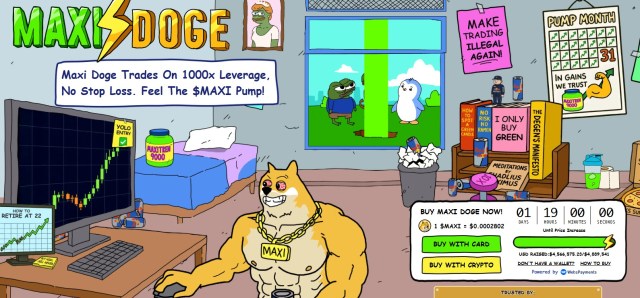
Frankly, the utility goes deeper than just aesthetics. Maxi Doge (unexpectedly for a meme token) integrates Holder-Only Trading Competitions, gamifying the experience like the leaderboards on major perp DEXs. It rewards top ROI hunters, aligning tokenomics with active participation. Plus, the ‘Maxi Fund’ treasury backs this ecosystem, ensuring liquidity for partnerships and high-impact marketing.

Sound familiar? It’s the strategies of top DeFi protocols applied to meme culture.

That cultural alignment counts. In a market where attention is the scarcest asset, projects mirroring their holders’ psychology often cook the hardest. Maxi Doge isn’t trying to be a currency; it’s a badge of honor for the “Leverage King” demographic.

Learn more about the project’s tokenomics.

Whales Accumulate $503K as Presale Momentum Builds

Smart money seems to agree with this thesis. While retail chases green candles elsewhere, on-chain data from Etherscan shows two whale wallets accumulated $503K in recent transactions within the Maxi Doge ecosystem. The largest single clip, a massive $314K transaction, executed on Oct 11, 2025.

That suggests high-net-worth players are positioning themselves well before the token hits public trading venues.

Presale metrics show demand accelerating. According to the official site, Maxi Doge has already raised over $4.5M, with tokens priced at $0.0002802. In a landscape fragmented across L2s and Solana, that’s no small feat. For an Ethereum mainnet token to command this level of early-stage capital signals real confidence in the ‘meme-first, utility-second’ hybrid model.

And then there’s the staking architecture. It’s designed to lock up supply while rewarding conviction. The smart contract governs a dynamic APY with daily automatic distribution from a 5% staking allocation pool. This setup encourages the long-term holding behavior seen in blue-chip DeFi governance tokens, aiming to dampen volatility.

Visit the official site for presale details.

The content provided in this article is for informational purposes only and does not constitute financial advice. Crypto assets are highly volatile.


Domande pertinenti

QWhat was the market reaction to Hyperliquid's announcement of expanding into prediction markets, and what does it indicate?

AThe market reaction was immediate and violent, with the HYPE token surging 20%. This indicates there is an immense appetite for infrastructure that bridges traditional trading with event wagering and represents a rapid repricing of the protocol's total addressable market.

QAccording to the article, what is the primary significance of Hyperliquid's integration of prediction markets?

AThe primary significance is liquidity consolidation. The integration hints at a future of supreme capital efficiency, where traders can hedge event outcomes (like elections) and leverage positions (like long ETH) from a single collateral pool, breaking down the silos between prediction markets and high-frequency perpetual trading.

QHow does the article describe the target demographic and ethos of the Maxi Doge ($MAXI) project?

AThe article describes Maxi Doge's target demographic as 'Leverage Kings' or 'degen' traders who hunt volatility, leverage, and competition. Its ethos is 'Never skip leg-day, never skip a pump', embodying the '1000x energy' of the bull cycle and resonating with retail traders who view the market as a grind requiring serious conviction.

QWhat utility does the Maxi Doge project offer beyond its meme token aesthetics?

ABeyond aesthetics, Maxi Doge integrates Holder-Only Trading Competitions that gamify the experience and reward top ROI hunters, aligning tokenomics with active participation. It is backed by the 'Maxi Fund' treasury to ensure liquidity for partnerships and marketing, applying strategies from top DeFi protocols to meme culture.

QWhat on-chain evidence does the article provide to suggest 'smart money' or whale interest in Maxi Doge?

AThe article cites on-chain data from Etherscan showing two whale wallets accumulated $503K in recent transactions within the Maxi Doge ecosystem, with the largest single transaction being $314K executed on Oct 11, 2025. This suggests high-net-worth players are positioning themselves early, before the token hits public exchanges.

Letture associate

a16z: AI's 'Amnesia', Can Continuous Learning Cure It?

The article "a16z: AI's 'Amnesia' – Can Continual Learning Cure It?" explores the limitations of current large language models (LLMs), which, like the protagonist in the film *Memento*, are trapped in a perpetual present—unable to form new memories after training. While methods like in-context learning (ICL), retrieval-augmented generation (RAG), and external scaffolding (e.g., chat history, prompts) provide temporary solutions, they fail to enable true internalization of new knowledge. The authors argue that compression—the core of learning during training—is halted at deployment, preventing models from generalizing, discovering novel solutions (e.g., mathematical proofs), or handling adversarial scenarios. The piece introduces *continual learning* as a critical research direction to address this, categorizing approaches into three paths: 1. **Context**: Scaling external memory via longer context windows, multi-agent systems, and smarter retrieval. 2. **Modules**: Using pluggable adapters or external memory layers for specialization without full retraining. 3. **Weights**: Enabling parameter updates through sparse training, test-time training, meta-learning, distillation, and reinforcement learning from feedback. Challenges include catastrophic forgetting, safety risks, and auditability, but overcoming these could unlock models that learn iteratively from experience. The conclusion emphasizes that while context-based methods are effective, true breakthroughs require models to compress new information into weights post-deployment, moving from mere retrieval to genuine learning.

marsbit2 h fa

a16z: AI's 'Amnesia', Can Continuous Learning Cure It?

marsbit2 h fa

Can a Hair Dryer Earn $34,000? Deciphering the Reflexivity Paradox in Prediction Markets

An individual manipulated a weather sensor at Paris Charles de Gaulle Airport with a portable heat source, causing a Polymarket weather market to settle at 22°C and earning $34,000. This incident highlights a fundamental issue in prediction markets: when a market aims to reflect reality, it also incentivizes participants to influence that reality. Prediction markets operate on two layers: platform rules (what outcome counts as a win) and data sources (what actually happened). While most focus on rules, the real vulnerability lies in the data source. If reality is recorded through a specific source, influencing that source directly affects market settlement. The article categorizes markets by their vulnerability: 1. **Single-point physical data sources** (e.g., weather stations): Easily manipulated through physical interference. 2. **Insider information markets** (e.g., MrBeast video details): Insiders like team members use non-public information to trade. Kalshi fined a剪辑师 $20,000 for insider trading. 3. **Actor-manipulated markets** (e.g., Andrew Tate’s tweet counts): The subject of the market can control the outcome. Evidence suggests Tate’sociated accounts coordinated to profit. 4. **Individual-action markets** (e.g., WNBA disruptions): A single person can execute an event to profit from their pre-placed bets. Kalshi and Polymarket handle these issues differently. Kalshi enforces strict KYC, publicly penalizes insider trading, and reports to regulators. Polymarket, with its anonymous wallet-based system, has historically been more permissive, arguing that insider information improves market accuracy. However, it cooperated with authorities in the "Van Dyke case," where a user traded on classified government information. The core paradox is reflexivity: prediction markets are designed to discover truth, but their financial incentives can distort reality. The more valuable a prediction becomes, the more likely participants are to influence the event itself. The market ceases to be a mirror of reality and instead shapes it.

marsbit3 h fa

Can a Hair Dryer Earn $34,000? Deciphering the Reflexivity Paradox in Prediction Markets

marsbit3 h fa

Trading

Spot
Futures
活动图片




