Hyperliquid "Invades" Wall Street: A Playground for On-Chain Whales, Facing Compliance Pressure Head-On

marsbitPubblicato 2026-03-17Pubblicato ultima volta 2026-03-17

Introduzione

Hyperliquid, a leading decentralized exchange (Perp DEX) for perpetual futures, is gaining significant traction by expanding into traditional asset trading through its HIP-3 market, which includes commodities like WTI crude oil and stock indices. With a monthly trading volume of $173.4 billion and over 4.11 trillion in total volume—81% of which comes from the top 100 addresses—it has become a hub for institutional and professional traders rather than retail users. Recent geopolitical tensions, such as the U.S.-Iran conflict, have accelerated adoption, as Hyperliquid offers 24/7 price discovery even when traditional markets are closed. This growth occurs amid a broader shift of liquidity from centralized exchanges (CEX) to DEXs, with Perp DEX volumes surging 346% in 2025. However, Hyperliquid faces mounting regulatory challenges. The CFTC is expected to introduce policies for crypto perpetual futures in the U.S. within a month, which may force platforms like Hyperliquid to adopt stricter compliance measures, including KYC—potentially undermining their permissionless appeal. To navigate these issues, Hyperliquid established a policy center in Washington D.C., led by crypto lawyer Jake Chervinsky, aiming to shape DeFi regulation and ensure long-term legitimacy. The platform’s founders emphasize building a sustainable, financially neutral infrastructure, recognizing that compliance is essential for broader adoption in traditional finance.

Author: Nancy, PANews

The narrative of on-chain finance is rapidly moving towards the global market.

In less than a week, multiple mainstream media outlets have turned their attention to Hyperliquid. This Perp DEX, which once focused on crypto derivatives, is having its "breakout moment," with decentralized pricing power becoming a focal point of discussion on Wall Street. However, as the volume of on-chain transactions continues to expand, the balance between decentralized innovation and compliance regulation is becoming an unavoidable challenge.

HIP-3 Invades Mainstream Finance, Hyperliquid is a Playground for Whales

As a leading Perp DEX, Hyperliquid is continuously widening the gap with its competitors and gradually becoming an emerging infrastructure force in the mainstream financial market.

According to data from DeFiLlama, as of March 16, Hyperliquid's monthly trading volume reached $173.42 billion, far surpassing similar platforms.

RWA (Real World Asset) trading is a significant growth driver for Hyperliquid recently. Platform data shows that in just the past 24 hours, its perpetual contract trading volume reached $5.4 billion, with the HIP-3 sector contributing approximately 21.3% (about $1.15 billion).
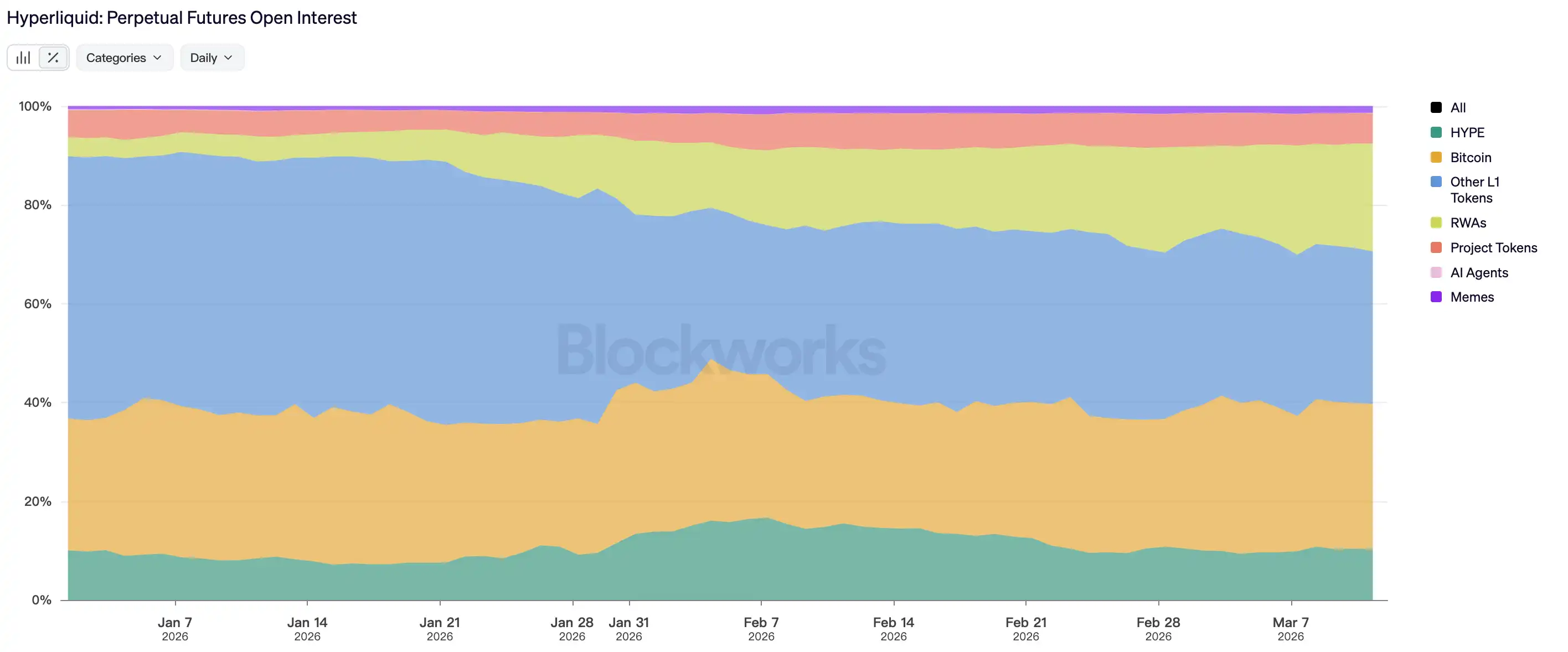
HIP-3 deploys perpetual futures markets for various assets like commodities, stock indices, etc. Among these traditional assets on HIP-3, WTI crude oil, silver, Brent crude oil, and XYZ100 currently show the most significant demand and activity, with WTI crude oil's daily trading volume accounting for over 35% of the total.

Behind the rapid expansion in trading scale is a large influx of whale players into Hyperliquid, whose global user base has exceeded 1.729 million. Further analysis by Hyperliquid Hub, an ecosystem data analysis service, points out that Hyperliquid's total trading volume has reached a staggering $411 trillion, with the top 100 addresses contributing over $334 trillion, accounting for 81.3% of all trading volume. The top 200 addresses account for 98.81%, leaving only about 1.19% of the volume for the remaining addresses.
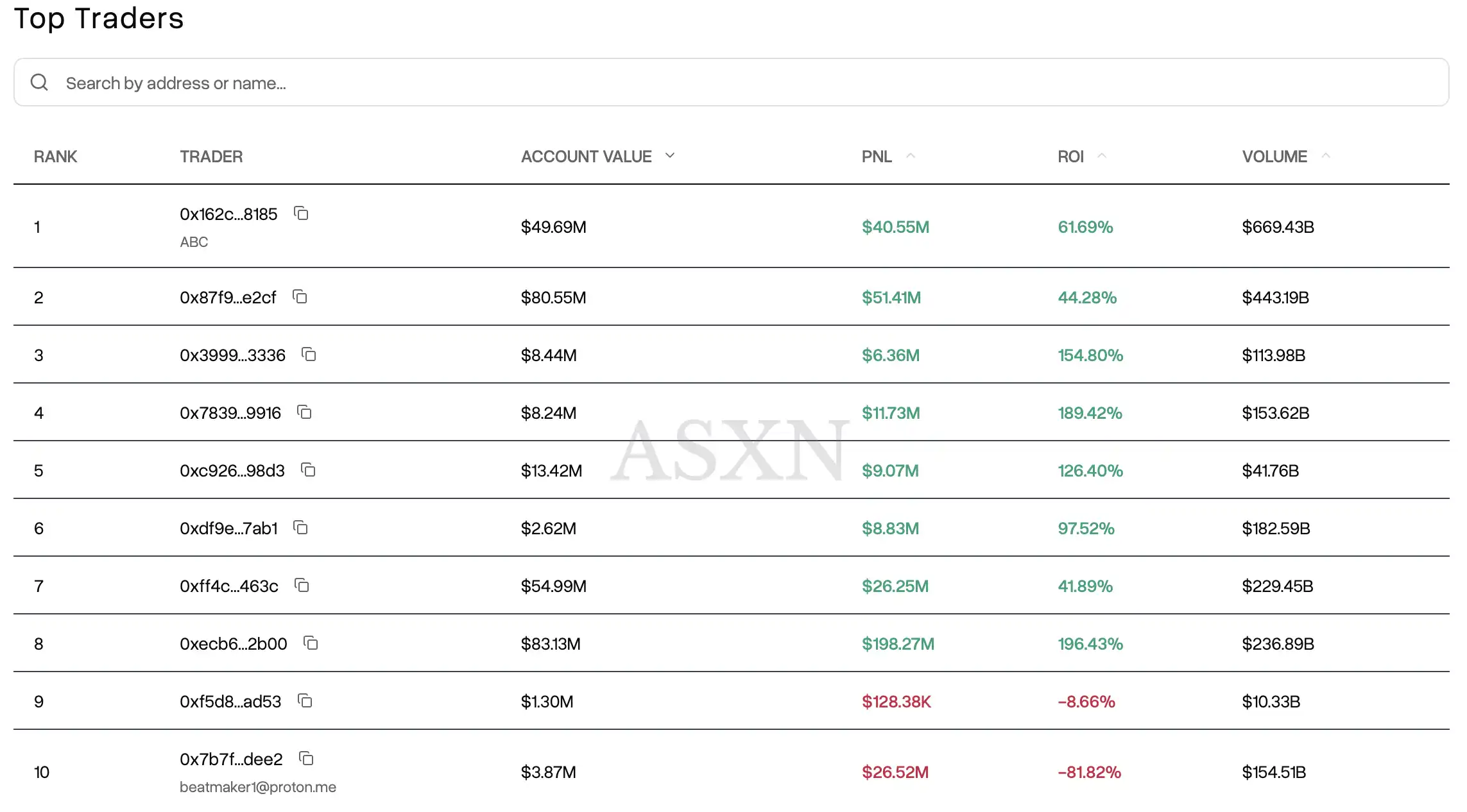
Clearly, Hyperliquid is not a playground for retail investors but is dominated by a small number of well-funded, highly active traders, such as institutions, whales, high-frequency traders, and professional market makers.

Looking further, the number of unique traders on HIP-3 has cumulatively exceeded 1.85 million (Note: the same wallet connecting on different days is counted as two separate wallets), with over 810,000 new traders added in the past month alone, further confirming the demand for trading tokenized assets.
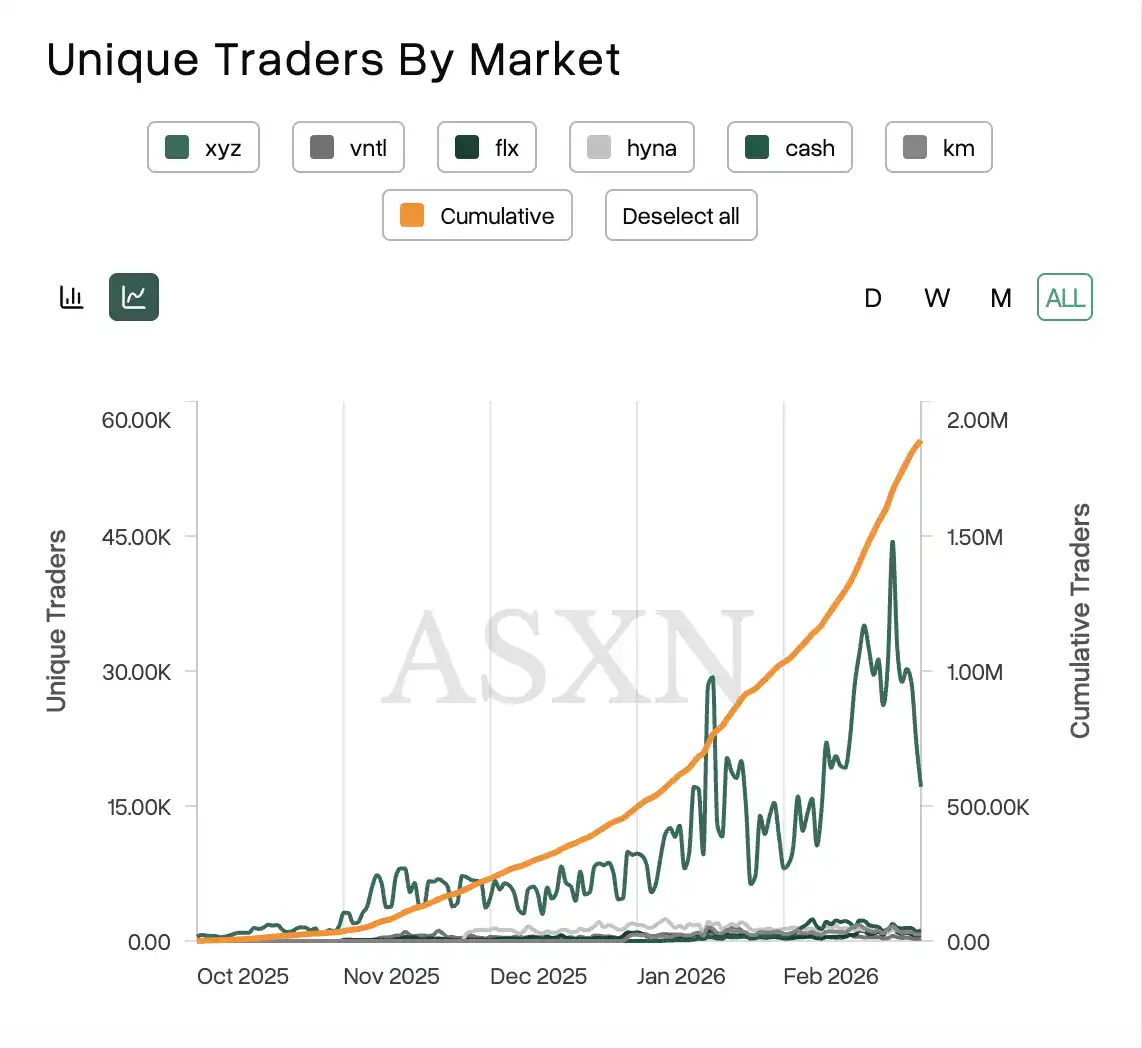
The recent significant growth in HIP-3 business is directly linked to the US-Iran conflict event, making Hyperliquid a new hub for global macro trading. Mainstream media like Bloomberg, Wall Street News, and Fortune, in recent reports, directly referenced Hyperliquid's crude oil contracts as a price reference, noting that before the CME (Chicago Mercantile Exchange) opened on Monday, Hyperliquid had already completed price discovery over the weekend, becoming a real-time window for global macro assets.

It is by seizing TradFi pricing power, liquidity vacuums, and macro hedging demand that Hyperliquid has begun to truly "invade" the mainstream financial market.

Matt Hougan, Chief Investment Officer of Bitwise, also stated that the US-Iran event has brought the 24/7 crypto market into focus. In the past, if a major geopolitical shock occurred on a Sunday morning, investors typically had to wait for the US futures market to open on Sunday at 6 PM ET to understand its impact. Now, they can directly turn to 24/7 on-chain trading platforms to execute trades in real-time. The shift of the financial industry to on-chain is an irreversible trend, like a ball rolling down a hill, unstoppable and much faster than imagined. However, there are still barriers to participating in on-chain markets, including familiarity with wallets, stablecoins, and platforms like Hyperliquid and Uniswap. (Related reading: Outside Wall Street Hours, Traditional Asset Pricing Power Shifts On-Chain)

Faced with this rapidly developing trend of on-chain finance, traditional financial players like Nasdaq and CME have also begun to lay out tokenized trading businesses to seize future market opportunities.

Crypto Perpetual Futures May Land in the US Next Month, Hyperliquid Faces Compliance Challenges Head-On

Since last year, the Perp DEX market has experienced a significant liquidity explosion.

A recent CoinGecko report pointed out that DEX perpetual contracts surged to $6.7 trillion in 2025, an increase of about 346% compared to the previous year, while CEX open interest fell by 20.8% during the same period. Behind this trend is the rise of perpetual DEXs like Hyperliquid and Lighter, also reflecting a large-scale migration of funds from CEXs to DEXs.
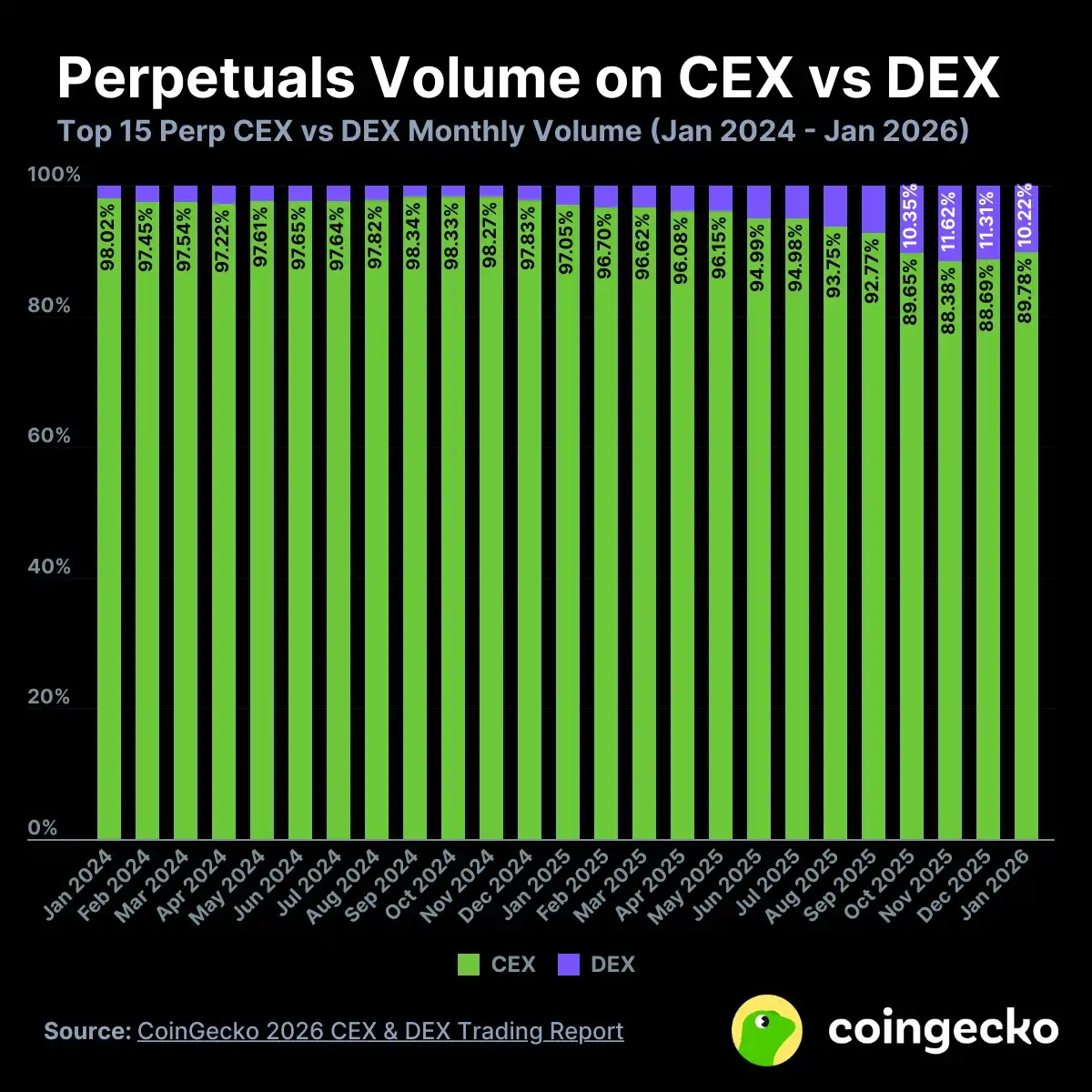
The gradual clarification of the regulatory environment is further amplifying the development space of the perpetual contract market, making more mainstream funds willing to enter this field. Recently, Mike Selig, Chairman of the U.S. Commodity Futures Trading Commission (CFTC), also discussed the regulatory progress of crypto perpetual futures and prediction markets in a public statement. He said the CFTC is working to launch true perpetual futures in the US and expects to announce related policies in about a month to attract liquidity back to the US while providing better protection for investors. Selig also pointed out that due to regulatory uncertainty in the past, a large amount of liquidity flowed overseas, and the CFTC is working with US SEC Chairman Paul Atkins to advance Project Crypto to coordinate digital asset regulatory reforms.

However, regulatory clarity could also lead to another outcome. Once the permissionless, intermediary-free on-chain trading path is broken due to compliance requirements, the core appeal of Perp DEXs could be significantly diminished, and they would directly face competition from compliant crypto platforms and traditional financial institutions.

In fact, for many users, besides factors like incentive mechanisms, self-custody needs, capital efficiency, and hedging demand, the lack of KYC is also an important reason attracting funds to on-chain trading.

For example, on-chain analyst Eye previously posted that some institutional trading parties active on Hyperliquid showed obvious discomfort after their on-chain trading wallets were identified, even actively contacting the analyst to pressure them to stop disclosing information, often related to the possibility of losing trades being known to the outside world.

If Hyperliquid hopes to be seen as a legitimate participant in the new financial system, it may have to accept and comply with corresponding regulatory rules. Especially against the background of previous controversial cases involving token manipulation and insider trading on the platform, its compliance pressure may further increase.

To address regulatory challenges, Hyperliquid formally established the Hyperliquid Policy Center in Washington, D.C. in February, with veteran crypto lawyer Jake Chervinsky as its first CEO. The center aims to create a legal path for the widespread adoption of DeFi in the US, help Congress and federal agencies understand the underlying technology of DeFi, and provide professional support for regulatory rule-making.

Chervinsky stated that the current regulatory framework was formed in the "analog era" and struggles to encompass new trading forms like decentralized protocols. A primary task of the policy center is to develop a legal framework for perpetual contracts. To support its operation, the associated Hyperliquid Foundation has donated 1 million native platform tokens HYPE (currently worth about $28 million) to support the center's operations.

Hyperliquid co-founder Jeff Yan emphasized in a recent interview that he wants the platform to "be used forever," not to fade away quickly with market hype. He also aims to distinguish Hyperliquid Labs from the Hyperliquid platform and ecosystem, and is committed to building Hyperliquid into a financially neutral platform, providing sustainable infrastructure for the development of on-chain perpetual contracts and decentralized finance.

As DeFi attempts to challenge traditional finance, compliance has become a prerequisite for accessing larger markets. This is not only a test for Hyperliquid but also a reality that other DEXs and even the entire DeFi track must face head-on.


Domande pertinenti

QWhat is Hyperliquid and why is it gaining attention from mainstream financial media?

AHyperliquid is a decentralized exchange (Perp DEX) focused on crypto derivatives that is rapidly expanding into traditional asset trading, such as commodities and indices, through its HIP-3 platform. It is gaining mainstream attention due to its significant trading volumes, role in price discovery for global macro events, and its emergence as a new infrastructure force in mainstream finance.

QHow does Hyperliquid's trading volume and user distribution reflect its dominance in the Perp DEX market?

AHyperliquid's monthly trading volume reached $173.4 billion as of March 16, far surpassing its competitors. Its user base is highly concentrated, with the top 100 addresses contributing over 81% of the total trading volume, indicating that it is dominated by large players like institutions, whales, and professional market makers rather than retail traders.

QWhat role did the U.S.-Iran conflict play in Hyperliquid's recent growth?

AThe U.S.-Iran conflict drove significant trading activity on Hyperliquid, particularly for oil contracts like WTI crude, as traders used the platform for real-time price discovery and hedging during periods when traditional markets like CME were closed. This event highlighted Hyperliquid's role as a global macro trading hub.

QWhat regulatory challenges does Hyperliquid face as it expands into traditional finance?

AHyperliquid faces compliance pressures related to regulatory clarity, potential requirements for KYC, and the need to balance its permissionless, decentralized nature with the demands of operating within legal frameworks. The platform has established a policy center in Washington D.C. to engage with regulators and help shape DeFi-friendly regulations.

QHow is the U.S. CFTC's upcoming policy on crypto perpetual futures expected to impact Hyperliquid and other DEXs?

AThe CFTC's expected policy on crypto perpetual futures, aimed at bringing liquidity back to the U.S. and providing investor protection, could create both opportunities and challenges for Hyperliquid. While regulatory clarity may attract more mainstream capital, it could also force DEXs to adopt compliance measures that may conflict with their decentralized, permissionless ethos.

Letture associate

UNI Doubles in Two Months Against the Trend: A 5-Year-Overdue Value Realization

Amidst a generally stagnant crypto market in June and July, UNI, the governance token of Uniswap, saw a significant surge, nearly doubling in price from around $2.3 to $4.6. This rally represents a delayed but significant value reassessment, triggered by the practical implementation of its long-debated "fee switch" mechanism. The key turning point was the on-chain execution of the UNIfication proposal in December 2025. It activated a protocol fee on select pools, directed Unichain sequencer revenue (net of costs) to a communal treasury, executed a one-time burn of 100 million UNI, and established a system where all protocol revenue flows into a "TokenJar" contract. This treasury has a single exit: purchasing and permanently burning UNI via a "Firepit" contract. Initially, the market reacted tepidly as the generated revenue and corresponding burn rate were modest. The narrative shifted dramatically in July 2025 with two major developments. First, the launch of Robinhood Chain, tailored for tokenized stocks, rapidly became a primary source of volume and fees for Uniswap, at one point contributing nearly half of its weekly fees. Second, governance votes successfully expanded the fee mechanism to v4 pools and initiated a temperature check for fees on Robinhood Chain. The activation of v4 fees caused the protocol's daily revenue earmarked for UNI burns to nearly triple. The core of UNI's recent price action is the transition from a pure governance token to a cash-flow asset with a permanent, protocol-funded buyer. Its effectiveness is amplified by UNI's mature and widely distributed supply, with no major impending unlocks to dilute the impact of the buybacks. The sustainability of this rally now hinges on whether the transaction volume, particularly on Robinhood Chain, persists after its initial gas subsidies expire, determining if this is a genuine value realization or a subsidy-fueled spike.

marsbit1 h fa

UNI Doubles in Two Months Against the Trend: A 5-Year-Overdue Value Realization

marsbit1 h fa

Breaking: Google Earth Urgently Pulls Back Nano Banana 2 Image Generation Feature!

Google Earth's newly launched "Create image" feature, powered by the Nano Banana 2 AI image generation model, was abruptly withdrawn shortly after its release due to being "played" by users. The feature allowed users to generate and overlay AI-created visuals directly onto real-world satellite and 3D maps in Google Earth. The tool enabled creative applications like historical recreations (e.g., visualizing ancient Pompeii), generating informational graphics for landmarks, and envisioning architectural projects or futuristic cityscapes on real terrain. It operated under "geospatial grounding," meaning the AI respected the underlying geography, topography, and perspective of the chosen map view. The model also integrated with Gemini to retrieve relevant factual information. However, upon release, users quickly tested its limits. A prominent example involved reimagining Philadelphia's historic Independence Hall as a post-apocalyptic ruin overrun by "happy" zombies, evil clowns, and giant alien mechs. This highlighted both the feature's playful potential and its risks regarding the generation of inappropriate or misleading content on realistic maps, leading to its swift temporary removal. Google stated it would re-release the feature after implementing "enhanced guardrails." Analysts note this move strategically leverages Google's vast proprietary geospatial data, positioning its AI not just for artistic generation but for spatially accurate world visualization—a unique advantage in the competitive AI image generation landscape.

marsbit2 h fa

Breaking: Google Earth Urgently Pulls Back Nano Banana 2 Image Generation Feature!

marsbit2 h fa

Altman Admits: Overestimated AI Snatching Jobs! Huang Renxun: The Unemployment Narrative Is Completely Backwards

Sam Altman has revised his earlier predictions about AI rapidly replacing jobs, admitting he overestimated the speed at which AI would eliminate entry-level white-collar roles. Speaking on the "Invest Like the Best" podcast, he stated that people do not truly want an AI CEO, as accountability and human connection remain critical. He found that individuals prefer interacting with people who can be held responsible for decisions. Similarly, NVIDIA's Jensen Huang argued that the narrative of AI destroying jobs is misguided. He distinguishes between tasks and jobs, noting that while AI can automate specific tasks, entire jobs—encompassing communication, judgment, coordination, and accountability—are not eliminated. He cited examples like radiologists and software engineers, where demand for these roles has increased as AI handles repetitive tasks, allowing for business expansion and the creation of more positions. Data from a University of Maryland and LinkUp study supports this, showing that U.S. job postings for new graduates have actually risen, countering the fear of vanishing entry-level roles. However, a significant shift is occurring: the traditional entry-level tasks that help newcomers gain experience are being automated, making initial career access more challenging. The key insight is that as AI takes over standardized tasks, the enduring value of human work shifts toward areas of responsibility, trust-building, and final decision-making—aspects that AI cannot replicate. The real "moat" for professionals lies in these irreplaceable human elements.

marsbit3 h fa

Altman Admits: Overestimated AI Snatching Jobs! Huang Renxun: The Unemployment Narrative Is Completely Backwards

marsbit3 h fa

Trading

Spot
活动图片