Hyperliquid: Can a $2.3 mln whale buy drive HYPE to $50?

ambcryptoPubblicato 2026-04-10Pubblicato ultima volta 2026-04-10

Introduzione

Hyperliquid (HYPE) has been trading within an ascending channel, reaching a two-week high of $40.9 and currently priced at $40.4, with 4.7% daily and 14% weekly gains. A newly created whale wallet deposited $5 million into Hyperliquid and purchased 59.2k HYPE worth $2.3 million, with an additional $2.6 million in USDC likely for further purchases. This whale activity and rising long positions, reflected in a Long/Short Ratio of 1.41, indicate strong bullish sentiment. Technical indicators like the RSI at 63 and price holding above key moving averages support continued upward momentum, potentially targeting $50 if resistance at $43 is broken. However, profit-taking has been observed, with $4.9 million in positive netflow, which could trigger a pullback. Key support levels are at $37 and $35.

Hyperliquid [HYPE] has traded within an ascending channel since it held $35 a week ago, touching a two-week high of $40.9. As of this writing, HYPE traded at $40.4, up 4.7% on the daily charts, adding to its 14% weekly gains.

With market conditions turning suitable, whales have taken the opportunity to re-enter the market.

Hyperliquid whale adds $2.3 million worth of HYPE

Whales have continued to accumulate HYPE, especially as it shows strong upside momentum. According to Lookonchain, a newly created wallet deposited $5 million into HyperLiquid and began buying HYPE after it crossed the $40 mark.

So far, the whale has purchased 59.2k HYPE worth $2.3 million. Still, the account holds $2.6 million in USDC, likely to be used for more purchases. With HYPE holding above the entry price, the whale is already up $10k.

Usually, when whales enter the market during an uptrend, it signals confidence and helps defend higher levels.

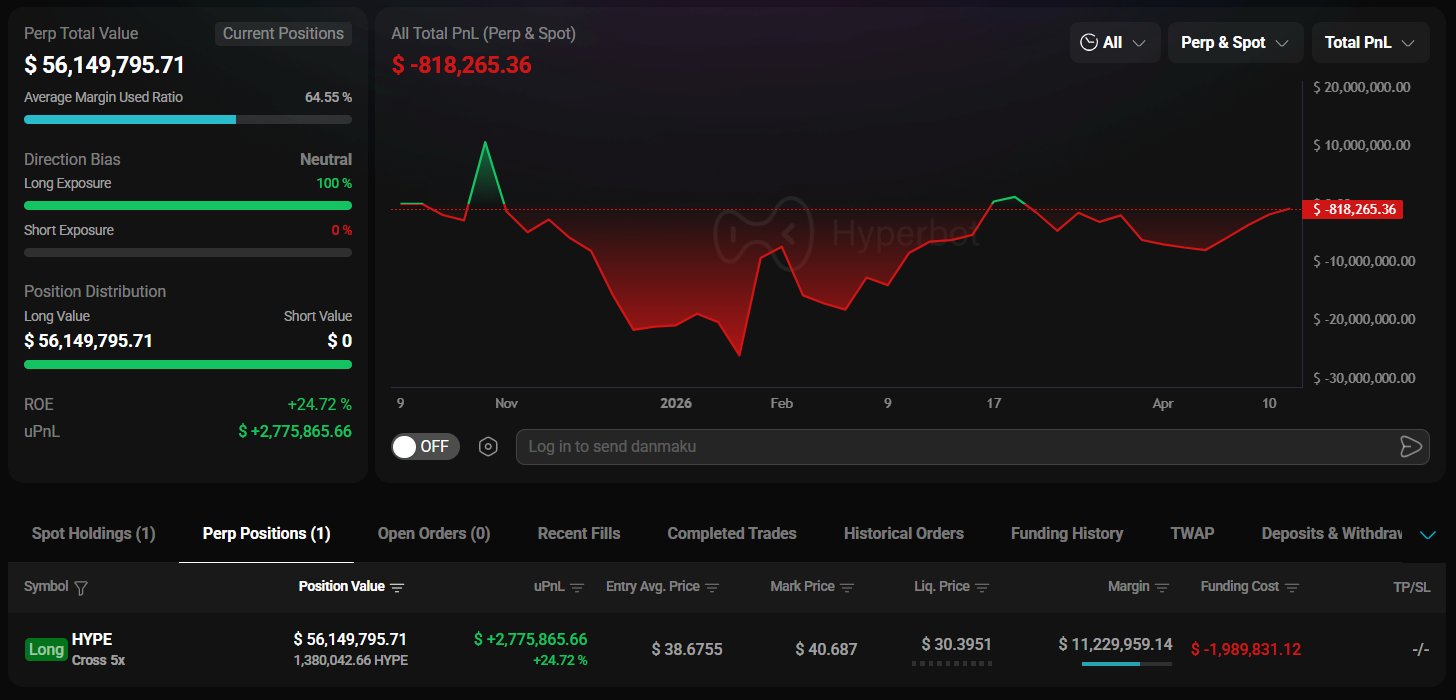
Coupled with that, whales have seen their profit margin surge amid the recent gains. Onchain Lens reported that a whale who held a 5x long position since the 6th of December 2025 is now erasing all losses.
Source: Onchain Lens

After HYPE dropped below $20, this whale saw his position go down by over $26 million. Despite the deep, the whale kept covering his position, losing $1.9 million in funding fees in the process.

However, with HYPE now trading above $40, the whale’s floating profit is over $2.77 million. Such determination to hold a losing position for five months showed confidence in the market.
Source: Coinalyze

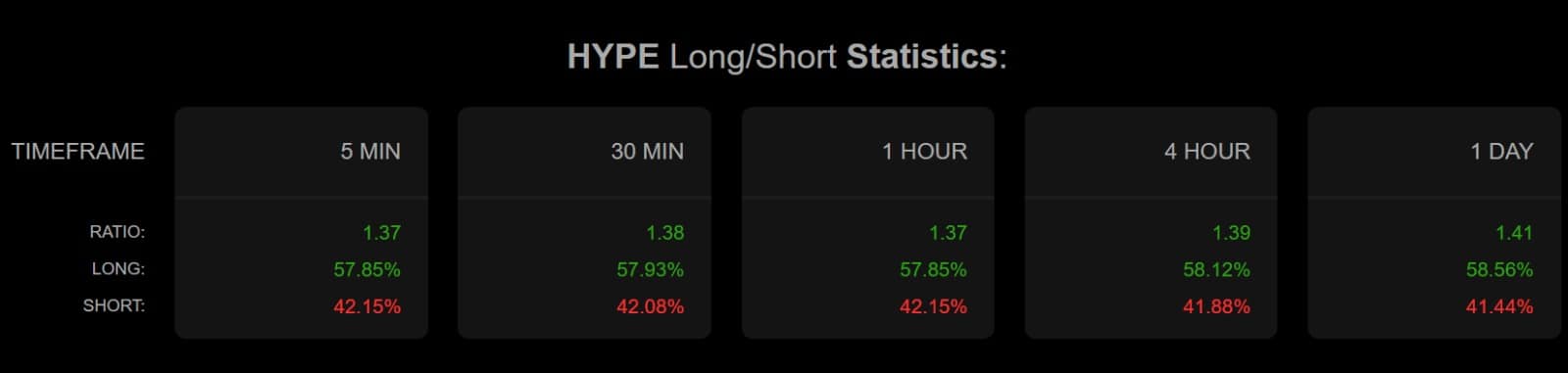
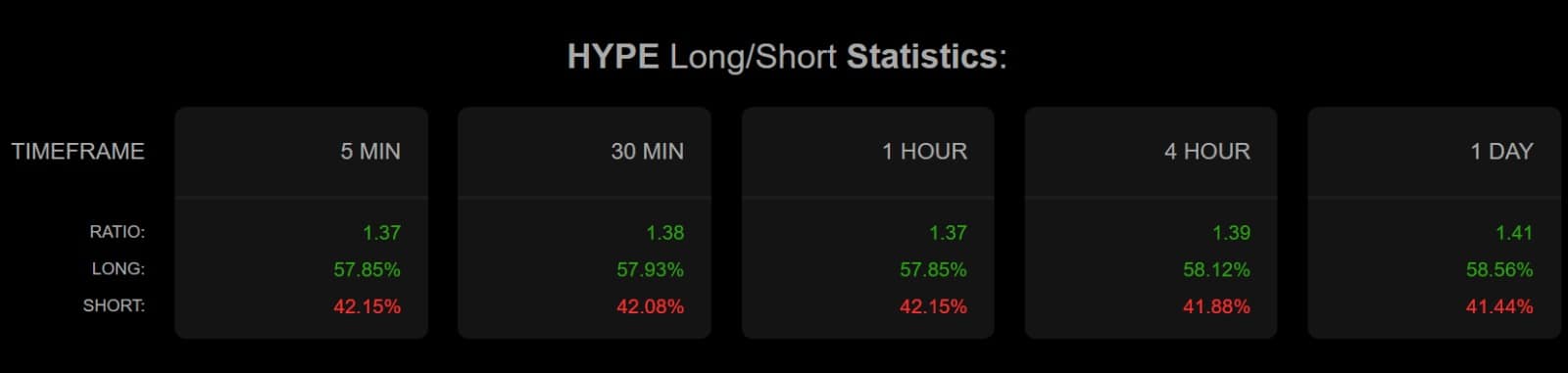
Besides this whale, the market has seen an influx in demand for long positions. Coinalyze data showed that the altcoin’s Long/Short Ratio rose to 1.41, with 58.5% of positions held by longs.

This implied that most market participants flipped bullish and deployed capital, betting on the prevailing trend’s continuation.

Historically, whale buying pressure on the spot and rising profitability in the perpetuals have boosted asset price action.

Is the demand sufficient to boost HYPE?

Hyperliquid showed bullish momentum amid rising market demand, especially driven by whales. The recent demand significantly strengthened the upside momentum.

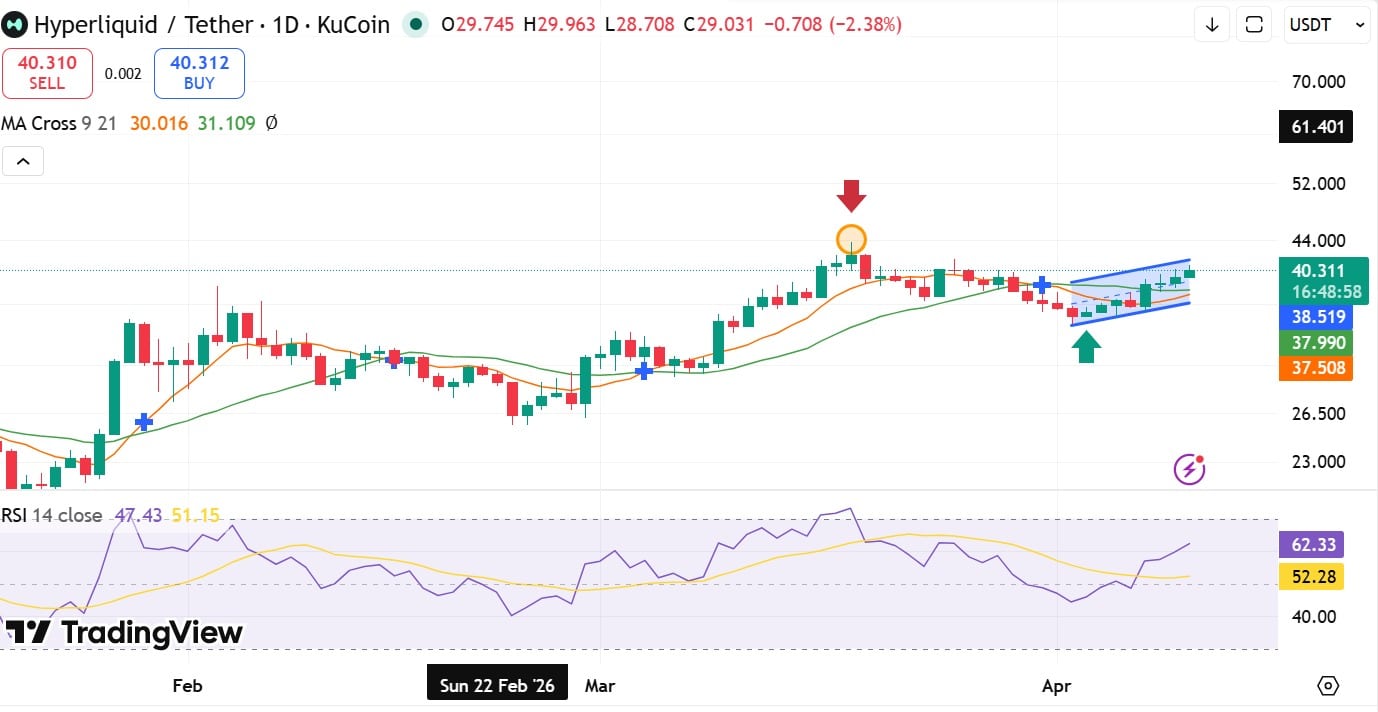
The altcoin’s Relative Strength Index (RSI) climbed to 63, remaining firmly within the bullish zone and indicating strong demand. At the same time, the altcoin held above the 9- and 21-day moving averages, reflecting a sustained upside momentum.
Source: Tradingview

Such market conditions point towards the likelihood of the trend’s continuation. If the momentum holds, HYPE will flip $43 resistance, where the uptrend previously collapsed, setting the ground for a move towards $50.

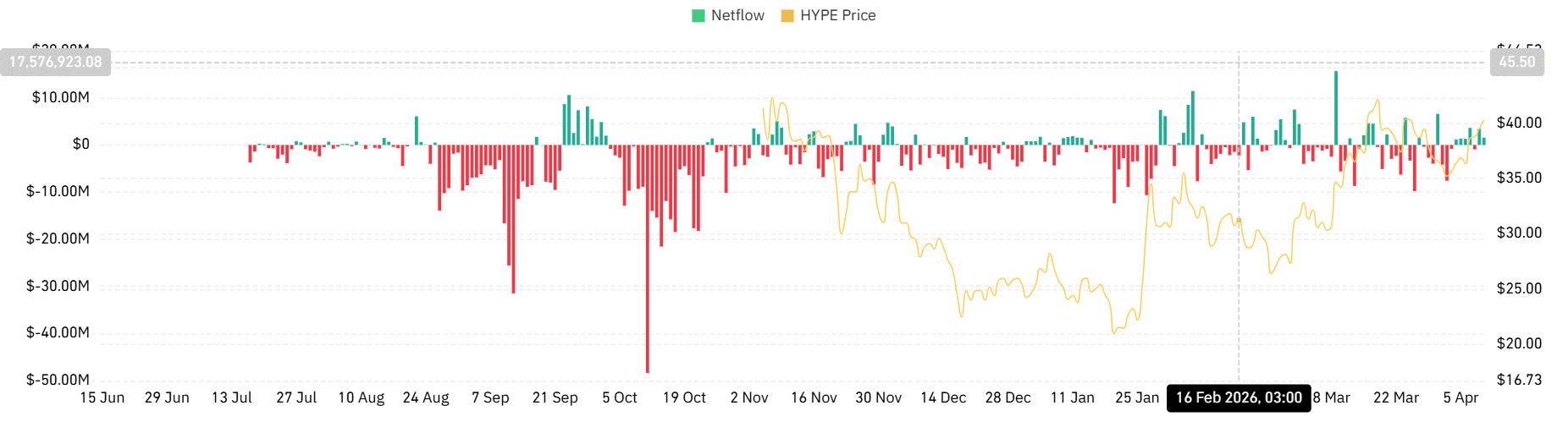
However, as HYPE crossed the $40 mark, investors who had been underwater showed greater determination to cash out at these levels. As such, the altcoin recorded positive Netflow on the 9th and 10th of April, totaling $4.9 million.
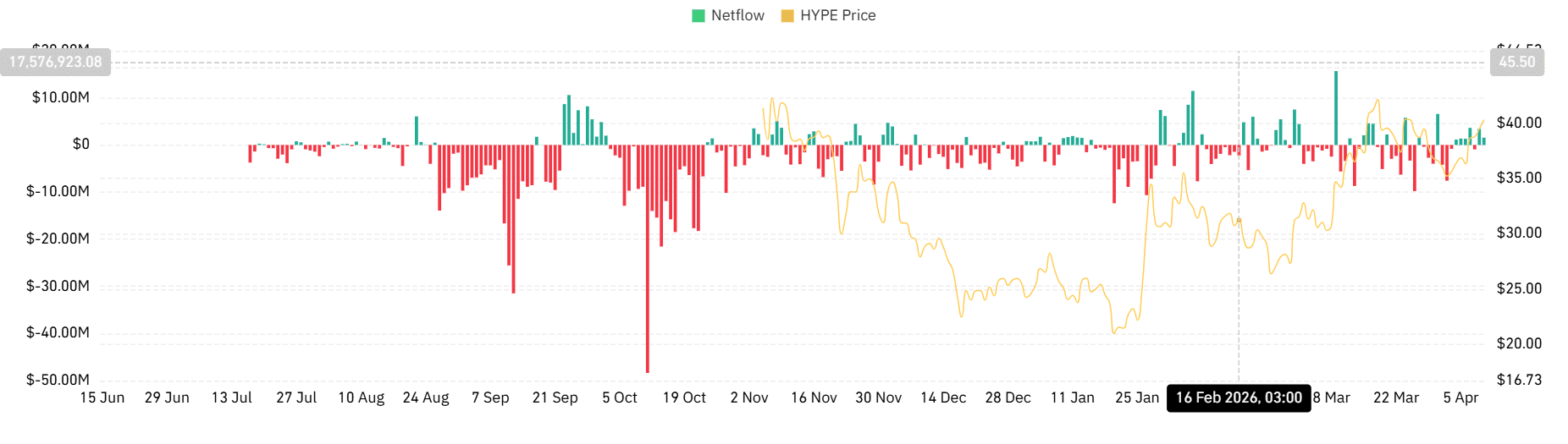
Source: CoinGlass

A positive Netflow suggested more sellers entered exchanges as prices pumped. Such profit-taking could derail the uptrend and trigger a pullback.

If profit-takers overwhelm demand, the 9- and 21-day moving averages at $37 will provide support, with $35 as a critical level.


Final Summary

  • A newly created whale wallet deposited $5 million on Hyperliquid and purchased 59.2k HYPE worth $2.3 million.
  • HYPE has traded within an ascending channel, touching a high of $40.9, but profit-taking could derail the rally.


Crypto di tendenza

Domande pertinenti

QWhat significant purchase did a whale make on Hyperliquid according to the article?

AA newly created whale wallet deposited $5 million into Hyperliquid and purchased 59.2k HYPE tokens worth $2.3 million, with an additional $2.6 million in USDC still available for potential future purchases.

QWhat is the current price and key resistance level for HYPE mentioned in the article?

AAs of the writing, HYPE was trading at $40.4. The key resistance level mentioned is $43, which is where the previous uptrend collapsed. A break above this could set the stage for a move towards $50.

QWhat on-chain metric suggests that most market participants are bullish on HYPE?

AThe Long/Short Ratio for HYPE rose to 1.41, with 58.5% of positions held by longs, indicating that a majority of traders are betting on the price increasing.

QWhat potential risk to the current uptrend does the article identify?

AThe article identifies profit-taking as a potential risk. It notes positive netflow of $4.9 million on April 9th and 10th, suggesting more sellers were moving tokens to exchanges to cash out, which could derail the uptrend and trigger a pullback.

QWhat technical indicators support the bullish momentum for HYPE?

AThe Relative Strength Index (RSI) climbed to 63, indicating strong bullish momentum. Additionally, the price was holding above the 9- and 21-day moving averages, further supporting a sustained upside trend.

Letture associate

Rubin Ultra Makes Major Cuts, Even Nvidia Can't Handle Memory Price Hikes?

NVIDIA's Rubin Ultra, the top-tier variant of the newly announced Rubin AI accelerators, has reportedly seen significant specification downgrades, according to an industry report from SemiAnalysis. Initially designed with four compute dies (4-die), the Rubin Ultra is now said to be reduced to a 2-die design. Key changes highlighted in the report include: * **No increase in peak theoretical compute performance**, remaining at 35 PFLOPs like the standard Rubin. * **Severe reduction in memory capacity** to 192GB using 8-Hi HBM stacks, which is less than the standard Rubin's 288GB using 12-Hi stacks. * **Negligible memory bandwidth improvement** of only 1 TB/s. * **Slightly higher chip-level power consumption**. * The **primary upgrade is a massive increase in scale-up interconnect capacity**, supporting connections for up to 576 GPUs via NVLink, compared to 72 for the standard Rubin. The report suggests the redesign is primarily a cost-optimization move driven by the sharp rise in HBM (High-Bandwidth Memory) prices. By reducing the expensive HBM content and shifting investment towards enhanced system-scale networking, NVIDIA aims to maintain the platform's value for large-scale AI training clusters while managing soaring material costs. The news reportedly triggered a sell-off in South Korean memory stocks, with SK Hynix and Samsung shares falling around 8%, as markets grew concerned that NVIDIA—a major HBM buyer—might be reducing its reliance on high-capacity memory, potentially capping future pricing power for memory makers.

Odaily星球日报12 min fa

Rubin Ultra Makes Major Cuts, Even Nvidia Can't Handle Memory Price Hikes?

Odaily星球日报12 min fa

Can Generative Models Finally Be Trained End-to-End? The Core Is a For Loop

This article introduces a novel training paradigm for generative models called Explorative Modeling (XM), which enables true end-to-end training. Traditionally, powerful generative models like autoregressive and diffusion models are not trained end-to-end. They are trained to predict a single small step but require iterative multi-step sampling for inference. This "exposure bias" leads to error accumulation and limits performance. The core challenge XM addresses is "mode blurring." In generative tasks, a single input (e.g., "generate a dog") corresponds to many valid outputs (multiple modes). Standard training objectives like reconstruction loss force the model to average these modes, producing unrealistic, blurry outputs. To avoid this, existing models break generation into many small, almost deterministic steps, sacrificing end-to-end training. XM tackles this by restructuring the training loop itself. Its key insight is to amplify "generative expressivity." For each training input, instead of generating one sample, the model generates K candidate outputs. Only the candidate closest to the real data is used for computing the loss and updating the model via backpropagation. This simple "best-of-K" mechanism is implemented as a short for-loop. By exploring multiple possibilities, the model learns to distribute its guesses across different modes rather than collapsing to their uninformative average. The paper demonstrates that "exploration" acts as a new, powerful scaling axis. Gains from XM increase with model size, data scale, and compute. Experiments show improvements in FID scores for image generation and significant efficiency gains, sometimes outperforming larger models without exploration. When pushed to the limit, XM enables fully single-step, end-to-end generative models. In robotics tasks, an "Explorative Policy" matched the performance of a 100-step Diffusion Policy with a single forward pass, drastically improving inference speed. While the best-of-K concept is not entirely new, the authors' contribution lies in formally understanding it as a direct method to boost generative expressivity without fragmenting the generation process. This work suggests that as models scale, enhancing exploration during training may become crucial for overcoming fundamental performance bottlenecks.

marsbit1 h fa

Can Generative Models Finally Be Trained End-to-End? The Core Is a For Loop

marsbit1 h fa

Trading

Spot

Articoli Popolari

Come comprare HYPE

Benvenuto in HTX.com! Abbiamo reso l'acquisto di Hyperliquid (HYPE) semplice e conveniente. Segui la nostra guida passo passo per intraprendere il tuo viaggio nel mondo delle criptovalute.Step 1: Crea il tuo Account HTXUsa la tua email o numero di telefono per registrarti il tuo account gratuito su HTX. Vivi un'esperienza facile e sblocca tutte le funzionalità,Crea il mio accountStep 2: Vai in Acquista crypto e seleziona il tuo metodo di pagamentoCarta di credito/debito: utilizza la tua Visa o Mastercard per acquistare immediatamente HyperliquidHYPE.Bilancio: Usa i fondi dal bilancio del tuo account HTX per fare trading senza problemi.Terze parti: abbiamo aggiunto metodi di pagamento molto utilizzati come Google Pay e Apple Pay per maggiore comodità.P2P: Fai trading direttamente con altri utenti HTX.Over-the-Counter (OTC): Offriamo servizi su misura e tassi di cambio competitivi per i trader.Step 3: Conserva Hyperliquid (HYPE)Dopo aver acquistato Hyperliquid (HYPE), conserva nel tuo account HTX. In alternativa, puoi inviare tramite trasferimento blockchain o scambiare per altre criptovalute.Step 4: Scambia Hyperliquid (HYPE)Scambia facilmente Hyperliquid (HYPE) nel mercato spot di HTX. Accedi al tuo account, seleziona la tua coppia di trading, esegui le tue operazioni e monitora in tempo reale. Offriamo un'esperienza user-friendly sia per chi ha appena iniziato che per i trader più esperti.

395 Totale visualizzazioniPubblicato il 2024.12.11Aggiornato il 2026.06.02

Come comprare HYPE

Discussioni

Benvenuto nella Community HTX. Qui puoi rimanere informato sugli ultimi sviluppi della piattaforma e accedere ad approfondimenti esperti sul mercato. Le opinioni degli utenti sul prezzo di HYPE HYPE sono presentate come di seguito.

活动图片