Hyperliquid: Can $100mln revenue from third-party apps fuel HYPE’s rally?

ambcryptoPubblicato 2026-03-24Pubblicato ultima volta 2026-03-24

Introduzione

Hyperliquid is gaining significant traction, driven by two key factors: trading of non-crypto assets (HIP-3) like oil and gold, which accounted for 40% of daily volumes in March, and integrations with third-party platforms such as Phantom and MetaMask via builder codes. Together, these now generate $100 million in annual revenue, representing 19% of Hyperliquid's total revenue share. Builder codes alone contribute 10% of total trading volumes. This growth has positively impacted HYPE, the platform's native token, as a significant portion of revenue is used for token buybacks, creating buying pressure. In Q1 2026, a surge in perp volumes and revenues led to a substantial price appreciation from $20 to $43. Although the price has retraced below $40, bullish whale activity suggests support around the $35-$50 range, with potential for a move toward $50 if the positive trend continues.

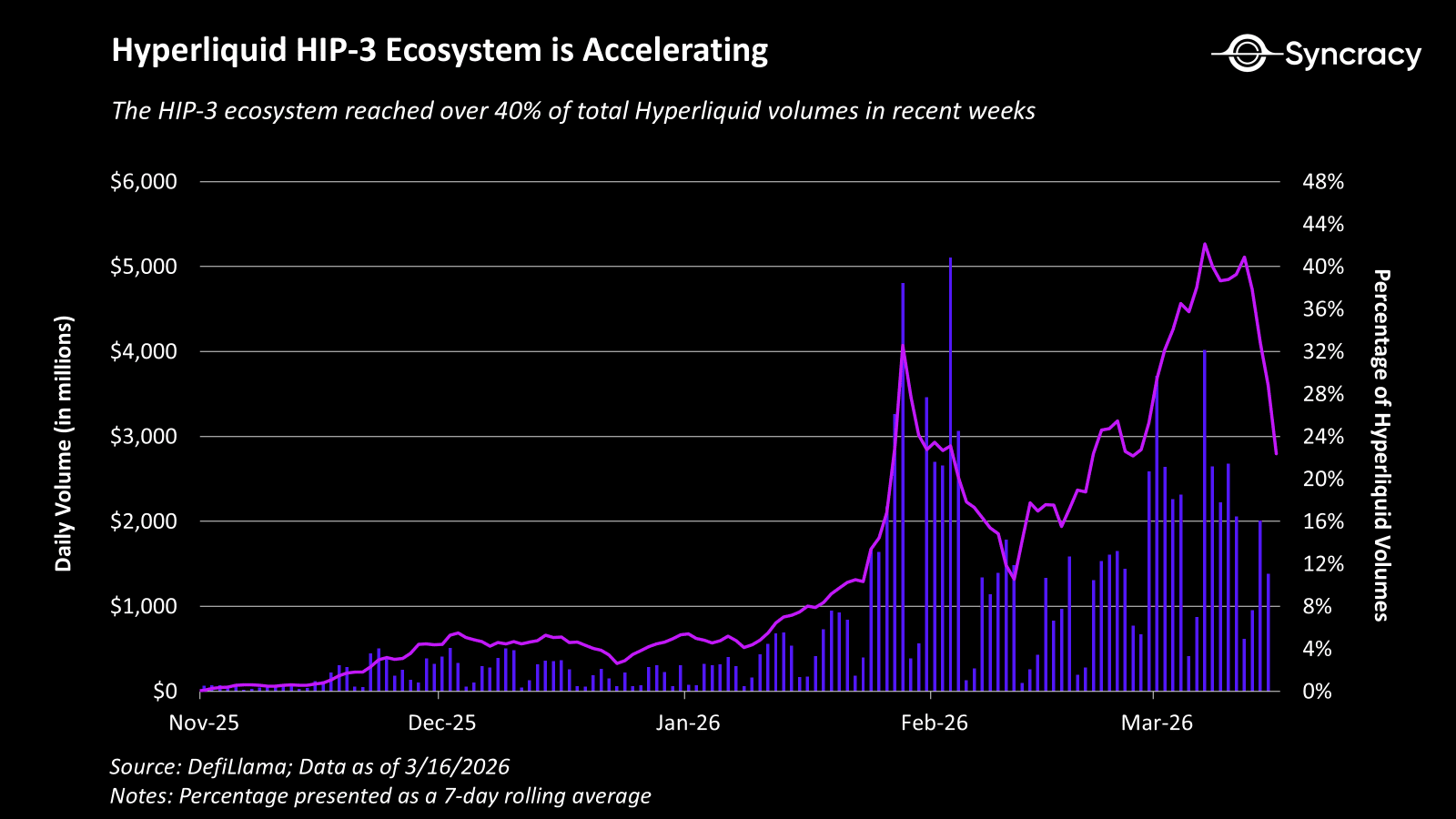
Hyperliquid has been hitting headlines lately, thanks to the growing interest in non-crypto assets (HIP-3) such as oil, gold, and silver trading on the platform.

In March alone, HIP-3 volumes accounted for 40% of total Hyperliquid daily volumes as the West Asia crisis dragged on.

Below the surface, however, HIP-3 isn’t the only growth driver. Builder codes or integration with other platforms, such as Phantom and MetaMask wallets, has also seen incredible adoption.
Source: Syncracy Capital

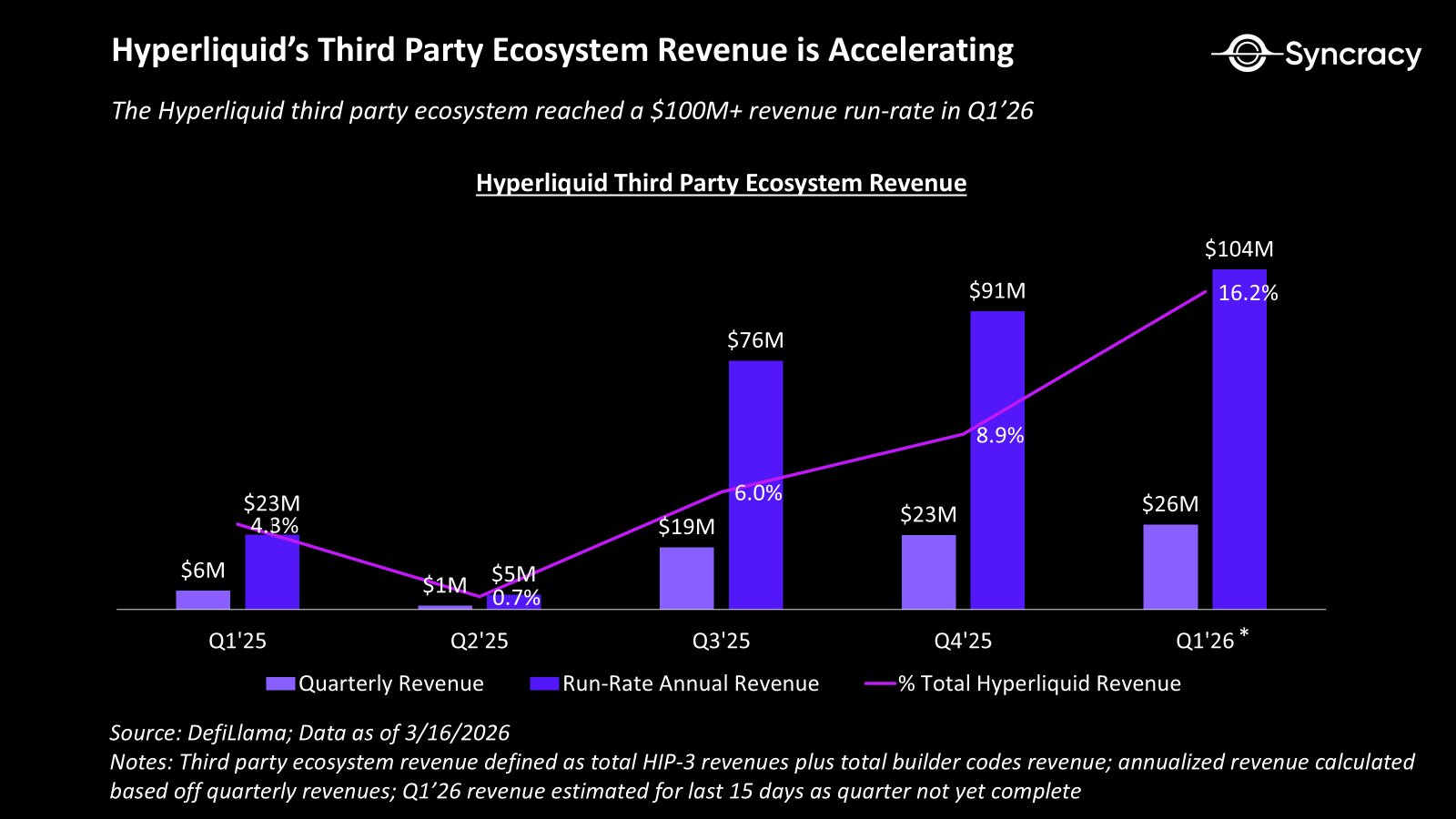
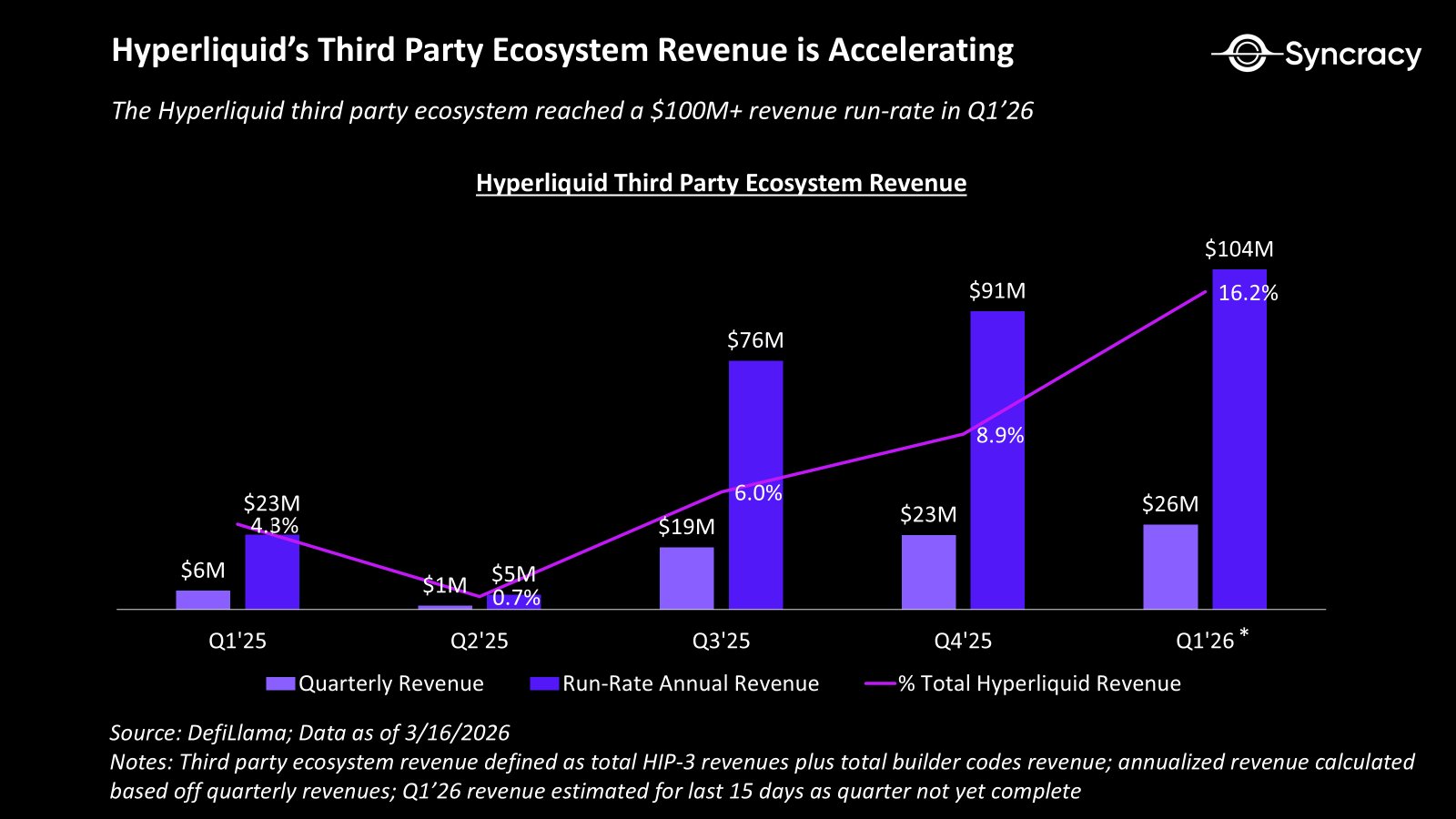
Collectively, HIP-3 and builder codes (third-party ecosystem) now generate $100 million annual revenue for Hyperliquid – About 19% of total revenue share.

In terms of trading volumes alone, builder codes account for 10% of total volumes, primarily from mobile interfaces.

These are platforms like Phantom, which have plugged Hyperliquid under the hood to empower their perp offerings. For every trade made via these integrations, a fee-sharing model applies between Hyperliquid and the builder.
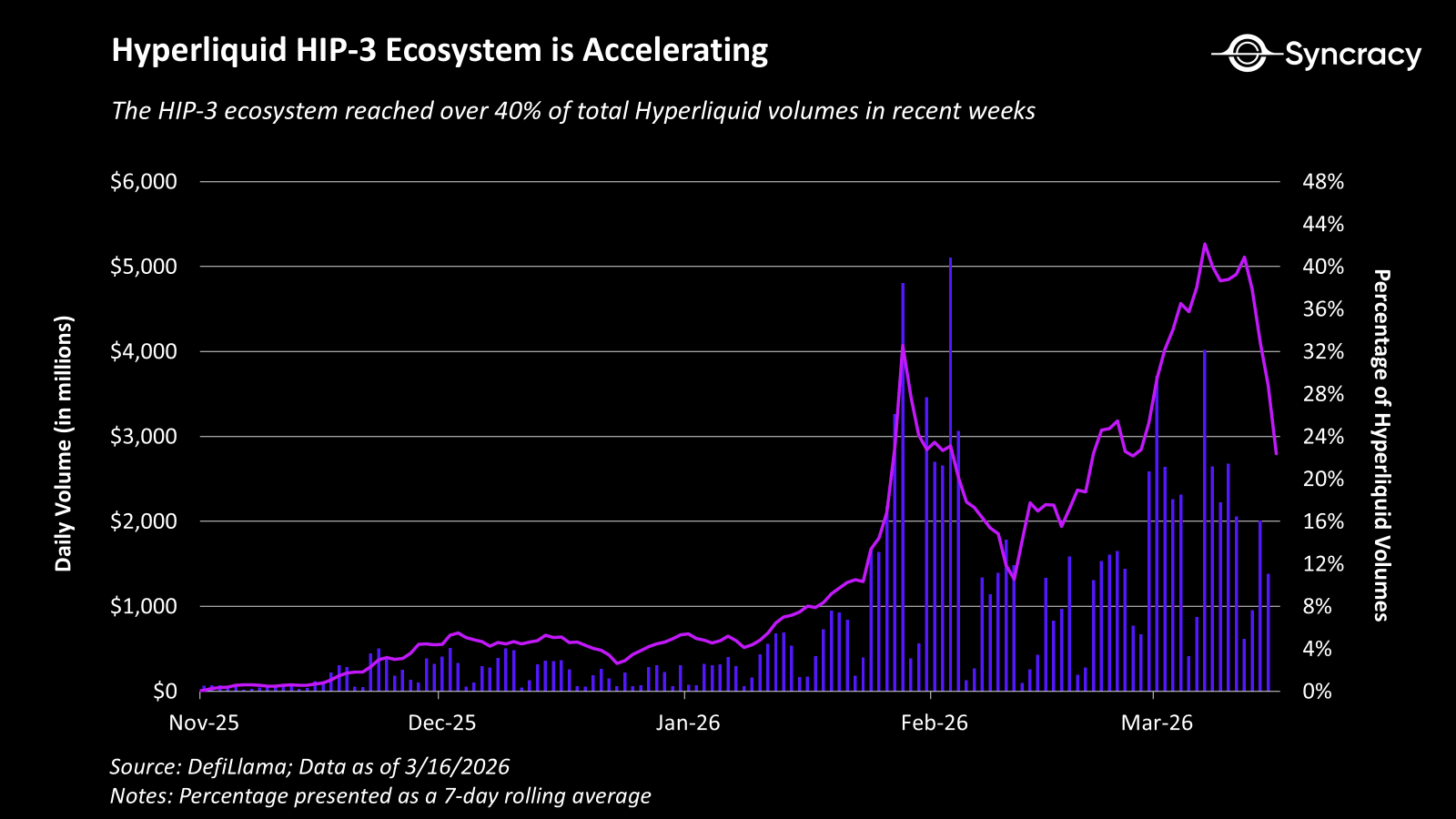
Source: Syncracy Capital (Builder codes vs HIP-3 revenues)

According to Ryan Watkins, co-founder of crypto VC firm Syncracy Capital, the two factors were ‘accelerating adoption’ for Hyperliquid.

Impact on HYPE?

Now, how does this monster adoption impact HYPE value or tokenholders? Well, since most of the revenue goes toward the token buyback program, buying pressure may trigger HYPE appreciation, especially in a positive macro environment.

In fact, this is exactly what happened in Q1 2026. As perp volumes doubled from $40B to nearly $90B, weekly revenues doubled too from less than $9M to over $22M.

This made HYPE retracement to stabilize around $20, setting up a breakout to $38- Marking a whopping 86% run. After a cool-off to $25, the second phase lifted HYPE to $43, a massive 71% upswing.
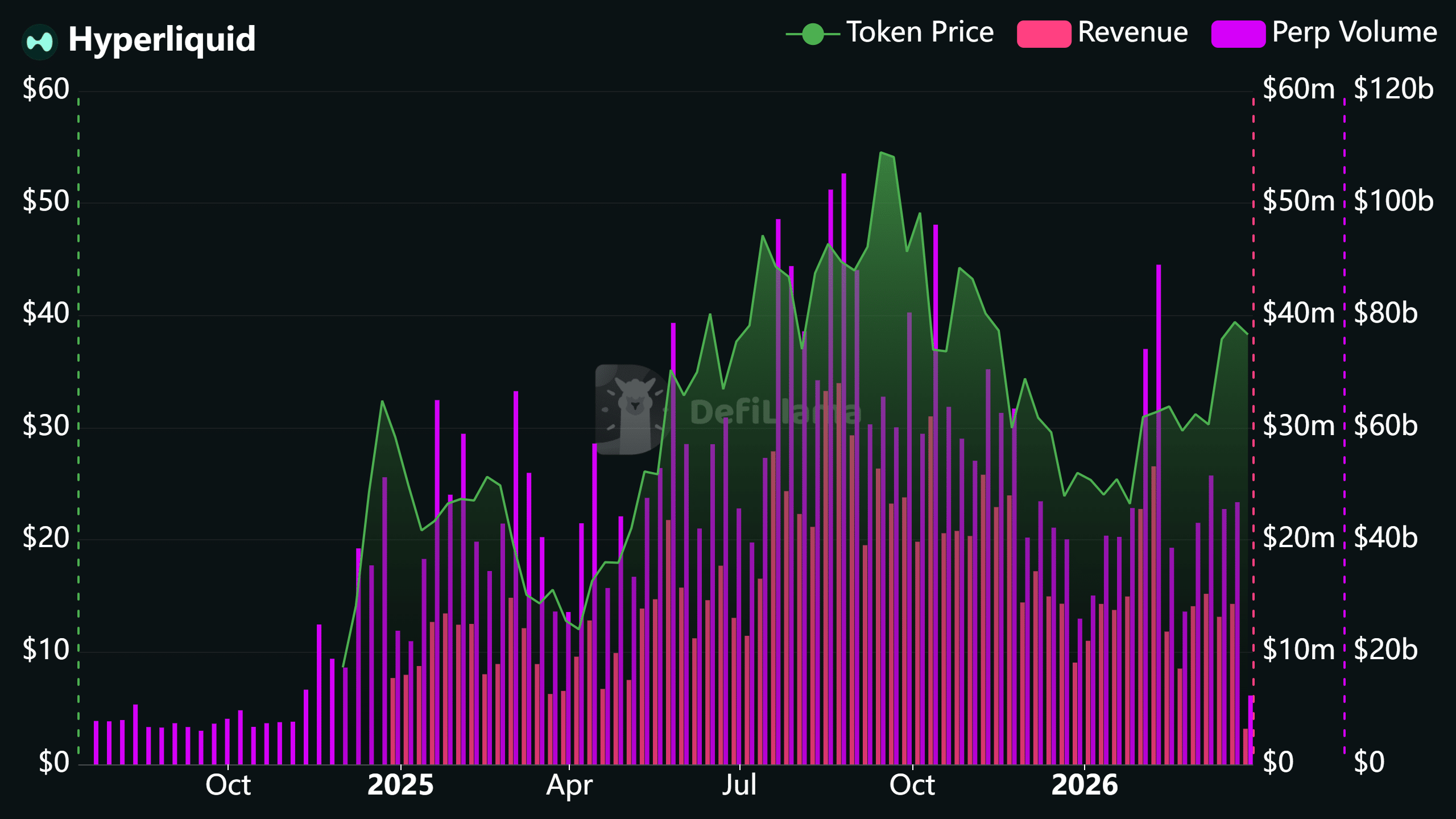
Source: DeFiLlama

In other words, under positive market sentiment, the strong adoption is a flywheel for HYPE and tokenholders.

What’s next for HYPE price?

At the time of writing, HYPE had retraced part of its recent gains and traded below $40. But some whales kept bidding as the price retraced, underscoring that some players remained bullish on the altcoin.

Even so, HYPE was back in its H2 2025 price range of $35-50, and defending the range lows could increase the odds of hitting $50.
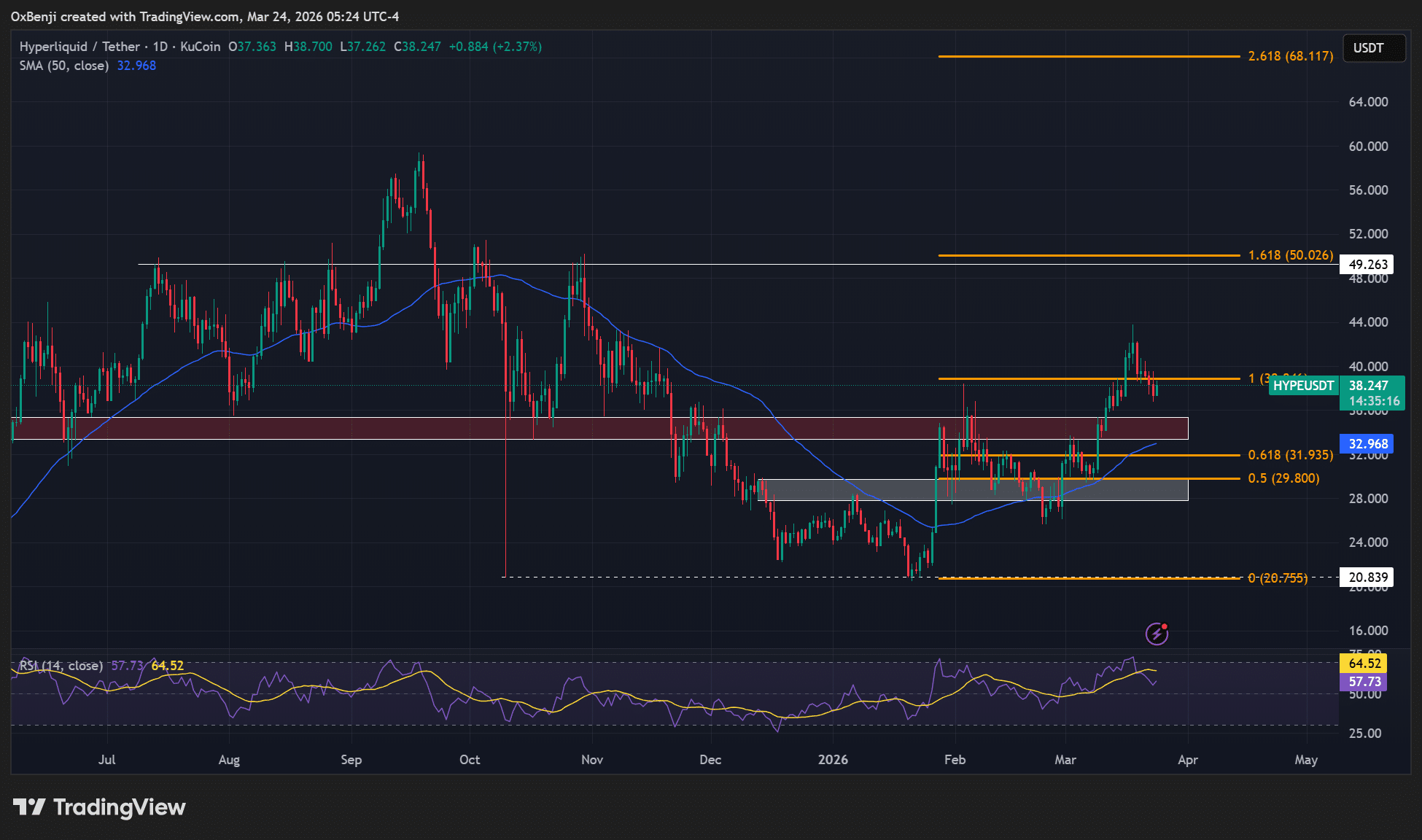
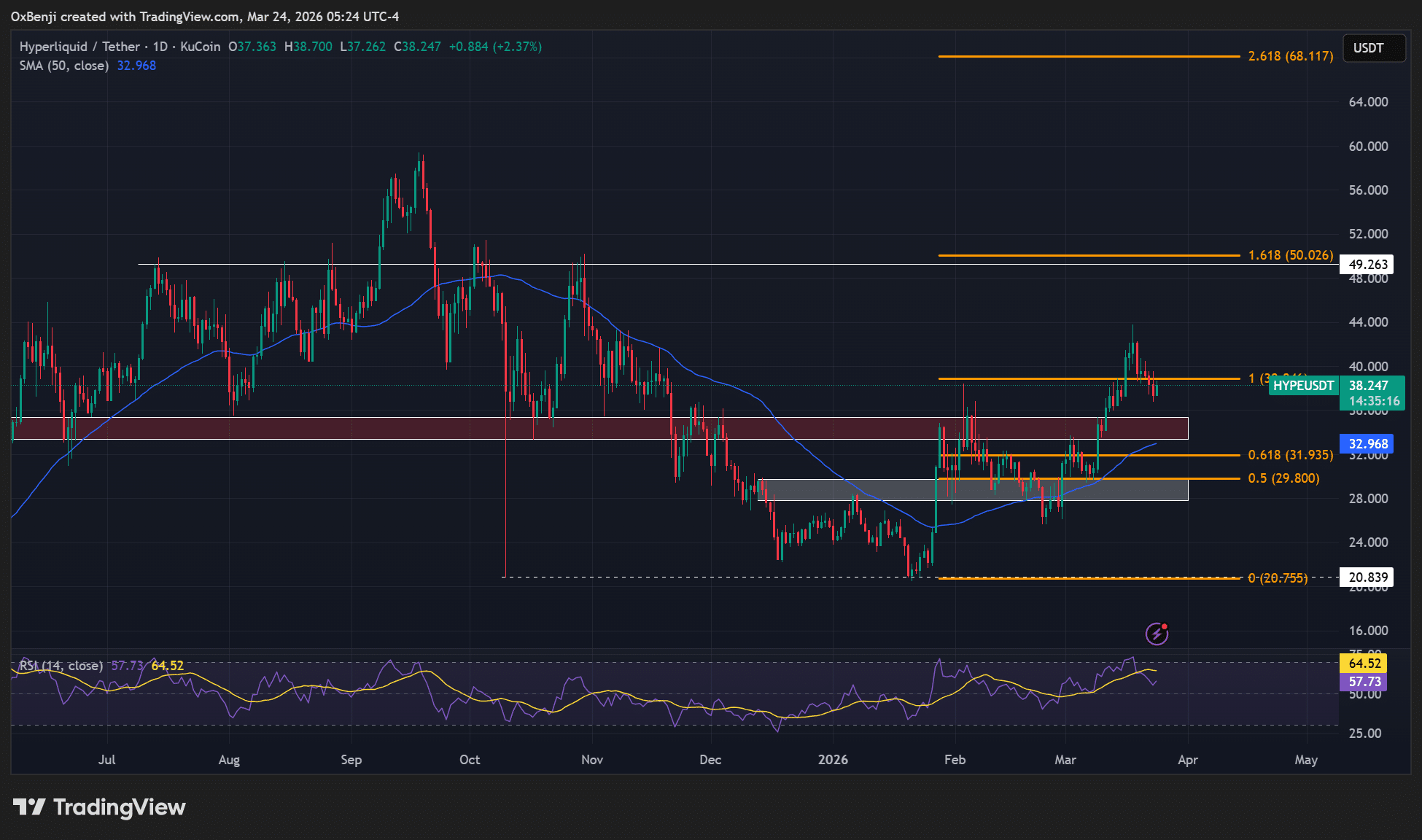
Source: HYPE/USDT, TradingView

Final Summary

  • Non-crypto assets and integration with other platforms now generate $100M annual revenue to Hyperliquid
  • The massive adoption has been net positive for HYPE, and bulls may defend the $35-$50 price range if the trend continues.


Crypto di tendenza

Domande pertinenti

QWhat are the two main growth drivers for Hyperliquid mentioned in the article?

AThe two main growth drivers are HIP-3 (non-crypto assets like oil, gold, and silver trading) and builder codes (integration with third-party platforms like Phantom and MetaMask wallets).

QHow much annual revenue do HIP-3 and builder codes collectively generate for Hyperliquid, and what percentage of the total revenue share is this?

AHIP-3 and builder codes collectively generate $100 million in annual revenue, which accounts for about 19% of Hyperliquid's total revenue share.

QAccording to the article, how does the revenue from third-party apps impact the HYPE token?

AMost of the revenue is used for a token buyback program, which creates buying pressure and can lead to HYPE token appreciation, especially in a positive macro environment.

QWhat was the price range for HYPE in H2 2025, as stated in the article?

AThe price range for HYPE in H2 2025 was $35 to $50.

QWho is Ryan Watkins and what did he say about Hyperliquid's growth factors?

ARyan Watkins is the co-founder of crypto VC firm Syncracy Capital. He stated that HIP-3 and builder codes were 'accelerating adoption' for Hyperliquid.

Letture associate

Bernstein Analysis: Can the $142 Billion Long-Term Order Hold Up the Memory Cycle?

Bernstein revisits long-term agreements (LTAs) in the memory industry, highlighting new contracts with purchase commitments, minimum prices, and financial guarantees signed by Micron and SanDisk. These aim to provide an earnings floor for the coming years. Micron has 16 strategic customer agreements, with 14 representing approximately $100 billion in minimum revenue and about $22 billion in cash deposits/commitments. SanDisk has contracts for around $42 billion in minimum revenue and over $11 billion in guarantees. Combined, these ~$33 billion in guarantees make it more costly for major clients to walk away. However, Bernstein models that the potential revenue needing protection over 3-5 years is around $5.2 trillion. The existing guarantees thus cover only about 0.6% of that scale. While LTAs provide a cushion, they cannot fully shield profits in a severe downturn, as clients may still find it cheaper to breach contracts if spot prices fall deeply below floor prices. LTAs are most suitable for large, credit-worthy customers like U.S. cloud service providers with stable, high-volume AI infrastructure needs. Consumer segments (phones, PCs) and some Chinese clients are less likely to adopt them, leaving an estimated 30-50% of the DRAM/NAND market exposed to spot price volatility. AI demand (e.g., HBM for training, storage for inference) supports higher valuations and makes LTAs more attractive for locking in high-demand customers. Yet, Bernstein stresses that LTAs soften, but do not eliminate, the memory cycle. Their true test will come in the next downturn, revealing whether clients honor contracts and whether guarantees provide sufficient pain to maintain supplier discipline.

marsbit7 min fa

Bernstein Analysis: Can the $142 Billion Long-Term Order Hold Up the Memory Cycle?

marsbit7 min fa

Dialogue with Jia Hang | Looking Back at Two Decades of Chinese Payment Going Global

**Summary: A Conversation with Jia Hang on Two Decades of China's Payment Globalization** Jia Hang, a veteran with over twenty years in payments, reflects on China's attempts to build a global payment network through three key phases: UnionPay (card networks), Alipay+ (digital wallets), and now, stablecoins. His journey began at UnionPay International, aiming to establish China's card network abroad. While successful in following Chinese tourists ("where Chinese go, UnionPay goes"), it struggled to achieve true global scale. The core lesson: card networks like Visa/Mastercard's unassailable advantage isn't just technical standards, but their deeply entrenched **governance and profit-sharing models** that create powerful network effects. Competing as the "same species" is nearly impossible. At Ant Group, he led Alipay+, a strategy to bypass card networks by interconnecting local e-wallets worldwide. While innovative, it faced a similar ceiling. Mobile QR payments and card swipes were essentially **the same species competing for the same pie**, lacking a disruptive value proposition for users or a sustainable new incentive model to replace the card networks' established flywheel. Today, at Singapore's DCS, Jia focuses on stablecoin-based payments. He argues stablecoins represent a fundamental shift. They are not competing with Visa for consumer payments but challenging the **traditional banking and account system for value movement**. Products like "U Cards" (stablecoin-linked payment cards) are transitional, leveraging existing card networks for acceptance while building new rails. The real potential lies in stablecoins enabling seamless, low-cost global value transfer, potentially reorganizing the financial infrastructure around **accounts rather than cards**. Jia believes stablecoin adoption for local retail payments, cross-border transactions, and as high-yield savings vehicles is becoming irreversible. This could gradually reduce reliance on traditional fiat channels, especially in regions with weak currencies or capital controls. The quest for the "next global payment network" continues, now centered on whether stablecoins can successfully bridge Web2 and Web3, establish new governance, and create compelling user value beyond mere cost reduction.

marsbit30 min fa

Dialogue with Jia Hang | Looking Back at Two Decades of Chinese Payment Going Global

marsbit30 min fa

Circle's Stock Price Plunges 76%, Hong Kong Dollar Stablecoin Set to Launch Within Two Weeks

Circle's stock price has plunged approximately 76% from its 2023 peak, reflecting a major market revaluation. Despite this, Circle President Heath Tarbert emphasized the company's focus on long-term execution and its dominant position with USDC's $73 billion circulation across 34 blockchains. The competitive landscape is intensifying. A new consortium-backed stablecoin, Open USD, is attempting to challenge incumbents by sharing reserve yields with partners. More significantly, Visa's new stablecoin platform, initially supporting Open USD while also being compatible with USDC, could erode Circle's network effects. In response, Circle is expanding into real-world payments through partnerships like the one with Japan's JCB. Separately, Tether (USDT) faces a two-year compliance window under new U.S. regulations, requiring it to adjust its reserve composition away from assets like Bitcoin and loans towards cash and U.S. Treasuries. Meanwhile, in Hong Kong, Standard Chartered-backed fintech firm Dian Dian is poised to launch a licensed HKD-pegged stablecoin (HKDAP), moving the industry into a phase where the real test is integrating licensed stablecoins into actual payment flows and corporate treasury systems. The sharp decline in Circle's stock underscores a broader shift: the stablecoin market is moving from a winner-takes-all dynamic to a multi-player competitive arena where execution, compliance, and real-world utility are becoming paramount.

marsbit31 min fa

Circle's Stock Price Plunges 76%, Hong Kong Dollar Stablecoin Set to Launch Within Two Weeks

marsbit31 min fa

Trading

Spot

Articoli Popolari

Come comprare HYPE

Benvenuto in HTX.com! Abbiamo reso l'acquisto di Hyperliquid (HYPE) semplice e conveniente. Segui la nostra guida passo passo per intraprendere il tuo viaggio nel mondo delle criptovalute.Step 1: Crea il tuo Account HTXUsa la tua email o numero di telefono per registrarti il tuo account gratuito su HTX. Vivi un'esperienza facile e sblocca tutte le funzionalità,Crea il mio accountStep 2: Vai in Acquista crypto e seleziona il tuo metodo di pagamentoCarta di credito/debito: utilizza la tua Visa o Mastercard per acquistare immediatamente HyperliquidHYPE.Bilancio: Usa i fondi dal bilancio del tuo account HTX per fare trading senza problemi.Terze parti: abbiamo aggiunto metodi di pagamento molto utilizzati come Google Pay e Apple Pay per maggiore comodità.P2P: Fai trading direttamente con altri utenti HTX.Over-the-Counter (OTC): Offriamo servizi su misura e tassi di cambio competitivi per i trader.Step 3: Conserva Hyperliquid (HYPE)Dopo aver acquistato Hyperliquid (HYPE), conserva nel tuo account HTX. In alternativa, puoi inviare tramite trasferimento blockchain o scambiare per altre criptovalute.Step 4: Scambia Hyperliquid (HYPE)Scambia facilmente Hyperliquid (HYPE) nel mercato spot di HTX. Accedi al tuo account, seleziona la tua coppia di trading, esegui le tue operazioni e monitora in tempo reale. Offriamo un'esperienza user-friendly sia per chi ha appena iniziato che per i trader più esperti.

330 Totale visualizzazioniPubblicato il 2024.12.11Aggiornato il 2026.06.02

Come comprare HYPE

Discussioni

Benvenuto nella Community HTX. Qui puoi rimanere informato sugli ultimi sviluppi della piattaforma e accedere ad approfondimenti esperti sul mercato. Le opinioni degli utenti sul prezzo di HYPE HYPE sono presentate come di seguito.

活动图片