Hunter Becomes the Hunted: The Most Profitable MEV Bot Gets Hacked

Odaily星球日报Pubblicato 2026-06-21Pubblicato ultima volta 2026-06-21

Introduzione

The prominent Ethereum MEV bot address Jaredfromsubway.eth suffered a targeted on-chain attack, losing over $7.5 million. The incident was identified as a "counter-MEV honeypot attack," where the attacker deployed numerous fake token contracts and liquidity pools over several weeks, mimicking mainstream assets like WETH and USDC to create seemingly profitable arbitrage opportunities. The MEV bot, designed to automatically detect and execute such trades, interacted with the malicious setup. During the process, it granted approvals to attacker-controlled contracts, which were not promptly revoked. The attacker later exploited these persistent permissions in a single transaction, draining the bot's holdings of ETH, USDC, and USDT. Jaredfromsubway.eth is known as one of Ethereum's most active and profitable MEV bots, primarily executing "sandwich attacks" to extract value from user transactions. Its operations have been linked to a majority of such attacks on the network. This event highlights the evolving security threats in crypto, demonstrating that even sophisticated, rule-exploiting systems can become targets of carefully designed behavioral traps. Following the theft, an impersonator account on X falsely claimed to offer a bounty for the return of the funds, prompting warnings from developers.

Original | Odaily Planet Daily (@OdailyChina)

Author | Azuma (@azuma_eth)

The well-known MEV Bot address Jaredfromsubway.eth, long active on the Ethereum network, was targeted in a highly sophisticated on-chain attack on Saturday, resulting in losses exceeding $7.5 million.

According to investigations by Blockaid and several on-chain analytics firms, this incident was not a traditional phishing attack or smart contract exploit. Instead, it was a "counter-MEV honeypot attack" specifically designed to target the operational logic of MEV Bots.

Over the preceding weeks, the attacker had systematically deployed 66 counterfeit token contracts and fake liquidity pools. These assets were meticulously disguised on-chain as mainstream stablecoins like WETH, USDC, and USDT, creating seemingly legitimate arbitrage trading pathways.

The attack chain unfolded step by step — the fake liquidity pools generated signals for "arbitrageable price gaps"; the MEV bot automatically identified the arbitrage opportunity and executed trades; during the transaction, the robot granted authorization to an auxiliary contract controlled by the attacker; this authorization was not promptly revoked, leading to persistent exposure of permissions; Ultimately, in a single transaction, the attacker triggered a pre-embedded backdoor logic, directly draining the ETH, USDC, and USDT held in the MEV bot's address.

On-chain data shows that the total value of assets stolen from Jaredfromsubway.eth in this attack has exceeded $7.5 million. The attacker subsequently split and transferred portions of the funds, further dispersing the flow through mixing tools.

Who is Jaredfromsubway.eth? The Most Notorious MEV Bot Address

The reason this attack is so notable today is that the victim, Jaredfromsubway.eth, is itself one of the most active, profitable, and notorious MEV Bots on the Ethereum network (if not the most).

Essentially, "MEV attacks" are a category of on-chain arbitrage behaviors revolving around "transaction ordering rights." On the Ethereum network, transactions enter the mempool to await block inclusion before being confirmed. Block builders or searchers can extract extra profit by adjusting transaction order, inserting transactions, or rearranging transactions within a block.

The most typical attack type is the "Sandwich Attack" — the attacker inserts buy and sell operations immediately before and after a user's transaction, profiting from the price slippage within a very short time frame. Such behavior is extremely common in high-liquidity DeFi trading pairs and constitutes one of the most fundamental profit models within the MEV ecosystem.

Jaredfromsubway.eth is precisely the most representative automated executor of this mechanism. Unlike traditional "single-point arbitrage bots," this MEV Bot resembles a highly industrialized MEV execution system. It continuously monitors unconfirmed transactions in the mempool, identifies in real-time transaction paths susceptible to being sandwiched, and completes transaction construction, Gas bidding, and order insertion within an extremely short time window, systematically capturing slippage profits.

Data from Cointelegraph Research shows that from November 2024 to October 2025, approximately 60,000 to 90,000 sandwich attacks occurred monthly on the Ethereum network, with about 70% related to the strategic system of Jaredfromsubway.eth.

In May of this year, when Ethereum co-founder Vitalik Buterin exchanged 26,544 DigitalBits (XDB), his transaction was also targeted and sandwiched by Jaredfromsubway.eth.

Regarding Jaredfromsubway.eth's historical revenue, there is no official statistic, but conservative estimates suggest that the address has accumulated MEV profits reaching tens of millions of dollars during its active periods. During some peak periods, its daily earnings could reach hundreds of thousands of dollars, and it consistently ranked near the top of Ethereum's MEV leaderboards.

Crypto Security Threats Intensify: Even Top Predators Are Not Spared

While one might muse that "the eagle-hunter finally got pecked," the hacking of Jaredfromsubway.eth has also sounded another alarm regarding risks in the cryptocurrency space.

In past perceptions, MEV Bots like Jaredfromsubway.eth belonged to the "predator" side of the on-chain ecosystem — they continuously capture slippage and arbitrage opportunities within user transactions through automated strategies, positioning themselves advantageously, arguably representing one of the most iconic types of attackers in the cryptocurrency market.

But this time, it became the one that was designed, lured, and ultimately harvested. Moreover, the attacker did not choose a traditional exploit path. Instead, they constructed a long-running "behavioral trap," allowing the MEV Bot's automated system to make progressively flawed decisions while fully complying with its own rules.

It must be acknowledged that even participants like Jaredfromsubway.eth, once most adept at "gaming the system," are now exposed to a broader attack surface.

Additionally, it is worth noting that after Jaredfromsubway.eth was hacked, an unknown X account with 94,000 followers changed its name to Jaredfromsubway.eth and falsely claimed it would "offer a $1 million bounty for the full return of all funds."
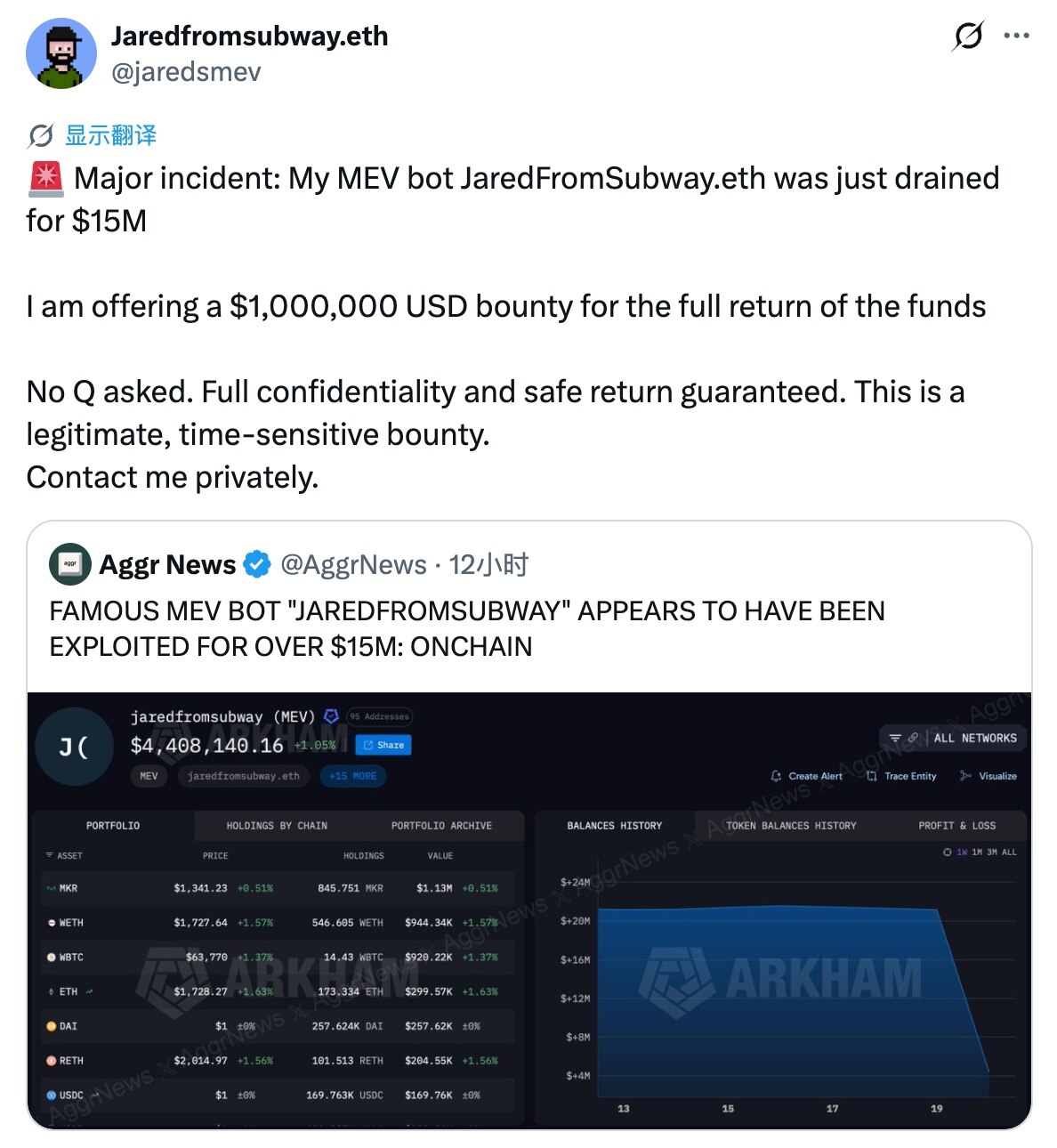
Several developers issued risk warnings, emphasizing that this account is not the official Jaredfromsubway.eth account (the MEV Bot team has no official account). They cautioned that this account might be used for scams subsequently and urged users to remain highly vigilant.


Domande pertinenti

QWhat type of attack did the MEV bot Jaredfromsubway.eth fall victim to, according to the article?

AThe article states that the MEV bot Jaredfromsubway.eth was targeted by a 'counter-MEV honeypot attack.' This was not a traditional phishing or smart contract exploit, but a sophisticated attack specifically designed to exploit the MEV bot's behavioral logic.

QWhat was the estimated total loss suffered by Jaredfromsubway.eth in this incident?

AAccording to on-chain data cited in the article, the total value of assets stolen from Jaredfromsubway.eth exceeded 7.5 million US dollars.

QAccording to the article, what is a 'Sandwich Attack' in the context of MEV?

AA 'Sandwich Attack' is described as a typical type of MEV attack. In this strategy, the attacker inserts buy and sell orders before and after a target user's transaction, respectively, to profit from the price slippage within a very short time window.

QWhat significant event involving Vitalik Buterin is mentioned in relation to Jaredfromsubway.eth?

AThe article mentions that in May of this year (presumably 2025), Ethereum co-founder Vitalik Buterin was targeted by Jaredfromsubway.eth when exchanging 26,544 DigitalBits (XDB) tokens.

QFollowing the hack, what fake action was taken by an unknown X account, and what warning was given?

AAn unknown X account with 94,000 followers changed its name to Jaredfromsubway.eth and falsely announced a '1 million US dollar bounty for the full return of all funds.' Developers issued warnings that this is not the official account (as the MEV bot team has none) and cautioned users to remain vigilant as the account might be used for scams.

Letture associate

9.42 Million Retail Investors Compete for Changxin Technology, Who Got Allotted?

Evergreen Technology's IPO subscription results are now available. On July 20, the domestic memory chip giant announced the offline preliminary allotment results and online lottery results for its IPO. A total of approximately 9.43 million retail investors participated in the online subscription, generating 770,000 winning lots with a final winning rate of about 0.4714%, setting a record for new shares on the STAR Market. After triggering a clawback mechanism from institutional to retail investors, the online retail allocation was significantly increased to 3.851 billion shares. Simultaneously, 285 institutional investors participated in the offline subscription, ultimately receiving 2.173 billion shares at an allotment rate of approximately 0.1756%. Leading insurers and public funds were among the major recipients. Notably, Liang Wenfeng, founder of the major AI model company DeepSeek, through his quantitative investment firms Ningbo Huanfang Quantitative and Zhejiang Jiuzhang Asset, secured the largest share among private funds, with a total allotment worth approximately 175 million yuan. Estimates suggest potential profits could reach 730 million yuan if Evergreen Technology's market capitalization reaches 3 trillion yuan post-listing. The company is expected to list on July 27 and could become the highest-valued tech stock on the A-share market, with various brokerages providing valuations ranging from 1 trillion to over 4 trillion yuan. However, recent significant corrections in global tech stocks may impact its post-listing performance. (Character count: 1,196)

marsbit41 min fa

9.42 Million Retail Investors Compete for Changxin Technology, Who Got Allotted?

marsbit41 min fa

L2 'Recalibration': When L1 Becomes Its Own Rollup, What Is Ethereum's Endgame?

The article discusses the evolving relationship between Ethereum's Layer 1 (L1) and Layer 2 (L2) solutions, moving beyond the initial "L2 for scaling" model. As Ethereum L1 itself scales (increasing Gas Limit, statelessness, zkEVM), the unique value proposition of L2s shifts from merely providing cheap execution to offering differentiated features like application-specific optimization, privacy, and flexible governance. The piece explores three key themes: 1. **L2's New Role:** L2s are transitioning from a pure scaling technology to a spectrum of execution environments with varying degrees of security inheritance from Ethereum L1. 2. **Interoperability as State Trust:** Solving L2 fragmentation is less about cross-chain bridges and more about enabling faster, trust-minimized state verification between environments. This involves initiatives like faster L1 finality, intent-based architectures (Open Intents Framework), and native account abstraction. 3. **Blurring Layers:** With the potential integration of zk-proofs into L1 validation (making L1 akin to its own "Rollup") and the concept of "Native Rollups," the rigid boundary between L1 and L2 may fade. The future could be a unified system with multiple execution domains (for DeFi, gaming, privacy, etc.) sharing a common security, settlement, and state framework. In conclusion, Ethereum's goal is not to abandon L2s or re-centralize everything on L1, but to re-integrate the fragmented user experience—liquidity, accounts, applications—while preserving the scaling benefits of a multi-environment ecosystem. The endgame is a cohesive "one chain" feeling for users, powered by diverse but securely interconnected execution layers.

marsbit1 h fa

L2 'Recalibration': When L1 Becomes Its Own Rollup, What Is Ethereum's Endgame?

marsbit1 h fa

Trading

Spot
活动图片




