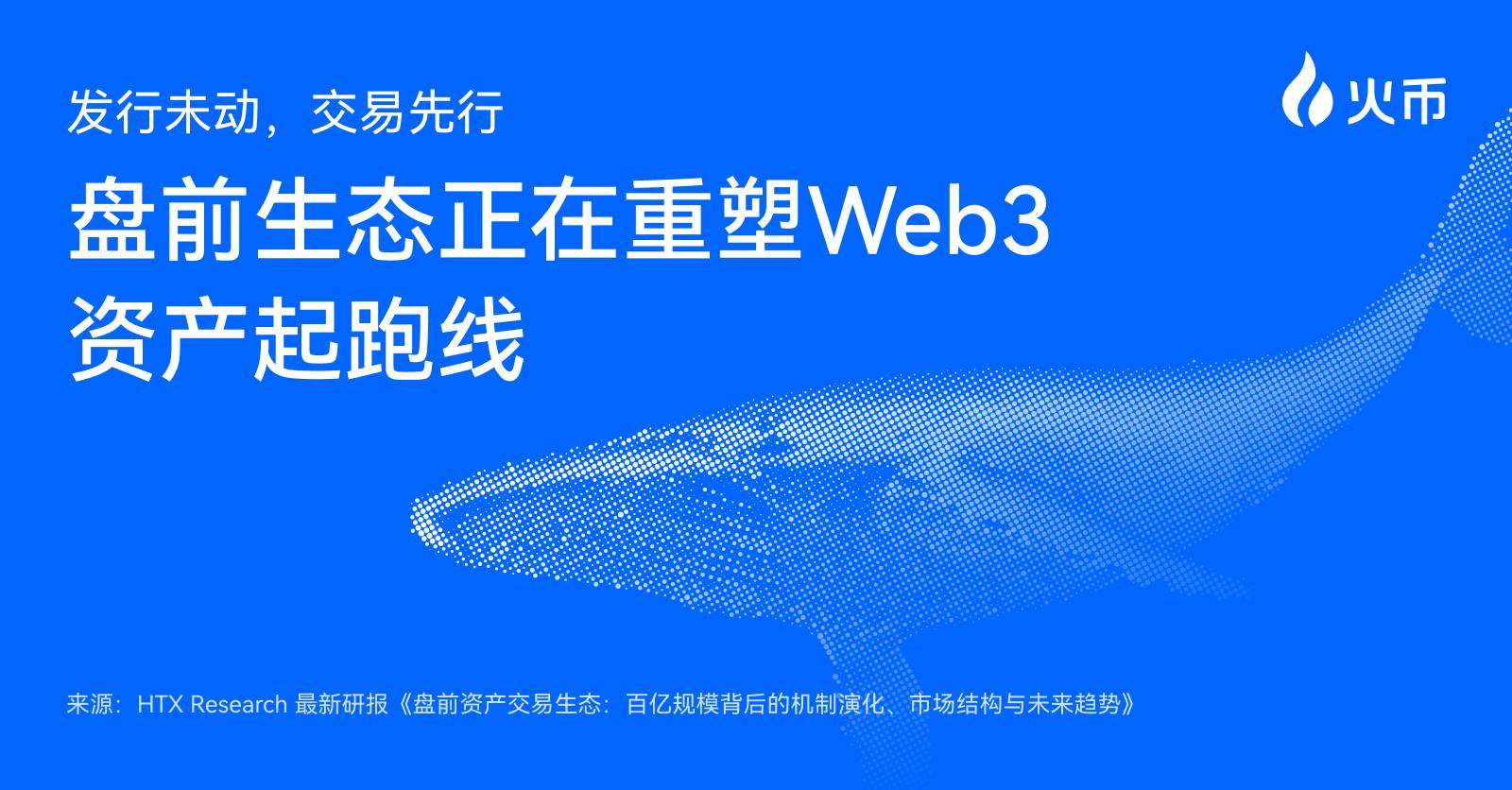
HTX Research Latest Report | Deciphering the Pre-Market Trading Ecosystem: How a Ten-Billion-Dollar Market is Reshaping the Starting Line of Web3 Assets?

深潮Pubblicato 2025-12-18Pubblicato ultima volta 2025-12-18

Introduzione

HTX Research's latest report, "Pre-Market Trading Ecosystem: How a Ten-Billion-Dollar Market is Reshaping the Starting Line for Web3 Assets," analyzes the emergence of a "1.5-level market" bridging primary and secondary crypto markets. Driven by tightened funding and prolonged token generation event (TGE) cycles, this pre-market allows the trading of future token value, points, and convertible rights (like NFTs or whitelist spots) before official listing. Key structures include OTC trades, spot trading, and innovative pre-listing perpetual contracts, exemplified by HTX's launch for WLFI. While growing into a multi-billion-dollar sector, the pre-market faces challenges like thin liquidity and information asymmetry. The report concludes it is a structural shift, not a short-term trend, fundamentally altering project launches, exchange listing strategies, and early user participation.

Recently, HTX Research, the exclusive research department under Huobi HTX, released its latest report titled "Pre-Market Asset Trading Ecosystem: Mechanism Evolution, Market Structure, and Future Trends Behind a Ten-Billion Scale." This report systematically studies the formation background, asset structure, typical models, and profound impact on project issuance and exchange systems of the pre-market trading ecosystem in the crypto market.

The report focuses on a rapidly emerging trend: against the backdrop of tightening financing environments and extended token issuance cycles, pre-TGE (Token Generation Event) trading activities are evolving from scattered attempts into a "1.5-level market" connecting primary and secondary markets, gradually becoming an independent market segment that cannot be ignored in the crypto industry.

From the "Pre-Token Vacuum" to the Pre-Market: A New Structure Between Primary and Secondary Markets

HTX Research points out that the rise of the pre-market trading ecosystem is not accidental. As primary fundraising contracts and project issuance cycles are passively extended, project teams are maintaining community activity through points, airdrop expectations, test qualifications, etc., while users continue to invest time and funds before TGE. In this process, previously non-tradable "early contributions" and "future expectations" gradually become assetizable.

At the same time, with lower barriers to token issuance and a surge in the number of projects, attention has become a scarce resource. Mechanisms for pre-market trading around attention, expectations, and future rights have naturally emerged, collectively forming an intermediate market that previously existed only within VCs and exchanges. This is an emerging 1.5-level market (Pre-Market), whose role is no longer just a speculative tool but a key structure reshaping project launch methods and early liquidity.

Three Asset Structures Comprising the Pre-Market Trading Ecosystem

From the perspective of "how future value is anchored," HTX Research categorizes pre-market assets into three structures:

The first category revolves around future token value, with trading models mainly including pre-market OTC, pre-market spot, and pre-market perpetual contracts. These assets are most directly linked to future spot prices and bear the most concentrated price discovery function in the pre-market stage.

The second category centers on points systems, i.e., user behavior points and their financialized derivatives, which have gradually formed a standardized points OTC market. Points, which carry user contribution and incentive expectations in airdrop economics, are incorporated into market pricing in advance through trading and profit-splitting mechanisms.

The third category revolves around future redeemable rights, appearing in forms such as NFTs, qualification certificates, or BuildKeys, converting non-standard rights like whitelists, Early Access, and token allocations into tradable assets.

These three structures collectively cover the complete chain from "user contribution—market expectation—rights confirmation—final settlement," making the pre-market no longer a single-point tool but a multi-layered pre-trading system.

Huobi HTX's Practical Exploration with Pre-Market Perpetual Contracts

As market demand expands and the ecosystem matures, pre-market trading is extending from OTC and spot forms to derivative structures. Pre-market perpetual contracts, as an innovative derivative design, allow users to engage in leveraged speculation around future spot prices before the token is officially listed, further advancing the possibility of price discovery. Currently, pre-market perpetual contracts have become one of the trading modes with the largest volume in pre-market trading.

In this direction, Huobi HTX previously took the lead in launching WLFI (World Liberty Financial) pre-market perpetual contracts before the official listing of the highly anticipated project, providing users with tools for early participation in price speculation and risk management before TGE. This practice also reflects the trend indicated in the report: the role of exchanges is extending from "listing nodes" to the "pre-issuance stage," and pre-market trading is becoming an important part of exchange product systems.

The Scale Potential and Structural Challenges of the Pre-Market

Pre-market trading already has a clear scale foundation. Leading projects often generate trading demand worth hundreds of millions of US dollars in the pre-market stage. The cumulative pre-market trading scale of projects like WLFI and Monad can even exceed one billion US dollars, making pre-market trading a ten-billion-dollar market with potential for further expansion.

However, the pre-market also exposes clear structural risks: liquidity is naturally thin, and prices are easily manipulated by large funds; settlement highly depends on project teams, and information asymmetry persists long-term; different asset forms lack unified standards in rules, performance, and risk allocation. These issues determine that the further expansion of the pre-market depends on whether it can transition from an "opportunistic market" to a more institutionalized and collaboratively governed structure.

Conclusion

HTX Research believes that pre-market trading is not a short-term gimmick but a structural trend driven by changes in the financing environment, the evolution of user participation methods, and the extension of trading platform products. It is reshaping project issuance paths, exchange listing logic, and how users participate in early markets.

In this process, pre-market trading is gradually evolving from a "gray area before issuance" into a key foundational layer connecting primary and secondary markets. Its final form may become a long-term, increasingly institutionalized core market structure in the crypto market.

About HTX Research

HTX Research is the exclusive research department under Huobi HTX, responsible for in-depth analysis of a wide range of areas including cryptocurrency, blockchain technology, and emerging market trends, writing comprehensive reports, and providing professional evaluations. HTX Research is committed to providing data-driven insights and strategic foresight, playing a key role in shaping industry perspectives and supporting informed decision-making in the digital asset field. With rigorous research methods and cutting-edge data analysis, HTX Research is always at the forefront of innovation, leading the development of industry thought, and promoting a deeper understanding of the ever-changing market dynamics. Visit us.

If you wish to communicate, please contact research@htx-inc.com

Crypto di tendenza

Domande pertinenti

QWhat is the main focus of the latest HTX Research report on the pre-market trading ecosystem?

AThe report systematically studies the formation background, asset structure, typical models, and the profound impact of the pre-market trading ecosystem on project issuance and exchange systems in the crypto market.

QAccording to the report, what are the three main asset structures that constitute the pre-market trading ecosystem?

AThe three structures are: 1) Assets tied to future token value (pre-market OTC, spot, and perpetual contracts), 2) Assets centered around points systems and their financialized derivatives, and 3) Assets representing future exchangeable rights (e.g., NFTs, qualification certificates, BuildKey).

QWhat role did HTX play in the development of pre-market perpetual contracts, as mentioned in the report?

AHTX pioneered the practice by launching pre-market perpetual contracts for the WLFI (World Liberty Financial) project before its TGE, providing users with tools for early price speculation and risk management.

QWhat is the estimated scale of the pre-market trading ecosystem, and what are its main challenges?

AThe pre-market trading ecosystem is a multi-billion dollar market, with top projects generating hundreds of millions to billions of dollars in trading demand. Its main challenges include thin liquidity, price susceptibility to large funds, high dependency on project issuers for settlement, information asymmetry, and a lack of unified standards.

QHow does HTX Research view the long-term significance of pre-market trading?

AHTX Research believes pre-market trading is not a short-term trend but a structural shift driven by changes in financing environments, user participation models, and exchange product evolution. It is reshaping project launch paths, exchange listing logic, and how users engage with early markets, potentially becoming a core, institutionalized market structure in crypto.

Letture associate

Intern, Earning 120,000 Monthly

An article titled "Intern, Monthly Income of 120,000 RMB" discusses the intense competition for top AI talent in China, highlighted by a viral social media post. A Tsinghua University student from the prestigious Yao Class reportedly received a staggering internship offer from the AI company DeepSeek with a daily salary of 5,500 RMB (pre-tax), translating to over 120,000 RMB per month. This case exemplifies the fierce "talent war" raging among major tech firms. Companies like DeepSeek, Huawei, Tencent, and ByteDance are aggressively recruiting interns and fresh graduates with unprecedented compensation packages, high conversion rates to full-time positions, and even company stock options for top performers like those in Moonshot AI's "Time Travel Plan." The trend shows recruitment starting earlier, even targeting high school students. The driving force is the belief that a few exceptional individuals can be pivotal in the AI race. Salaries for elite AI researchers have skyrocketed from around one million RMB annually to tens of millions. Young, highly-educated talents from top schools, seen as adaptable "AI Natives," are being placed at the forefront of core projects. Examples include Tencent appointing a 27-year-old former OpenAI researcher as its Chief AI Scientist. In essence, the competition is shifting from just models and computing power to a battle for talent density. A new generation of young experts is rapidly rising to central roles, poised to reshape the future AI landscape.

marsbit6 h fa

Intern, Earning 120,000 Monthly

marsbit6 h fa

Trading

Spot

Articoli Popolari

Come comprare O

Benvenuto in HTX.com! Abbiamo reso l'acquisto di O1 exchange (O) semplice e conveniente. Segui la nostra guida passo passo per intraprendere il tuo viaggio nel mondo delle criptovalute.Step 1: Crea il tuo Account HTXUsa la tua email o numero di telefono per registrarti il tuo account gratuito su HTX. Vivi un'esperienza facile e sblocca tutte le funzionalità,Crea il mio accountStep 2: Vai in Acquista crypto e seleziona il tuo metodo di pagamentoCarta di credito/debito: utilizza la tua Visa o Mastercard per acquistare immediatamente O1 exchangeO.Bilancio: Usa i fondi dal bilancio del tuo account HTX per fare trading senza problemi.Terze parti: abbiamo aggiunto metodi di pagamento molto utilizzati come Google Pay e Apple Pay per maggiore comodità.P2P: Fai trading direttamente con altri utenti HTX.Over-the-Counter (OTC): Offriamo servizi su misura e tassi di cambio competitivi per i trader.Step 3: Conserva O1 exchange (O)Dopo aver acquistato O1 exchange (O), conserva nel tuo account HTX. In alternativa, puoi inviare tramite trasferimento blockchain o scambiare per altre criptovalute.Step 4: Scambia O1 exchange (O)Scambia facilmente O1 exchange (O) nel mercato spot di HTX. Accedi al tuo account, seleziona la tua coppia di trading, esegui le tue operazioni e monitora in tempo reale. Offriamo un'esperienza user-friendly sia per chi ha appena iniziato che per i trader più esperti.

150 Totale visualizzazioniPubblicato il 2026.06.19Aggiornato il 2026.06.29

Come comprare O

Come comprare PROS

Benvenuto in HTX.com! Abbiamo reso l'acquisto di Pharos (PROS) semplice e conveniente. Segui la nostra guida passo passo per intraprendere il tuo viaggio nel mondo delle criptovalute.Step 1: Crea il tuo Account HTXUsa la tua email o numero di telefono per registrarti il tuo account gratuito su HTX. Vivi un'esperienza facile e sblocca tutte le funzionalità,Crea il mio accountStep 2: Vai in Acquista crypto e seleziona il tuo metodo di pagamentoCarta di credito/debito: utilizza la tua Visa o Mastercard per acquistare immediatamente PharosPROS.Bilancio: Usa i fondi dal bilancio del tuo account HTX per fare trading senza problemi.Terze parti: abbiamo aggiunto metodi di pagamento molto utilizzati come Google Pay e Apple Pay per maggiore comodità.P2P: Fai trading direttamente con altri utenti HTX.Over-the-Counter (OTC): Offriamo servizi su misura e tassi di cambio competitivi per i trader.Step 3: Conserva Pharos (PROS)Dopo aver acquistato Pharos (PROS), conserva nel tuo account HTX. In alternativa, puoi inviare tramite trasferimento blockchain o scambiare per altre criptovalute.Step 4: Scambia Pharos (PROS)Scambia facilmente Pharos (PROS) nel mercato spot di HTX. Accedi al tuo account, seleziona la tua coppia di trading, esegui le tue operazioni e monitora in tempo reale. Offriamo un'esperienza user-friendly sia per chi ha appena iniziato che per i trader più esperti.

144 Totale visualizzazioniPubblicato il 2026.06.22Aggiornato il 2026.06.29

Come comprare PROS

Cosa è VERONA

I. Introduzione al Progetto VERONA è una blockchain costruita per tutti, ovunque attraverso l'astrazione della catena. Utilizzando il suo livello di astrazione generalizzato, VERONA si distingue integrando funzionalità blockchain complesse, come conti, firme e interoperabilità, direttamente a livello di protocollo. Questo approccio consente di interagire con le applicazioni blockchain senza la necessità di comprendere le tecnologie sottostanti.1) Informazioni di Base Nome:VERONA(VERONA)III. Link Correlati Link al sito ufficiale:https://xion.burnt.com/ Whitepaper:https://xion.burnt.com/whitepaper.pdf Esploratori:https://explorer.burnt.com/ Social Media: https://x.com/burnt_xion Nota: L'introduzione al progetto proviene dai materiali pubblicati o forniti dal team ufficiale del progetto, che è solo a scopo di riferimento e non costituisce consulenza per investimenti. HTX non si assume responsabilità per eventuali perdite dirette o indirette risultanti.

157 Totale visualizzazioniPubblicato il 2026.06.22Aggiornato il 2026.06.22

Cosa è VERONA

Discussioni

Benvenuto nella Community HTX. Qui puoi rimanere informato sugli ultimi sviluppi della piattaforma e accedere ad approfondimenti esperti sul mercato. Le opinioni degli utenti sul prezzo di A A sono presentate come di seguito.

活动图片