How Wagyu Is Changing the Monero Narrative: One Tool Lifting Years of Price Suppression

比推Pubblicato 2026-01-14Pubblicato ultima volta 2026-01-14

Introduzione

Wagyu, a new exchange tool, is breaking years of price suppression on Monero (XMR) by addressing a critical flaw in its acquisition process. Since 2018, despite strong demand, XMR's price remained stagnant, primarily because major exchanges delisted it, forcing over 60% of users to rely on instant swap services. These offshore services charged exorbitant fees (effectively 3-4%) and often froze funds under "AML checks," creating constant sell pressure as they immediately converted XMR profits to stablecoins. This parasitic cycle drained an estimated $30,000-$100,000 daily from the market. Wagyu v2 routes orders to Hyperliquid, providing exchange-level pricing and near-zero fees, eliminating the need for exploitative swap services. By removing this sell pressure and allowing true price discovery, Wagyu has already processed millions in trades, contributing to XMR's recent breakout above $600. The tool is effectively saving Monero by connecting genuine demand directly to real market liquidity.

Written by: PerpetualCow.hl

Compiled by: AididiaoJP, Foresight News

Original Title: How Wagyu Is Saving Monero: How One Tool Is Breaking Years of Price Suppression?


A few days ago, I exposed the trillion-dollar instant exchange industry. Today, I'm connecting the dots that haven't been pieced together yet on Crypto Twitter.

Since 2018, while almost every other cryptocurrency has been surging, the price of Monero (XMR) has been stuck in a range.

Most attribute this to exchange delistings, regulatory pressure, or the narrative that 'privacy coins are dead.'

They are all wrong.

To understand what's happening, you must first delve deep into the history of Monero XMR, including all the exchange delistings, and how most people actually buy this coin.

The Real Demand for Monero XMR

People have always wanted Monero, not just for privacy, but because it's seen as a store of value alternative to Bitcoin, like a 21st-century Swiss bank account.

Its utility didn't change just because exchanges got scared of regulation and delisted it.

This can be compared to illegal drug trade: when it's impossible to buy from a legitimate pharmacy, addicts will seek out more dubious channels, paying a higher price to get what they need.

As a result, the demand for Monero flowed to instant exchange services, not centralized exchanges.

Think from the perspective of an average user in 2024:

You want to buy Monero, but Binance just delisted it, and Coinbase won't touch it. Other small exchanges that still trade Monero are likely to freeze your funds for dealing with this coin.
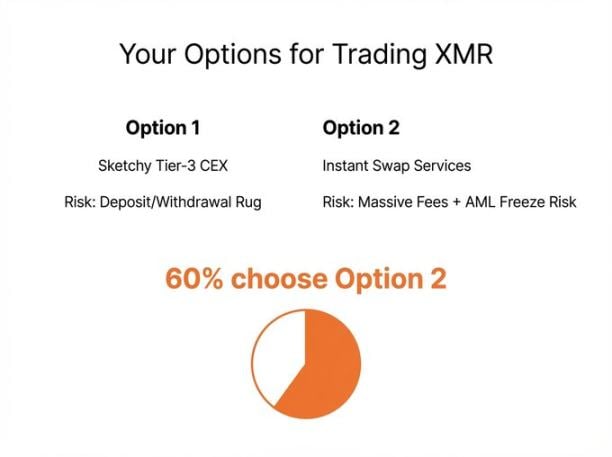
You only have two choices:

Find a third-rate exchange that still lists Monero and pray they don't run off with the money.

Use an instant exchange service, pay high fees, and pray they don't freeze your funds indefinitely under the pretext of 'AML review'.

Over 60% of users chose the second path.

These services became the de facto on/off ramps for the Monero ecosystem.

They are, of course, unregulated and offer terrible exchange rates, but users have no other choice.

After all legitimate exchanges abandoned Monero, the instant exchange industry became the only channel, absorbing all Monero trading volume.

Tracking the Flow of Funds

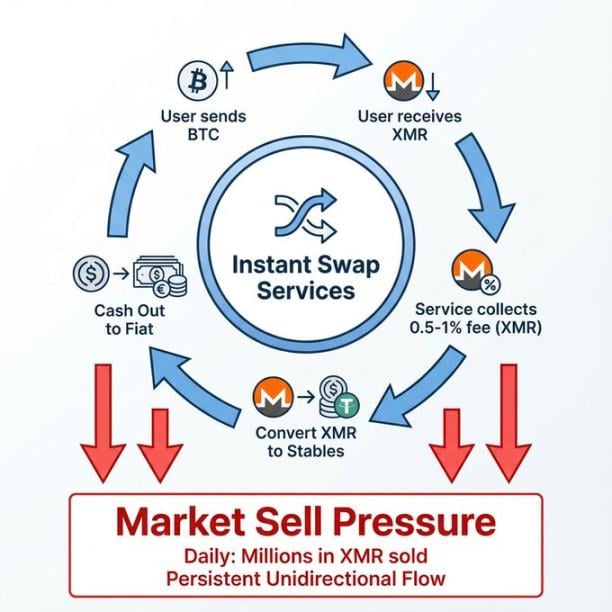
All instant exchange services operate the same way:

The user sends Bitcoin and receives Monero, with the service secretly charging a 3-4% fee (while ostensibly only charging 0.5-1%).

But these fees are priced in Monero.

So how do these service providers handle the Monero they receive?

They don't hold it long-term; they are not believers. These are offshore companies chasing fiat profits, who immediately convert Monero to stablecoins and cash out.

Just like that, millions of dollars worth of Monero are sold into the market every day.

In market microstructure terms, this creates a persistent one-way outflow of funds. Regardless of overall market conditions, these services are constantly selling. While this is just their business model, the impact on price is devastating.
Quantifying the Capital Drain

In my previous article, I estimated the instant exchange industry handles about $1.5 trillion in transactions annually (across all chains), and that's just the on-chain verifiable part.

Monero's volume is invisible due to its privacy features, but industry estimates suggest it accounts for about 20% of total instant exchange flow.

Assume $30 billion worth of Monero is exchanged through these services annually.

Conservatively, the actual figure might be half of that, around $15 billion.

At an average fee of 0.75% (most actually charge 1%), the Monero fees collected annually are worth about $112.5 million.

All of this Monero is sold into the market.

This means over $300,000 in passive selling pressure every day. It's like an invisible pump constantly draining value from Monero.

And this is a conservative estimate. If Monero truly accounts for 20% of the volume and fees are 1%, that's $300 million annually, approaching $1 million in daily selling pressure.

But it doesn't end there; there's also the 'AML Trap'.

The AML Trap

This is the 'dirty secret' I exposed in my last article: these services, while advertising 'No KYC', arbitrarily freeze user funds under the pretext of 'AML review'.

It's estimated that 2-5% of transactions through instant exchange services get frozen. The rate is higher for large transactions.

This creates a vicious cycle:

Small transactions go through but are charged fees 10-20 times higher than normal

Large transactions are completely frozen, often permanently

Only a fraction of the actual buying demand actually reaches the market
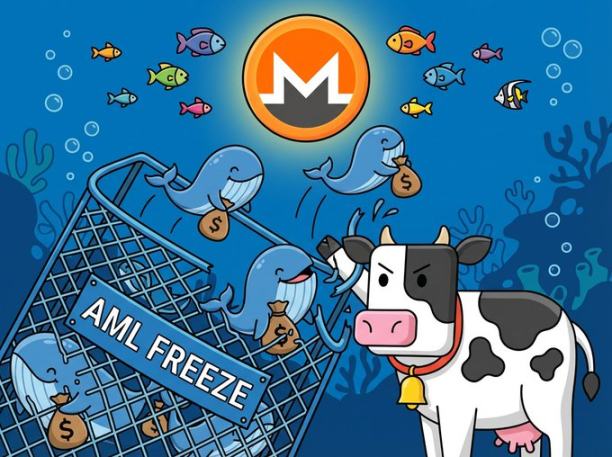
This creates the most brutal price discovery barrier: buyers who could actually influence the price are systematically excluded from the market.

The real demand for Monero has always been far higher than its price reflects. The instant exchange industry either extracts from this demand or outright chokes it off.

A Captive Market

Let me be clear about this vicious cycle:

The instant exchange industry did not win the market through competitiveness. They gained a monopoly position when all exchanges delisted Monero, and then proceeded to extract the maximum possible from users who had nowhere else to go.
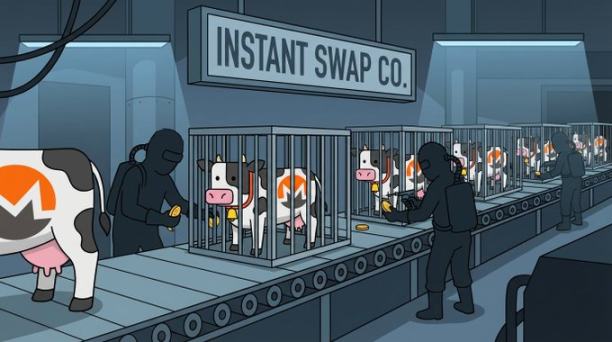
1% fees plus terrible exchange rates, plus random fund freezes.

Users tolerate it because they have no choice, and these service providers know it.

This is what happens when an entire asset class is forced into a single channel controlled by anonymous offshore operators: they extract with an uncompetitive product.

Every cent they extract turns into selling pressure on Monero.

Wagyu's Solution

Two days ago, Wagyu v2 launched.
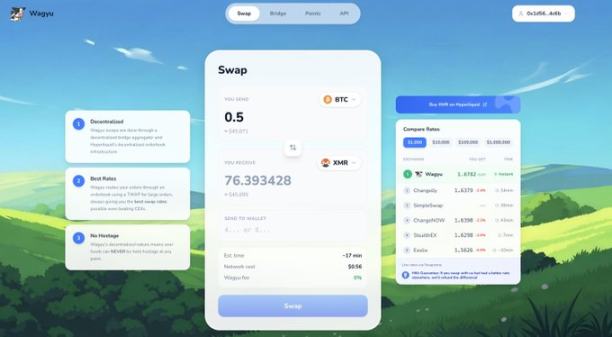
The core idea is simple: let Monero users enjoy the same pricing level as exchange traders.

When you exchange through Wagyu, your order is routed to @Hyperliquidx—where the most competitive market makers in crypto compete for orders.

These are the same market makers that provide liquidity for Binance, Bybit, and OKX, offering tiny spreads.

The result: you get exchange-level prices and fees. No more 1% or 0.5%, but ultra-low rates like professional traders.

For the first time since Monero was delisted from exchanges, users don't have to get 'ripped off' just for using their own assets.
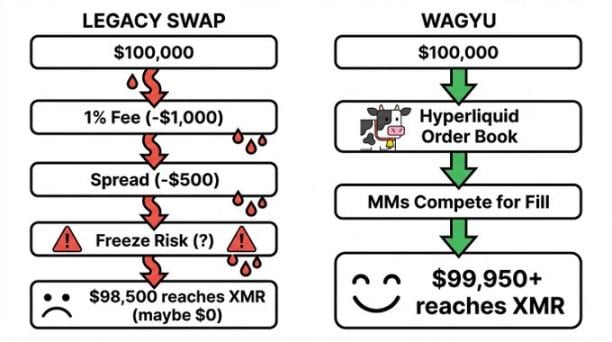
A single $100,000 transaction prevents over $1,000 in selling pressure from hitting the market.

Within 48 hours of launch, Wagyu v2 has already processed millions in exchanges, offering the best market prices:
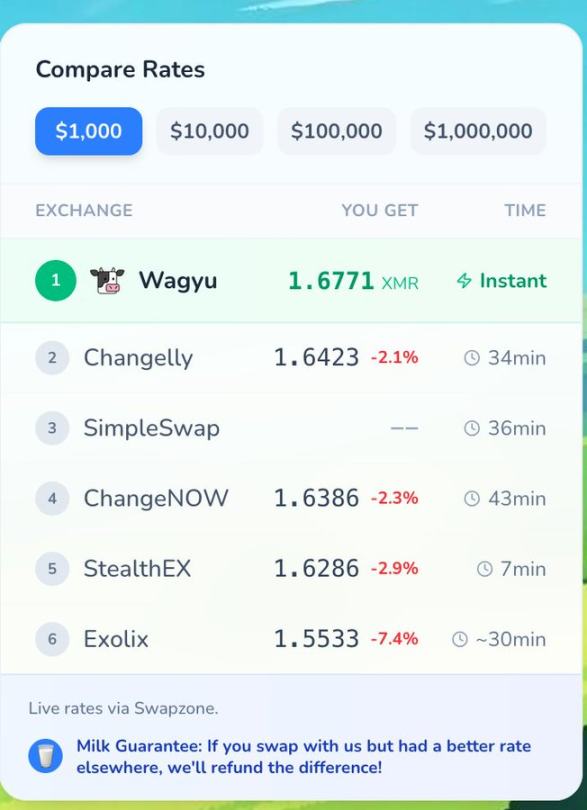
Trades that would have gone through traditional services, been charged over 1% in fees, and caused the market to instantly absorb tens of thousands in selling pressure, are now happening through Wagyu.

$1 million exchange through traditional services = $10,000 worth of Monero sold

The same $1 million exchange through Wagyu = Zero forced selling

Multiply this effect by every large Monero buyer who discovers they no longer have to be 'robbed'.

Reversing the Vicious Cycle

For years, Monero has been trapped in a negative feedback loop:
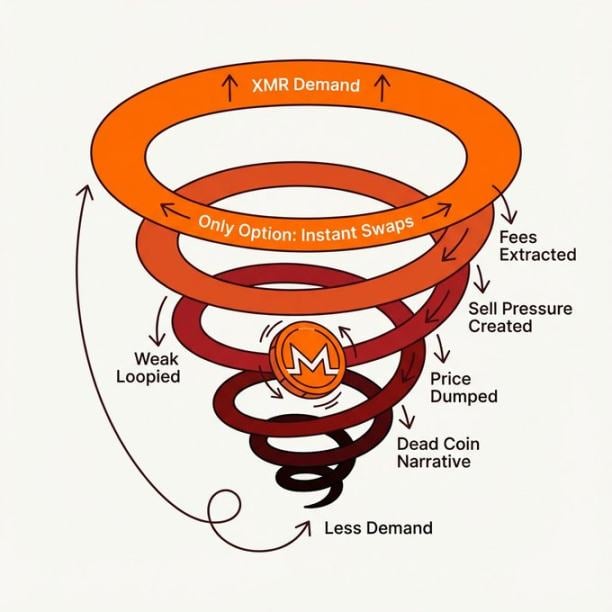
The instant exchange industry acted as a value extraction layer, sitting between buyers and the real price. They intercepted demand, extracted profits, and distorted price signals. Users couldn't bypass them because there was no alternative.

Now, that has changed.

Just two days after launch, volume is already migrating to Wagyu. People are realizing they can get Binance-level pricing for an asset Binance won't even list, and the word is spreading fast.

The cycle is reversing:
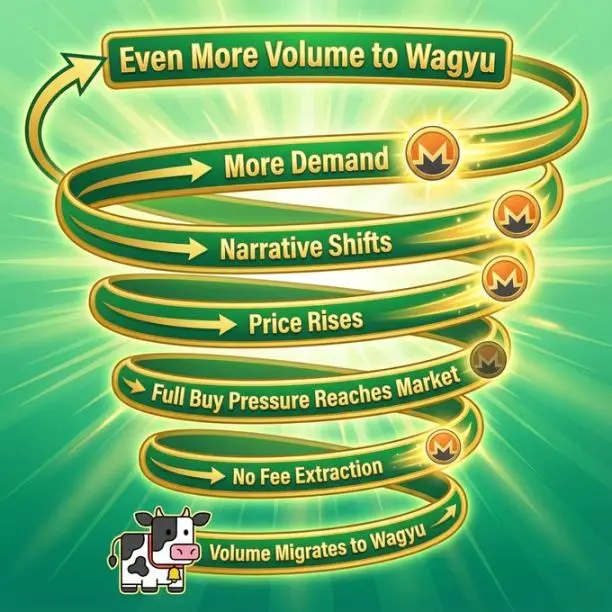
It's no coincidence that Monero broke through $600 and began its first price discovery in years.

Wagyu Is Saving Monero

I'm not going to be modest about this:

Every exchange made through Wagyu instead of a traditional service is real buying pressure that reaches the market.

Every million-dollar trade that flows through us means over $10,000 won't be sold onto other holders.

We are not extracting from the Monero ecosystem; we are plugging it directly into real liquidity.

The parasitic layer that has suppressed Monero for years has finally met its competitor. And we are not competing on their terms—we are making their entire model obsolete.

When users can get exchange-level pricing with zero freeze risk through Wagyu, who will pay 1% fees to anonymous offshore services that might freeze their funds?

No one will.

What This Means

I'm not here to give price predictions. I don't know if Monero will go to $1,000, $2,000, or fall back to $400.

But I know for sure: for the first time since being delisted from exchanges, demand for Monero can truly translate into price.

We've been live for only two days and are already processing millions in trades—trades that would have continuously 'bled' the market.

With the 'ceiling' removed, Monero at $600 is still undervalued. At least now, the market will truly decide its value.

Price discovery is finally possible, and Wagyu is making it happen.


Twitter:https://twitter.com/BitpushNewsCN

Bitpush TG Group:https://t.me/BitPushCommunity

Bitpush TG Subscription: https://t.me/bitpush

Original link:https://www.bitpush.news/articles/7602589

Crypto di tendenza

Domande pertinenti

QWhat is the main reason the author argues that Monero's price was suppressed for years?

AThe author argues that Monero's price was suppressed due to the parasitic extraction by instant exchange services, which acted as the primary on/off-ramp after centralized exchanges delisted XMR. These services charged high fees (effectively 3-4%) and immediately sold the XMR fees for stablecoins, creating constant sell pressure of an estimated $30,000 to $100,000 daily.

QHow did the instant exchange industry impact Monero's price discovery according to the article?

AThe instant exchange industry severely distorted Monero's price discovery by intercepting demand, charging exorbitant fees, and systematically freezing large transactions. This created a one-way outflow of value, preventing genuine buy-side demand from reaching the market and influencing the price.

QWhat solution does Wagyu v2 provide to the problem described in the article?

AWagyu v2 routes user orders to the Hyperliquid exchange, where professional market makers provide highly competitive, exchange-level pricing and minimal fees. This allows users to trade XMR without the excessive fees and freezing risks of traditional instant exchanges, eliminating the forced selling pressure those services created.

QWhat was the estimated annual volume of Monero processed by instant exchanges, and what was the resulting sell pressure?

AThe article estimates that instant exchanges processed approximately $150 billion to $300 billion in annual Monero volume. With an average fee of 0.75% to 1%, this resulted in $112.5 million to $300 million worth of XMR being sold annually, creating a daily sell pressure of over $300,000 to nearly $1 million.

QHow does the author describe the change in the market cycle for Monero after the introduction of Wagyu?

AThe author states that the negative feedback loop, where instant exchanges extracted value and suppressed the price, is now reversing. With Wagyu providing a efficient, non-extractive on-ramp, genuine buy-side demand can finally reach the market, allowing for true price discovery for the first time since XMR was delisted from major exchanges.

Letture associate

The Verdict in Choi Tae-won's Divorce Case: Revealing the Inheritance Undercurrent Behind SK Hynix's Trillion-Won Empire

SK Group Chairman Chey Tae-won's high-profile divorce case, involving a record 1.38 trillion won settlement, has drawn attention to the succession plans for Korea's second-largest conglomerate, especially its crown jewel, SK hynix. Unlike traditional chaebol scripts centered on the eldest son, Chey's three children from his marriage to former President Roh Tae-woo's daughter, Roh Soh-yeong, are carving distinct, non-traditional paths. Eldest daughter Chey Yun-jung (b. 1989) is seen as the most evident successor. With a scientific and consulting background, she holds executive roles at SK bioscience and SK Inc.'s growth support department, focusing on future strategy and biopharma. Her marriage is to an AI infrastructure entrepreneur, not a traditional business alliance. Second daughter Chey Min-jung (b. 1991) took a unique route, voluntarily serving as a South Korean naval officer, including an anti-piracy deployment. She later worked on policy and strategy for SK hynix in Washington D.C. before co-founding an AI-driven healthcare startup. She married a former U.S. Marine Corps officer, connecting her to U.S. defense and policy circles—networks crucial for a global semiconductor giant. The only son, Chey In-geun (b. 1995), who studied physics like his father, worked briefly at SK E&S before joining McKinsey. Despite fitting the traditional "heir" profile as the eldest son, he remains silent and holds no public position or shares in SK, suggesting the old succession playbook is obsolete. As SK hynix's valuation soars, becoming a geopolitical asset in the AI era, the heirs' legitimacy is no longer automatic. They must prove themselves in fields like AI biotech, global policy, and strategic consulting. Their marriages also reflect new elite networks in tech and defense, not old political alliances. Their inheritance is the complex challenge of navigating a globalized, tech-driven world, not just a corporate throne.

marsbitIeri 09:06

The Verdict in Choi Tae-won's Divorce Case: Revealing the Inheritance Undercurrent Behind SK Hynix's Trillion-Won Empire

marsbitIeri 09:06

From OpenSea to OpenRouter: Is Alex Atallah Repeating His 'Exit at the Peak' Playbook?

From OpenSea to OpenRouter: Is Alex Atallah Repeating His "Exit at the Peak" Playbook? According to the Wall Street Journal, payments giant Stripe is in talks to acquire the AI model aggregation platform OpenRouter in a potential deal valuing the company near $100 billion. This would mark founder Alex Atallah's second creation of a company reaching a $100 billion valuation, following his co-founding of NFT marketplace OpenSea. OpenRouter, founded just over three years ago, has grown rapidly by acting as a unified gateway for developers to access over 400 AI models. It currently has about 10 million users and processes over 200 trillion tokens monthly. While the platform's annualized revenue is around $50 million, its valuation has skyrocketed from $1.3 billion in March 2026. The potential acquisition by Stripe, a company OpenRouter's founder once likened it to, represents a major expansion into AI infrastructure for the payments leader. This move echoes Atallah's previous timing with OpenSea, where he departed before the NFT market's significant downturn. For OpenRouter, selling now may be strategic. Despite its scale, its business model—charging a 5-5.5% fee on AI inference calls—faces pressure from competition, open-source models, and potential price wars among model providers, limiting its profitability narrative for an IPO. A key asset for potential acquirers like Stripe is OpenRouter's vast repository of real-world AI usage data, which offers unique insights into model performance and developer preferences that are difficult to replicate. Whether this potential deal signifies a new valuation benchmark for AI infrastructure or another market peak signal remains to be seen.

链捕手Ieri 08:42

From OpenSea to OpenRouter: Is Alex Atallah Repeating His 'Exit at the Peak' Playbook?

链捕手Ieri 08:42

Trading

Spot

Articoli Popolari

Come comprare ONE

Benvenuto in HTX.com! Abbiamo reso l'acquisto di Harmony (ONE) semplice e conveniente. Segui la nostra guida passo passo per intraprendere il tuo viaggio nel mondo delle criptovalute.Step 1: Crea il tuo Account HTXUsa la tua email o numero di telefono per registrarti il tuo account gratuito su HTX. Vivi un'esperienza facile e sblocca tutte le funzionalità,Crea il mio accountStep 2: Vai in Acquista crypto e seleziona il tuo metodo di pagamentoCarta di credito/debito: utilizza la tua Visa o Mastercard per acquistare immediatamente HarmonyONE.Bilancio: Usa i fondi dal bilancio del tuo account HTX per fare trading senza problemi.Terze parti: abbiamo aggiunto metodi di pagamento molto utilizzati come Google Pay e Apple Pay per maggiore comodità.P2P: Fai trading direttamente con altri utenti HTX.Over-the-Counter (OTC): Offriamo servizi su misura e tassi di cambio competitivi per i trader.Step 3: Conserva Harmony (ONE)Dopo aver acquistato Harmony (ONE), conserva nel tuo account HTX. In alternativa, puoi inviare tramite trasferimento blockchain o scambiare per altre criptovalute.Step 4: Scambia Harmony (ONE)Scambia facilmente Harmony (ONE) nel mercato spot di HTX. Accedi al tuo account, seleziona la tua coppia di trading, esegui le tue operazioni e monitora in tempo reale. Offriamo un'esperienza user-friendly sia per chi ha appena iniziato che per i trader più esperti.

359 Totale visualizzazioniPubblicato il 2024.12.12Aggiornato il 2026.06.02

Come comprare ONE

Discussioni

Benvenuto nella Community HTX. Qui puoi rimanere informato sugli ultimi sviluppi della piattaforma e accedere ad approfondimenti esperti sul mercato. Le opinioni degli utenti sul prezzo di ONE ONE sono presentate come di seguito.

活动图片