How to Systematically Track High-Win-Rate Addresses on Polymarket?

marsbitPubblicato 2026-03-02Pubblicato ultima volta 2026-03-02

Introduzione

This article explores methods to systematically identify and track high-success-rate addresses on Polymarket, a blockchain-based prediction market where all transactions are publicly recorded on-chain. It highlights that while data is transparent, the key challenge lies in extracting meaningful signals from vast datasets to detect addresses with potential informational advantages. The piece outlines common characteristics of such addresses: new wallets making large, concentrated bets; specialization in specific verticals; abnormal changes in position size; and exceptionally precise timing, repeatedly entering positions hours before major news breaks. A three-step systematic approach is recommended: First, filter addresses based on sustained profitability (e.g., 30-day positive returns, >55% win rate) using leaderboards like Polymarket Analytics. Second, analyze their holdings in specific event markets, focusing on addresses that are consistently among the top holders before full market pricing. Third, scrutinize their on-chain behavior: entry timing relative to news, position-building patterns (e.g., rapid, concentrated entries), holding periods, and trading focus. Advanced strategies include monitoring exit behavior (e.g., large, unexplained sell-offs), conducting wallet clustering analysis to find linked addresses, tracking unusual volume spikes in low-liquidity markets, and cross-referencing on-chain activity with external real-world data for validation. The goal is to ...

An address on Polymarket turned $35,000 into $442,000, achieving a 12.6x return. Notably, the position was established hours before a major market movement, and the trades were largely settled before the news spread to mainstream channels. This is not an isolated incident. Before the news of the "Venezuela Raid" political event became public, three addresses made moves in advance and collectively profited $630,000 from the same event.

If such trading occurred in traditional financial markets, one might easily think of information asymmetry. However, in prediction markets, all fund flows and position changes are recorded on the public blockchain; there are no hidden accounts or private transactions.

Being public does not mean there is no gap. The key is not whether you can see the trades, but whether you can discern the truly informative signals from the massive amount of data.
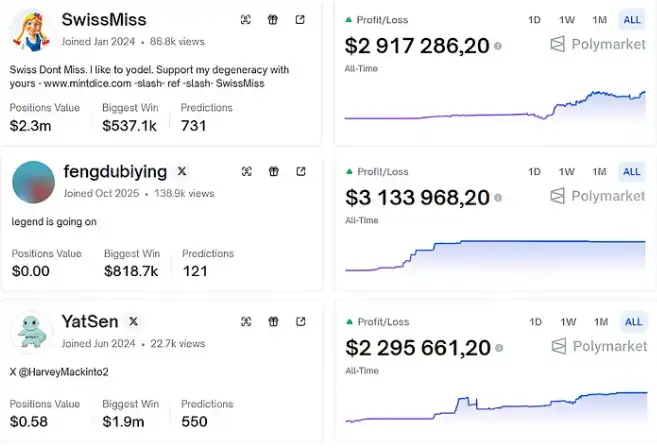
Every Trade on Polymarket is Public Data

Many prediction market participants still view Polymarket as a traditional betting platform: watch the odds, pick a direction, and bet on the outcome. But Polymarket's underlying structure is completely different from DraftKings or ordinary sports betting. All transactions occur on-chain; fund flows, position sizes, and entry/exit timings are all publicly viewable. The operational paths of the most accurate and timely addresses are not post-hoc speculation but real-time on-chain records.

Polymarket's API is also open. Transaction records, market data, and historical trades can be directly called by anyone; there is no permission barrier.

Therefore, the gap is not about who can see the data, but about who can extract meaning from it. On-chain information is public, but what is truly valuable is the ability to identify wallets worth tracking continuously and to recognize behavioral changes before prices fully reflect them.

What Characteristics Do True "Informed Addresses" Typically Have?

It is important to emphasize that not all profitable wallets imply insider information. Some traders have solid research capabilities, while others rely on quantitative models and algorithmic advantages. However, when profitability is repeatedly coupled with specific behavioral patterns, one can observe structural features that distinguish them from mere "luck."

· Type 1: New Addresses Combined with Unusually Large Bets

A wallet created just days ago, with very few transactions, suddenly invests a large amount of capital in a low-liquidity niche market. This behavior is uncommon. Especially in the absence of public catalysts, large, concentrated positions often carry stronger informational significance.

· Type 2: Highly Vertical Trading Focus

Some addresses do not operate across markets but focus long-term on a specific niche, maintaining a stable and significant win rate in that area. They do not diversify across crypto prices, elections, sports, etc., but concentrate their firepower on a single theme, with more decisive position decisions.

· Type 3: Abnormal Changes in Position Size

When an address that has been betting with medium size for a long time suddenly significantly increases its position size in a particular market, this behavior often indicates a change in the strength of conviction. Position size itself is an attitude; a sudden change in scale usually reflects an upgrade in information or belief.

· Type 4: Overly Precise Timing

Occasional early positioning can be attributed to coincidence, but if an address repeatedly completes its positions hours before major news announcements, with highly consistent direction, this temporal lead is difficult to explain simply as luck. Once is random; repeated occurrences are more likely to reflect an information advantage.

How to Systematically Screen for Potential "Information-Advantaged Addresses"

· Step 1: Analyze Performance on Polymarket Leaderboards

Start with the leaderboard on Polymarket Analytics (link: https://polymarketanalytics.com/traders), sorted by 30-day P&L, using recent stable profitability as the first filter. Focus on wallet addresses with an overall positive return over 30 consecutive days, a win rate above 55%, and total profit significantly higher than total loss. Also, confirm that their trading is concentrated in markets with real liquidity, not low-volume prediction events with little participation.
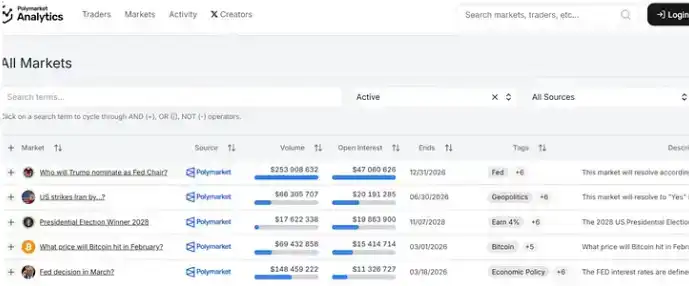
The goal at this stage is not to directly judge whether they have an information advantage, but to build a watchlist of addresses with sustained profitability. A consistent profit record is the foundation for subsequent behavioral analysis.

· Step 2: Analyze Position Structure in Specific Events

After the initial screening, drill down into specific trading events. Enter active prediction markets and check the Top Holders list for that event. Polymarket publicly displays the addresses with the largest current positions; these large positions often represent stronger conviction.
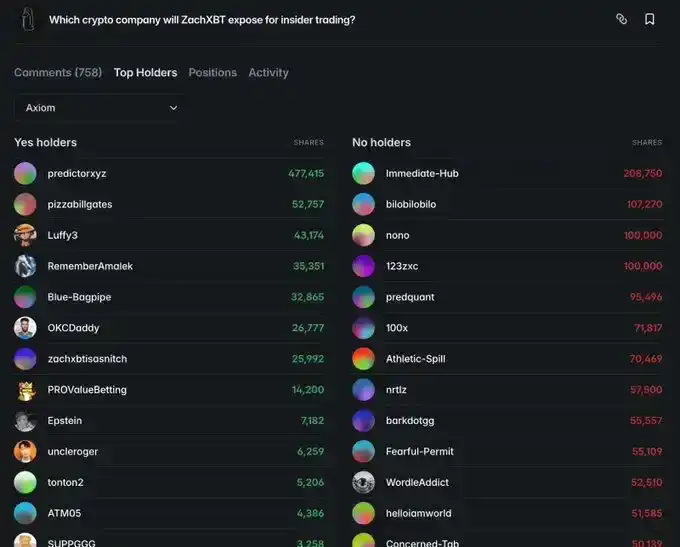
The key is not whether an address hits a single large bet, but whether its behavior is persistent. If a wallet repeatedly appears in the top holder lists for multiple significant events, and these positions were established before the market was fully priced, this repetition itself constitutes a signal.

Hitting once might be chance, but repeatedly making large, early-stage positions with consistent direction and validated outcomes often indicates a judgment system with a stable advantage.

· Step 3: Analyze Trading Behavior and Position Timing

After identifying candidate addresses, further analyze their on-chain transaction history, focusing on entry timing, position structure, and holding rhythm.
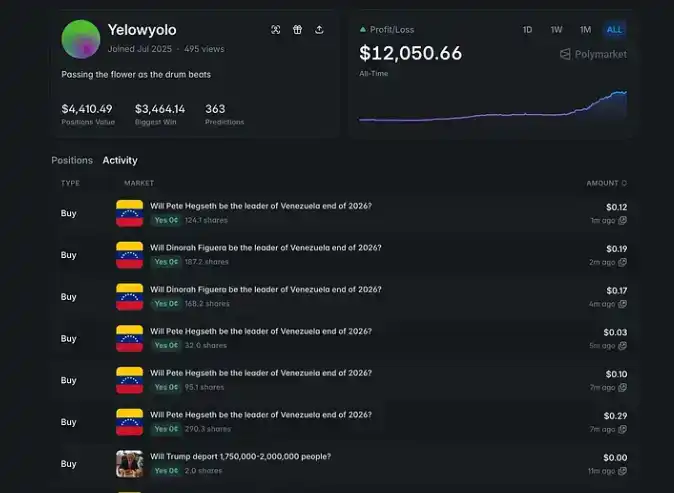
First, observe the entry time. If the purchase occurs hours before the official news release and repeats multiple times, the timing advantage itself becomes an important variable; entering after media reports is more likely to be just information following.

Second, analyze the method of position building. Mature traders typically build positions in batches and add gradually, while wallets with strong information judgment often complete concentrated layouts quickly within a short time window because their opportunity is limited.

Furthermore, pay attention to the holding period. Some high-quality addresses choose to exit during the middle of the trend发酵, rather than waiting for the tail end of extreme volatility, indicating their goal is to capture the main trend rather than marginal profits.

Finally, observe their trading scope. Addresses that are highly vertical and long-term focused on a single niche are more likely to form stable information advantages; addresses that frequently operate across sectors are more likely to rely on market sentiment rather than specific domain judgment.

Advanced Address Tracking Strategies

After mastering the basic screening methods, what truly makes the difference is the further dissection of the details of fund behavior.

First, focus on exit behavior, not just entry timing. Addresses with information advantages often not only position early but also actively reduce positions before potential negative news emerges. When a large address with a long, stable holding history suddenly significantly reduces its position without obvious catalysts, the informational content of this action is often higher than the initial buy. Especially when the reduction reaches a significant proportion, this change itself is a signal.

Second, perform wallet clustering analysis using on-chain data. Connections between addresses are not completely untraceable. Identical funding sources, similar Gas usage patterns, and transactions occurring consecutively within a very short time may reveal relationships between addresses. Many seemingly "new" accounts can often be traced back to a long-active old address through 2 or 3 fund transfers. Tracking along the fund flow path helps identify new potential high-quality accounts before the market notices.

Additionally, pay attention to abnormal volume changes in niche markets. If a market with usually small daily trading volume suddenly experiences a large influx of funds without public news, this structural increase in volume often means some participants have acted early. Analyzing the specific addresses driving the volume change can help build a new watchlist.

Finally, cross-validate on-chain behavior with external public information. The so-called "Pizza Index" once inferred potential military action from abnormal order volumes at pizzerias near the Pentagon. Similarly, flight tracking data, social media activity of key figures, adjustments to public calendars, and other information can provide corroboration or counter-verification for on-chain position behavior. The linkage between on-chain capital flows and real-world signals can often strengthen the reliability of judgment.


Domande pertinenti

QWhat are the key characteristics of potentially high-performing addresses on Polymarket?

AKey characteristics include: 1) New addresses making unusually large bets, 2) High specialization in a narrow trading domain, 3) Abnormal changes in position size indicating conviction shifts, and 4) Exceptionally precise timing of trades before major news breaks.

QHow can one systematically identify addresses with potential information advantages on Polymarket?

AA systematic approach involves: 1) Analyzing the Polymarket Analytics leaderboard for consistently profitable addresses, 2) Examining specific event holders lists for large, early positions, and 3) Conducting deep analysis of transaction timing, position structure, and holding patterns.

QWhy is transaction timing particularly important when analyzing Polymarket addresses?

ATransaction timing is crucial because addresses that consistently establish positions hours before major news becomes public, rather than after media coverage begins, demonstrate a potential information advantage that cannot be easily explained by luck alone.

QWhat advanced strategies can be used for tracking high-performance addresses beyond basic screening?

AAdvanced strategies include: analyzing exit behaviors and sudden position reductions, conducting wallet clustering through on-chain data analysis, monitoring unusual volume spikes in niche markets, and cross-referencing on-chain activity with external real-world signals.

QHow does Polymarket's structure differ from traditional betting platforms in terms of data transparency?

AUnlike traditional platforms, all Polymarket transactions occur on-chain, making fund flows, position sizes, and entry/exit timestamps publicly visible and accessible through open APIs, creating a transparent environment where performance is verifiable through public blockchain data.

Letture associate

SpaceX, OpenAI, Anthropic: The Three AI Giants Racing for IPO, Which One Is Worth Betting On?

SpaceX, OpenAI, and Anthropic are poised for historic IPOs within weeks, potentially raising a combined $180 billion—a sum exceeding the entire internet bubble's fundraising. The hosts of the Limitless Podcast argue this isn't just individual company financing but an unprecedented capital concentration for AI infrastructure, driven by an insatiable need for compute, data centers, power, and chips. SpaceX's IPO is notable for reportedly changing market index rules to allow faster inclusion, potentially funneling trillions in passive retirement funds into its stock, despite its unproven space-based data center business model. In contrast, Anthropic demonstrates explosive growth, with ARR reportedly hitting $45 billion and approaching profitability, fueled by strong enterprise adoption of products like Claude Code. Google's separate $80 billion raise highlights the immense capital pressure, even for giants. The discussion acknowledges bubble risks but leans optimistic. The hosts contend the massive spending is building essential physical infrastructure for the next technological era. A key bottleneck isn't capital but the real-world limits of chip manufacturing and construction speed. As long as demand for AI compute outstrips supply, this investment cycle represents a foundational build-out rather than a purely financial bubble. All three companies are seen as foundational bets on the future, with Anthropic often cited as the most immediately compelling due to its proven revenue trajectory.

marsbit58 min fa

SpaceX, OpenAI, Anthropic: The Three AI Giants Racing for IPO, Which One Is Worth Betting On?

marsbit58 min fa

From 'Old Guys' to 'New Favorites': How AI Is Revaluing Old Infrastructure from Dell to Nokia?

From "Vintage Tech" to "New AI Darlings": How AI Revalues Old Infrastructure One year ago, tech giants like Dell, Nokia, Cisco, and Western Data were seen as slow-growth, low-valuation stories, far from the AI spotlight dominated by players like Nvidia. Now, these legacy tech stocks are gaining market attention, sparking debate on whether this is genuine industry revaluation or a temporary narrative. As AI moves from model parameters to real-world data centers, the market is recognizing companies with proven delivery and infrastructure capabilities. This shift marks a change in the AI investment thesis: from pure model and GPU focus to the complex systems engineering required for deployment. Companies like Dell, HPE, and Corning are being revalued not for being "sexy" AI innovators, but for their decades of accumulated expertise in supply chains, enterprise delivery, and infrastructure—assets that have become critical in the AI buildout phase. The revaluation is unfolding across three key infrastructure lines: 1. **Servers & System Integration:** Dell and HPE are emerging as crucial system integrators or "general contractors" for AI data centers, translating GPU orders into complete, deployable server racks integrated with power, cooling, and networking. 2. **Networking & Connectivity:** AI's scale demands robust high-speed connections. Corning (fiber optics), Nokia (AI-RAN, 6G), and Cisco (data center switches) are gaining importance for enabling efficient data transfer within and between AI clusters. 3. **Storage:** Beyond high-speed memory (HBM/DRAM), the AI data explosion is driving demand for high-capacity hard drives (HDDs) from companies like Western Digital and Seagate to handle training data, logs, and cold storage cost-effectively. For this revaluation to be substantive and not just a narrative, three criteria are key: 1) Concrete AI-related order and revenue growth (e.g., Dell's AI server sales), 2) Upward revisions to company financial guidance, and 3) Sustainable improvements in profit quality, not just top-line revenue spikes. In essence, AI's transition to a real construction phase is re-pricing "old assets" against "new demand." The opportunity, however, is selective. Only those legacy firms that are demonstrably integrated into the capital expenditure chains of data center and enterprise AI deployment are likely to experience a true "logic re-rating" rather than just a temporary valuation bounce.

marsbit1 h fa

From 'Old Guys' to 'New Favorites': How AI Is Revaluing Old Infrastructure from Dell to Nokia?

marsbit1 h fa

The Merger of Codex and ChatGPT Marks the Beginning of a Major Reshuffle in Programming Tools

OpenAI is shifting its strategic focus from ChatGPT to Codex, merging them along with the browser tool Atlas into a unified desktop super-app. This move signals an internal belief that Codex, originally a programming tool, represents the next evolution of AI more than conversational models like ChatGPT. Over the past year, Codex's weekly active users have surged past 5 million. The key distinction is that while ChatGPT answers questions, Codex executes tasks. Enterprises increasingly value this ability to get work done over simply receiving advice. Consequently, Codex is attracting professionals beyond developers, including analysts, bankers, marketers, and product managers. OpenAI's reorganization and increased investment in Codex stem from recognizing that the future of AI competition lies in execution capabilities, not just conversation. The company is launching role-specific plugins (e.g., for data analysis, sales, design) to transform Codex into a broad knowledge work platform that automates and redefines white-collar workflows. Beyond being a tool, Codex reflects OpenAI's ambition to redefine software. New features like "Sites"—which generates interactive websites from documents—and collaborative "Annotations" aim to create a paradigm where the AI understands the goal and handles the tools and steps, functioning more like a digital colleague than traditional software. The ultimate goal is a unified experience where the user cares only about the completed task.

marsbit1 h fa

The Merger of Codex and ChatGPT Marks the Beginning of a Major Reshuffle in Programming Tools

marsbit1 h fa

Interpreting Investment Opportunities in the Age of Great Navigation, Invesco Great Wall Fund Releases '2026 Report on Chinese Enterprises Going Global'

Invesco Great Wall Fund has released its "2026 China Corporate Globalization Report," titled "The 'Great Navigation Era' of Chinese Enterprises." The report analyzes the new trends and investment opportunities as Chinese companies expand globally, moving from simple product exports to comprehensive overseas operations involving services, branding, and local production. Driven by factors like trade friction, the pursuit of higher profit margins abroad, and policy support, globalization is becoming essential for Chinese companies. The report outlines an evolution: from early product export ("Globalization 1.0") to the current "Globalization 2.0," characterized by overseas capacity, capital goods investment, consumer brand expansion, and service exports. Chinese firms' competitive advantages are highlighted, including a vast engineer talent pool, low-cost and robust infrastructure, and complete industrial clusters. Specific sectors with significant出海 potential are identified: * **Capital Goods** (e.g., engineering machinery, power equipment): Benefiting from global demand, especially in Belt & Road markets and the AI-driven power grid upgrade cycle. * **Consumer Brands**: Transitioning from cost to brand advantage, leveraging供应链 efficiency. * **Technology & Innovation**: Including AI applications, optical modules within global tech supply chains, and new energy vehicles focusing on local production. * **Pharmaceuticals**: Chinese biotech firms are becoming preferred partners for global pharma, with potential for breakthrough drugs in areas like oncology and weight loss. The report concludes that corporate globalization represents a sustained, core theme for China's capital markets, though companies must navigate challenges like geopolitics and localization.

marsbit1 h fa

Interpreting Investment Opportunities in the Age of Great Navigation, Invesco Great Wall Fund Releases '2026 Report on Chinese Enterprises Going Global'

marsbit1 h fa

Trading

Spot
Futures

Articoli Popolari

Come comprare WIN

Benvenuto in HTX.com! Abbiamo reso l'acquisto di WINkLink (WIN) semplice e conveniente. Segui la nostra guida passo passo per intraprendere il tuo viaggio nel mondo delle criptovalute.Step 1: Crea il tuo Account HTXUsa la tua email o numero di telefono per registrarti il tuo account gratuito su HTX. Vivi un'esperienza facile e sblocca tutte le funzionalità,Crea il mio accountStep 2: Vai in Acquista crypto e seleziona il tuo metodo di pagamentoCarta di credito/debito: utilizza la tua Visa o Mastercard per acquistare immediatamente WINkLinkWIN.Bilancio: Usa i fondi dal bilancio del tuo account HTX per fare trading senza problemi.Terze parti: abbiamo aggiunto metodi di pagamento molto utilizzati come Google Pay e Apple Pay per maggiore comodità.P2P: Fai trading direttamente con altri utenti HTX.Over-the-Counter (OTC): Offriamo servizi su misura e tassi di cambio competitivi per i trader.Step 3: Conserva WINkLink (WIN)Dopo aver acquistato WINkLink (WIN), conserva nel tuo account HTX. In alternativa, puoi inviare tramite trasferimento blockchain o scambiare per altre criptovalute.Step 4: Scambia WINkLink (WIN)Scambia facilmente WINkLink (WIN) nel mercato spot di HTX. Accedi al tuo account, seleziona la tua coppia di trading, esegui le tue operazioni e monitora in tempo reale. Offriamo un'esperienza user-friendly sia per chi ha appena iniziato che per i trader più esperti.

332 Totale visualizzazioniPubblicato il 2024.12.11Aggiornato il 2025.03.21

Come comprare WIN

Discussioni

Benvenuto nella Community HTX. Qui puoi rimanere informato sugli ultimi sviluppi della piattaforma e accedere ad approfondimenti esperti sul mercato. Le opinioni degli utenti sul prezzo di WIN WIN sono presentate come di seguito.

活动图片